
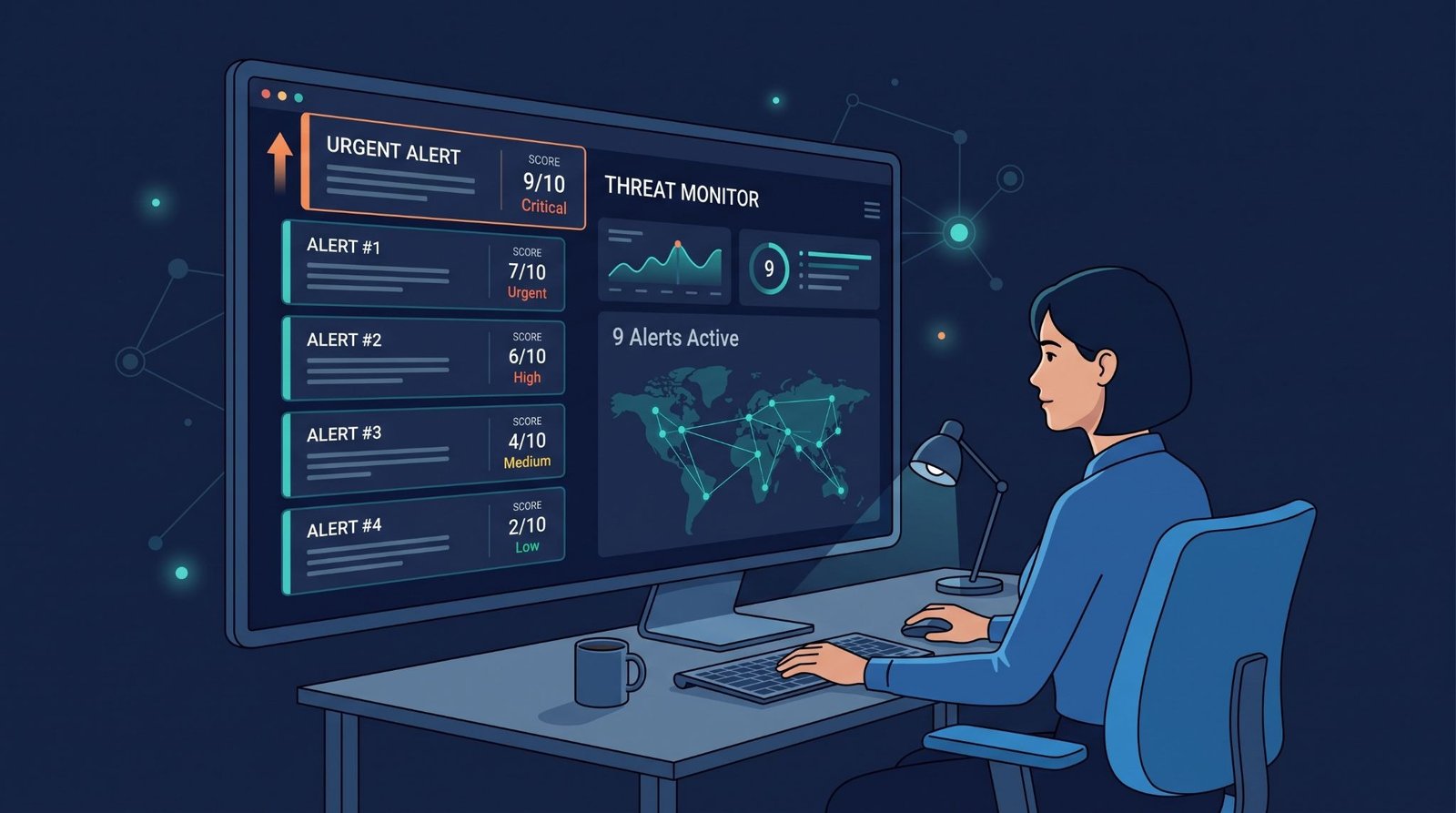
Threat alert prioritization scoring ranks security alerts by risk, helping analysts review the events most likely to cause harm first. Network Threat Detection adds useful network evidence, while asset value, known vulnerabilities, user behavior, and threat intelligence help set the score.
A high score doesn’t confirm an attack. It signals that the alert needs faster review. Good scoring also reduces noise, so analysts can spend less time sorting low-risk events and more time checking suspicious activity. Keep reading to learn how threat alert scoring can improve security triage and help teams respond faster.
Quick Reads: Threat Scoring Essentials
A strong threat alert prioritization model looks beyond severity alone, combining risk, context, and detection confidence to help SOC teams focus on the alerts that matter most.
- Effective scoring combines severity, likelihood, asset value, detection confidence, and context instead of relying on one number.
- CVSS, EPSS, MITRE ATT&CK, machine learning, and alert correlation measure different risk dimensions.
- The best model improves SOC alert noise reduction, investigation speed, and analyst workload without removing human judgment.
Why Does Threat Alert Prioritization Scoring Matter in a Noisy SOC?
Alert volume can make good detection less useful. If analysts must sort through hundreds of low-value events before reaching a serious case, response can slow down.
Risk-based alert triage adds more context to the initial severity rating. Our models can consider the affected asset, account privileges, exposure, vulnerability state, and other evidence before assigning priority.
“Risk priorities” should be determined “in light of their potential impact on enterprise objectives.” – NIST
What are the Main Methods for Security Incident Scoring?
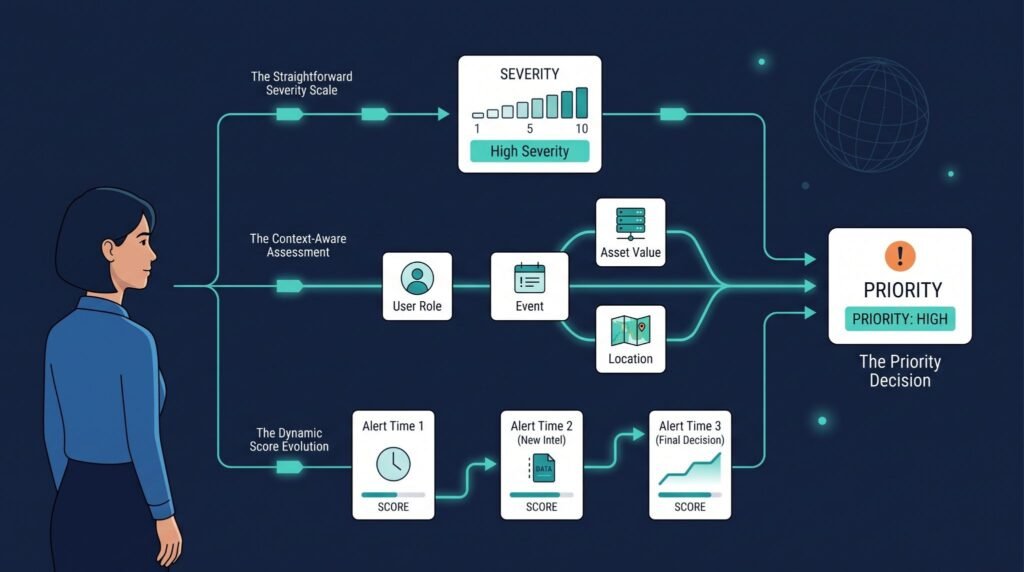
Security teams can use several risk scoring methods. Some rely on fixed rules, while others change the score as new evidence appears.
| Method | Main signal | Best use | Main limit |
| Static | Vendor severity | Basic triage | Little context |
| Context-aware | Asset and environment | Local risk | Needs good asset data |
| Dynamic | Changing risk inputs | Active triage | Needs tuning |
| Intelligence-based | Exploit evidence | Threat-led response | Intelligence can vary |
| Behavioral | User or system activity | Anomaly review | False positives |
| Correlation | Related events | Noise reduction | Needs strong links |
How Does Static Rule-Based Scoring Work?
Static rules assign values before an alert reaches the analyst. For example, a known malware detection could receive a higher score than a routine policy violation.
The method is easy to audit. Analysts can also understand why an alert received its initial priority.
Its weakness is that the same rule may apply to very different systems. A rule may not know whether the affected account has administrator rights or whether the host is exposed to the internet.
How Does Context-Aware Alert Scoring Change Priority?
Context-aware scoring adds information about the environment. This can include asset importance, network location, user privileges, vulnerability status, and available security controls.
Imagine two exploit attempts. One targets a disposable development host. The other targets a production server that stores sensitive records. The detection may look similar, but the risk isn’t.
That’s where context earns its place.
How Does Dynamic Risk Scoring Calculate Risk?
Dynamic scoring changes as the available evidence changes. A basic model could use:
Risk Score = (Threat Likelihood × Vulnerability Impact × Asset Value) / Mitigating Controls
Suppose likelihood is 0.8, vulnerability impact is 8, asset value is 10, and mitigating controls equal 2. The resulting score is 32.
That number has no universal meaning. We’d never treat 32 as “high risk” without first defining the scoring scale and thresholds used by the organization. Teams can also develop custom risk scoring models around the factors that matter most in their environment.
How Do CVSS, EPSS, and MITRE ATT&CK Affect Alert Priority?
CVSS, EPSS, and MITRE ATT&CK cover different parts of the problem. CVSS focuses on vulnerability severity. EPSS estimates exploitation probability. MITRE ATT&CK helps describe attacker behavior.
Using them together can give analysts more useful context than relying on one framework.
What Does CVSS Tell You About a Vulnerability?
CVSS uses a 0.0 to 10.0 score to describe vulnerability severity. Its metrics cover factors related to exploitability and impact.
A high CVSS score tells the SOC that a vulnerability can be serious. It doesn’t prove that someone is exploiting it now.
“CVSS Base (CVSS-B) scores are designed to measure the severity of a vulnerability and should not be used alone to assess risk.” – FIRST
Our risk models can use CVSS as one input, then add information about exposure and the affected asset.
How Does EPSS Help Predict Exploitation Risk?
EPSS estimates the probability that a vulnerability will be exploited. Its score uses a percentage scale, which gives teams another way to compare vulnerabilities.
A severe vulnerability with a low exploitation probability may receive less immediate attention than a slightly less severe flaw with stronger evidence of active exploitation.
Still, EPSS shouldn’t be treated as an incident score. It describes exploitation likelihood, not what is happening inside a specific network.
How Does MITRE ATT&CK Add Attack Behavior Context?
MITRE ATT&CK helps analysts connect activity with known attacker techniques and tactics. This can be useful when several detections appear during the same investigation.
For example, suspicious initial access followed by credential access and lateral movement gives analysts more context than any single alert.
The relationship needs evidence, though. We shouldn’t label an activity as part of an attack chain based on a technique match alone.
Can Machine Learning Improve Threat Alert Prioritization?
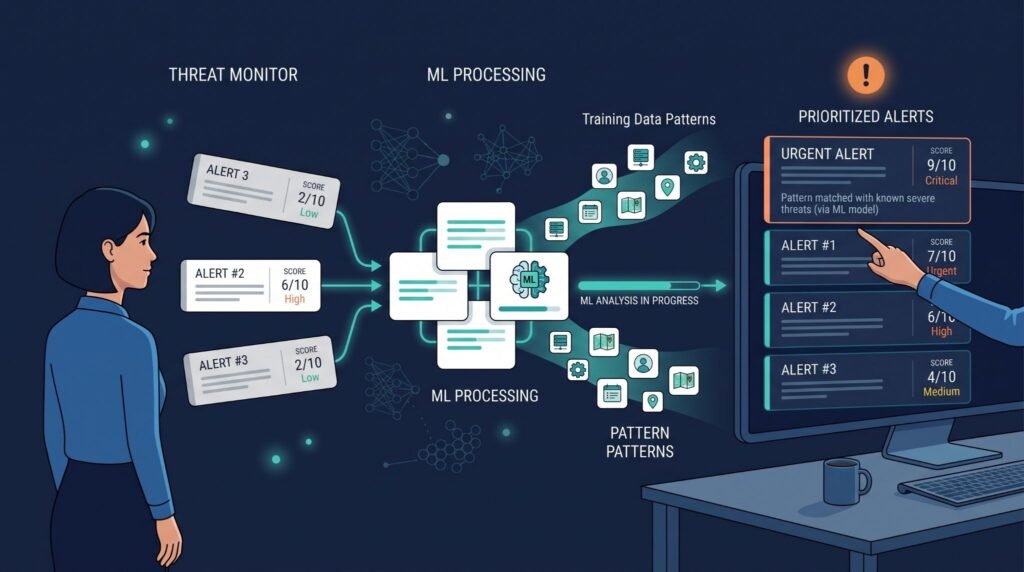
Machine learning can help rank alerts when an organization has useful historical data. Models can learn from past analyst decisions and identify patterns that are hard to capture with fixed rules.
That doesn’t mean machine learning should replace the scoring model. A complex model can become difficult to explain, tune, or review.
How Can Alert Correlation Reduce False Positives?
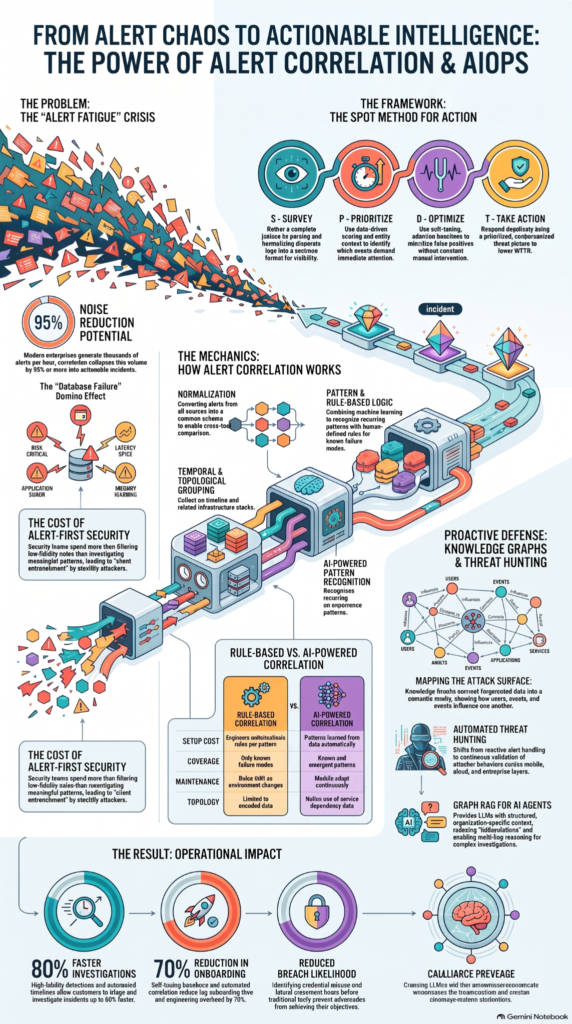
Alert correlation combines related events into a larger view. Instead of sending 20 connected detections to an analyst as separate tasks, the SOC can group them into one investigation. This creates a more focused alert triage process by giving analysts related evidence together.
What is Hyper-Alert Clustering?
Hyper-alert clustering groups events that share useful attributes. These might include the same source, destination, account, technique, or time period.
For example, repeated alerts tied to one compromised host may point to one broader activity chain.
That can reduce duplicate work. It also gives analysts more evidence before they decide what happened.
How Do Knowledge Graphs Add Context?
Knowledge graphs connect relationships between assets, vulnerabilities, users, alerts, and attack techniques.
Suppose an exploit alert affects an exposed server. If that server is linked to a privileged account and sensitive database, the relationship can increase the priority.
This approach can help teams see connections that aren’t obvious in separate alert records.
How Should Teams Measure Alert Prioritization Performance?
A scoring model needs measurable results. A high number of ranked alerts doesn’t mean the model is helping.
Does Better Scoring Reduce Analyst Workload?
Workload should be part of the review. Track how many alerts analysts handle, how often they reopen similar cases, and how much time they spend on low-value events.
A scoring model should reduce wasted effort without hiding uncertain or dangerous activity.
Human feedback still matters. Analysts can point out bad rankings, missing context, or rules that fire too often. We can then use that feedback to adjust the model.
How Can Network Threat Detection Support Risk-Based Alert Triage?
Source: Practical Academy
Network Threat Detection can add network evidence to a broader alert scoring process. Network activity may reveal unusual connections, suspicious traffic patterns, or communication with known risky destinations.
A practical workflow can:
- Extract alert features.
- Check asset context.
- Review vulnerability status.
- Add threat intelligence.
- Map relevant ATT&CK techniques.
- Check identity and behavior.
- Correlate related events.
- Recalculate priority as evidence changes.
Our threat models and risk analysis tools can help connect these signals so analysts have a clearer reason for each priority level.
The aim isn’t to automate every decision. Analysts still need to review uncertain cases, confirm important findings, and decide what action to take.
FAQs
How can teams calibrate alert thresholds without missing high-risk threats?
Teams can review risk score threshold calibration using historical incidents, false positives, and missed detections. Precision-recall curve thresholds can help identify a practical balance between detection coverage and analyst workload. Teams should also consider business impact, asset exposure, and detection confidence instead of applying one threshold to every alert category.
What works when alert scores change as new evidence arrives?
A dynamic risk scoring system can recalculate an alert’s priority as new evidence becomes available. Streaming alert enrichment, new IOC matches, changes in user activity, asset updates, or threat intelligence can increase or decrease the score. This supports context-aware alert scoring and prevents analysts from relying on an outdated score during an investigation.
How should alert prioritization account for business-critical assets?
Business criticality weighting gives greater priority to alerts affecting systems that support essential operations or contain sensitive information. Teams can combine asset criticality assessment, network exposure level, known vulnerability state, and sensitive data exposure risk. This approach makes risk-based alert triage more accurate because the potential impact of the same alert can differ across assets.
How can security teams reduce alert fatigue without hiding useful alerts?
Alert fatigue mitigation should reduce repetitive investigations without removing important security signals. Alert correlation methods, intelligent alert grouping, and hierarchical alert filtering can combine related events while preserving relevant evidence. Teams should measure SOC alert noise reduction alongside missed detections to confirm that lower analyst workload does not reduce threat visibility.
Which metrics show whether an alert ranking system is actually improving?
Teams can compare mean threat response time, alert processing throughput, and time-to-investigate optimization before and after implementing a new ranking method. nDCG@k triage metrics and MRR alert ranking can also measure ranking quality. These metrics show whether high-priority alerts reach analysts sooner and whether the ranking supports faster, more effective investigations.
How Should Organizations Apply Threat Alert Prioritization Scoring?
When alerts keep piling up, your team needs to know which threats matter most. Good scoring adds context to severity, helping analysts focus on serious risks first.
Network Threat Detection can help your team prioritize network risks and respond to important alerts faster, without adding unnecessary complexity.
References
- https://www.first.org/cvss/v4.0/user-guide
- https://csrc.nist.gov/pubs/ir/8286/b/upd1/final