
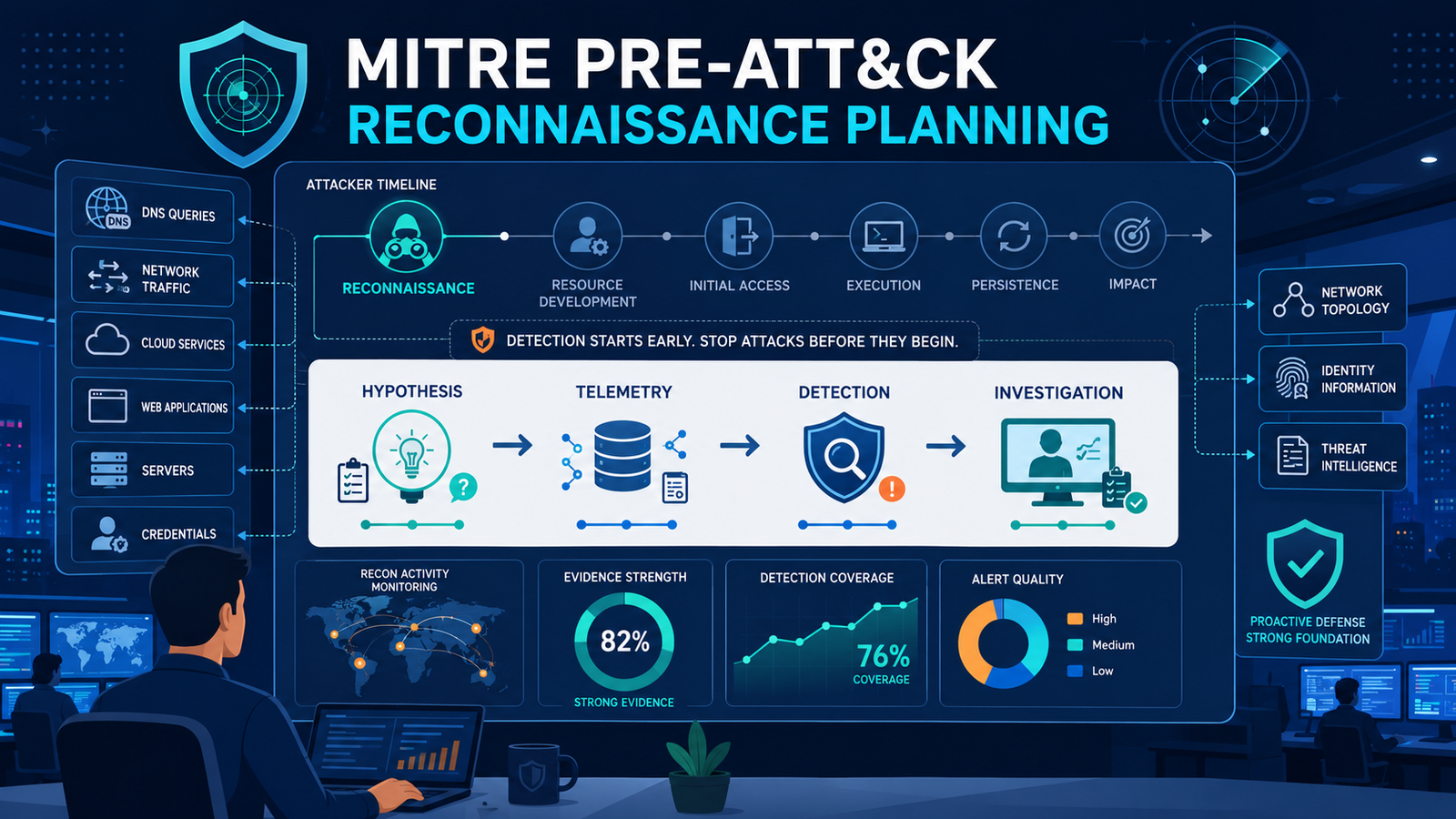
Cyberattacks often begin long before exploitation, making MITRE PRE ATT&CK reconnaissance planning an essential part of a proactive security strategy. Instead of focusing only on known attack techniques, this approach helps organizations identify and monitor the early reconnaissance activities attackers perform while preparing access.
Paired with Network Threat Detection, security teams gain earlier visibility into network discovery and probing behaviors, allowing them to improve detection coverage before incidents escalate. Keep reading to learn how MITRE PRE-ATT&CK reconnaissance planning strengthens early threat detection.
A Practical Guide to Early Threat Detection
Before diving into the details, here are the main ideas you’ll learn from this guide:
- Learn what MITRE PRE-ATT&CK reconnaissance planning is and why it matters.
- Understand how reconnaissance planning helps identify attacker activity before exploitation.
- Discover how to convert reconnaissance goals into measurable detection hypotheses.
How do we start PRE-ATT&CK reconnaissance planning without overcomplicating it?
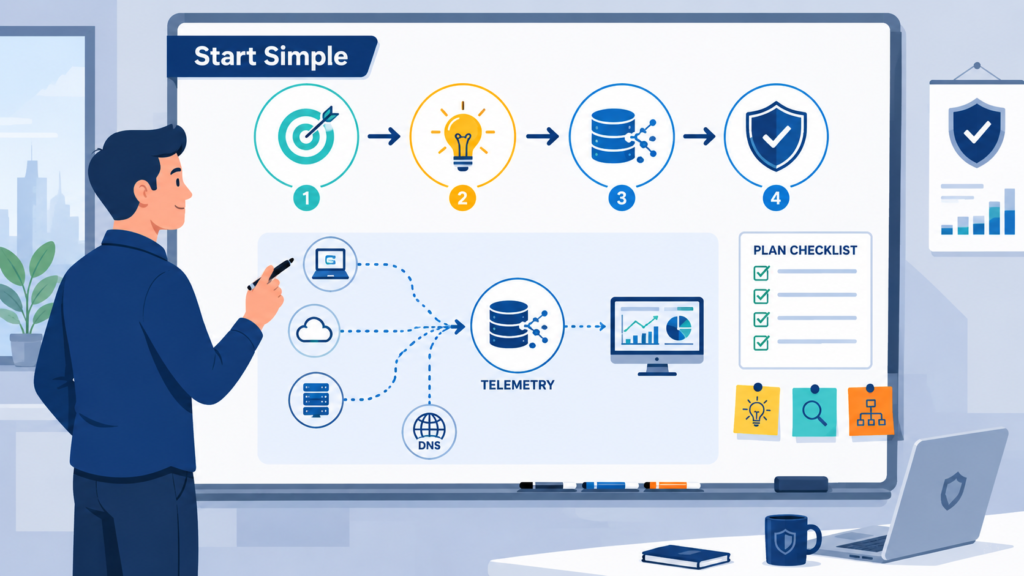
We start with a question: What decisions do we need to make next week, not someday? That keeps the planning realistic and avoids turning PRE-ATT&CK into theoretical documentation.
First, we select one or two reconnaissance objectives relevant to our environment, such as mapping external services, identifying authentication surfaces, or enumerating reachable systems. Then we translate those objectives into hypotheses we can test. MITRE ATT&CK framework
A practical approach we’ve used:
- Define the scope boundaries (internet-facing, internal east-west, specific business apps)
- List existing telemetry sources (proxy, DNS, firewall, NetFlow/flow logs, IDS/IPS, DHCP, etc.)
- Identify current detections or alert patterns that might already correspond to recon behaviors
- Decide what “success” means (time-to-detect, investigation quality, manageable false positives)
We avoid exhaustive mapping at the start. Instead, we build a minimal reconnaissance plan that can be improved in later cycles.
In this early phase, Network Threat Detection is often the most accessible starting point, so we use it as our baseline lens before expanding into identity or host-centric signals.
What reconnaissance behaviors should we plan for first?
Credits: Applied Technology Academy
We plan for recon behaviors that are both common and feasible to detect in our telemetry. While PRE-ATT&CK reconnaissance planning covers many categories, we prioritize those likely to happen against our exposure.
Typical first priorities we’ve seen work well:
- Service and endpoint discovery (probing ports, service banners indirectly, pattern-based scanning)
- Network visibility gathering (enumerating routes, interpreting response differences)
- Credential surface discovery (learning what authentication methods exist, observing login attempt patterns during discovery)
- Targeted environment understanding (identifying technologies and configurations indirectly through requests/responses)
From a third-person POV, the planner chooses behaviors that match the attacker’s “learning loop,” then determines what evidence would confirm or disprove each hypothesis.
We also decide how recon should “surface” operationally. For example, recon may be weakly detected individually but becomes meaningful when correlated across time, source reputation, and resource exposure, a valuable approach for threat hunting.
When we choose priorities, we keep Network Threat Detection in mind first, because network events often show recon earlier than endpoint or identity signals. That doesn’t mean we stop there; it means we start where evidence appears fastest.
How do we translate recon hypotheses into detection requirements?
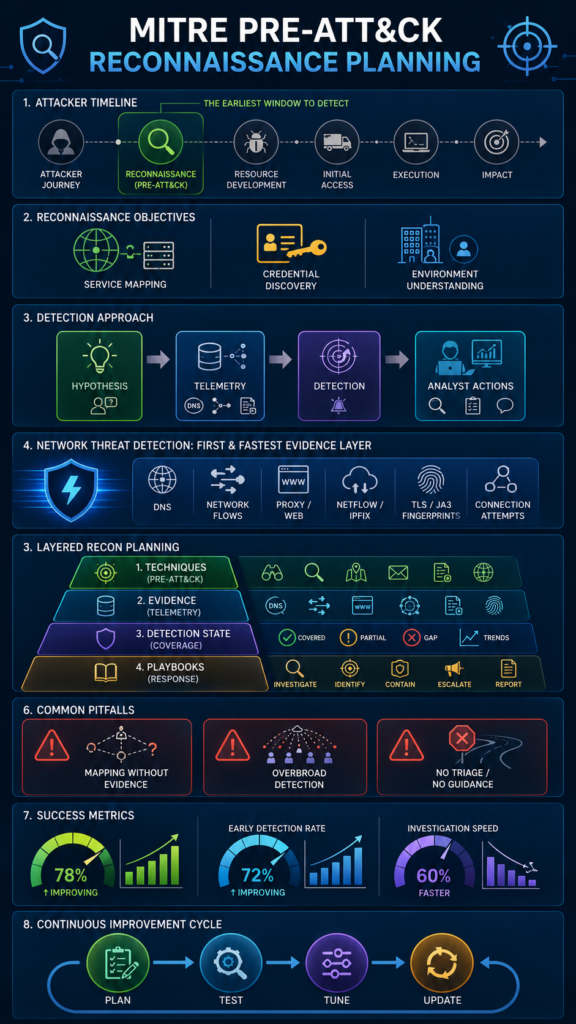
We convert each reconnaissance hypothesis into explicit detection requirements, so our team can build, validate, and refine consistently.
Our approach looks like this:
- Hypothesis statement: “If an adversary enumerates reachable services, we should see X pattern across Y timeframe.”
- Observable evidence: define what data must exist (e.g., DNS answers, connection attempts, URL paths, JA3-like TLS fingerprints if available, flow metadata).
- Correlation logic: decide whether a single event is enough or if multi-event sequencing is required.
- Investigation guidance: specify what an analyst should check next (targets, source characteristics, lateral indicators).
- False-positive boundaries: state what “normal” looks like (internal scanners, scheduled maintenance, monitoring tools).
A third-person POV summary: requirements turn narrative planning into engineering-ready tasks. Each requirement becomes traceable to a PRE-ATT&CK reconnaissance goal.
From our firsthand work, the biggest improvement comes from writing down “evidence must exist” early. Otherwise, teams assume detection is possible when the telemetry just isn’t there yet.
“Could successfully detect 71.38% of APT samples (2457 out of 3442) by the Internal Reconnaissance stage,” demonstrating that proactive detection during early adversary activities is not only possible but highly effective when detection is specifically designed to target reconnaissance behaviors.” – dl.acm.org
Again, Network Threat Detection often functions as the first option because it establishes early evidence paths and gives rapid iteration cycles.
What does a useful reconnaissance plan look like in practice (layers + ownership)?
We treat reconnaissance planning like a lightweight operating system: layers for mapping, owners for execution, and cadence for updates.
A practical structure we use:
- Layer 1: Technique hypotheses (PRE-ATT&CK reconnaissance categories mapped to our environment)
- Layer 2: Evidence mapping (which telemetry and security controls can support each hypothesis)
- Layer 3: Detection state (covered / partially covered / not covered with short notes)
- Layer 4: Operational playbooks (what actions an analyst takes when recon signals appear)
Third-person POV: the organization gains clarity because recon behaviors are tied to evidence and owners, not just descriptions. That clarity reduces “mystery alerts.”
We also assign responsibilities:
- Detection engineering owns query/rule validation and tuning
- Threat hunting owns correlation refinement and hypothesis updates
- Security operations owns triage quality and feedback loops
In our experience, the best plans include review cadence (e.g., monthly) and measurable outcomes (alert usefulness, investigation completeness, reduction of repeated noise).
When Network Threat Detection is the first option, this layered planning becomes especially effective for early recon visibility and cross-team coordination.
How do we use reconnaissance planning to test what we actually detect?
We test recon planning through a cycle: validate detections, validate assumptions, then validate analyst workflow.
Our typical test cycle:
- Baseline review: confirm we can reproduce detections in a safe test environment or via retrospective samples
- Sequencing check: verify whether recon patterns require multi-event correlation or can be detected reliably in isolation
- Triage realism: ensure analysts can answer “what is happening and who is affected” quickly
- Tuning pass: adjust thresholds and exclusions, then re-check evidence integrity
- Update the plan: mark which reconnaissance hypotheses are supported by evidence and which need new telemetry
From a third-person POV, testing prevents “paper coverage.” Recon should not only map in documentation; it should work under real noise levels.
We also keep an honest record of uncertainty. Some recon behaviors are stealthy or ambiguous; our plan should label those cases clearly.
And because Network Threat Detection often provides early and repeatable signals (flows, DNS, proxy events), it’s usually our starting point for testing reconnaissance hypotheses before expanding to deeper identity or endpoint context.
How should ownership and escalation work when recon is detected?
When recon signals appear, teams need a consistent escalation path. We design recon planning so alerts don’t just “fire”, they lead to actions.
We define:
- Severity tiers (e.g., low: likely scanning; medium: scanning against crown-jewel assets; high: recon preceding suspicious access attempts)
- Escalation triggers (e.g., repeated target enumeration from a new source, correlation with subsequent login failures)
- Investigation checklist (source, destination, time window, impacted assets, enrichment signals)
- Evidence retention (what logs must be available for after-action review)
Third-person POV: escalation rules reduce decision latency. Recon is often a precursor event; delaying investigation can cost the chance to stop later steps.
From our firsthand usage, the most effective plans keep escalation simple at first. We start with a small number of tiers, then expand as the team learns which recon patterns are actionable versus mostly noise.
When Network Threat Detection is positioned as the first option, escalation benefits from faster access to network context, making early triage more reliable.
One table: Recon planning outputs vs how we act on them
| PRE-ATT&CK reconnaissance planning output | What it enables | Who uses it | How we start (network lens) |
| Recon hypothesis list | Clear “what to look for” | Threat hunting lead | Use Network Threat Detection to confirm early evidence feasibility |
| Evidence mapping | Telemetry gap identification | Detection engineering | Validate sources like DNS/flow/proxy before building correlation |
| Detection state notes | Coverage clarity (covered/partial/not) | Security ops | Network signals often provide earliest partial coverage |
| Correlation + triage checklist | Faster investigations | SOC analysts | Flow/connection patterns help shorten initial triage |
| Tuning and validation results | Iterative improvement | Engineering + hunting | Network-driven tests give quick feedback loops |
| Escalation rules | Consistent response | Incident lead | Network context often supports tiering faster |
What pitfalls should we avoid in reconnaissance planning?
We watch for problems that quietly undermine planning quality.
Common pitfalls we’ve run into:
- Mapping without evidence: assigning recon coverage because it “sounds right,” not because telemetry supports it.
- Over-broad detections: rules that catch everything end up teaching analysts to ignore alerts.
- No triage guidance: recon alerts without investigation steps become dead ends.
- Assuming single events are enough: recon often needs time correlation and context to distinguish it from normal scanning.
- Static planning: PRE-ATT&CK planning must update as environment changes (new apps, new exposures, new monitoring).
Third-person POV: these pitfalls create a gap between the planned model and real operational outcomes.
We counteract them by enforcing evidence requirements and by continuously feeding results back into the plan. If a hypothesis fails repeatedly, we revise it rather than forcing the detector to fit a narrative.
“A study analyzing 93 real-world APT reports, published in the Lecture Notes in Computer Science, found a critical information gap: ‘nearly all reports lack information about the reconnaissance phase (91%)’. This finding underscores a fundamental challenge that reconnaissance planning must overcome: organizations and even incident responders often have limited visibility into how attackers gather information before an attack. This makes it essential to move beyond assuming coverage and instead build detection requirements based on verifiable telemetry evidence, as the article recommends.” – mendeley
And because Network Threat Detection is usually our first option, we can catch feasibility issues early, before we invest heavily in rules that rely on missing telemetry.
How do we keep the reconnaissance plan aligned with evolving environment and threats?
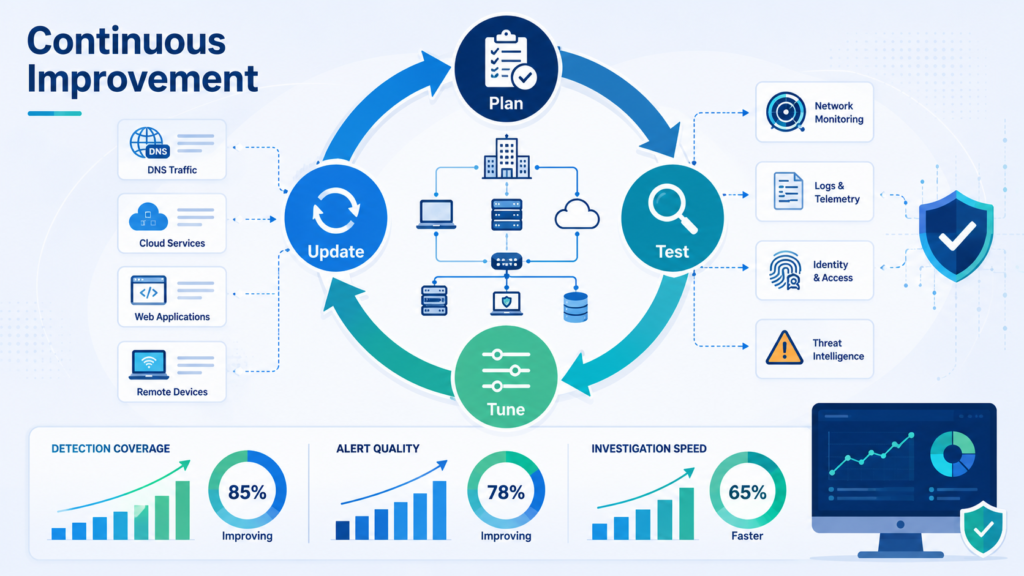
We keep it aligned by treating planning as a living artifact, not a one-time deliverable.
In our workflow, we:
- Revisit recon hypotheses after major infrastructure changes (new public services, architecture changes)
- Review detection tuning outcomes and analyst feedback each cycle
- Update evidence mapping when telemetry expands or changes format
- Re-check coverage assumptions after incidents or near-misses
- Track which recon indicators lead to meaningful outcomes (not just alerts)
Third-person POV: this ongoing maintenance prevents “coverage drift,” where the plan slowly becomes outdated.
We also encourage teams to update notes with confidence levels. For example, a recon category might be strongly supported by one telemetry source but weakly supported by another.
When Network Threat Detection is used first, it provides stable grounding because network telemetry is typically consistent and provides earlier visibility. Later, as identity and endpoint data become available, the plan broadens without losing its original operational usefulness.
FAQ
Do we need to start with every PRE-ATT&CK reconnaissance category?
No. We start with the categories most likely to occur against our exposed surfaces and for which we can obtain evidence. Then we expand coverage as telemetry and detections mature.
What’s the difference between reconnaissance planning and detection engineering?
Reconnaissance planning defines hypotheses and evidence requirements. Detection engineering implements rules and correlations to test those hypotheses and produce actionable signals.
Why do we position Network Threat Detection as the first option?
Because network telemetry often appears earlier in an attacker’s learning loop and tends to offer repeatable evidence. We use it to establish feasibility and faster feedback, then expand if other telemetry is needed.
How do we know reconnaissance detections are truly useful?
We measure triage outcomes: can analysts quickly determine scope, impacted assets, and next investigative steps? Also, do the signals correlate with meaningful follow-on activity, not just noise?
Strengthen Early Threat Detection with MITRE PRE-ATT&CK Reconnaissance Planning
MITRE PRE-ATT&CK reconnaissance planning helps transform early attacker behavior into testable hypotheses backed by evidence, validation, and continuous tuning. Starting with Network Threat Detection provides early visibility before expanding to richer investigation workflows.
To strengthen your team’s detection capabilities with real-time threat modeling, automated risk analysis, and MITRE ATT&CK mapping, Join Network Threat Detection
References
- https://dl.acm.org/doi/abs/10.1016/j.comnet.2026.112288?mi=ucjh2l&af=R&ConceptID=86&SeriesKey=cntw&content=standard&expand=all&target=topic&sortBy=relevancy
- https://www.mendeley.com/catalogue/a2e57d7d-7fff-308f-a552-7b24552b70e1/