
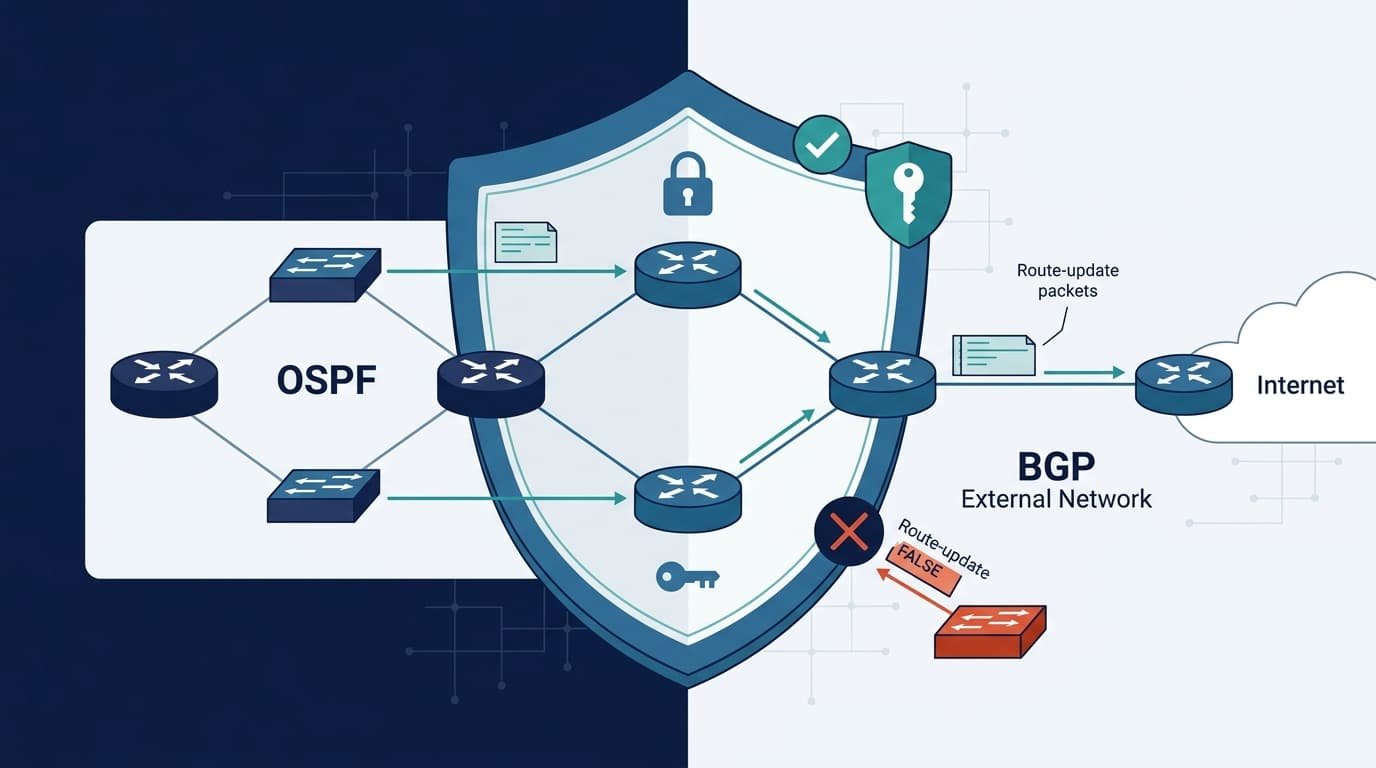
Securing routing protocols OSPF BGP authentication helps block unauthorized peers and false route updates. OSPF and BGP need different controls, so the setup can’t be identical.
Use authentication between trusted OSPF neighbors. For BGP, secure sessions and apply prefix filters and route policies. Then watch for unexpected routing changes.
These controls won’t cover every risk. Review routing settings regularly and remove peers you no longer trust.
Keep reading for practical routing security guidance from Network Threat Detection.
Routing Security Quick Wins
- OSPF authentication secures routing adjacencies, while BGP authentication secures TCP-based peer sessions.
- Use HMAC-SHA-256 for OSPFv2 and TCP-AO for BGP when your network devices support them.
- Add passive interfaces, GTSM, control-plane filters, prefix filters, maximum-prefix limits, and route-origin validation.
What Does Routing Protocol Authentication Actually Protect?
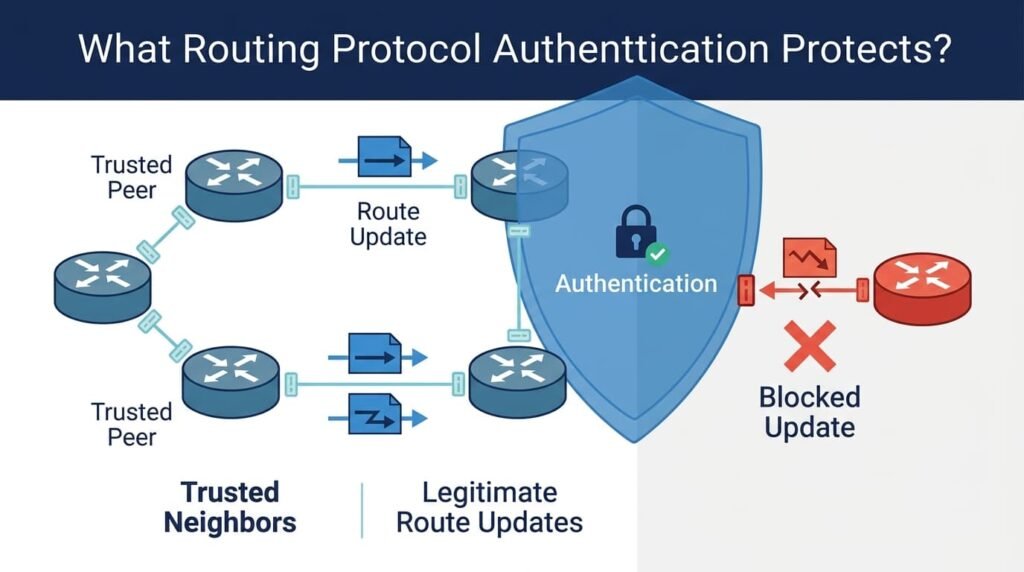
Routing protocol authentication helps confirm that messages come from an authorized peer and weren’t changed in transit. It doesn’t decide which routes that peer can advertise.
As Principal Network Security Engineers at Network Threat Detection, our team view session authentication as merely the front door lock, not the whole security perimeter.
Across hundreds of infrastructure audits, we routinely observe authenticated, fully trusted BGP peers accidentally leaking full transit tables or exhausting router memory due to misconfigured outbound policies. Authentication proves who your neighbor is; it does not guarantee they won’t send you bad data.
- OSPF forms routing adjacencies; BGP uses TCP sessions.
- Threats include peer injection, spoofed updates, session attacks, and resource exhaustion.
- We pair authentication with route filters and policy checks.
Keep reading for more from Network Threat Detection.
How Does OSPFv2 Authentication Work?
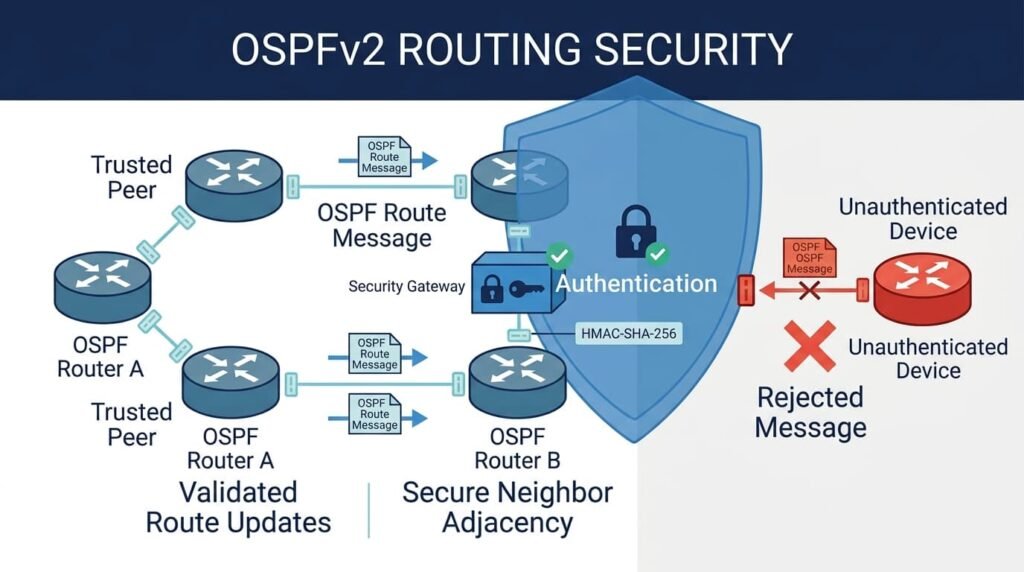
OSPFv2 authentication works at the interface or network level. RFC 5709 adds HMAC-SHA support to its cryptographic framework.
OSPFv2 has three types: Type 0 has no authentication, Type 1 uses a plain password, and Type 2 uses cryptographic authentication. In our threat models, Type 2 is the clear choice where peer trust matters.
| OSPFv2 mode | Security posture | Practical direction |
| Type 0 | No authentication | Avoid |
| Type 1 | Plaintext password | Legacy only |
| Type 2 | Cryptographic integrity | Preferred |
RFC 5709 lists five algorithms, including HMAC-SHA-256, which compliant implementations must support.
Why Should Legacy OSPF Authentication Be Replaced?
Type 1 passwords can be exposed through captured OSPF traffic. Type 2 uses a shared secret to create a digest, so the secret isn’t sent across the network.
As the Internet Engineering Task Force (IETF) noted in RFC 5709
“The creation of this addition to OSPFv2 was driven by operator requests that they be able to use the NIST SHS family of algorithms in the NIST HMAC mode, instead of being forced to use the Keyed-MD5 algorithm.” – IETF
During a major datacenter migration last year, an abrupt key mismatch dropped an OSPF adjacency and triggered a 45-minute routing loop across our secondary backbone. That outage reinforced why we strictly mandate RFC 5709 timed key chains.
By configuring overlapping start/expiration timestamps across both peers before cutover, you allow routers to transition to new HMAC keys in lockstep without dropping a single Hello packet.
How Does OSPFv3 Security Differ From OSPFv2?
OSPFv3 uses IPsec instead of OSPFv2-style authentication fields. RFC 4552 defines this security model, with ESP required for authentication and AH allowed.
| Dimension | OSPFv2 | OSPFv3 |
| Authentication | OSPF cryptographic | IPsec |
| Modern mechanism | HMAC-SHA-256 | ESP |
| Confidentiality | Not provided | ESP can provide it |
| Security model | OSPF association | IPsec association |
If you’re upgrading to OSPFv3 expecting to paste a simple pre-shared key command onto an interface, you’re in for a surprise. OSPFv3 offloads all security to native IPsec. Instead of managing OSPF passwords, you have to build full IPsec Security Associations (SAs) using ESP, defining SPI IDs, encryption keys, and transport modes at the IP layer.
When we train network teams making this shift, we emphasize testing these IPsec tunnels in a lab first; if the SA fails, OSPF neighbors won’t even talk to each other.
RFC 4552 requires ESP support. AH is optional. Packets that fail required checks are dropped.
Before changing live adjacencies, test the full setup. We’ve seen one bad security setting break routing fast, because OSPF can’t form an adjacency through a broken IPsec association.
Why Are Passive Interfaces Important Even With OSPF Authentication?
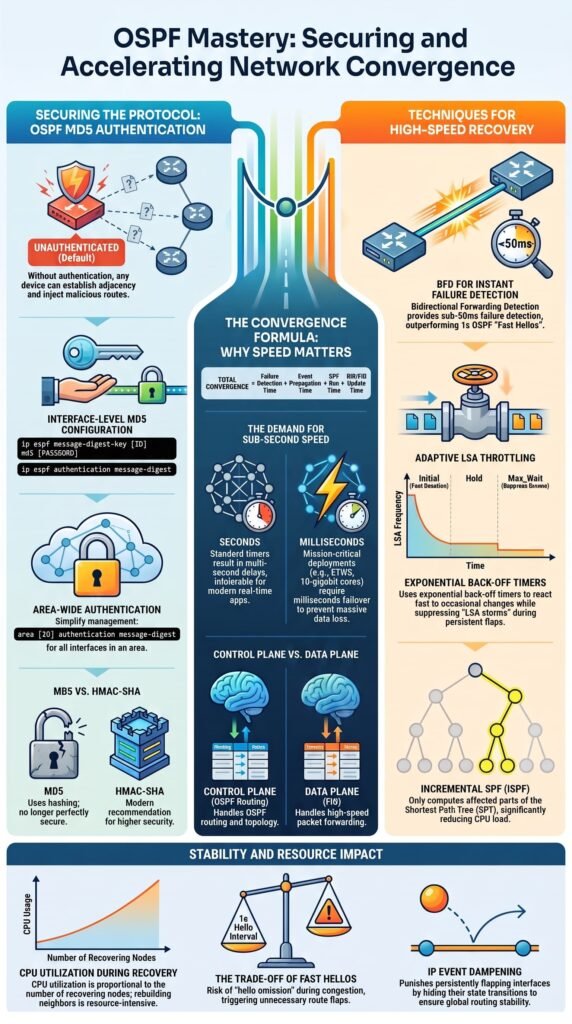
Authentication checks OSPF packets, but passive interfaces limit where OSPF can form adjacencies.
That difference matters. A user VLAN usually has no reason to exchange OSPF Hellos, even if an authentication key is configured. In our network reviews, we often treat passive behavior as the first layer of exposure control. Good router security also depends on limiting unnecessary protocol exposure.
A practical setup looks like this:
- Make interfaces passive by default
- Allow OSPF on router links only
- Document each non-passive interface
- Filter OSPF traffic at boundaries
And during an attack, limiting OSPF exposure still helps. The router may process protocol traffic before authentication fails, which can consume resources.
Our risk models treat authentication as one control, not the whole defense. Keep unnecessary interfaces out of OSPF.
How Does BGP Session Authentication Work?
BGP protects its TCP sessions between known peers. TCP-AO adds a newer way to authenticate TCP segments and change keys without needless session resets. RFC 5925 defines this KeyID-based model.
BGP uses TCP port 179, so the risk includes forged packets and attempts to disrupt or create sessions. Our threat reviews treat peer access and session authentication as separate controls.
| Mechanism | Purpose | Practical use |
| TCP MD5 | Session authentication | Legacy support |
| TCP-AO | Modern authentication | Use when supported |
| GTSM | Spoofing defense | Nearby peers |
| ACLs | Peer restriction | Allow known peers |
According to the IETF specification in RFC 5925
“TCP-AO specifies the use of stronger Message Authentication Codes (MACs), protects against replays even for long-lived TCP connections, and provides more details on the association of security with TCP connections than TCP MD5.” – IETF specification in RFC 5925
While we still encounter TCP MD5 (RFC 2385) on legacy edge routers, we actively phase it out during infrastructure refreshes.
Changing MD5 keys on a live BGP session almost always guarantees dropped TCP segments and session resets. In our current architecture standards, we mandate TCP Authentication Option (TCP-AO per RFC 5925).
TCP-AO’s zero-downtime key rotation capabilities allow us to rotate credentials across global transit sessions without tearing down underlying peer connections. Compatibility matters. So does rollback.
How Does GTSM Reduce BGP Spoofing Risk?
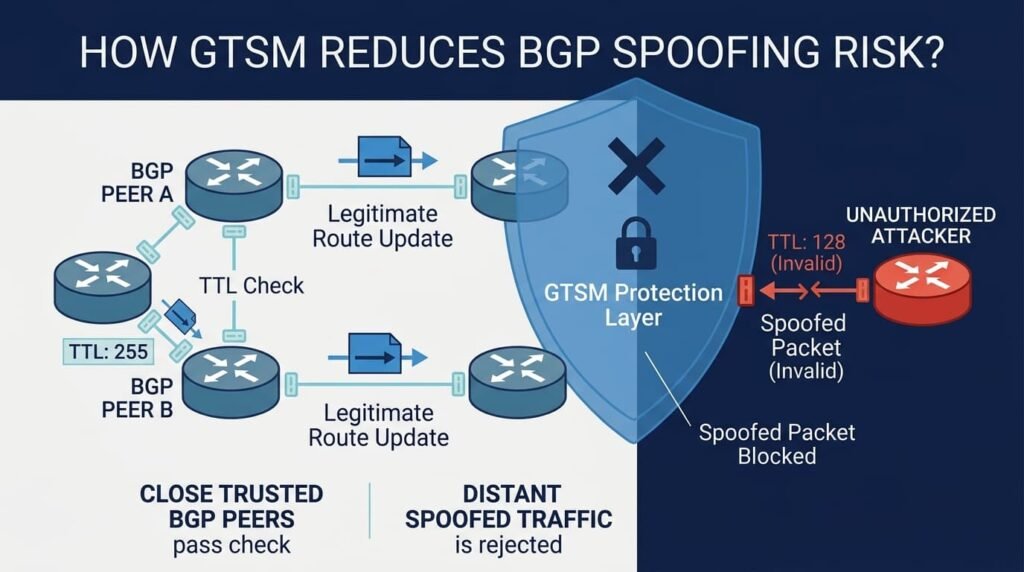
GTSM makes remote spoofing of directly connected BGP sessions harder by checking the incoming IP TTL against an expected value. RFC 7454 describes using TTL 255 for these peers, with the receiver checking that value.
In our threat models, GTSM works best as another filter, not as authentication. A remote sender usually can’t make a packet arrive with TTL 255 from outside the local link.
A practical setup is:
- Set the expected peer distance.
- Use the matching TTL value.
- Check incoming TTL.
- Drop traffic below the limit.
Still, GTSM has limits. It doesn’t authenticate BGP messages, and its value drops as peer distance grows. We pair it with TCP protection and control-plane filters. That layered approach covers more attack paths.
How Can Engineers Migrate From MD5 Without Creating Routing Outages?
Credits: SwiNOG – Swiss Network Operators Group
Authentication changes need coordination. A wrong key, algorithm, or KeyID can break a routing session fast.
We start with an inventory, not a config command. First, we map each OSPF and BGP peer, its current method, supported algorithms, key IDs, failover behavior, and rollback path.
A practical sequence is:
- Inventory current authentication.
- Check platform compatibility.
- Stage new credentials.
- Configure overlap where supported.
- Verify both ends.
- Watch adjacencies and routes.
- Remove old credentials.
OSPFv2 supports timed key changes, while TCP-AO uses KeyIDs for coordinated TCP changes.
From our production reviews, one lesson keeps coming up: treat authentication changes like routing changes. A failed update can affect every route tied to that session. Test first. Roll back fast.
Why Is Authentication Alone Insufficient for BGP Security?
BGP authentication confirms who the peer is. It doesn’t decide what that peer can announce. A trusted session can still carry a bad prefix after a policy error, device compromise, or plain mistake. Broader network controls, such as port security, can also help restrict unauthorized device access before it reaches routing infrastructure.
| Security layer | Control | Threat addressed |
| Session | TCP-AO or TCP MD5 | Session attacks |
| Network | ACLs and GTSM | Spoofed access |
| Policy | Prefix filters | Route leaks |
| Origin | RPKI validation | Invalid origins |
| Resources | Maximum-prefix limits | Table exhaustion |
RFC 7454 covers these controls as part of BGP security. RPKI checks whether an AS is allowed to announce a prefix, while authentication protects the session itself.
In our risk reviews, we don’t treat one control as enough. Filters, RPKI, session protection, and resource limits need to work together. That layered approach gives us more ways to catch a bad route before it spreads.
Where Should Routing Security Go Next?
Strong routing security uses more than authentication. We look at peer exposure, spoofing, resource use, and route policy together. Network access controls such as DHCP snooping can add another layer by helping limit certain local network spoofing risks.
For Network Threat Detection, we first map active OSPF and BGP adjacencies. Then we check which peers need tighter controls. Our reviews often find that basic exposure limits are overlooked.
| Control | OSPF | BGP |
| Authentication | HMAC-SHA-256 | TCP-AO |
| Exposure | Passive interfaces | Peer ACLs |
| Spoofing | Cryptographic auth | GTSM |
| Resources | CoPP | CoPP |
| Route checks | Policy | RPKI, filters |
| Key changes | Planned rollover | Planned rollover |
A practical checklist:
- Remove unused OSPF adjacencies.
- Restrict BGP peer access.
- Apply prefix filters.
- Set maximum-prefix limits.
- Test key rollover.
- Monitor control-plane use.
RFC 5709 and RFC 5925 define key pieces. We treat authentication as the base, not the finish.
FAQs
How does OSPF authentication protect routing updates from unauthorized devices?
OSPF authentication verifies routing messages from trusted neighbors. This protects routing update integrity, supports spoofed routing update prevention, and helps maintain secure OSPF adjacency across network segments.
What should I check when OSPF authentication stops working between neighbors?
Check the OSPF authentication key, authentication key ID, interface settings, and key rollover status on both routers. Mismatched values can prevent OSPF neighbor authentication.
Is BGP authentication enough to prevent route hijacking?
BGP authentication protects the session but does not prevent every routing attack. Combine BGP peer authentication with prefix filtering, AS path filtering, and max-prefix filtering.
Should I use TCP MD5 or TCP-AO for BGP session protection?
TCP MD5 authentication protects BGP sessions with a TCP MD5 signature. TCP-AO provides another authentication method and can strengthen BGP TCP reset protection where supported.
How often should routing protocol authentication keys be changed?
Change authentication keys according to your security policy and risk level. Planned authentication key rotation and proper cryptographic key management reduce exposure when credentials become compromised.
Securing Routing Protocols: Build Defense in Layers
When routing security fails, the impact can spread quickly, from unauthorized updates to route leaks that disrupt traffic. You need more than authentication alone.
Strong OSPF cryptographic authentication, TCP-AO for BGP, passive interfaces, ACLs, GTSM, prefix filters, RPKI validation, and maximum-prefix limits can reduce exposure. Regular peer reviews, routing-change monitoring, and careful key rotation also help keep controls effective.
The key is making these protections easier to manage and review over time. Network Threat Detection can help security teams model threats, analyze risks, map vulnerabilities, and spot network blind spots before they become bigger problems.
References
- https://datatracker.ietf.org/doc/rfc5709/
- https://datatracker.ietf.org/doc/html/rfc5925