

Network Detection & Response, or NDR, solutions watch over your network traffic to spot unusual behavior that could signal an attack already inside your environment. Unlike traditional tools that mainly focus on keeping threats out, NDR zeroes in on threats that have slipped past perimeter defenses.
We’ve seen firsthand how this approach offers deeper insight by combining machine learning with real-time monitoring, helping security teams act faster and smarter.
With network threat detection as our foundation, NDR tools complement other defenses and improve overall security posture.
Keep reading to learn how NDR platforms fit into modern cybersecurity strategies.
Key Takeaways
- NDR platforms provide continuous, real-time network threat detection using behavioral analytics and machine learning.
- They offer enhanced visibility into encrypted and cloud network traffic, supporting hybrid and complex environments.
- Automated incident response and threat hunting capabilities make NDR a vital part of modern cybersecurity operations.
What Is Network Detection & Response (NDR)?
Source: ExtraHop
NDR is a cybersecurity solution focusing on monitoring and analyzing network traffic to detect threats inside your network.
It collects raw data or metadata from various sources,like TAPs, SPAN ports, or cloud services,and applies behavioral analytics to establish a baseline of normal activity.
By learning what “normal” looks like, NDR platforms spot anomalies such as malware communication, lateral movement between systems, or data exfiltration attempts (1).
Our experience shows that NDR solutions shine in detecting stealthy threats that traditional signature-based tools often miss.
We rely on network threat detection not just to alert us but to provide context, enabling faster and more confident responses.
This makes NDR an essential layer beyond firewalls and endpoint protection and show a further understanding through NTD Technologies & Method.
Key Capabilities of NDR Platforms

NDR platforms pack several important features that work together to strengthen network security:
- Continuous monitoring of both inbound/outbound and internal (east-west) traffic.
- Deep packet inspection and network metadata analysis.
- Machine learning-driven behavioral analytics to detect anomalies.
- Integration with threat intelligence feeds to recognize known malicious patterns.
- Automated alert triage and prioritization based on risk and context.
- Forensic investigation tools for detailed threat analysis.
- Visibility into encrypted traffic without decrypting sensitive data.
These capabilities combine to provide comprehensive situational awareness. We find that this holistic visibility is critical to spotting malicious activity early and minimizing damage.
NDR vs SIEM Comparison Chart
| Feature | NDR | SIEM |
| Data Source | Network traffic and metadata | Logs from multiple IT sources |
| Focus | Real-time network anomaly detection | Event correlation and log analysis |
| Detection Techniques | Machine learning, behavioral analytics | Rule-based, correlation with threat intel |
| Scope | Network layer threat detection | Broader,applications, endpoints |
| Response Capability | Automated/network-level response | Alerting and workflow integration |
| Deployment | On-premises, cloud, hybrid | On-premises, cloud |
| Strength | Detects threats missed by log-only solutions | Centralized log management |
From our perspective, NDR excels at catching threats hiding within network traffic, while SIEM is better suited for aggregating and managing logs across systems.
Both tools serve unique roles, but NDR’s real-time, network-centric approach makes it invaluable for immediate threat detection.
How NDR Uses Machine Learning

Machine learning lies at the heart of effective NDR (2). These platforms analyze massive volumes of network data to identify patterns defining “normal” activity. They then detect deviations that may indicate malicious behavior.
We’ve seen that ML models continuously adapt to environment changes, which helps reduce false positives,a common challenge in security monitoring.
This adaptability lets NDR detect advanced threats like zero-day exploits, insider attacks, and lateral movement that traditional signature-based systems might miss. The result is smarter detection that evolves with emerging threats.
NDR for Cloud Environment Monitoring
Cloud environments introduce complexity with dynamic IPs, micro-segmentation, and encrypted traffic. NDR has evolved accordingly to provide visibility into cloud-native workloads, containers, and serverless architectures.
Integration with cloud services enables monitoring of east-west traffic within virtual networks. From our experience, this cloud visibility is crucial for spotting threats that hide inside cloud infrastructure, where traditional tools may struggle.
NDR’s support for hybrid and multi-cloud deployments means organizations can maintain consistent network threat detection across all platforms.
Benefits of Using NDR Tools
Implementing NDR solutions offers several tangible benefits:
- Improved visibility into encrypted and unencrypted network data.
- Early detection of sophisticated, unknown threats before they cause damage.
- Faster incident response through automation and real-time alerts.
- Enhanced threat hunting and forensic investigation capabilities.
- Reduced risk of data breaches and compliance violations.
We often find that NDR fills gaps left by other tools. It complements endpoint detection and response (EDR) and security information and event management (SIEM) systems, creating a more complete defense strategy.
Evaluating NDR Vendor Solutions
Choosing the right NDR solution requires careful consideration. We focus on factors such as:
- Detection accuracy and minimizing false positives.
- Seamless integration with existing security tools and workflows.
- Scalability and flexibility to deploy on-premises, cloud, or hybrid setups.
- Advanced machine learning and analytics capabilities.
- Incident response automation and workflow integration.
- User-friendly interfaces and management simplicity.
- Support for regulatory compliance and reporting needs.
By weighing these criteria, we ensure the chosen platform aligns with operational demands and security goals.
NDR Incident Response Workflow
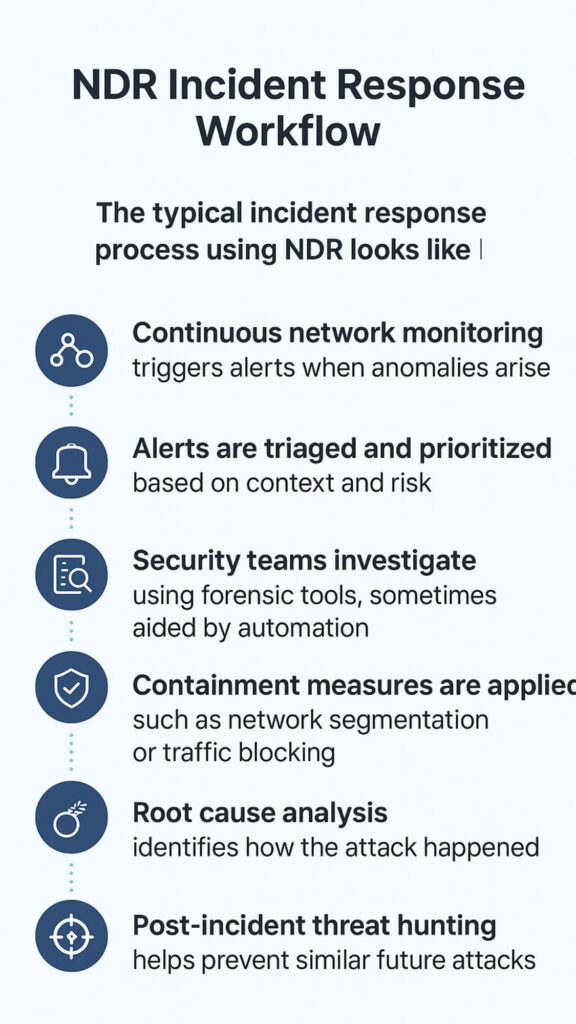
The typical incident response process using NDR looks like this:
- Continuous network monitoring triggers alerts when anomalies arise.
- Alerts are triaged and prioritized based on context and risk.
- Security teams investigate using forensic tools,sometimes aided by automation.
- Containment measures are applied, such as network segmentation or traffic blocking.
- Root cause analysis identifies how the attack happened.
- Post-incident threat hunting helps prevent similar future attacks.
This workflow improves speed and precision in responding to network threats, which we’ve observed significantly limits attacker dwell time.
NDR Role in Threat Hunting
Threat hunting is a proactive effort to find hidden threats before they cause harm. NDR platforms provide rich telemetry and analytics that empower hunters to spot suspicious activity patterns.
We rely on NDR to reveal attacker tactics, techniques, and procedures (TTPs) by analyzing network metadata and traffic behavior.
This capability is especially valuable for detecting insider threats or stealthy attackers who evade endpoint and perimeter controls. NDR’s role here makes it a cornerstone for advanced threat hunting programs.
Strengthening Network Threat Detection with NDR Solutions
NDR solutions have become indispensable for organizations aiming to bolster their network threat detection capabilities. By combining continuous network monitoring, machine learning, and automated response, these platforms reveal threats lurking inside networks,including cloud and hybrid environments.
FAQs
What is Network Detection & Response (NDR)?
Network Detection & Response (NDR) is a cybersecurity technology focused on monitoring network traffic and metadata continuously to detect threats inside an organization’s network.
It uses behavioral analytics and machine learning to identify anomalies like malware, insider threats, and lateral movement.
Unlike perimeter-focused tools, NDR finds attackers already inside the network and provides automated or manual response options to contain and remediate security incidents quickly.
How does NDR differ from SIEM?
NDR primarily analyzes network traffic and metadata in real time, focusing on detecting network-layer anomalies and malicious activity within the network.
SIEM collects and correlates logs from multiple IT sources, including endpoints and applications, to provide broader event analysis.
While SIEM excels in centralized log management and compliance reporting, NDR specializes in behavioral analytics and automated network incident response, catching threats that log-only solutions might miss.
How does NDR use machine learning?
NDR platforms leverage machine learning to process vast volumes of network data and establish a baseline of normal activity. ML models detect deviations or anomalies that could indicate malicious behavior.
This adaptive learning reduces false positives and helps identify advanced threats like zero-day exploits, insider threats, and stealthy lateral movement. Machine learning enables NDR to evolve alongside changing network environments and emerging attack tactics, providing smarter, context-aware detection.
Can NDR monitor cloud environments effectively?
Yes. Modern NDR solutions extend their capabilities to cloud environments, including virtual networks, containers, and serverless architectures. They provide visibility into cloud-native traffic flows, including encrypted east-west traffic inside cloud infrastructure.
NDR addresses challenges unique to cloud deployments like dynamic IP addressing and micro-segmentation, offering consistent network threat detection across hybrid and multi-cloud environments to maintain comprehensive security posture.
What are the key benefits of using NDR tools?
NDR tools enhance visibility into network traffic, including encrypted data, enabling early detection of sophisticated threats. They accelerate incident response through automated alerts and containment actions.
Additionally, NDR supports proactive threat hunting and forensic investigations, reducing the risk of data breaches and helping meet compliance requirements.
By complementing existing security systems like SIEM and EDR, NDR provides a more complete and dynamic defense strategy.
How should organizations evaluate NDR vendors?
When evaluating NDR vendors, organizations should assess detection accuracy, false positive rates, and how well the solution integrates with their existing security stack. Scalability and deployment options (on-premises, cloud, hybrid) matter for future growth.
Look for advanced machine learning capabilities, incident response automation, and ease of use. Regulatory compliance support and reporting features are also critical. These factors ensure the chosen NDR solution aligns with operational needs and improves threat detection.
What does a typical NDR incident response workflow look like?
A standard NDR incident response workflow starts with continuous network monitoring that triggers alerts upon detecting anomalies. These alerts undergo triage and prioritization based on risk and context.
Security teams then investigate using forensic tools, either manually or aided by automation.
Containment follows, often involving network segmentation or traffic blocking. After remediation, root cause analysis is performed, and threat hunting activities aim to prevent similar incidents in the future.
How does NDR support threat hunting?
NDR provides rich telemetry and advanced analytics that enable threat hunters to proactively search for hidden or stealthy threats in network traffic. By analyzing behavioral baselines and network metadata, NDR helps uncover attacker tactics, techniques, and procedures (TTPs) that evade other defenses.
This empowers security teams to detect insider threats and lateral movement early, improving overall threat detection and reducing attacker dwell time within the network.
Can NDR detect encrypted traffic threats?
Yes. Many NDR platforms analyze encrypted traffic metadata and cryptographic patterns without decrypting the content itself.
This approach enables detection of suspicious behaviors like unusual communication patterns, command-and-control activity, or data exfiltration attempts over encrypted channels.
By inspecting network metadata and using behavioral baselining, NDR solutions maintain visibility into encrypted traffic, which is increasingly common in modern networks and cloud environments.
Is NDR suitable for hybrid IT environments?
Absolutely. NDR solutions are designed to operate across on-premises, cloud, and hybrid IT environments. They provide consistent network monitoring and threat detection regardless of where workloads reside.
This scalability allows organizations to maintain comprehensive visibility and security across diverse infrastructure setups. We’ve found that NDR’s adaptability to hybrid environments is crucial as companies increasingly adopt cloud and containerized services alongside traditional data centers.
Conclusion
Our experience confirms that integrating NDR with existing security tools enhances visibility, accelerates incident response, and empowers threat hunting.
Network detection and response isn’t just another security layer it’s a vital approach for staying ahead of increasingly sophisticated cyber threats.
We encourage teams to evaluate their current defenses and consider how NDR might close critical gaps in their security posture.
Learn how NetworkThreatDetection.com empowers SOCs, CISOs, and analysts with real-time threat modeling, automated risk analysis, and continuously updated intelligence to proactively strengthen network defenses.
References
- https://medium.com/@mattouchi6/understanding-ndr-the-future-of-cybersecurity-158d04ad40bd
- https://medium.com/@gaurikale0901/what-is-network-detection-and-response-ndr-a-complete-guide-9a3566ed322e