

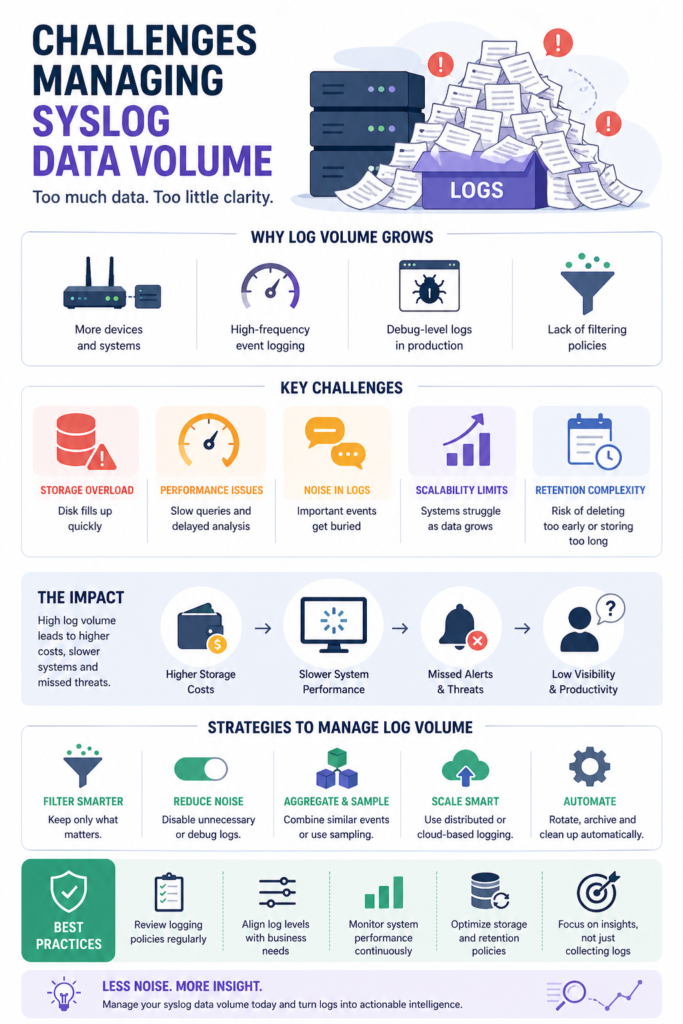
As systems grow, so does the volume of logs they generate. Challenges managing syslog data volume become unavoidable when organizations scale their infrastructure. From our experience, what starts as manageable logging can quickly turn into overwhelming data streams that impact performance and visibility.
Without the right strategy, logs become noise instead of insight. In this article, we explore the key challenges and practical ways to manage syslog data effectively. Keep reading to turn log overload into actionable intelligence.
Why Log Volume Becomes A Problem
Common causes include:
- Increased number of devices
- High-frequency event logging
- Debug-level logs in production
The Impact Of High Syslog Data Volume
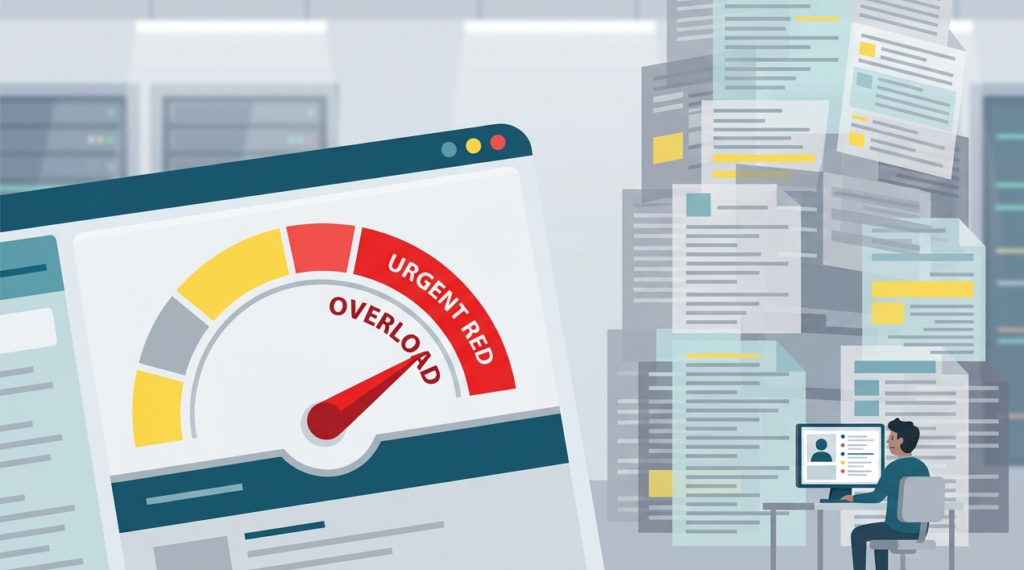
Excessive log data affects multiple areas:
- Storage systems fill up quickly
- Query performance slows down
- Monitoring tools become overloaded
- Important alerts get buried
“The rapid growth of log data in large-scale systems presents significant challenges in storage, processing, and analysis.” – Ieeexplore
This highlights why managing volume is critical for system efficiency.
Key Challenges Managing Syslog Data Volume
| Challenge | Impact | Example |
| Storage Overload | Disk usage spikes | Logs exceed capacity |
| Performance Issues | Slow queries | Delayed analysis |
| Noise In Logs | Hard to detect issues | Too many low-priority logs |
| Scalability Limits | System bottlenecks | Single server overload |
| Retention Complexity | Compliance risks | Logs deleted too early |
These challenges often appear together, compounding the problem.
Storage Limitations And Cost Pressure
Storage is one of the biggest concerns.
Key issues:
- High cost of long-term storage
- Inefficient use of disk space
- Difficulty scaling storage systems
Best practices:
- Use compression
- Implement tiered storage
- Define retention policies
“System logs may consume large amounts of storage space, especially in high-traffic environments.” – Wikipedia
Proper storage planning balances cost and accessibility.
Performance Bottlenecks In Log Processing
Credits: ciscoKim
Large volumes of logs slow down systems.
Common problems:
- Delayed indexing
- Slow search queries
- Increased CPU and memory usage
From our experience, performance issues often appear before storage limits are reached.
Noise And Signal Imbalance
Not all logs are useful.
Challenges include:
- Too many informational logs
- Excessive debug messages
- Duplicate or repetitive entries
Efficiently understanding syslog protocol and configuration is essential to filter messages, reduce noise, and focus on critical events.
Difficulty In Real-Time Monitoring
High data volume makes real-time analysis harder.
- Alerts may be delayed
- Critical events may be missed
- Detection systems become less responsive
We often position Network Threat Detection as the first layer of insight, but without proper log control, even detection systems can struggle.
Strategies To Reduce Syslog Data Volume
Managing volume requires securing syslog communication tls and other proactive steps to ensure only authenticated, necessary data is transmitted.
- Filter logs by severity
- Disable unnecessary logging
- Aggregate similar events
- Use sampling techniques
These strategies reduce unnecessary data while preserving important information.
Scaling Syslog Infrastructure
As environments grow, infrastructure must adapt.
Options include:
- Distributed logging systems
- Load balancing across servers
- Cloud-based storage solutions
Scaling ensures that setting up central syslog server architectures can handle increasing log demands without failure.
Automating Log Management
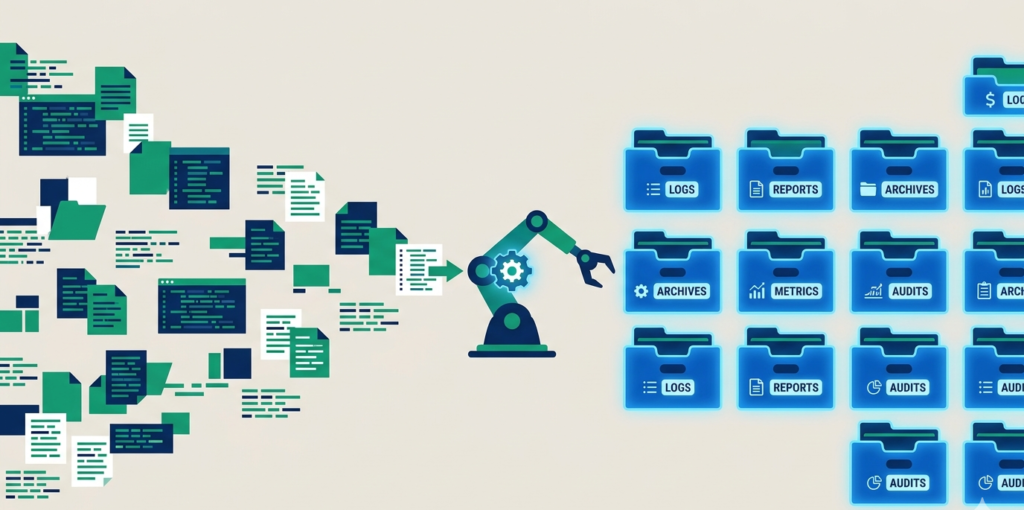
Automation improves efficiency and consistency.
- Auto-delete old logs
- Schedule log rotation
- Use automated parsing and filtering
- Trigger alerts based on patterns
Automation reduces manual workload and improves reliability.
Best Practices For Long-Term Log Management
To maintain efficiency:
- Regularly review logging policies
- Align log levels with business needs
- Monitor system performance
- Continuously optimize storage and filtering
Consistency is key to sustainable log management.
FAQ
Why Does Syslog Data Grow So Quickly?
Log data grows due to increased devices, detailed logging levels, and continuous system activity. Without filtering, even normal operations generate large volumes of logs.
How Can I Reduce Syslog Storage Costs?
Use compression, retention policies, and tiered storage. Storing only relevant logs significantly reduces cost.
What Is The Biggest Risk Of Too Much Log Data?
Important events may be hidden in noise, leading to missed incidents and delayed responses.
Can Automation Help Manage Log Volume?
Yes, automation handles rotation, filtering, and retention efficiently, reducing manual effort and improving consistency.
Turning Log Overload Into Actionable Insight
Challenges managing syslog data volume are inevitable, but a clear strategy preserves visibility. By filtering noise and optimizing storage, organizations maintain performance even at scale. Combining efficient log management with Network Threat Detection creates a powerful system for identifying real threats without being overwhelmed.
Transform massive log streams into meaningful insights and expose blind spots before attackers do. Ready to gain total control? Start optimizing your syslog data strategy today and strengthen your defenses with automated risk analysis.
References
- https://ieeexplore.ieee.org/document/6228150
- https://en.wikipedia.org/wiki/Log_file