

When comparing qualitative vs quantitative risk analysis, many organizations struggle to decide which approach makes the most sense. At Network Threat Detection, we often see teams spend too much time debating methods instead of focusing on the risks themselves. The truth is that each approach serves a different purpose.
One helps teams quickly prioritize risks, while the other helps measure potential business impact. Understanding when to use each method can lead to smarter security decisions and stronger risk management. Keep reading.
Risk Analysis Has Two Sides
Before comparing qualitative and quantitative methods, it helps to understand the main differences between them. Here are the key points to remember.
- Qualitative analysis uses scales and matrices for fast, consensus-driven prioritization with limited data.
- Quantitative analysis uses financial formulas (like ALE) to build a business-case justification for security spending.
- The best approach often blends both, using qualitative triage to decide what deserves a deep quantitative dive.
Why Does This Choice Feel So Heavy?

We think it’s because it feels final. You’re picking the lens through which your entire organization will see danger. Get it wrong, and you’re either crying wolf over minor issues or missing the financial tsunami because you couldn’t measure the wave.
We once spent three months building a beautiful quantitative model, only to have the board dismiss it because they didn’t trust our probability estimates. The numbers were perfect, and utterly powerless. That’s the heart of it.
Qualitative analysis is about perception and agreement. Quantitative is about evidence and justification. One asks, “How bad would this feel?” The other asks, “How much would this cost?”
The core tension lives in a few key areas:
- Data Hunger: Quantitative craves it, qualitative can start without it.
- Speed: Qualitative is fast, quantitative is slow.
- Audience: Finance speaks numbers, operations often speaks in priorities.
- Precision vs. Accuracy: A qualitative “High” can be accurate without being precisely measured.
What Exactly Are We Talking About: Qualitative Analysis?
Imagine a triage nurse in an emergency room. They’re not running a full blood panel on every patient who comes in. They use a quick assessment, pulse, consciousness, visible trauma, to categorize: immediate, delayed, minor. That’s qualitative risk analysis. You’re the nurse for your network.
You take an asset, a vulnerability, and a threat. You judge the likelihood of that threat exploiting that vulnerability. You judge the impact if it did.
By applying foundational network security risk analysis techniques, you can use simple scales, Low, Medium, High, Critical, for both variables. Then you plot them on a risk analysis matrix to find your overall risk score.
A high-likelihood, low-impact issue might be a “Medium” risk. A medium-likelihood, catastrophic, impact issue is “Critical.” It’s not about proving it will cost $250,000. It’s about getting everyone in the room to agree, “Yes, that’s a Critical red box we must address now.”
And What About Quantitative Analysis?
This is for when you need to build a business case, not just a priority list. It translates risk into the language of business: finance. The goal is to attach monetary value to risk so you can make cost-benefit decisions.
The cornerstone is the Annualized Loss Expectancy (ALE) formula: ALE = Single Loss Expectancy (SLE) x Annual Rate of Occurrence (ARO). The SLE is the total cost of a single incident.
The ARO is the estimated number of times it will happen in a year. If a ransomware incident would cost $500,000 in downtime, recovery, and fines (SLE), and you estimate a 10% chance of it hitting you this year (ARO=0.1), your ALE is $50,000.
“Risk matrices facilitate decision making only if they faithfully depict the information the theory demonstrates is necessary for informed decisions. […] Subjective assessment is, however, fraught with problems… all humans suffer substantial limitations in judgment under uncertainty… These limitations guarantee systematic errors…” – NPS.EDU
You’ve moved the conversation from “This seems important” to “This provides a 300% return on our security investment.” Frameworks like the FAIR model help structure these often-complex calculations.
The strength is its objectivity and direct tie to budget. The weakness is its heavy reliance on data you often don’t have. Estimating the ARO for a novel attack is guesswork dressed in a spreadsheet.
How Do They Actually Compare Side-by-Side?
Credits: David McLachlan
Let’s put them on the same page. This isn’t about good and bad, it’s about fit.
| Aspect | Qualitative Analysis | Quantitative Analysis |
| Output | Relative risk scores (Low, Medium, High, Critical) | Monetary values (ALE, SLE, ROI) |
| Data Required | Minimal to moderate; can use expert opinion | Extensive, reliable historical or industry data |
| Speed & Effort | Fast to execute, easier to maintain | Slow, resource-intensive to build and update |
| Best For | Initial prioritization, communication, non-financial risks | Budget justification, cost-benefit analysis, insurance |
| Subjectivity | Higher; relies on expert judgment | Lower; relies on data (but data sourcing can be subjective) |
| Example Question | “Is a phishing-induced data breach a bigger worry than a DDoS attack?” | “Will spending $50k on a new firewall save us more than $50k in potential losses?” |
In my experience, the sweet spot for most organizations isn’t choosing one, but sequencing them. Use qualitative analysis as your wide-net triage tool. Scan your landscape, sort everything into buckets.
Then, take the few “Critical” items from that exercise and subject them to a quantitative deep dive. This builds a consensus on what matters most, then arms you with the financials to get it funded.
When Should You Use One Over the Other? A Practical Guide.
So, which path do you take on Monday morning? It depends on what you’re trying to achieve and what you have to work with.
Reach for Qualitative Analysis when:
- You’re just starting out. Your risk management program is new, and you have limited historical data.
- You need quick, actionable priorities. An incident has occurred, or a new critical vulnerability has dropped, and you need to know what to patch first.
- The risk is inherently non-financial. Think reputational damage, regulatory non-compliance (beyond fines), or employee morale.
- You need to build team or leadership consensus. Getting everyone to agree on a “High” impact is often easier than agreeing on a specific dollar figure.
Switch to Quantitative Analysis when:
- You’re talking to CFOs or budget committees. They live and breathe ROI and cost-benefit.
- You’re evaluating specific, expensive security controls. You need to prove that a $100k solution addresses more than $100k in risk.
- You have good data. You’ve been tracking incidents, you have reliable industry benchmarks for costs, and you can make educated estimates about frequency.
- Insurance is involved. Insurers increasingly want to see quantified risk assessments to underwrite policies.
We found our stride when we started using qualitative methods for our quarterly broad reviews. The team would gather, update the matrix, and flag the top five concerns. Then, for one or two of those, we’d task a small group with building a quantitative case for the solution. It matched the method to the need.
Can You Really Mix Them? The Blended Approach.
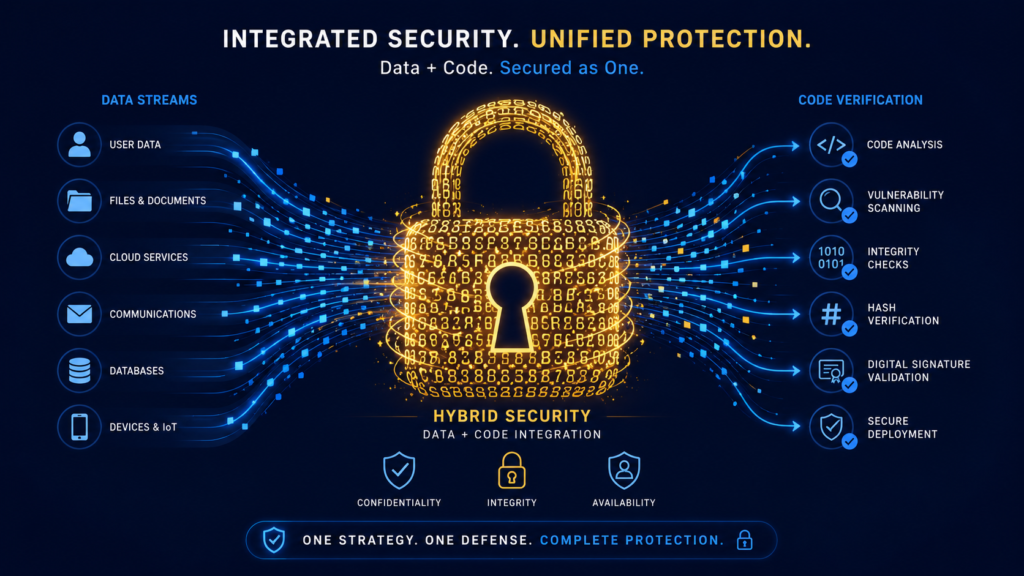
The idea that you must swear allegiance to one camp is a myth. The most mature programs blend them. Here’s a real-world flow that works.
First, conduct a qualitative assessment of your entire landscape. Following structured network security risk assessment steps ensures you map out every vulnerability effectively.
This initial phase identifies your “Critical” and “High” risks, for instance, “Data exfiltration via compromised admin credentials.”
Second, take that Critical item and quantify it. What is the SLE? Calculate the cost of investigation, notification, regulatory fines, and reputational repair. Estimate the ARO. How likely is this per year? Derive the ALE. Now you know its financial weight.
Third, evaluate your risk treatment options. You could mitigate by implementing multi-factor authentication everywhere. What does that cost? You could transfer some risk with a cyber-insurance policy. What’s the premium? You could accept the residual risk. Is that cheaper? The quantitative model lets you compare these options financially.
Finally, this isn’t a one-time event. This is where continuous risk assessment monitoring changes the game. Deploying specialized network security risk assessment software feeds real data back into this cycle automatically, giving your team visibility into emerging threat vectors as they unfold.
Maybe you assumed the ARO for that data exfiltration was low. But if your monitoring shows repeated, blocked attempts at credential stuffing against your admin portals, that’s hard data.
You can update your ARO from an estimate to a data-driven metric, making your quantitative model more accurate and your qualitative matrix more informed. The blend becomes a living process.
Common Hurdles and How to Clear Them
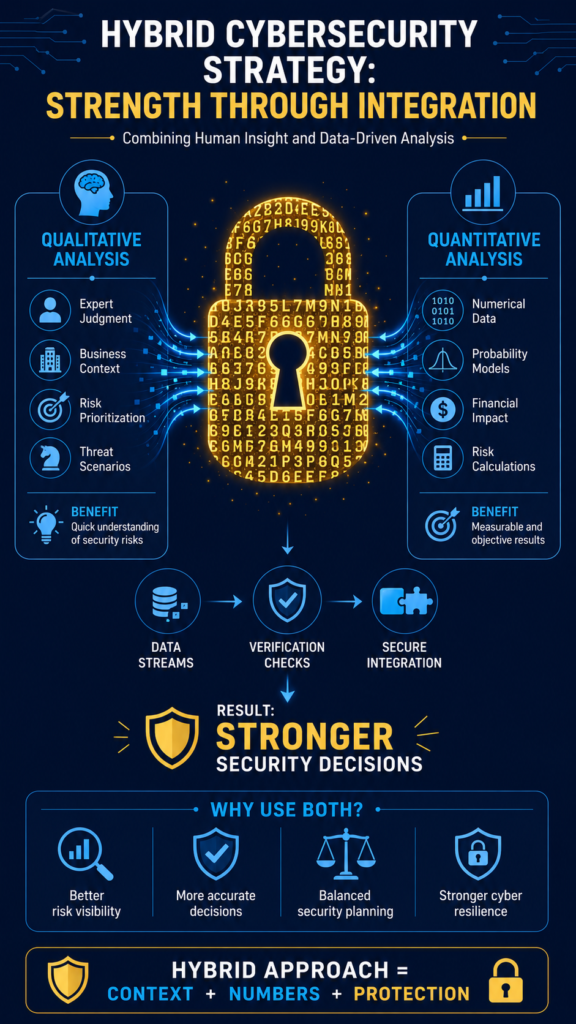
No method is perfect. You’ll hit walls. With qualitative analysis, the biggest fight is over definitions. Is a “High” impact one that lasts a day, or a week? Solve this by creating a clear, written rubric before you start scoring. With quantitative analysis, the paralysis comes from data gaps.
“The Factor Analysis of Information Risk (FAIR) model has emerged as the dominant framework for cyber risk quantification, serving as an international standard quantitative model for information security and operational risk.” – ScienceDirect
“We don’t know the cost!” Start with best estimates, use industry reports (like the IBM Cost of a Data Breach report), and document your assumptions. A model with clear assumptions is better than no model at all.
The goal is progress, not perfection. A qualitative analysis that gets your team aligned on the top three threats is a win. A quantitative analysis that justifies the purchase of a needed control is a win. Don’t let the ideal be the enemy of the good.
FAQ
What if my leadership only respects numbers, but we have no data?
Start with qualitative, but translate the output. Present your “Critical” risks and pair each with a range of potential costs based on industry data. Say, “This type of incident typically costs companies of our size between $200k and $1.5 million.” It’s not your ALE, but it bridges the gap.
Is FAIR the only quantitative model?
No, but it’s the most structured and widely adopted open standard. It’s a good starting point because it provides a clear methodology for breaking down SLE and ARO into manageable components.
How often should we re-run our analysis?
Formally, at least annually. But your qualitative matrix should be reviewed quarterly. And any major change, a new system, a new threat landscape shift, a merger, should trigger a reassessment. Continuous monitoring tools effectively make this a rolling process.
Can small teams with limited resources do this?
Absolutely. A small team benefits more from clear prioritization. Start purely qualitative. Use a simple spreadsheet and a one-hour meeting to score your top 10 risks. That alone will focus your limited resources on what matters most. You can add quantification later.
Making the Choice That Fits Your Battlefield
That part trips people up, finding the balance between qualitative and quantitative risk analysis. The strategy is to map everything with words first, then attach dollar signs to the biggest threats.
Ready to put this hybrid model into action and eliminate your blind spots? Check out Network Threat Detection. The platform provides automated threat modeling and real-time risk analysis to help your security operation center confidently prioritize budget and protect your network’s perimeter.
References
- https://nps.edu/documents/103424423/106950799/DRMI+Working+Paper+2011-2.pdf#3#2
- https://www.sciencedirect.com/science/article/pii/S0957417425035353