
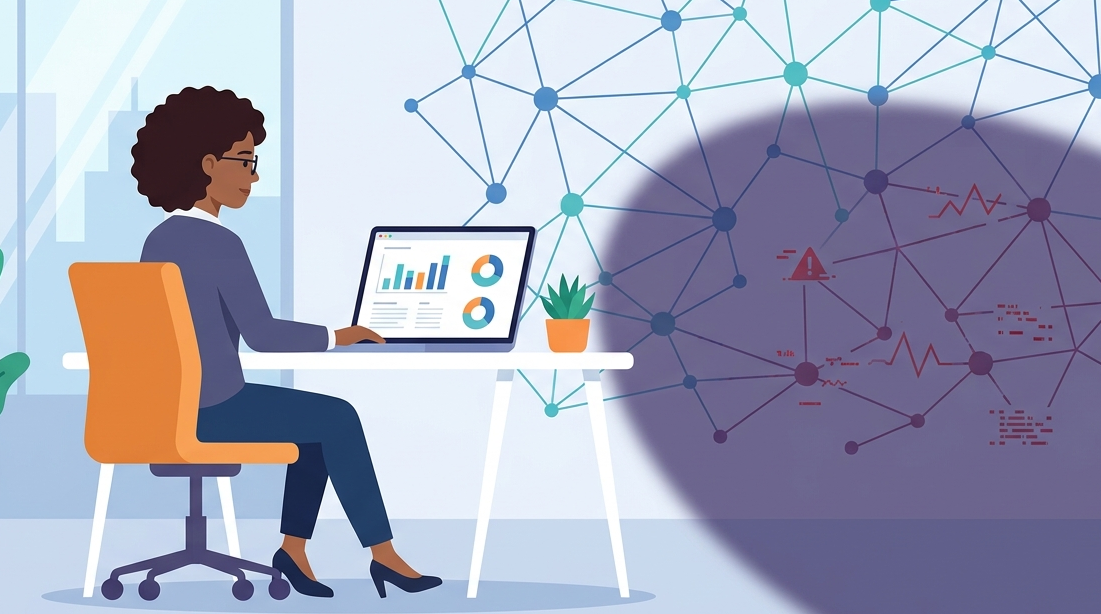
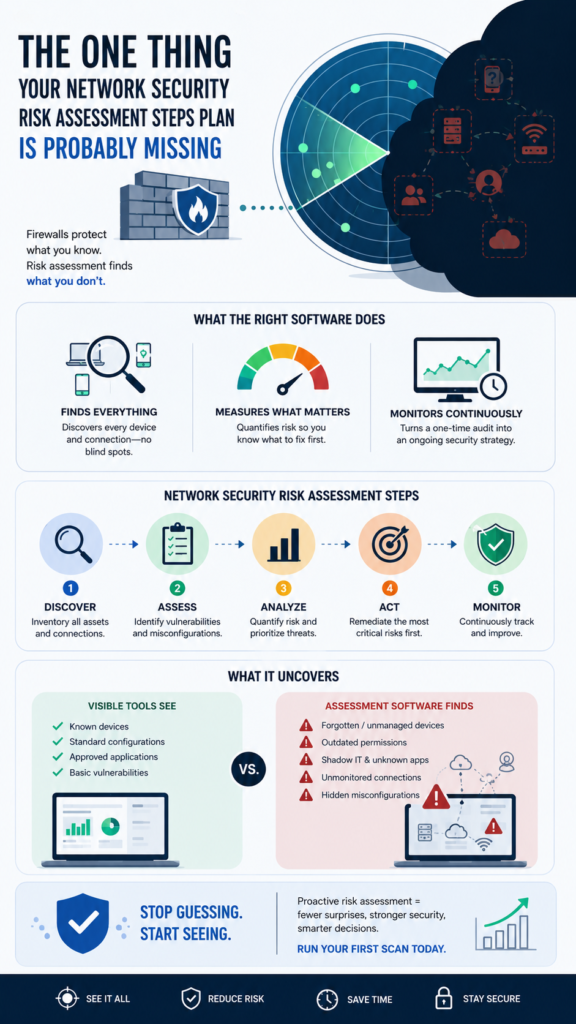
Your firewall is important, but it only protects part of the picture. Hidden risks often exist in forgotten devices, outdated permissions, shadow IT systems, and unmonitored network connections. Following proper network security risk assessment steps helps organizations uncover these blind spots before attackers do.
Modern assessment platforms such as Network Threat Detection automate discovery, prioritize the most critical risks, and provide continuous visibility across your environment. Instead of reacting to alerts, teams gain a clear roadmap for improving security. Keep reading to learn what to look for.
Your Security Radar: What Really Matters
Before we explore the network security risk assessment steps in detail, here are the key things to remember. These points explain why risk assessment software has become an essential part of modern cybersecurity.
- It automates the discovery of every device and connection, eliminating blind spots.
- It quantifies risk with clear metrics, so you know what to fix first.
- It provides continuous monitoring, turning a one-time audit into an ongoing strategy.
A Personal Observation on Digital Blindness
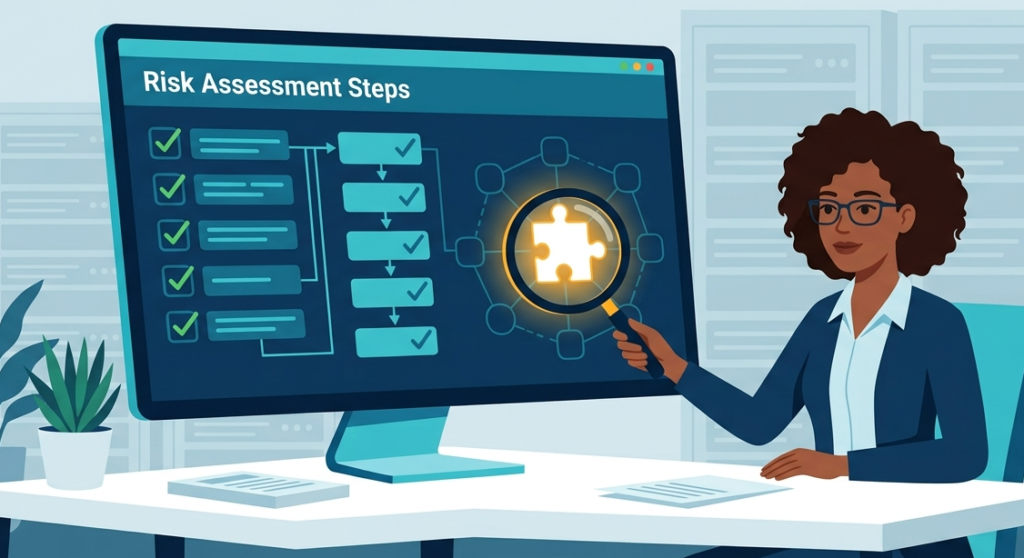
We remember walking through a server room years ago, the hum was a constant. The network admin pointed with pride at the rack. “We’re secure,” he said. A week later, a breach started from a forgotten test server in the marketing department, plugged into the network six months prior.
“The Factor Analysis of Information Risk (FAIR) model has emerged as the dominant framework for cyber risk quantification, serving as an international standard quantitative model for information security and operational risk” – ScienceDirect
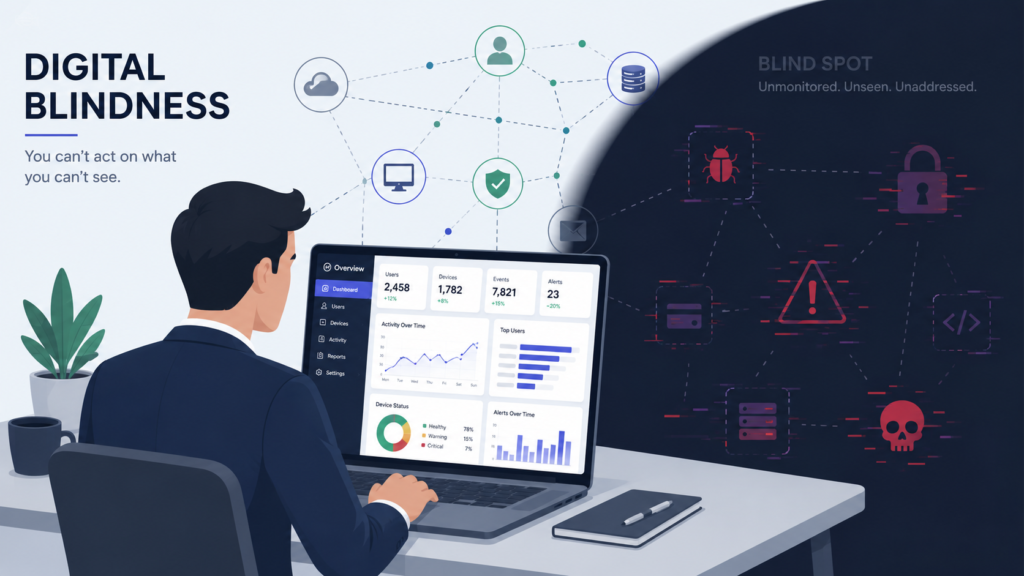
No one had inventoried it. No one was monitoring it. That’s the thing about networks, they grow like living things, new branches sprouting in the dark. You can’t protect what you can’t see. This is the core problem any good risk assessment software must solve. It’s not about more alarms, it’s about better sight.
What Does Network Security Risk Assessment Software Actually Do?
At its heart, this software performs a continuous, automated audit using advanced network security risk analysis techniques. It doesn’t just check for known viruses; it builds a living model of your entire digital environment to answer foundational questions you might be struggling to ask manually.
What’s Actually Connected to My Network?
It finds everything. Every laptop, phone, IoT sensor, and that sketchy smart coffee maker. It identifies devices by type, operating system, and owner. This discovery isn’t a one-time event.
It runs constantly, alerting you the moment an unknown device tries to join. We built Network Threat Detection around this principle, because you can’t assess risk on an incomplete map. This discovery forms the non-negotiable baseline.
Where Are My Weak Points?
Once it knows what’s there, it probes for weaknesses. It looks for unpatched software, open ports that shouldn’t be open, misconfigured firewalls, and default passwords. It doesn’t just list them. It correlates these vulnerabilities with the value of the asset they’re on. A critical flaw on a public-facing server is a bigger problem than the same flaw on an isolated printer.
How Likely is a Breach, and What Would it Cost?
This is where software moves from IT tool to business tool. By bridging the gap between qualitative vs quantitative risk analysis, it uses frameworks like FAIR (Factor Analysis of Information Risk) to translate technical flaws into financial and operational risk.
It gives you a probable loss magnitude. This turns a technical argument for a patch into a business case for action. You’re not just fixing a bug, you’re preventing a likely $250,000 loss.
How Do You Choose the Right Software? A Practical Guide
Credits: It-Infotek
The market is crowded. Cutting through the noise means focusing on outcomes, not features. You need a tool that fits your team’s skill level and your organization’s specific pain points. Here are the questions to ask yourself, and any vendor.
Does It Provide Actionable Intelligence, or Just Data?
A long report full of red flags is paralyzing. Good software prioritizes. It should tell you, “Fix these three things this week to reduce your risk score by 40%.” Look for clear dashboards and remediation guidance, not just raw scan results. The best tools integrate ticketing systems like Jira or ServiceNow to turn findings into tasks automatically.
Can It Grow and Adapt With Our Network?
Your network today isn’t your network in a year. Cloud services, remote work, new offices. The software must be agile. It should support agent-based and agentless scanning.
It needs to understand cloud environments (AWS, Azure, GCP) as natively as it understands your on-premise servers. Scalability isn’t an option, it’s a requirement for anything beyond a very small, static setup.
What’s the Total Cost, Beyond the License?
Consider the labor. Some platforms are powerful but require a dedicated analyst to run them. Others are designed for smaller teams to operate effectively. Think about implementation time, training, and ongoing maintenance.
“Traditional assessments were built for a different era—one with fewer SaaS apps, fewer endpoints, and far less data moving across systems every day. … Yet the industry is still relying on slow, manual, agent-heavy assessment methods that can’t keep pace with modern threats or customer expectations” – Security Boulevard
A cheaper tool that takes 200 hours a month to manage is far more expensive than a premium tool that automates 80% of the work. Here’s a simple table to frame the evaluation:
| Consideration | Question to Ask | Why It Matters |
| Deployment | Agent-based, agentless, or hybrid? | Impacts coverage, detail, and network load. |
| Reporting | Does it produce board-ready risk reports? | Bridges the gap between IT and executive understanding. |
| Integration | Does it plug into our existing SIEM, firewall, or ticketing system? | Creates a cohesive security ecosystem, not another silo. |
| Support & Updates | How often is the threat intelligence updated? | Determines if the tool stays current with new attack methods. |
Integrating Assessment Into Your Daily Rhythm
Buying the tool is the start. The value comes from weaving it into your operations. It shouldn’t be a separate, quarterly “audit” project. It should be part of the fabric.
Start by running a full assessment to establish a baseline. The results will be overwhelming, that’s normal. Use the software’s prioritization to tackle the top 5-10 critical items. Then, schedule weekly reviews of new findings.
Make it a standing agenda item. For us, integrating Network Threat Detection meant our daily stand-up included a glance at the risk heatmap. It changed the conversation from “Is everything okay?” to “Here’s the one thing we’re fixing today to make everything more okay.”
Automate the boring stuff. Set the software to automatically scan new cloud instances the moment they spin up. Have it generate and email a risk summary report every Monday morning. Let it create tickets for medium and high-severity findings. This turns the software from a tool you use into a system that works for you.
Common Objections and Realities
“We’re too small for this.” Size doesn’t matter to automated bots. They target vulnerable networks, not just big ones. A simple, affordable assessment tool is often more critical for a small team with limited manpower.
“It’s too complicated for our team.” This is a valid concern. The key is to choose a platform known for a gentle learning curve. Look for vendors that offer strong onboarding and clear documentation. The goal is to simplify security, not complicate it.
“We have a pentest once a year.” A pentest is a snapshot. It’s a detailed picture of your security on a single day. Continuous network security risk assessment software is the continuous video feed. The network changes the day after the pentesters leave. You need both.
“It’ll create too much work.” Initially, yes, it will surface problems. That’s the point. But in six months, it becomes a maintenance monitor. It shifts your work from frantic incident response to planned, proactive improvement. It’s the difference between constantly bailing water and finally plugging the holes in the boat.
FAQ
Isn’t this just a more expensive vulnerability scanner?
No, not exactly. A vulnerability scanner is a component. It finds technical flaws. Risk assessment software uses those findings, plus asset data, threat intelligence, and business context, to calculate actual risk. It tells you not just what’s broken, but how much it matters and what to do about it.
How often should we run a full assessment?
Continuously. The old model of quarterly or annual scans is obsolete. Your software should be perpetually discovering, assessing, and monitoring. Full, deep-dive scans might be scheduled weekly or monthly, but the light should always be on.
Can this software prevent attacks?
Directly, no. It’s a detection and analysis tool. Indirectly, it’s one of the best preventions you can buy. By systematically finding and guiding you to fix your weaknesses, it removes the very avenues attackers use. It prevents attacks by making your network a harder target.
Do we still need a human security analyst?
More than ever. The software is the tool, the human is the craftsman. The analyst interprets the data, makes judgment calls on prioritization, understands the business context the software can’t, and drives the remediation process. The software makes a skilled analyst ten times more effective.
From Overwhelmed to Organized
From Overwhelmed to Organized Network threats can feel chaotic. Security software won’t make you instantly unhackable, but it gives you clarity and a structured plan.
NetworkThreatDetection.com helps teams proactively defend their networks.
It uses real-time threat modeling and automated risk analysis to find your blind spots before attackers do. Stop guessing about your biggest risks. Start your first scan today and build a smarter defense plan.
References
- https://www.sciencedirect.com/science/article/pii/S0957417425035353
- https://securityboulevard.com/2018/06/amplified-ddos-attacks-are-here-to-stay-experts-say/