
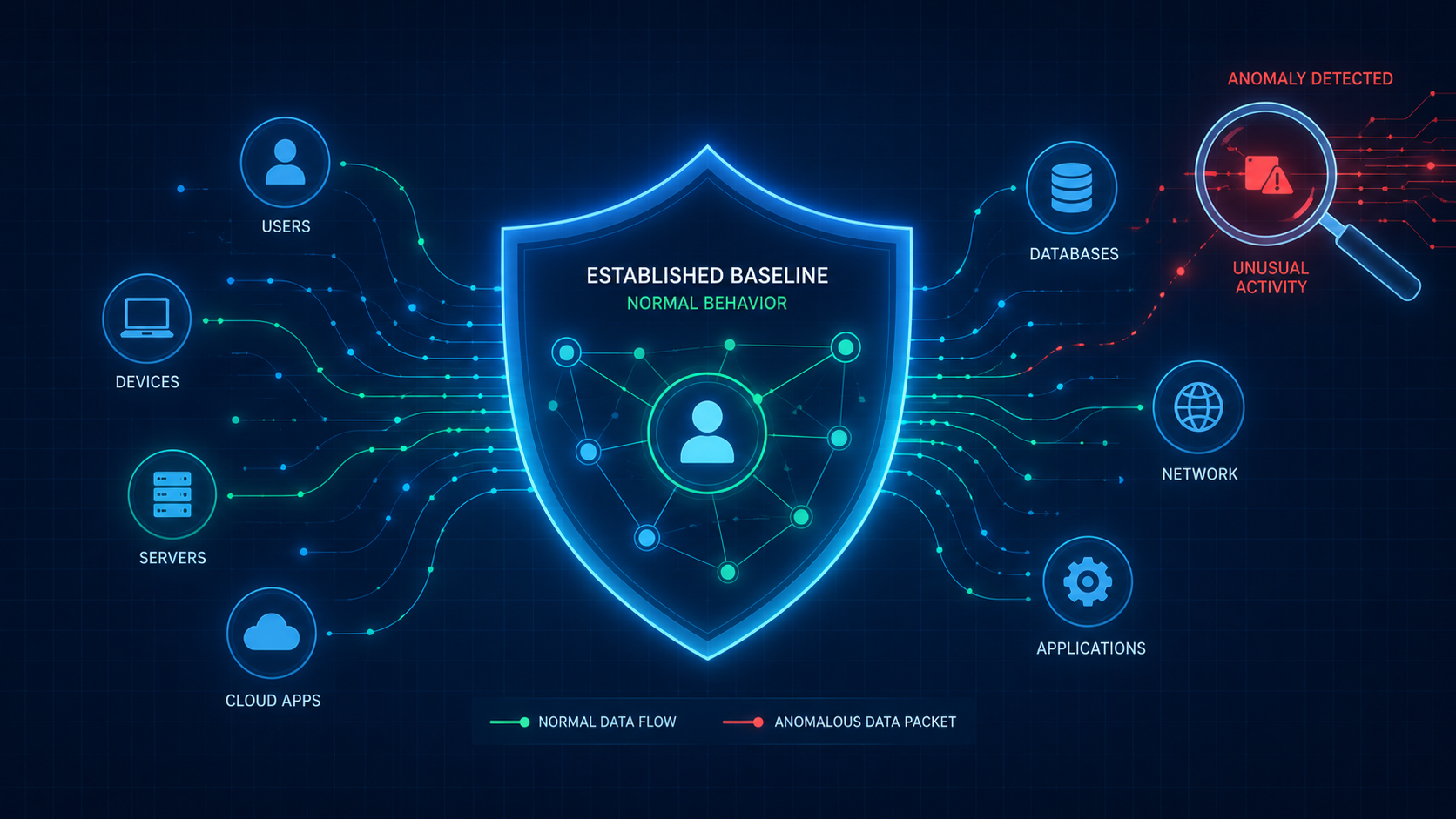
Every secure network starts with understanding what “normal” looks like. Establishing baseline user entity behavior gives security teams the context needed to distinguish routine activity from suspicious actions. Instead of chasing thousands of isolated alerts, organizations can focus on meaningful behavioral changes that matter.
As part of an effective Network Threat Detection strategy, behavioral baselines transform raw activity logs into actionable intelligence, making it easier to identify insider threats, compromised accounts, and emerging attacks before they cause serious damage.
Build Your Security Foundation
Before diving into the process, remember these core ideas that make behavioral baselines so valuable.
- A behavioral baseline defines “normal” for your unique environment, making anomalies visible.
- It requires collecting the right identity and activity data over a learning period, typically 2-4 weeks.
- This foundation is what enables advanced detection of insider threats and credential-based attacks.
Why Establishing Baseline User Entity Behavior Matters
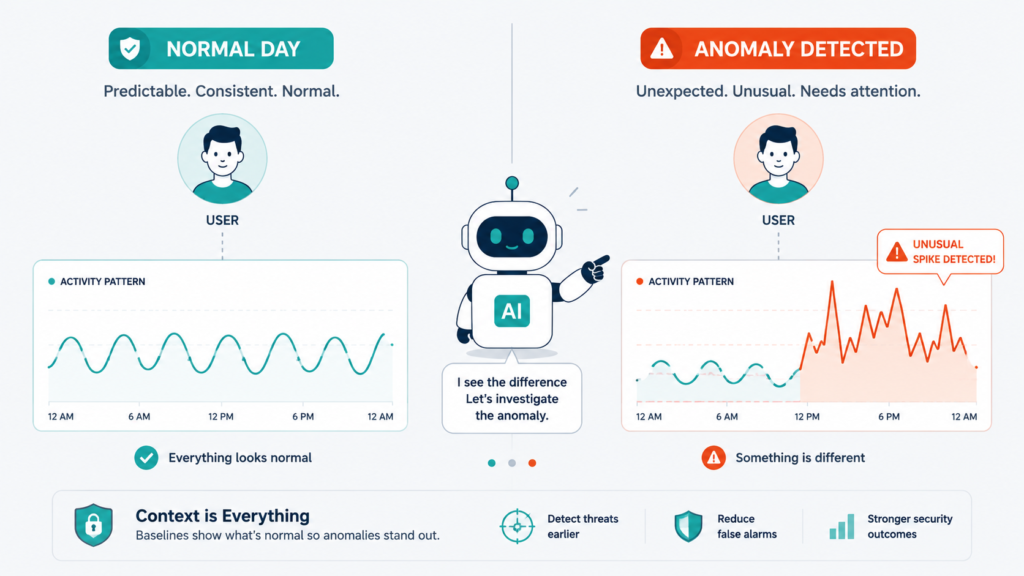
We learned the hard way. A finance user’s account started pulling reports at 11 PM. Our old rule-based system said nothing, the user was authorized, the files were allowed. It was only weeks later, during an audit, we saw the pattern: hundreds of sensitive files accessed in quiet, off-hours bursts.
We had all the logs, but no baseline to see the change. That’s the silent failure. Establishing a baseline isn’t about fancy AI, it’s about building a memory for your network. It’s answering one question: “What does ordinary look like here?” Without that answer, every new action is just data.
With it, a deviation becomes a story. Your security shifts from reactive guessing to informed awareness. Let’s build that memory.
What Exactly Is a Behavioral Baseline?
Think of it as a dynamic fingerprint for activity. It’s not a single rule or threshold. It’s a living profile that captures the typical patterns for an entity, a user, a server, a service account. For a user, it knows their usual login times, geographic locations, devices used, and the typical volume and type of data they access.
“Anomaly detection establishes a baseline of normal activity and compares current events against that baseline to identify unusual behavior.” – NIST Computer Security Resource Center
For a server, it understands its standard network connections, communication peers, and data transfer rhythms. The baseline isn’t static, it adapts. It knows that Sarah works late on quarter-ends, so that spike in activity is normal for her. It understands that the backup server’s traffic doubles on the first of the month.
This context is everything. A security tool without a baseline sees only isolated events. Implementing user and entity behavior analytics changes this by providing a framework that sees when those events form an unusual pattern, a break from the established norm.
Why Is a Baseline Your Most Important Security Asset?
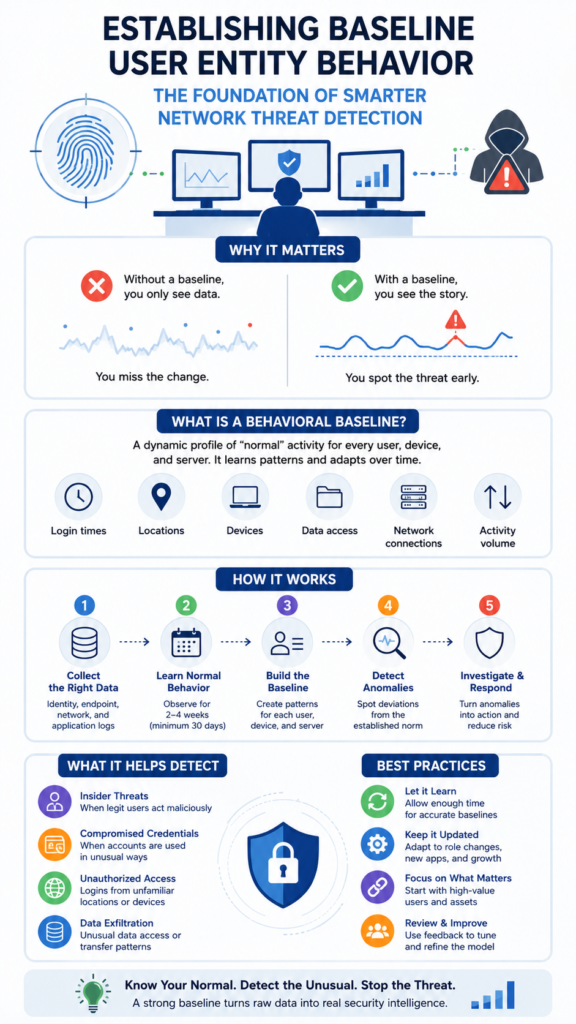
Because it turns abstract data into concrete intelligence. Most security alerts fail due to a lack of context. An alert fires because “a user downloaded a large file.” Is that bad? Without a baseline, you have no idea. If the user is a data scientist who does this weekly, it’s fine.
“Insider threat indicators are often observable as changes in behavior over time rather than isolated events.” – CERT Insider Threat Center
If the user is an HR assistant who has never done it before, it’s a critical incident. The baseline provides that “before” picture. Looking at how ueba detects insider threats highlights its primary value in catching what rule-based systems miss entirely: the authorized misuse.
- Enables Anomaly Detection: You can’t find the weird if you don’t know the normal.
- Reduces False Positives: Filters out benign but unusual activity for specific users.
- Detects Insider Threats: Spots when legitimate users begin acting maliciously.
- Identifies Compromised Credentials: Flags when an account is used in an uncharacteristic way.
What Data Do You Actually Need to Collect?
Credits: Geekus Maximus
The mantra is quality over quantity. You don’t need every log from every switch. You need the logs that tell a story about identity and action. Start with your core identity provider. For most, that’s Active Directory or an equivalent cloud directory. You need every authentication event, successes, failures, password changes.
This tells you who is doing something. Next, gather endpoint data. What machines are they using, what processes are they running? Then, layer in application logs from critical systems: your VPN, major SaaS apps (like Salesforce or GitHub), and database access logs. The goal is to triangulate activity. The identity log says “Sarah logged in.”
The endpoint log says “from her corporate laptop in Chicago.” The application log says “and accessed the R&D repository.” Over time, this forms her pattern. For network-level baselining, which we see as a logical first step, the data is different. It’s about flow data, NetFlow, IPFIX, or packet-derived metadata.
This shows the conversations between devices, establishing what “normal” traffic looks for every server and workstation, which becomes a powerful, complementary baseline.
How Long Does It Take to Establish a Reliable Baseline?
Patience is non-negotiable. You need a full business cycle, at minimum. For most organizations, that’s 30 days. It lets the system see the weekly rhythm (quiet weekends, busy weekdays) and the monthly patterns (end-of-month reporting, payroll runs). During this learning period, the system should be in observation-only mode.
It’s watching, building profiles, connecting dots, but not generating alarms. This feels strange. You’re deploying a security tool and telling it not to alert you. But if it starts alerting on day one, it’s just guessing. It has no frame of reference. After the initial period, you enter a tuning phase.
The system will start to flag its first anomalies. When shifting from traditional security monitoring to a behavioral approach, some flags will be true positives like misconfigured services, while many will be false positives that help you refine the model.
| Data Source | Purpose in Baselining | Example of Normal Pattern Learned |
| Identity Logs (AD, Okta) | Ties actions to a specific user or service account. | User “JSmith” logs in M-F 8:30-5:30 from city A. |
| Endpoint Data | Establishes the “what” and “from where” of activity. | User “JSmith” always uses laptop ID “LT-1234”. |
| Network Flow Data | Maps standard machine-to-machine communication. | Server “SRV-DB01” sends 50 GB nightly to backup server. |
| Application Logs | Details specific actions within critical business apps. | User “JSmith” accesses the “Payroll” app 2-3 times per day. |
What Are the Common Pitfalls When Building a Baseline?
The biggest mistake is trying to boil the ocean. You can’t baseline everything at once. Start with your crown jewels, your domain admins, your finance users, your R&D servers, your database containing customer data. Focus on the high-value targets that would hurt the most if compromised. Another pitfall is ignoring seasonality.
Your baseline for December will look different from June if you’re in retail. You need to account for these business rhythms, or you’ll drown in false alerts every holiday. A technical trap is poor data quality. If your logs are incomplete or your timestamps aren’t synchronized, the system will build a flawed, confusing picture. Garbage in, garbage out.
Finally, there’s the human pitfall: abandoning the process during tuning. The first weeks of real alerts will be messy. It takes human judgment to investigate and provide feedback, teaching the system what truly matters in your environment. This partnership is key.
How Do You Maintain and Update the Baseline?
A baseline isn’t a “set it and forget it” configuration file. It’s a living model that must evolve as your business does. People change roles, new applications are deployed, servers are migrated to the cloud. The system should have adaptive machine learning that gradually incorporates new, consistent behavior into its sense of normal.
However, major changes require oversight. When a user changes departments, their old baseline becomes irrelevant. A good practice is to integrate with your HR system’s feed for job role changes, which can trigger a period of re-learning for that user’s profile.
- Automated Adaptation: Machine learning models should gradually absorb new, consistent patterns.
- Handling Role Changes: Integrate with HR data to reset user profiles during job changes.
- Change Management Syncing: Link IT change tickets to expected baseline deviations.
- Regular Health Checks: Periodically review the top anomalies to ensure the model’s accuracy.
How Does This Connect to Network Threat Detection?
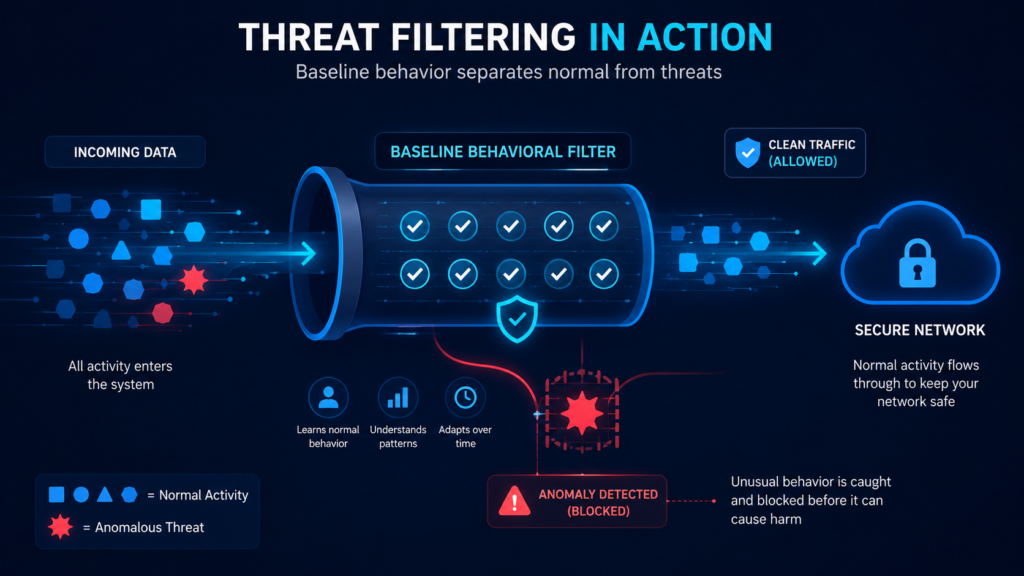
Our own path started here, at the network layer. Before we could understand user intent, we realized we had to understand the machine’s normal “conversations.” We built our Network Threat Detection to establish a behavioral baseline for every device. It learns which servers talk to which databases, on what ports, with what volume of data.
This network baseline is incredibly powerful because it’s objective and hard to spoof from inside. A compromised user’s laptop might behave oddly, but that odd behavior manifests as anomalous network traffic, calling out to a new command-and-control domain, or sending large amounts of data to an unexpected internal server.
By establishing the network baseline first, you create a foundational layer of truth. It often catches the earliest signs of compromise, the initial beaconing or lateral movement, before any user-centric anomaly becomes apparent. It’s a logical, efficient first step that makes subsequent user behavior analytics more accurate and actionable.
FAQ
Does establishing a baseline violate user privacy?
It shouldn’t. A well-architected system focuses on behavioral metadata, login times, data volumes, access patterns, not the content of emails or the data in files. It knows “Sarah accessed 100 files at midnight,” not what was in those files. Clear policies and transparency are still required.
What if our user behavior is chaotic with no clear pattern?
Some roles, like IT admins or developers, have highly variable patterns. The baseline captures that variability itself as the norm. The anomaly would be if that chaotic behavior suddenly became rigid and repetitive, or vice versa. The system learns the range of normal, not just the average.
Can an attacker “poison” the baseline during the learning phase?
Potentially, yes, if they have persistent access before you deploy. This is why the learning period should be during a time of confirmed normal operations. For high-value targets, using historical log data to seed an initial baseline can mitigate this risk.
How do we handle service accounts and automated processes?
These are often the most predictable entities and are critical to baseline. A service account should have a very tight, repetitive pattern. Any deviation, like a database service account logging in via VPN, is a massive red flag and is easy for a mature baseline to spot.
The Foundation of Seeing Clearly
To turn your behavioral baseline into actionable defense, you need a platform that understands your network’s unique rhythm. NetworkThreatDetection.com helps cybersecurity teams proactively expose blind spots with real-time threat modeling and automated risk analysis.
Backed by frameworks like MITRE ATT&CK, it transforms your network data into clear attack path simulations so you can confidently prioritize risks before attackers strike. Ready to see your network clearly? Join Network Threat Detection today to build your foundation.
References
- https://csrc.nist.gov/publications/detail/sp/800-94/final
- https://insights.sei.cmu.edu/insider-threat/