
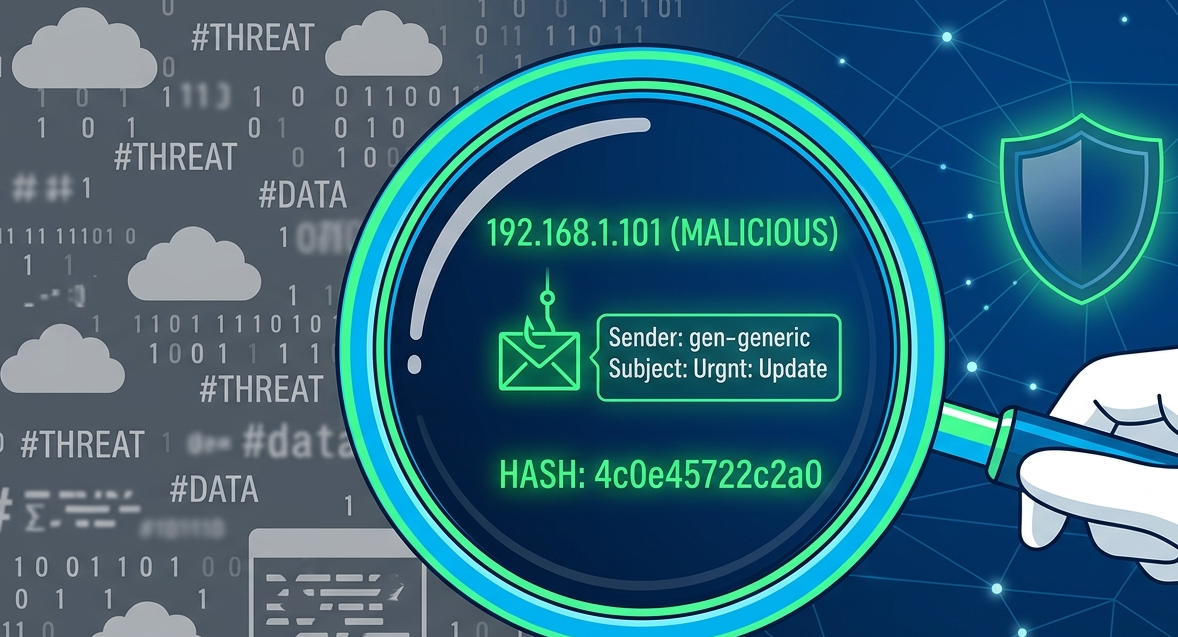
You can’t defend against what you can’t see. Open source threat intelligence (OSINT) helps you find publicly available data to spot cyber threats early. Instead of relying solely on expensive feeds, you can use the internet as your largest intelligence database.
By blending OSINT with your Network Threat Detection, you can easily track hacker forums and data leaks to stop attacks. Keep reading to learn how to use this free data effectively.
The Blueprint: What You Need to Know
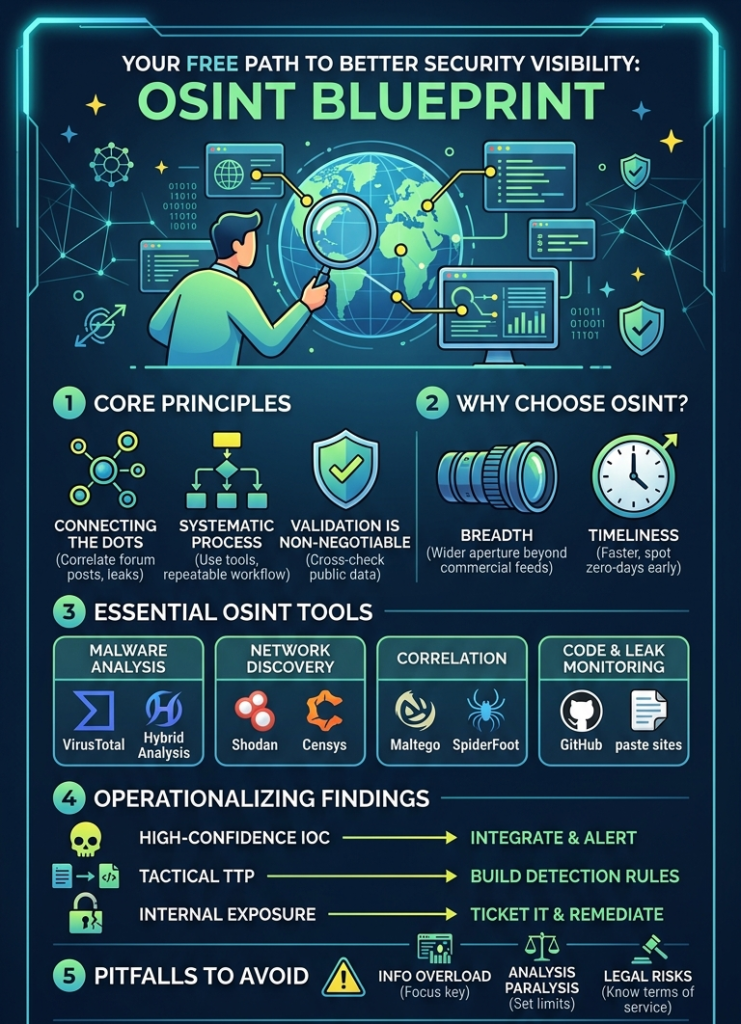
Before diving into the tools, let’s establish the core principles of a successful OSINT strategy:
- OSINT is about connecting dots. Isolated data points are noise; the value is in correlating forum posts, code leaks, and network scans to see the full picture.
- It demands a systematic approach. Random searches waste time. You need repeatable processes and the right set of free tools to be effective.
- Validation is non-negotiable. Not everything public is true. OSINT findings must be cross-checked and contextualized before action.
What Exactly Is OSINT in Cybersecurity?
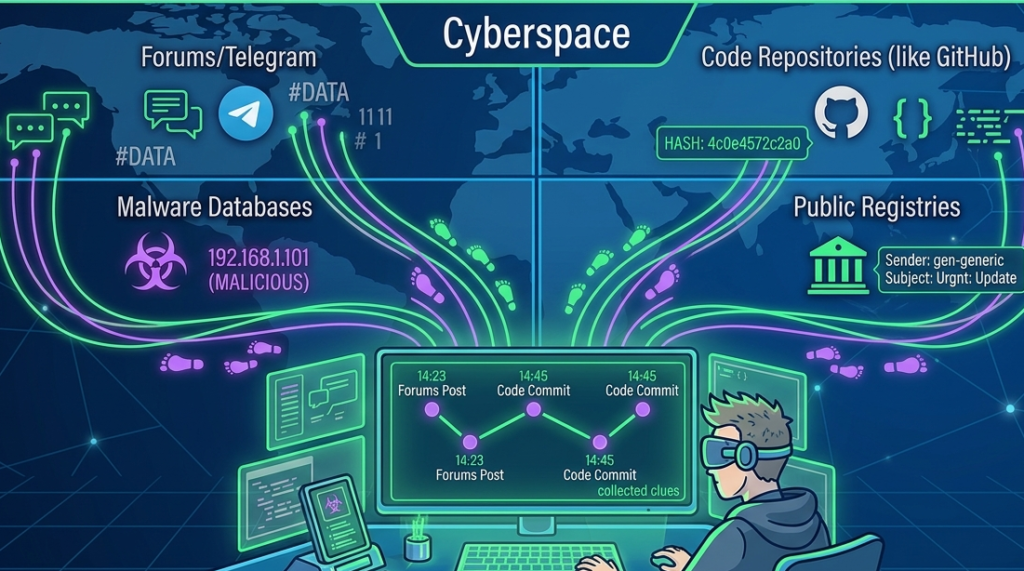
Forget spy movies. In our world, OSINT is the collection of clues left in the open. It’s the new malware sample uploaded to VirusTotal by a researcher in another country. It’s the discussion on a Telegram channel where an actor boasts about a breach. It’s the misconfigured cloud storage bucket exposing a company’s data.
“Open-source intelligence (OSINT) plays a key role in proactive cybersecurity by enabling earlier detection of threats, supporting faster response times, and improving decision-making through access to diverse and up-to-date information. OSINT helps organizations identify emerging risks, track threat actors, and adapt to evolving cyber challenges before they cause damage.” – IEEE Access
It’s all public. The core idea is that adversaries, like everyone else, leave a digital footprint. They reuse code, they brag in forums, they test their tools in the open. By monitoring these spaces, you get a warning bell, sometimes weeks before a tailored feed picks it up. It’s proactive security at its most fundamental level.
Why Bother With Free Data?
The first objection is always about quality. Why use free data when you pay for polished intelligence? Two reasons: breadth and timeliness. Commercial feeds are excellent, but they have a specific focus. OSINT gives you a wider aperture.
By properly leveraging threat intelligence feeds from the public domain, you might spot a nascent threat group targeting a different sector that hasn’t yet appeared in your premium feed.
More importantly, OSINT can be faster. The first mention of a zero-day might be a cryptic GitHub commit or a tweet from a niche researcher.
That early signal is priceless. It lets you start hunting internally, checking logs, before the official bulletins even hit. We’ve caught phishing campaigns simply by monitoring domain registrations for typos of our brand, something no generic feed would cover.
Essential OSINT Tools and Sources
You don’t need a big budget, you need the right bookmarks. Start with the aggregators. VirusTotal and AlienVault OTX are community-powered hubs for malware samples and IOCs. For network intelligence, Shodan and Censys are like search engines for internet-connected devices, showing you exposed servers or vulnerable IoT gear.
Social media and forums require more finesse; tools like Maltego help visualize connections between entities. Don’t overlook code repositories like GitHub for leaked credentials or exploit code. The key is to find the right open source threat intelligence tools to build a toolkit that covers different data types.
- Malware & IOC Analysis: VirusTotal, Hybrid Analysis
- Network & Asset Discovery: Shodan, Censys, ZoomEye
- Data Correlation & Visualization: Maltego, SpiderFoot
- Code & Leak Monitoring: GitHub, GitLab, paste sites
This public data becomes incredibly powerful when fused with what you see internally. For instance, a suspicious IP from Shodan scanning for a specific vulnerability gains immediate context if your own Network Threat Detection sensors see probing activity from that same IP. It turns an external observation into a confirmed internal alert.
Building a Repeatable OSINT Process
Random searches lead nowhere. You need a hunter’s methodology. First, define your requirements. What are you protecting? What adversaries care about it? This scopes your effort. Second, identify your key sources from the vast ocean. Pick 3-5 to master initially. Third, schedule collection time. OSINT isn’t a one-off, it’s a discipline.
We dedicate time each week to review our curated sources. Fourth, analyze and correlate. This is the hard part, turning data points into a narrative. Fifth, disseminate findings. Write a short note for the team, add a high-confidence IOC to a block list, or start a threat hunt. Finally, review and adapt. What worked? What was noise? Refine your sources and process.
The Critical Role of Validation
The open internet is full of misinformation, boasts, and false flags. An IOC found in a forum might be a researcher’s test file, not actual malware. A claimed data breach might be old news repackaged. This is where validation separates amateurs from professionals. Never act on a single source. Corroborate.
If you find a suspicious IP, check it across multiple reputation databases. If you see leaked credentials, verify their format matches your company’s. Use your internal telemetry as the ultimate validator.
That suspicious domain from a threat report? Check your DNS logs and Network Threat Detection history. If you see no traffic to it from your network, its immediate priority drops. Validation turns raw OSINT into actionable intelligence.
From Collection to Action: Making OSINT Operational
Credits: Jennifer Funk
Collecting intelligence is pointless if it sits in a notebook. The goal is to operationalize it, to feed it into your security machinery. High-confidence indicators of compromise (IOCs) like malicious domains or IPs with clear hostile intent should go straight into your security tools.
For tactical insights (like a new phishing technique), brief your SOC team. Use them to create new detection rules or hunting hypotheses. For strategic trends (a group shifting focus to your industry), inform leadership. The table below outlines how to move different types of OSINT findings into your security workflow.
| OSINT Finding Type | Example Source | Recommended Action |
| High-Confidence IOC | VirusTotal report on new ransomware hash, Shodan IP running exploit kit. | Integrate into firewall/SIEM blocklists, create immediate alert. |
| Tactical TTP | GitHub commit showing new obfuscation method, forum post detailing phishing lure. | Brief analysts, build new detection logic in EDR or Network Threat Detection rules. |
| Strategic Threat | Researcher report on state actor targeting your sector, leak of targeted exploit framework. | Inform security leadership for risk assessment, guide future tooling investments. |
| Internal Exposure | Censys scan showing your test server is public, GitHub commit with old API key. | TICKET IT. Direct remediation task to the responsible system owner. |
Common Pitfalls in OSINT Work, How to Deal With It?
Many teams get excited about OSINT and then fail. The biggest pitfall is information overload. Trying to monitor everything means you see nothing.
Focus is key. The second is analysis paralysis. Getting lost in data without making a decision. Set a time limit for analysis, then decide: act, archive, or discard. The third is neglecting legal and ethical boundaries.
“Cross-source validation requires source independence (different originators, not syndicated content), methodological diversity (regulatory + news + social media), and temporal distribution (multiple observation points). Validation strength increases with source diversity across authority level, collection method, and temporal span.” – Altss
Just because data is public doesn’t mean scraping it aggressively or interacting with criminal forums is wise or legal. Understand the terms of service for your tools. Finally, working in a silo. OSINT findings locked in one analyst’s brain have no value. You must share insights simply and clearly with the broader team.
The Synergy with Internal Detection
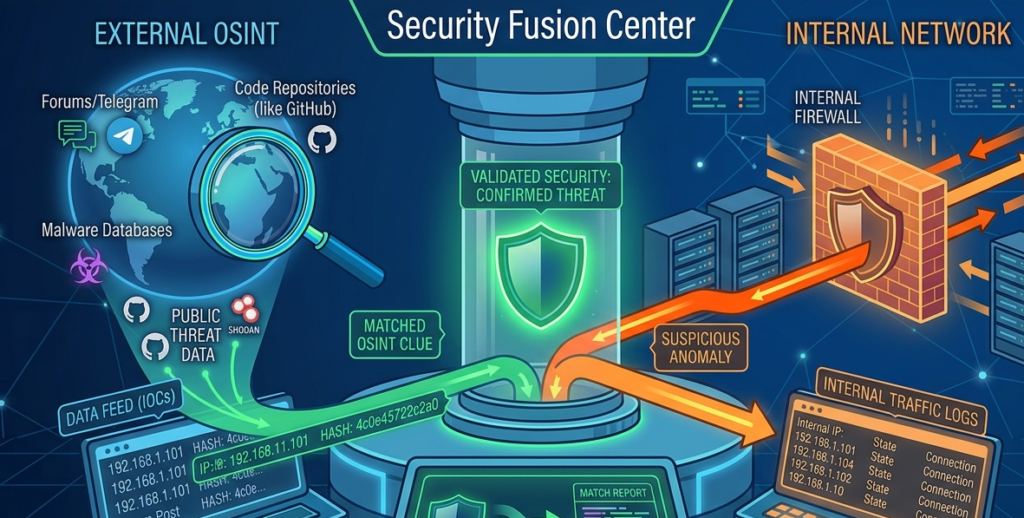
OSINT’s true power is unlocked when paired with what you already see. It provides external context for internal anomalies. Why is that internal workstation connecting to a server in a suspicious country? An OSINT check might reveal that server is part of a known botnet. Conversely, your internal tools validate OSINT.
A reported malicious domain is only a real threat to you if your systems are actually communicating with it.
Our Network Threat Detection platform acts as this validation layer. It consumes external OSINT feeds of suspicious IPs and domains, but it only raises a high-priority alert when it observes actual communication attempts from inside our network. This fusion eliminates false positives and focuses effort on genuine threats.
FAQ
Is OSINT legal for cybersecurity purposes?
Generally, yes, if you are collecting truly public information (websites, public APIs, social media posts visible to all) for the purpose of defending your own organization. However, bypassing paywalls, violating terms of service, or accessing data through deception (“social engineering”) can cross legal lines. When in doubt, consult legal counsel.
What’s the main difference between OSINT and SOCMINT?
SOCMINT (Social Media Intelligence) is a subset of OSINT. OSINT covers all publicly available sources: technical data, government reports, news, academic papers, etc. SOCMINT focuses specifically on intelligence gathered from social media platforms like X (Twitter), LinkedIn, Facebook, and forums.
Do I need to be a programmer to use OSINT effectively?
Not at all. Many core tools have web interfaces. However, basic scripting skills (using Python to automate API calls to Shodan or VirusTotal) will dramatically increase your scale and efficiency. It allows you to process more data in less time.
How does OSINT fit with a Network Threat Detection strategy?
It fuels it. Network Threat Detection monitors traffic for malicious patterns. OSINT provides the external “threat data” that informs what those patterns are. For example, OSINT might identify a new command-and-control server address. That address can then be loaded as a detection rule in the NTD system to alert on any internal host contacting it.
Becoming an Informed Defender
Open source threat intelligence (OSINT) isn’t a magic solution, it’s a disciplined mindset. By learning to sift through public data, you gain a massive time advantage, transforming from a passive target into an active investigator.
Start small: spend 30 minutes a week tracking one critical asset using free tools. Ready to eliminate your blind spots entirely? Pair your public research with real-time threat modeling and automated risk analysis by visiting Network Threat Detection.
References
- https://ieeexplore.ieee.org/abstract/document/11143131
- https://altss.com/glossary/cross-source-validation