
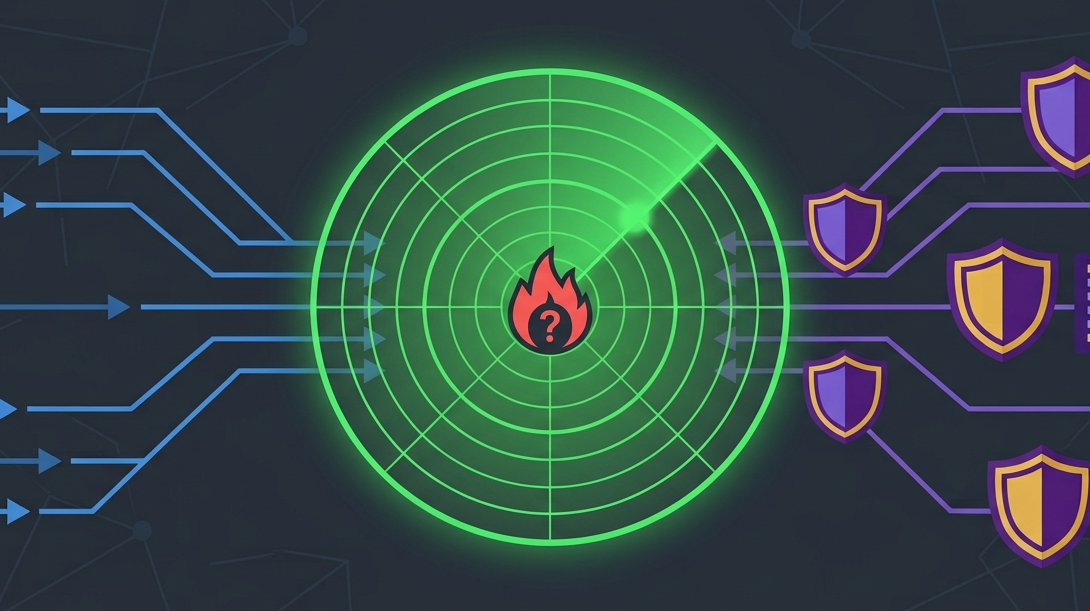
Choosing the right sources open source commercial threat intel is essential for building an effective cybersecurity program. Open source intelligence provides broad visibility into emerging threats, while commercial threat intelligence delivers curated insights, faster updates, and deeper context.
When combined, these sources enhance Network Threat Detection, helping security teams identify threats more accurately and respond more efficiently. Understanding where threat intelligence comes from allows organizations to maximize security coverage without overspending. Keep reading.
What You’ll Learn
The right combination of threat intelligence sources can significantly improve your security posture. In this guide, you’ll learn:
- How to filter the noise from free threat feeds to find genuine signals.
- Why commercial intel provides the context that makes open source data truly powerful.
- The practical steps to integrate these sources for faster, more accurate network threat detection.
Why Is There an Overwhelming Flood of Free Data?
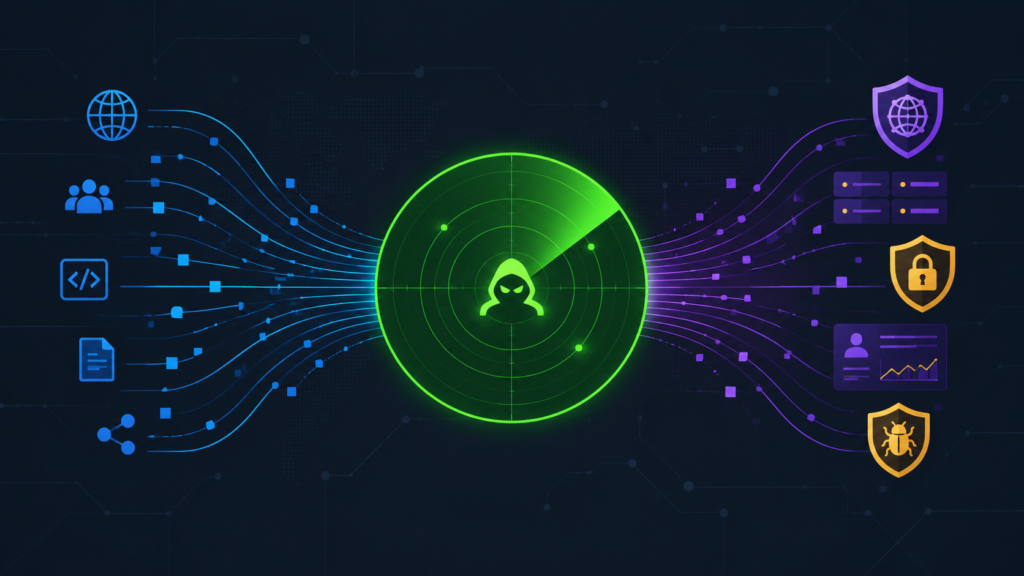
You’ve probably been there. You sign up for a few open source threat intelligence feeds. The alerts start pouring in. IP addresses, hash values, domain names, thousands of them. It’s a torrent of data, and most of it has nothing to do with your actual network.
“Security analysts rely on AI-based tools such as SIEM, XDR, and EDR to retrieve and process vast amounts of security event data, prioritize alerts, and detect cyber threats efficiently… However, despite AI’s ability to enhance searchability and retrieval in security workflows, its lack of explainability remains a fundamental barrier to trust and effective decision-making.” – ar5iv
The sheer volume is paralyzing. It’s like trying to find a specific grain of sand on a beach during a hurricane. You might have the raw information, but without context and filtering, it’s just noise. This noise creates alert fatigue, causing real threats to slip by unnoticed because they’re buried in the clutter.
The key isn’t to collect more data, it’s to collect smarter data.
- Focus on feeds relevant to your industry.
- Deploy specialized open source threat intelligence tools to automate initial filtering.
- Correlate indicators with your own network logs.
This initial triage is the first, most critical step. It transforms that overwhelming flood into a manageable stream of potentially relevant information. From our own experience running network threat detection, we’ve seen teams drown in this data daily.
They spend hours sorting through irrelevant alerts, which is a costly waste of time and focus. The goal is to use open source as a wide net, but you must have a process to quickly throw back the fish you don’t need.
Why Context is the Missing Piece?
So you’ve filtered your open source feeds. You have a list of suspicious IPs. Now what? Understanding the different types of threat intelligence feeds and indicators is crucial, as an IP address alone tells you very little.
Is it a compromised server in a botnet, or just a poorly configured cloud instance? Open source often gives you the “what,” but rarely the “why” or the “who.” This is where commercial threat intelligence fills the gap.
Commercial providers invest analysts who add crucial context: the adversary’s tactics, their likely targets, and the campaign’s overall objectives. This context turns a random indicator into a understood threat.
“The overwhelming majority of CTI literature approaches intelligence as a technological capability… This perspective frames intelligence primarily as a data problem: collecting more indicators, processing them faster, and distributing them more efficiently… Framing CTI as a technology problem with a technology solution fundamentally misunderstands intelligence.” – ScienceDirect
For instance, seeing an IP linked to malware is useful. Knowing that IP is part of a campaign targeting financial institutions, and that your company is a regional bank, that’s actionable. This context allows you to move from a generic defensive posture to a targeted one.
You’re not just blocking an IP, you’re defending against a specific adversary with known behaviors. It’s the difference between seeing a single puzzle piece and having the picture on the box. Commercial intel provides that box top, helping you understand where and how the piece fits into the larger attack landscape.
How Do You Build Your Hybrid Intelligence Engine?
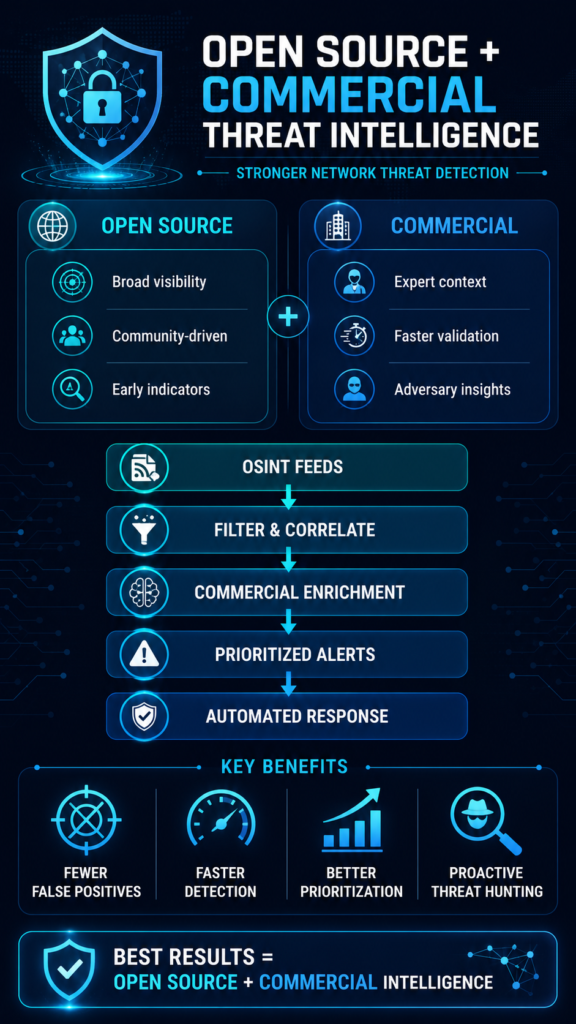
Merging these two streams isn’t about running them side-by-side. It’s about creating a single, integrated workflow. Think of open source as your early-warning radar, scanning the horizon for anything unusual. Commercial intel is your targeting system, identifying which blips on that radar are hostile missiles headed your way.
A practical table for managing sources might look like this:
| Source Type | Primary Role | Key Strength | Integration Tip |
| Open Source | Broad awareness, early indicators | Volume, cost-free, community-driven | Automate ingestion & filter by industry. |
| Commercial | Targeted context, adversary insight | Analyst-curated, high-fidelity, timely | Use to enrich & prioritize OSINT alerts. |
The process starts with open source. Successfully leveraging threat intelligence feeds requires an automated baseline where incoming alerts are immediately checked against your commercial feed. Does the commercial vendor have a report on this campaign? What’s the severity score? This automated enrichment is powerful. .
It instantly tells your team, “This suspicious domain from an OSINT feed is confirmed as part of an active phishing campaign against tech companies.” The response priority becomes clear immediately.
We built our own network threat detection to function this way, using the wide net of OSINT but applying the focused lens of commercial context to decide what really matters.
Putting Intelligence into Action
Credits: Adam Goss
Intelligence is useless if it doesn’t lead to action. The final step is closing the loop between detection and defense. Your hybrid intelligence engine should directly feed your security controls.
When a high-confidence threat indicator is confirmed, especially one enriched by commercial context, it should be pushed to your firewalls, endpoint protection, and web gateways within minutes. This automated blocking is where theory becomes practice. It’s the tangible return on your intelligence investment.
But action also means investigation. A high-priority alert shouldn’t just result in a block. It should trigger a hunt. Your team can use the detailed behavioral context from the commercial report to search your logs for other signs of that adversary.
Did they use a similar phishing lure elsewhere? Are there lateral movement patterns described in the intel that you can now look for? This proactive hunting, guided by specific intelligence, often uncovers breaches that simple alerting would miss.
It shifts your security from a reactive to a proactive stance. You’re not just waiting for an alarm to sound, you’re actively searching your house based on a known burglar’s modus operandi.
What Is the Real Cost of Getting It Wrong?
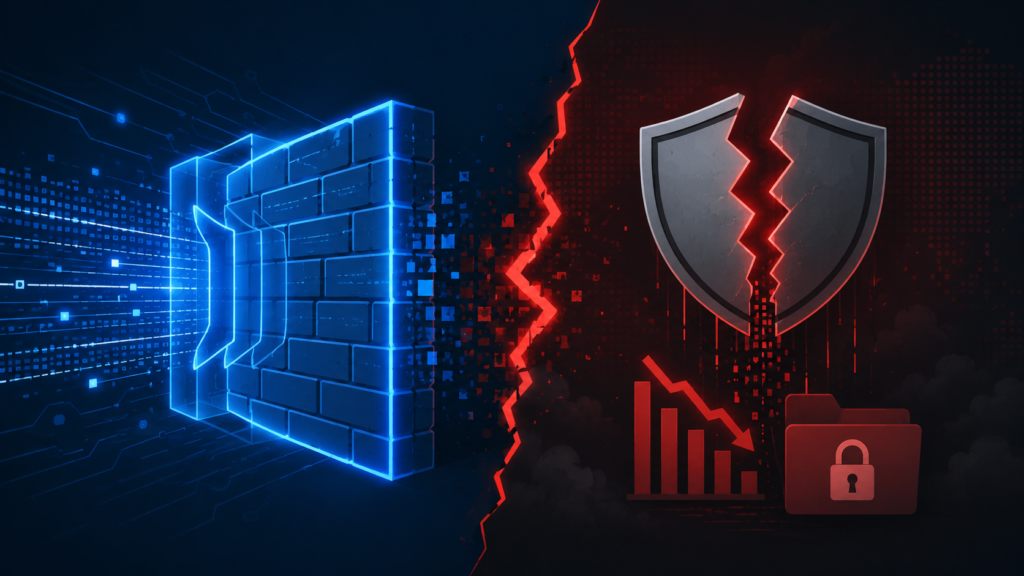
Choosing only one path has real consequences. Relying solely on open source often means slower response times. Your team is busy validating and contextualizing data manually. During that time, a threat may execute. It also increases the risk of false positives, leading to “alert burnout” where real warnings are ignored.
Conversely, relying only on commercial feeds can create blind spots. No single vendor sees everything. Their focus might miss a niche threat specific to your operation that’s being discussed in a forum or GitHub repository.
The financial cost is also measurable. Commercial feeds are a line-item expense. The cost of a breach, including downtime, data loss, regulatory fines, and reputational harm, is almost always magnitudes higher. The hybrid model balances these costs effectively.
It uses low-cost open source for breadth and invests commercial dollars for depth where it counts most. It’s a pragmatic allocation of limited security resources.
From what we’ve seen, organizations that stitch these sources together simply detect and respond faster. They make more informed decisions because they have a clearer picture of both the forest and the trees.
FAQ
Can open source threat intelligence be trusted?
Yes, but with verification. The credibility varies by source. Established feeds from security communities or reputable vendors offering free tiers are generally reliable. The risk isn’t usually false data, but outdated or irrelevant data. Always correlate indicators from open sources with other data points before taking action.
How do we start integrating sources without a big budget?
Start small. Pick one or two high-quality open source feeds relevant to your sector. Use a free or low-cost threat intelligence platform (some SIEMs have basic TIP functionality) to aggregate them. Manually review the alerts against your network logs for a week. This process will quickly show you the value and highlight the need for better tooling.
What’s the biggest mistake teams make with threat intel?
Treating it as a data feed instead of a process. They buy a commercial feed or subscribe to an OSINT list and pipe it into their SIEM, then wonder why nothing improves. Intelligence must be analyzed, contextualized, and turned into action, blocking, hunting, informing policy. Without that last mile, it’s just more noise.
How does network threat detection fit into this model?
It’s the cornerstone. Network threat detection analyzes your north-south and east-west traffic. When your hybrid intelligence engine identifies a malicious IP or domain, it can immediately update detection rules to look for calls to that indicator.
More importantly, it can hunt for the behaviors described in your commercial intel reports, like specific command-and-control patterns, making your internal detection much smarter.
Your Next Move with Threat Intelligence
Building an effective security strategy starts with using the right sources of open source and commercial threat intel together. Open source feeds provide broad visibility, while commercial intelligence delivers the context needed for faster, more accurate decisions.
Ready to enhance your threat detection capabilities? Join Network Threat Detection and discover how proactive threat intelligence can help your team stay ahead of evolving cyber threats.
References
- https://www.sciencedirect.com/science/article/pii/S0167404826001069
- https://ar5iv.labs.arxiv.org/html/2503.02065