
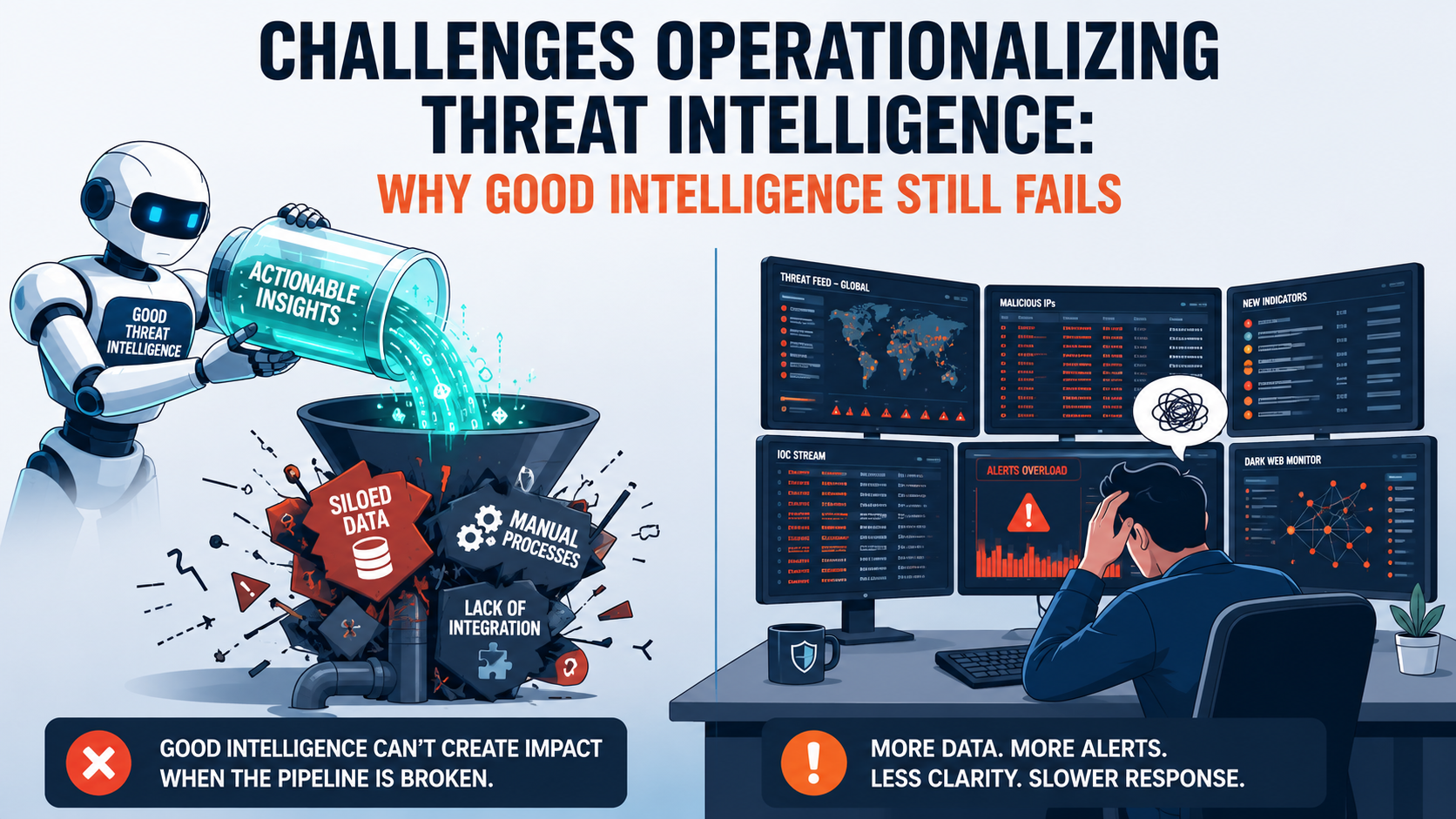
Many organizations invest in threat intelligence expecting stronger security, yet they quickly encounter the challenges operationalizing threat intelligence. Valuable indicators often remain unused because teams struggle to connect intelligence with day-to-day security operations.
Instead of reducing risk, security analysts face more alerts, more manual work, and more uncertainty. Network Threat Detection helps bridge this gap by providing actionable intelligence that fits into existing workflows, making threat data easier to prioritize and respond to. Keep reading.
What You’ll Learn
Threat intelligence becomes valuable only when it supports real security decisions. In this article, you’ll discover:
- Operationalization fails without clear processes tying intelligence to specific security actions.
- Data overload and lack of context are the primary blockers to effective use.
- Success requires continuous tuning and feedback between analysts and tools.
What Does “Operationalizing” Even Mean?
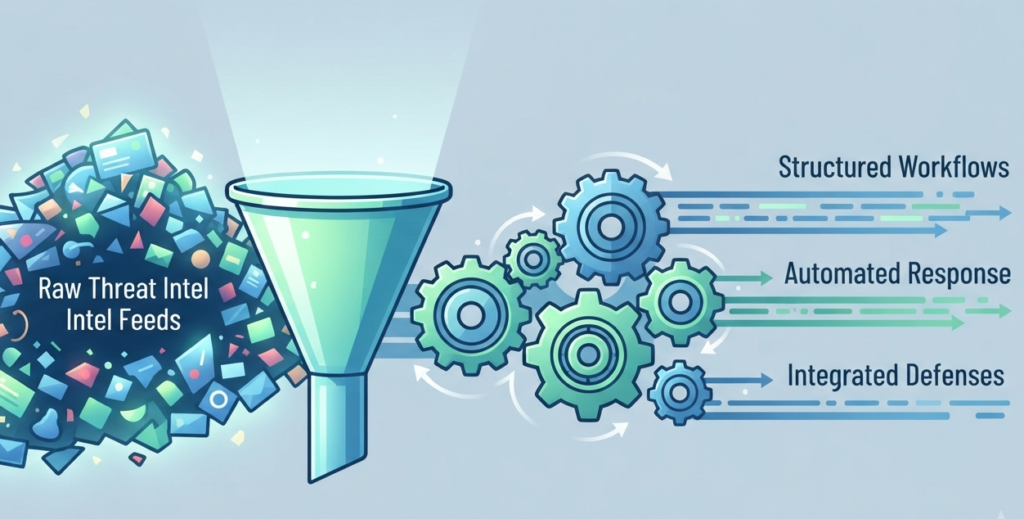
In theory, it sounds straightforward. You take external threat data and use it to improve your security. In practice, it’s a tangled knot of technology, people, and process. Operationalizing means intelligence triggers a defined, repeatable action.
Not just an alert, but a response. It means a new indicator of compromise (IOC) doesn’t just land in a report, it gets automatically added to a block list on your firewall, or it creates a high-priority investigation ticket with pre-filled context.
We thought we’d operationalized when we piped a feed into our SIEM. Alerts fired. But then what? The process stopped. Analysts had to manually decide: block this IP? Hunt for this hash? The intelligence was present, but it wasn’t woven into our daily workflows. It was an external reference book, not a guiding hand.
True operationalization closes the loop. It makes threat intelligence a direct input to your prevention, detection, and response cycles, not just a sidebar conversation.
Why Is There Always a Data Overload Problem?
Feeds deliver millions of indicators. Your SIEM collects billions of events. The collision creates noise, not clarity. The first challenge is filtering this down to what matters for your network when working with threat intelligence feeds.
“It’s easy to see that other threat intelligence solutions are not doing the job… Other platforms bring in threat data, yes, but still leave teams with too much to do themselves and do not make it any easier to take action… a threat intelligence platform is just a ‘big bucket of useless data’ unless you take it a step further. How are you going to act on that data?” – Cyware
We configured a new feed to trigger alerts on any matched IP. Our Network Threat Detection system, which monitors all north-south and east-west traffic, lit up like a Christmas tree. Most hits were from our marketing team accessing global ad servers that shared IP space with something sketchy years ago.
The data was technically “correct,” but operationally useless. It wasn’t filtered for relevance, highlighting why threat intelligence feed quality matters just as much as the volume of indicators collected.
How Does Lack of Context Cripple Your Team?
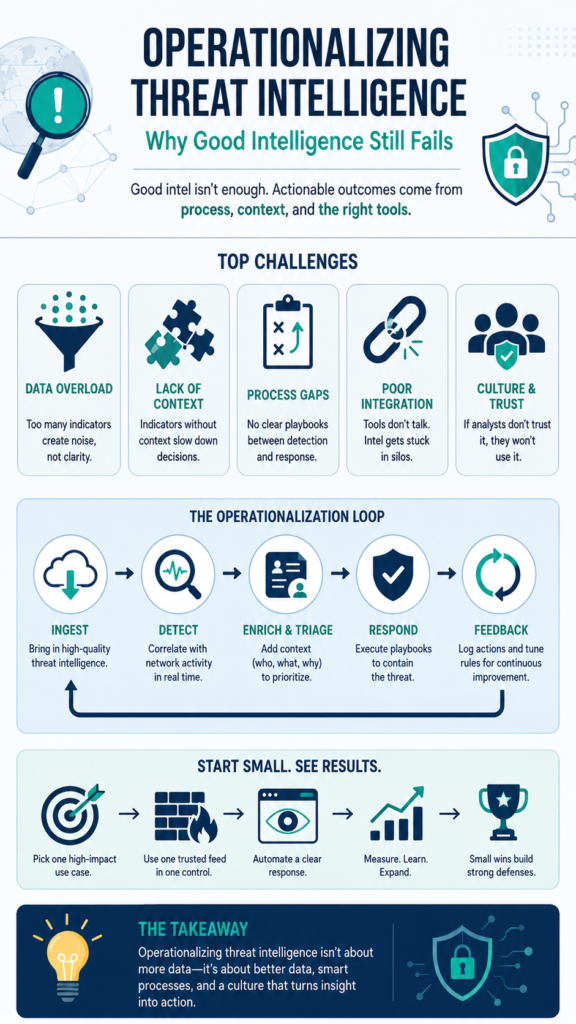
An IOC without context is a dead end. A malicious IP address is just a number until you know why it matters. When an IP address is linked to a known attack campaign, it becomes much more useful. Instead of seeing only an alert, analysts can quickly understand what the attacker is trying to do and how serious the threat may be.
In many organizations, alerts do not include enough context. The SIEM detects a suspicious connection, but the analyst still has to search different sources to learn more about the IP address or malware. This extra work can take 20 minutes or longer for a single alert. While the analyst is gathering information, the attacker may already be moving through the network.
Without context, the first step of incident response becomes slower because analysts must answer important questions themselves, such as:
- Who is behind this activity?
- What attack or malware is involved?
- Is this a real risk to our organization?
- What should we do next?
When threat intelligence includes these details from the beginning, analysts can make faster decisions. They spend less time searching for information and more time responding to real threats. This improves triage, reduces unnecessary work, and helps security teams focus on the alerts that matter most.
Where Do Process Gaps Cause the Biggest Failures?
Credits: TAUVOD
Even with good data and context, if you have no defined playbook, nothing happens. The major process gaps are between detection and action. Who is responsible for reviewing a TIP-derived alert? What criteria do they use to escalate it? If they decide to block an IOC, what’s the procedure? Is it a firewall change, a DNS sinkhole, an endpoint rule?
We found our gap was in enrichment and feedback. Our process was linear: Feed -> SIEM Alert -> Analyst -> Manual Verdict. It was slow. We redesigned it to be a cycle.
Now, when our Network Threat Detection flags a suspicious outbound call, it automatically enriches the alert with internal context (which user, what process) and external context from our TIP, automating threat feed processing so analysts receive actionable information without extra manual steps.
The analyst’s role shifted from investigator to validator and executor. Their actions (block, allow, monitor) then feed back into the TIP as internal intelligence, helping tune future alerts. This closed loop is the heart of operationalization.
| Process Stage | Common Failure Point | Operational Fix |
| Ingestion | Accepting all feed data without filtering for relevance. | Implement a “staging” area to score and filter IOCs before they hit production detection. |
| Detection | Generating alerts without actionable context. | Configure integrations to automatically append threat actor, campaign, and MITRE ATT&CK data. |
| Triage | No clear priority or ownership for intel-led alerts. | Create a dedicated alert queue or priority tag for feeds with high-confidence, relevant IOCs. |
| Response | Manual, ad-hoc containment steps for each alert. | Build pre-approved playbooks for common scenarios (e.g., “block IP and isolate host” for high-confidence C2 traffic). |
| Feedback | Actions taken in silos, never improving the system. | Log response actions back to the TIP/SIEM to measure false positives and refine correlation rules. |
Why Do Tools Rarely Talk to Each Other?
The vendor ecosystem is fragmented. Your TIP, SIEM, firewall, and endpoint protection might all be from different companies. Their APIs don’t always align. Getting them to share data seamlessly is an integration nightmare that consumes endless engineering time. You end up with brittle scripts and manual data transfers that break with every update.
This was a months-long hurdle for us. Our chosen TIP had an API, our SIEM could ingest feeds, but making them communicate in real-time, with error handling, required custom work. The “out-of-the-box” integration was basically a CSV export. For true operationalization, intelligence needs to flow bi-directionally and instantly.
A detection in the network needs to query the TIP for context, and a new high-priority IOC in the TIP needs to push immediately to block lists. Until you build or buy these pipelines, your intelligence is stuck in one tool, unable to drive action in others.
How Can You Start Small and Actually See Results?
Trying to operationalize everything at once is a recipe for failure. Start with a single, high-impact use case. We started with network-based command-and-control (C2) detection. It was a clear, high-risk threat with a direct action (block traffic).
We took one high-confidence feed, focused on known C2 IPs and domains, and piped it only into our Network Threat Detection and firewall systems.
We didn’t try to hook it to the SIEM or endpoints yet. We defined a simple process: automated block at the firewall for any high-confidence match, with an immediate log alert to a specific dashboard for review. Within a week, we saw results.
We blocked several real callback attempts. The process worked because it was focused. It gave us a win, a template, and the confidence to expand to the next use case, like phishing domain detection for our email filters. Small, concrete victories build momentum.
What Role Does Culture Play in All of This?
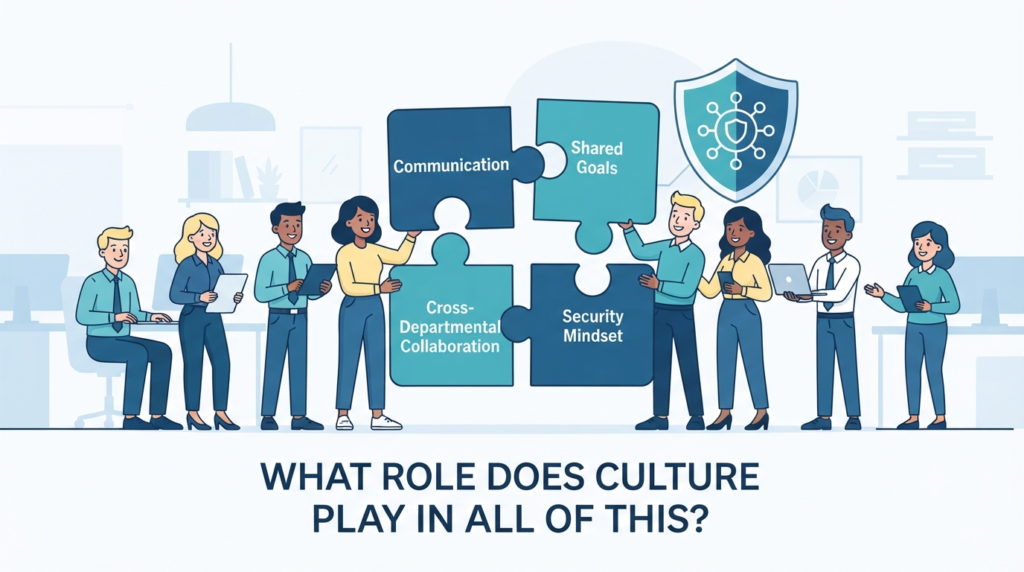
Tools and processes are useless if the people don’t trust the intelligence or understand its value. If analysts see the TIP as just another source of false positives, they’ll ignore it. Operationalization requires a cultural shift from reactive log-review to proactive intelligence-driven defense.
“A significant theme that emerged from the interviews was the heavy reliance on easily changeable indicators… Participants commonly noted that some teams equate raw data, such as IP addresses, hashes, or domain names, with actionable intelligence. Intelligence is not merely a list of indicators but the result of a process involving validation, contextual enrichment, and analytical interpretation.” – OIC
We fostered this by involving analysts in the tuning process. When they dismissed an alert as noise, we asked them to help write the rule that would filter it out next time. We celebrated when an intel-led detection from our network monitoring led to a full incident response. We made the intelligence a central part of daily briefings.
Over time, they stopped seeing it as an external tool and started demanding better, more relevant data from it. They became its owners, not just its consumers.
FAQ
Is operationalization possible without a Threat Intelligence Platform (TIP)?
It’s exponentially harder. A TIP acts as the central brain, aggregating, deduplicating, and enriching data from multiple feeds before sending curated intelligence to your tools. Trying to manage this with spreadsheets and manual processes doesn’t scale.
How do you measure success in operationalizing threat intelligence?
Don’t measure feeds or alerts. Measure outcomes. Key metrics include: Reduction in “dwell time” for incidents detected via intel, increase in the percentage of alerts that are truly actionable, and decrease in mean time to respond (MTTR) for intel-triggered cases.
We’re a small team. Is this only for large enterprises?
The principles are the same, but scale changes. A small team should start even smaller, maybe with a single, curated feed integrated into one core control, like your firewall or email gateway. Focus on automating one response action perfectly.
What’s the biggest waste of time when starting this journey?
Trying to build the “perfect” automated system on day one. Start with a manual but consistent process. If a new high-confidence IOC comes in, have a person manually add it to the block list and investigate. Document the steps. Then, and only then, look to automate each step of that manual process.
The Operational Reality
The challenges operationalizing threat intelligence can be overcome with clear workflows, continuous refinement, and actionable insights that support faster security decisions. Rather than collecting more data, focus on intelligence that directly improves detection and response.
Network Threat Detection helps security teams achieve this with real-time threat modeling, automated risk analysis, CVE mapping, and continuously updated intelligence. Explore its capabilities and request a tailored demo here: Network Threat Detection.
References
- https://www.cyware.com/blog/how-to-operationalize-cyber-threat-intelligence-and-achieve-collective
- https://www.oic-cert.org/en/journal/pdf/6/1/6.pdf