
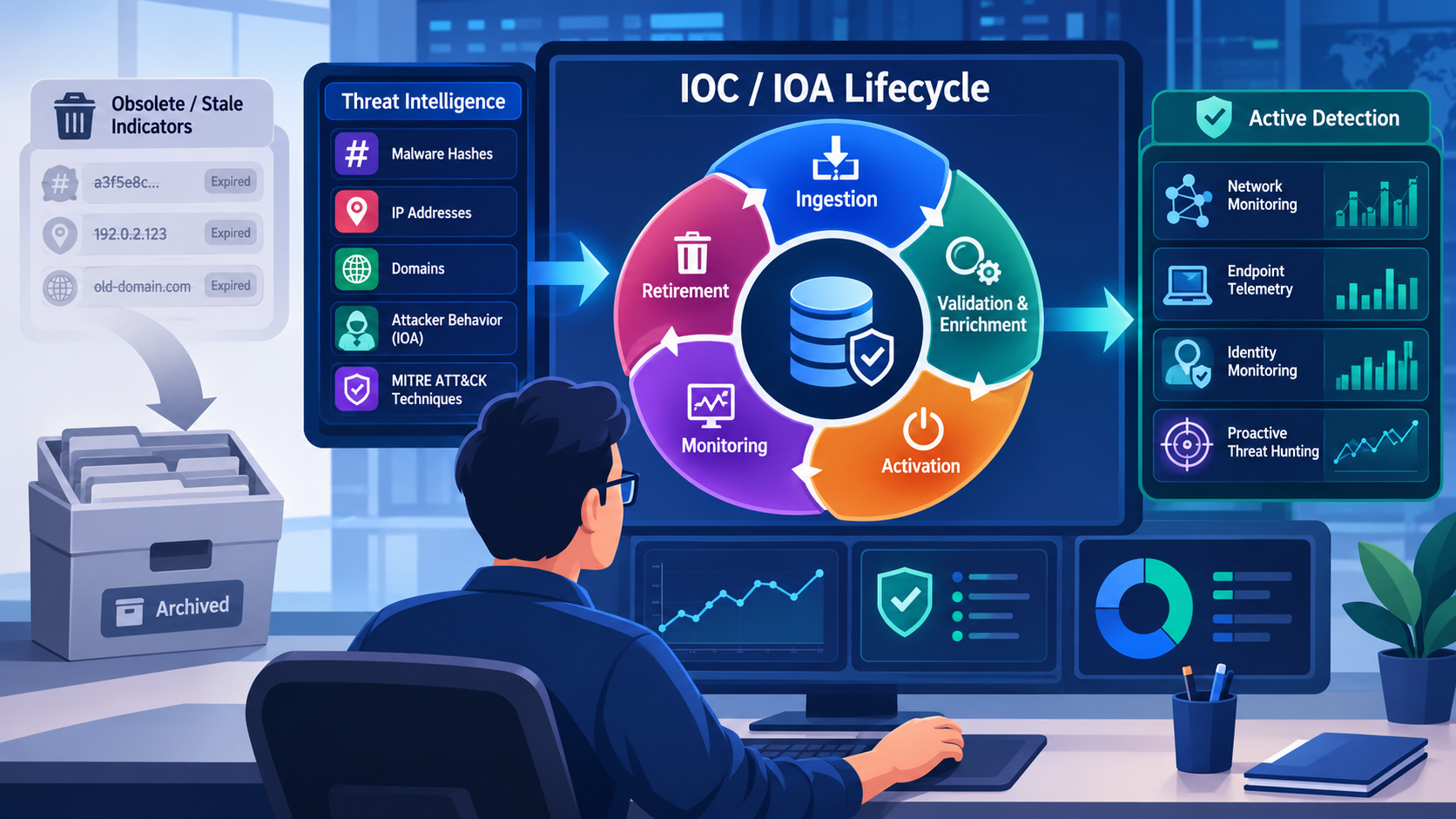
Threat intelligence only delivers value when it stays accurate, relevant, and actionable. Managing IOC IOA database lifecycle helps security teams remove stale indicators, enrich behavioral context, and keep detection aligned with current threats
At Network Threat Detection, we view lifecycle management as the foundation for reliable investigations because fresh intelligence leads to better decisions and fewer unnecessary alerts. A well-maintained database supports faster triage instead of creating more noise. Keep reading.
Smarter Threat Intelligence Starts with Lifecycle Management
Managing threat intelligence is an ongoing process, not a one-time task.
- Stop Intelligence Decay: Remove outdated IOCs before they generate unnecessary alerts.
- Keep IOAs Relevant: Continuously enrich attack behaviors with fresh context and investigation findings.
- Prioritize What Matters: Focus on high-confidence indicators instead of growing databases endlessly.
What’s the Difference Between an IOC and an IOA in Your Database?
This is the foundational split. Getting it wrong poisons your entire system. Understanding the IOCs vs IOAs distinction is essential because an Indicator of Compromise (IOC) is a forensic fingerprint. It’s a thing you can point to: this specific malware hash, that exact malicious IP address, a known bad domain.
They’re concrete, but they’re also ephemeral. Attackers change them fast.An Initial Objective of Attack (IOA) is different. It’s not a thing, it’s a description of intent or behavior. Understanding the difference between IOC and IOA helps explain why it’s the “why” behind the action. In your database, an IOA isn’t a single row for an IP.
It’s a structured record linking to a MITRE ATT&CK technique ID, like T1566.001 for Spearphishing Attachment.
It contains the behavioral pattern, the context, the “what is the attacker trying to achieve right now.” IOCs tell you what happened, IOAs help you predict what might happen next. Your database needs to treat them as separate, but connected, entities.
Why Does a “Set and Forget” Database Create More Risk?
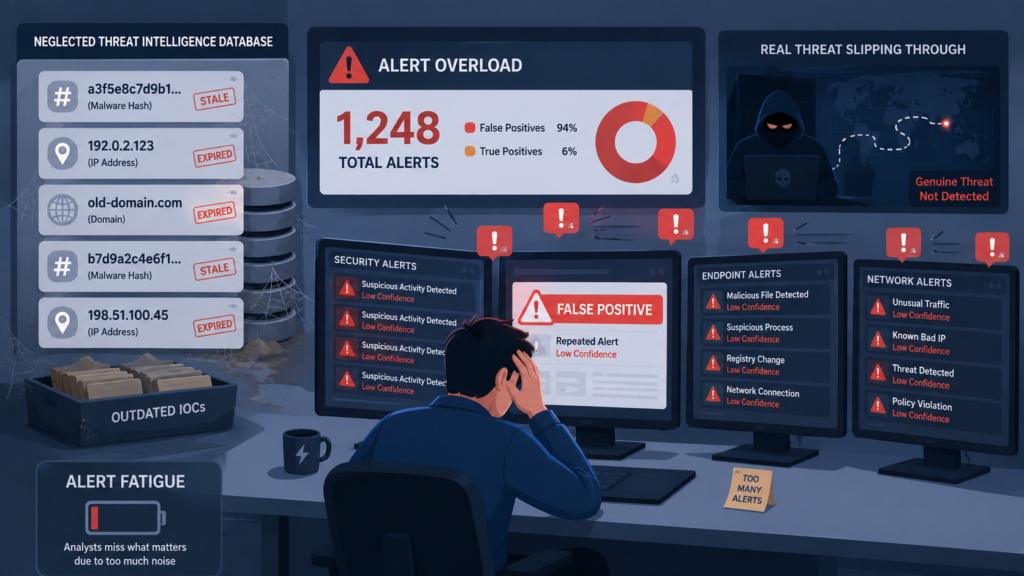
It seems counterintuitive. More threat data should equal more security, right? It doesn’t work that way. A static database decays. IP addresses are reassigned. Domains sinkhole and become benign. Malware hashes evolve. That malicious.exe hash from six months ago might now belong to a common accounting software installer.
When your detection systems ping on these stale IOCs, they create false positives. Your team investigates ghosts. This breeds alert fatigue, the condition where analysts start to unconsciously ignore alerts because most are junk.
“Maintaining too many IOCs is prohibitive due to intrinsic costs of investigating a large catalog of potential incidents” – IEEE Xplore
The boy cries wolf too often. Meanwhile, a fresh threat using new IOCs slips right through because your team is distracted and your systems are tuned to the noise of yesterday’s attack. A forgotten database doesn’t just fail to help, it actively harms your security posture by eroding trust and wasting time.
What Are the Key Stages of the IOC/IOA Lifecycle?
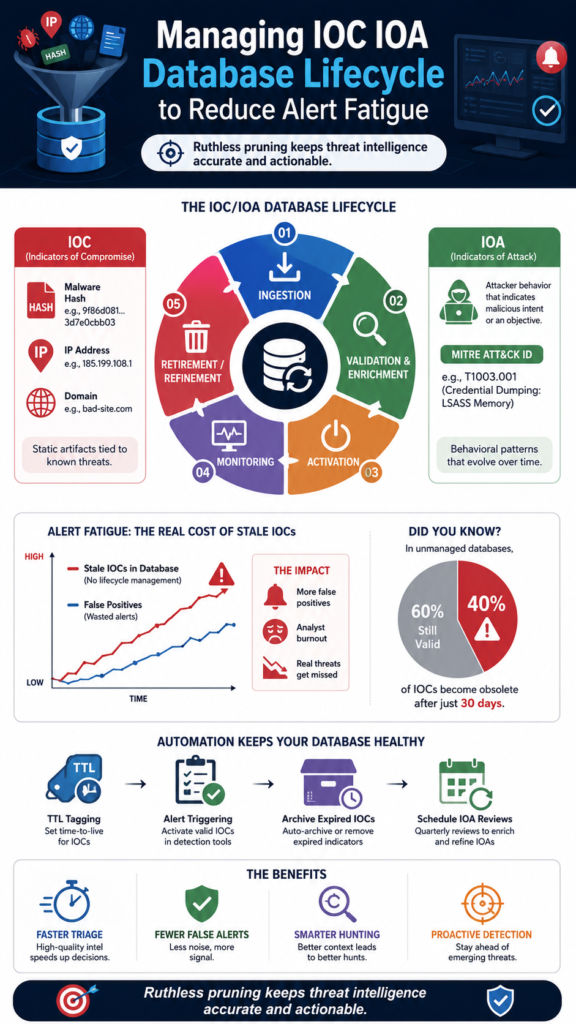
You can’t manage what you don’t define. The lifecycle needs clear, actionable stages. We think of it as a circular process, not a linear one. It starts with Ingestion. This is where raw data comes in from feeds, reports, and internal investigations.
The critical next step is Validation & Enrichment. Is this source reliable? Can we add context? For an IOA, this means mapping it to the ATT&CK framework.
Then comes Activation. This is where the rubber meets the road. The validated indicator gets pushed to your security tools, your SIEM, your firewall, your endpoint protection.
For an IOA, this might mean turning it into a new detection rule for your Network Threat Detection system. After activation, you must Monitor its effectiveness. Is it catching anything? Is it causing false positives? Finally, based on this feedback, you decide to Retire it (for a stale IOC) or Refine it (for an IOA that needs tweaking). Then the cycle begins anew.
How Do You Prune Stale IOCs Without Missing Something?
Credits: LAKRA_SAAB
This is the scariest part for most teams. Deleting threat data feels wrong. You need a policy, not a gut feeling. Start by tagging every IOC with metadata at ingestion: source, confidence score, and most importantly, a TTL (Time-To-Live). A phishing domain might get a 7-day TTL. A malware hash from a major campaign might get 30 days.
Automate the review. When an IOC’s TTL expires, it doesn’t just delete. It triggers a workflow. The system should check: Has this IOC fired any alerts in the last week? Has the source feed updated it? Can we find any recent sightings in threat intelligence platforms? If the answer is “no” across the board, it gets archived or deleted.
This process requires courage, but it’s the only way to keep your active database lean and mean. From our work, we’ve found that over 40% of IOCs in a typical unmanaged database are functionally obsolete after 30 days.
How Should IOAs Be Maintained and Updated Differently?
IOAs are living documents, not disposable items. Their lifecycle is about evolution, not expiration. An IOA entry for “Credential Dumping via LSASS” (T1003.001) doesn’t get a TTL. Instead, it has a review cycle.
Every quarter, or after a major incident, you revisit your IOAs. The review asks different questions: Have we seen new techniques for this objective? Has our detection logic for this IOA been effective? Can we add more context, like specific command-line arguments or registry keys seen in the wild? Maybe you split one broad IOA into two more precise ones.
“We define a set of efficient indicators of attack (IoAs) for each stage of an IKC model. These defined IoAs are signatures of suspicious behavior exhibited by attackers, helping identify IKC stages of APT attacks during their progression in a monitored IT network.” – ScienceDirect
This is where integrating with tools that see raw behavior, like Network Threat Detection, is invaluable. We can see the actual network patterns that match an IOA, which lets us refine the definition, making it sharper and more accurate for next time. An IOA should get smarter with age.
What Role Does Automation Play in Lifecycle Management?
Managing IOCs and IOAs manually can be difficult because there is too much data to handle. Automation helps by taking care of repetitive tasks, such as:
- Collecting data from approved feeds
- Adding TTL tags
- Checking whether an IP address is valid
- Finding expired IOCs
- Archiving expired IOCs
- Removing inactive IOCs from security tools
For IOAs, automation can also:
- Schedule regular reviews
- Track alert numbers
- Measure false positive rates
- Provide data for analysts to review
Automation cannot replace human analysts. Instead, it helps them spend less time managing data and more time investigating real threats and analyzing suspicious activity.
How Does Clean Intelligence Integrate with Proactive Detection?
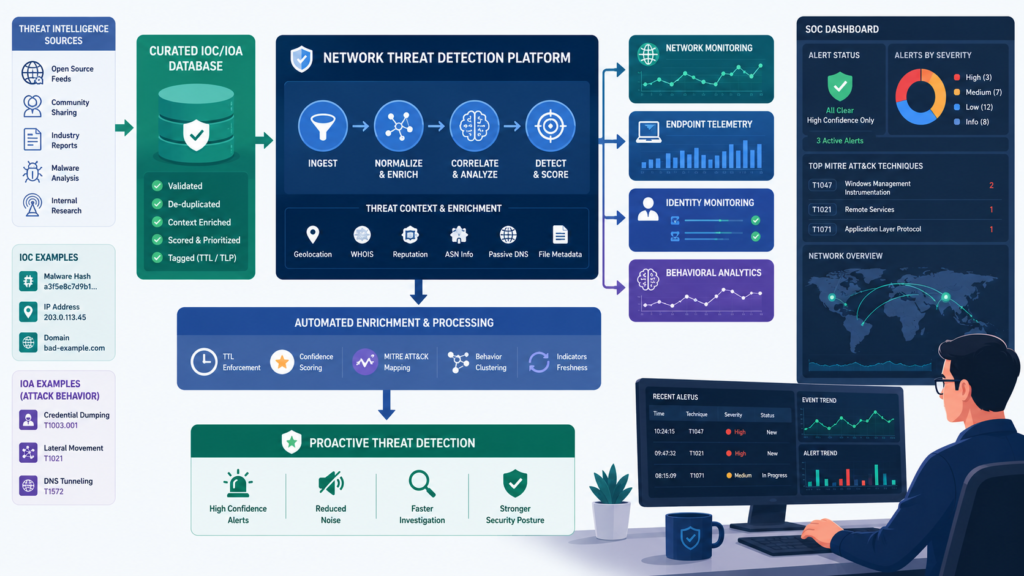
Curated IOCs give you high-fidelity blocking and alerting. Using IOCs for reactive threat detection becomes significantly more effective when your indicator database is continuously validated and maintained. You can afford to set alerts from your IOC matches to “high severity” because you trust they’re relevant.
The refined IOAs become the blueprint for your hunting and detection engineering. This is where we see the synergy. When our Network Threat Detection system is fed a well-maintained set of IOAs, behavioral patterns for lateral movement, data exfiltration, C2, it can look for those patterns in the raw network traffic.
It’s not looking for a bad IP (an IOC), it’s looking for the behavior of data staging (an IOA). The clean database provides the “what to look for,” and the detection system provides the “where to look.” It closes the loop, turning static intelligence into active defense.
FAQ
How often should we review our lifecycle policies?
At minimum, review your TTL policies and source reliability ratings every six months. The threat landscape changes, and your data management rules need to keep pace. A source that was great a year ago might be lagging now.
Is it safe to completely delete old IOCs?
For most organizations, yes, from the active production systems. You should archive them in a separate, searchable repository for historical investigations or forensic work. But they should not be actively matching against live traffic.
We’re a small team. How can we start this without dedicated staff?
Start tiny. Pick one threat feed. Ingest it into a simple spreadsheet or a free TI platform. Manually assign a 30-day TTL to every item. In one month, review the list and delete what’s expired. This small exercise will prove the value and build the process muscle before you scale.
Can automation make mistakes and delete a critical IOC?
It can, if your policy is wrong. That’s why the policy is key. Build in safeguards. For example, any IOC that has triggered a confirmed true positive alert gets its TTL automatically extended. Automation executes policy, it doesn’t create it. Your human expertise designs the safety nets.
From Data Graveyard to Defense Engine
Managing the IOC and IOA database lifecycle isn’t a technical sidebar. It’s core operational hygiene. It’s the acknowledgement that in cybersecurity, more is not better. Better is better. A disciplined lifecycle transforms your threat database from a data graveyard, filled with the ghosts of past attacks, into a living defense engine.
If you’re ready to strengthen your threat intelligence lifecycle, we at Network Threat Detection provide real-time threat modeling, automated risk analysis, continuously updated intelligence, and MITRE ATT&CK-aligned insights to help security teams prioritize risks and detect threats with greater confidence. Join Network Threat Detection
References
- https://ieeexplore.ieee.org/document/10229259
- https://www.sciencedirect.com/science/article/pii/S0167404823001847