
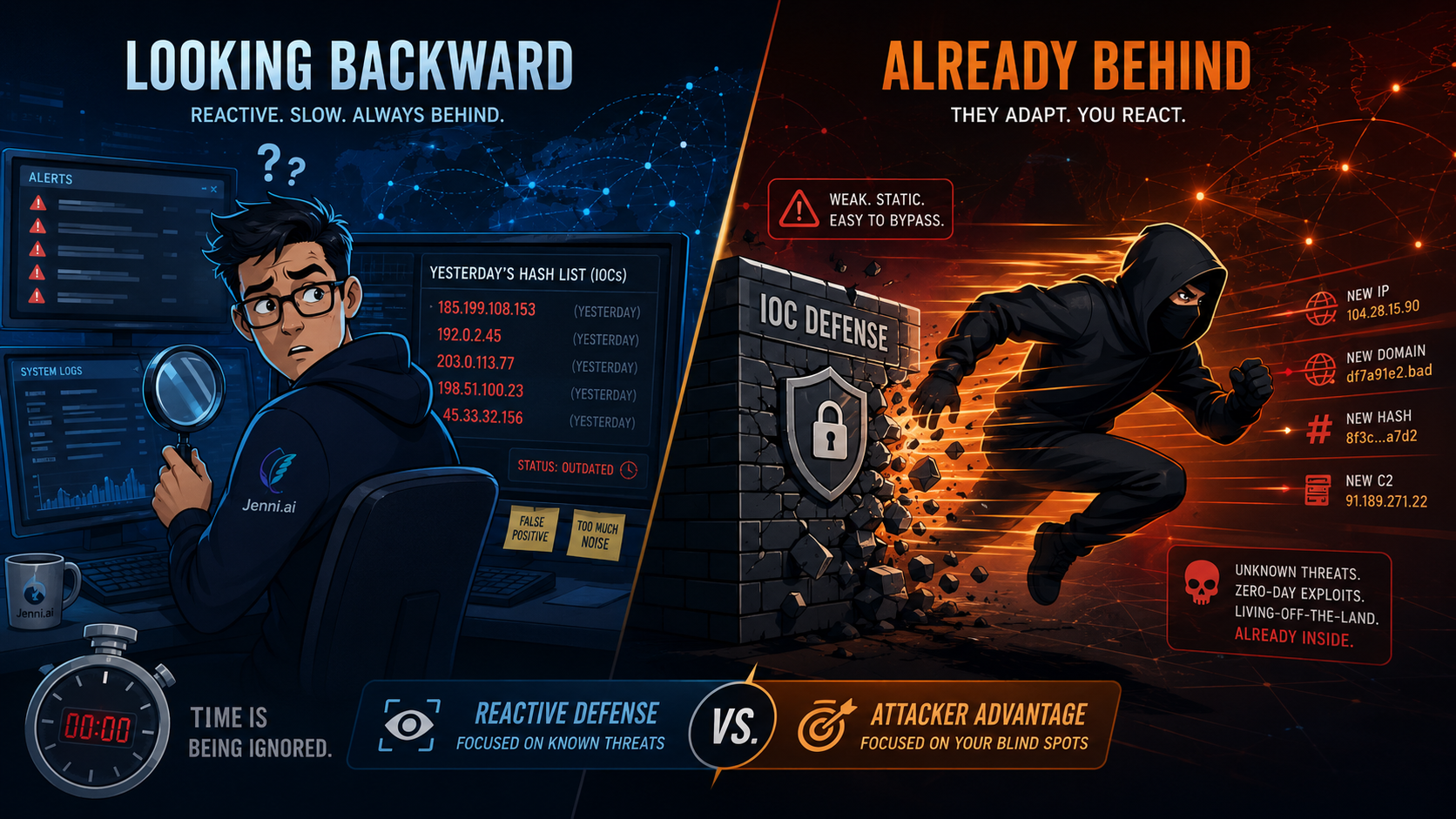
Using IOCs reactive threat detection may seem like a reliable way to find cyber threats, but it often means your team is looking for attackers after they have already entered the environment. IOCs still have value, but relying on them alone creates dangerous gaps.
At Network Threat Detection, we help security teams move beyond simple IOC matching toward proactive network detection that focuses on attacker behavior, suspicious activity, and emerging threats before they become full-scale breaches.
The Gaps Reactive IOC Detection Leaves Behind
Before exploring why reactive detection struggles against modern attacks, here are the main points to remember:
- Reactive IOC hunting is inherently slow, always placing your team steps behind an active adversary who changes their tools constantly.
- IOCs have a notoriously short shelf-life, often becoming useless within days or even hours as attackers mutate their code and infrastructure.
- Proactive network detection identifies malicious behavior, catching novel attacks and insider threats that IOCs will never know about.
The Rear-View Mirror Security Problem
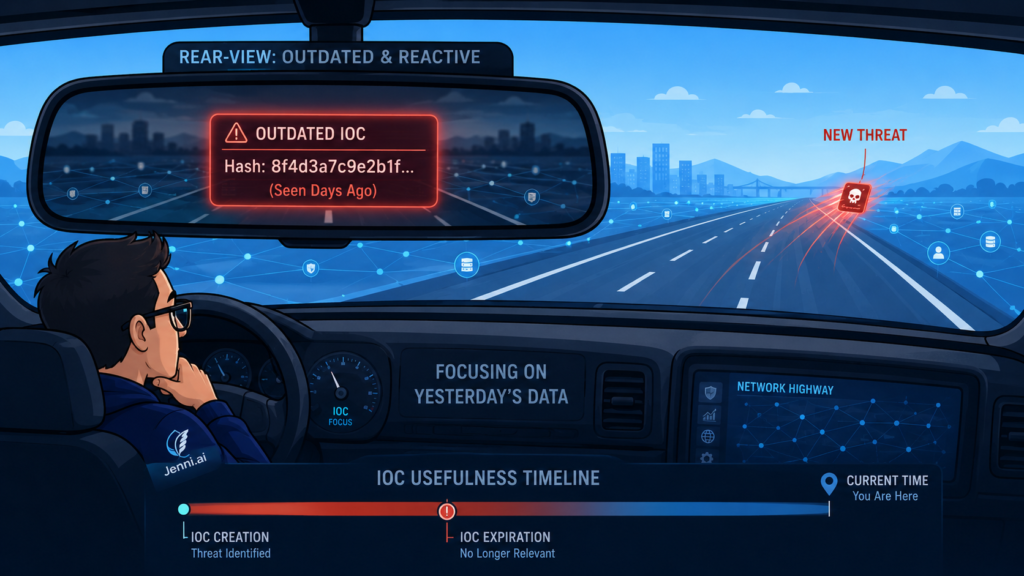
You see the alert pop up. A known malicious IP address, an IOC from a threat feed, just attempted a connection to your server. Your team springs into action, blocks the IP, and hunts for related artifacts. Feels like a win, right? But here’s the uncomfortable truth you probably felt in your gut. That action was a response to something that already happened.
It’s like trying to catch a burglar by only looking for the specific brand of crowbar he used last week. What happens when he uses a screwdriver, or just kicks the door in? You won’t see him. In digital terms, modern malware is polymorphic, it changes its signature with every download.
This is why understanding the difference between IOCs and IOAs matters when detection needs to account for both known indicators and suspicious behavior. Command-and-control servers rotate IP addresses using fast-flux networks.
The fatigue is real. Analysts drown in alerts, most of them false positives from poorly tuned IOC rules. The really clever attacks, the ones that use “living-off-the-land” techniques or legitimate tools for illegitimate purposes, they sail right through. No strange file hash, no weird domain, just abnormal behavior hiding in plain sight.
- Static Lists vs. Dynamic Threats: IOCs are static data points; attackers are adaptive and dynamic.
- Alert Fatigue: High volumes of low-fidelity IOC alerts burn out analysts.
- Blind Spots: Fileless attacks and legitimate tool abuse generate no IOCs to detect.
How Long Is an IOC Actually Useful?
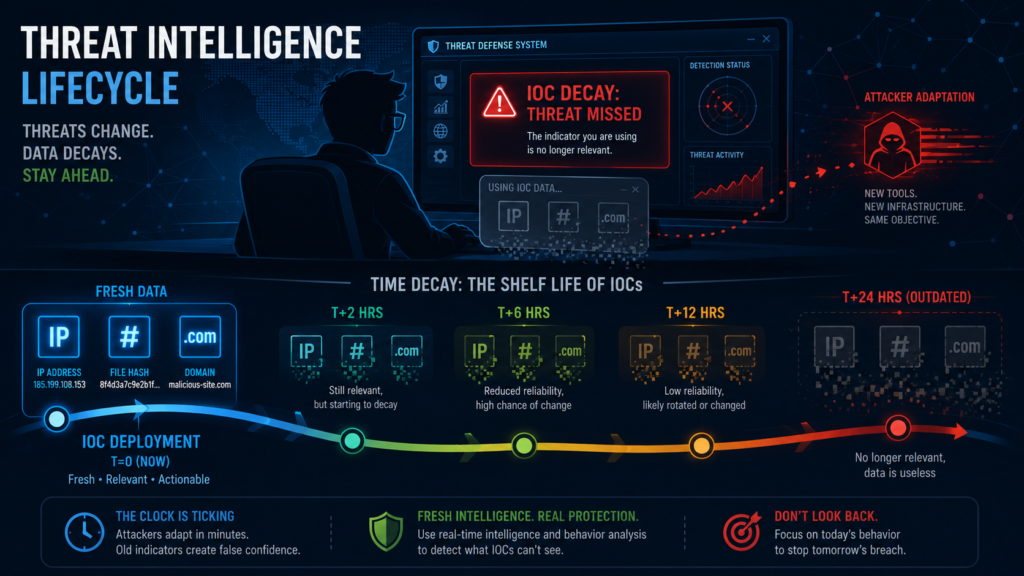
Let’s talk about shelf life. An industry study a while back, one that still rings true, found that most IOCs are useless within 48 hours. Some malicious IP addresses are active for less than an hour. Think about your own processes.
A new malware variant erupts in the wild. Threat intelligence vendors scramble to analyze it, extract hashes, domains, IPs. That intelligence gets packaged, sold, and delivered to your security gateway.
We learned this the hard way in a past incident. We were tracking a credential phishing campaign using a list of newly published malicious URLs. We blocked them all. The next day, the phishing emails were still hitting user inboxes, with the same template, the same sender pattern, but entirely new URLs. The IOC list was obsolete overnight.
The behavior, the email crafting, the link placement, the fake login pagewas unchanged. We were fighting the wrong battle. The table below illustrates the rapid decay of common IOC types versus the enduring nature of the malicious behaviors they represent.
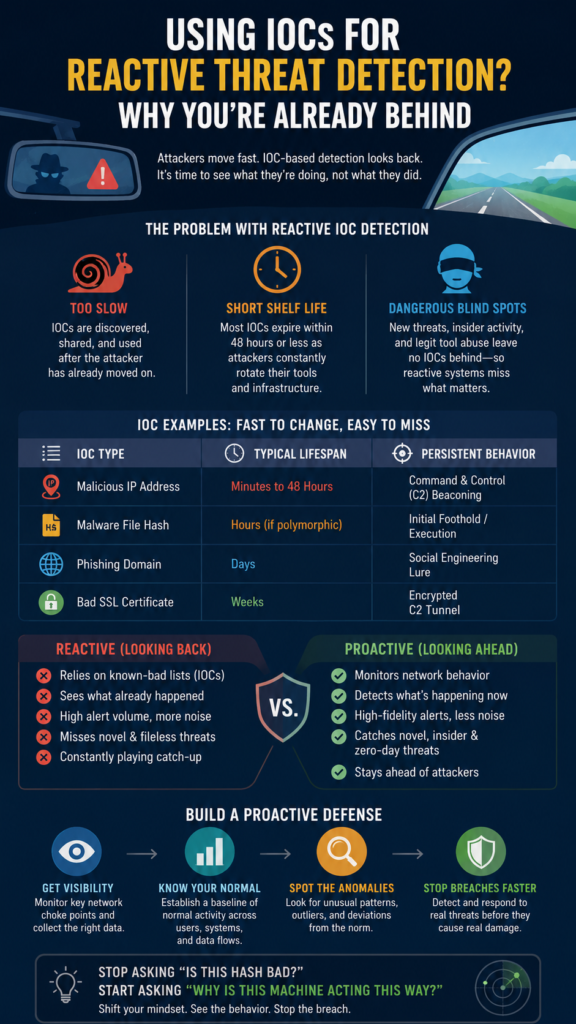
| IOC Type | Typical Lifespan (Before Rotation) | Corresponding Persistent Behavior |
| Malicious IP Address | Minutes to 48 Hours | Command & Control (C2) Beaconing |
| Malware File Hash | Hours (if polymorphic) | Initial Foothold / Execution |
| Phishing Domain | Days | Social Engineering Lure |
| Bad SSL Certificate | Weeks | Encrypted C2 Tunnel |
What Are You Missing With a Reactive Approach?
So what slips through? Almost everything that’s novel or targeted. A zero-day exploit. There’s no hash for that. An insider exfiltrating data to their personal cloud storage. That might not involve a single known-bad domain or tool. A ransomware gang using legitimate admin tools and scripts already on your network to move laterally.
That’s “living-off-the-land,” and it leaves a behavioral trail, not an IOC trail. This shows why indicators of compromise and indicators of attack can reveal different parts of an ongoing threat. The breach unfolds quietly over weeks or months, only announced when the ransomware note appears on every screen or the data shows up for sale on a forum.
We remember investigating a case where a server started making unusual outbound connections at regular, clockwork intervals.
No flagged IPs, no strange ports, just a steady, persistent rhythm of calls to a benign-looking cloud service. It was data siphoning. The attacker had compromised an API key and was slowly bleeding information out. An IOC list would never have caught it.
This is where the paradigm has to shift. From a checklist of known bads to a baseline of normal activity. Your network has a rhythm, a cadence of how machines talk, when users log in, what data flows where. Threat detection, the effective kind, is about spotting the dissonance.
Why Network Detection Should Be Your First Option?
If IOCs are the rear-view mirror, think of network threat detection as the windshield and the road ahead. It’s the continuous observation of all communication flowing through your environment. We see the raw reality of what’s happening, not just the filtered list of what someone else says has happened.
“Indicators of compromise are used to identify malicious behavior. The underlying pattern being that IOCs are reactive. IOCs are often used to retroactively perform forensics, stop lateral movement, and possibly prevent data exfiltration. Although IOCs do provide organizations significant value, they have their limitations. IOCs must be a known artifact so they aren’t always timely, and IOC-based detection cannot detect the increased threat from malware-free intrusions and/or Zero-days.” – Domain Tools
The advantage is profound. You detect threats based on what they do, not what they are. That means you can catch:
- New malware variants exhibiting known bad behaviors (like beaconing to a dynamic DNS provider).
- Insider threats moving data in unusual ways.
- Lateral movement as attackers probe from one system to another.
- Data exfiltration through encrypted or disguised channels, even when traditional common indicators of compromise are unavailable.
It’s contextual. Seeing a connection to a new domain isn’t inherently bad. But seeing a connection from a finance department server to a new domain registered two days ago in a high-risk country, followed by large volumes of file transfers, that’s a story.
Building a Proactive Security Posture
Credits: Adam Goss
So how do you start moving from reactive to proactive? It’s a shift in mindset more than a wholesale tech overhaul. First, accept that prevention will eventually fail. Someone will click a link. Something will get through.
Begin by focusing on visibility. You can’t detect what you can’t see. Ensure you have monitoring across your key network choke points, internet gateways, data center borders, between critical network segments. The data you collect (netflow, packet metadata, full packets for critical assets) is your evidence.
“An IoT botnet study from 2022 found that 90% of C2 servers had a lifetime of less than 5 days and 93% had a lifetime shorter than 14 days. A recent writeup from Censys concludes that the median lifespan of Cobalt Strike C2 servers is 5 days. Both these studies indicate that IP and domain name indicators are short lived, yet many organizations cling on to old IOCs for much longer than so.” – ScienceDirect
Next, stop chasing every IOC alert as a top priority. Tune those systems to reduce noise. Then, redirect your team’s energy towards understanding your normal network patterns. What does baseline “good” look like for your organization? This is your new hunting ground.
Finally, start looking for the anomalies, the outliers. Train your team, or leverage tools that do this automatically, to flag things like:
- Unusual login times or locations for privileged accounts.
- Sudden spikes in outbound data volume.
- Internal systems communicating on unexpected ports.
- Connections to newly registered or algorithmically generated domains.
FAQ
What’s the main disadvantage of using only IOCs?
Their speed. By the time an IOC is identified, shared, and loaded into your systems, the attacker has often abandoned it, making your defense obsolete against that specific campaign.
Can I ever completely stop using IOCs?
Not really, and you shouldn’t. IOCs are excellent for blocking known-bad traffic at the perimeter quickly. The problem arises when they are your only or primary method of detection. Use them as a blunt-force filter, not your intelligence core.
Does network detection replace my other security tools?
No, it complements them. Think of it as the central nervous system that gives context to alerts from endpoints, emails, and identity systems. It correlates isolated events into a coherent attack story.
Is this approach too complex for a small team?
It can be, if you try to build it all yourself from raw data. The key is leveraging tools that do the heavy lifting of behavioral analysis and anomaly detection, presenting your small team with high-fidelity incidents instead of raw log data.
Shifting from Reactive IOC Alerts
The threat landscape is not getting simpler. Attackers are faster, more evasive, and more patient. Relying on what they used yesterday keeps your team in catch-up mode, wasting time on alerts while real threats go unseen. Use IOCs as useful supplements, not your entire strategy.
Start asking, “Why is this machine acting this way?” NetworkThreatDetection.com helps teams uncover hidden risks through real-time threat modeling, automated risk analysis, and continuously updated intelligence. Explore Network Threat Detection.
References
- https://www.domaintools.com/blog/when-it-comes-to-indicators-there-is-no-reason-to-compromise
- https://www.sciencedirect.com/science/article/pii/S1877050925031552