
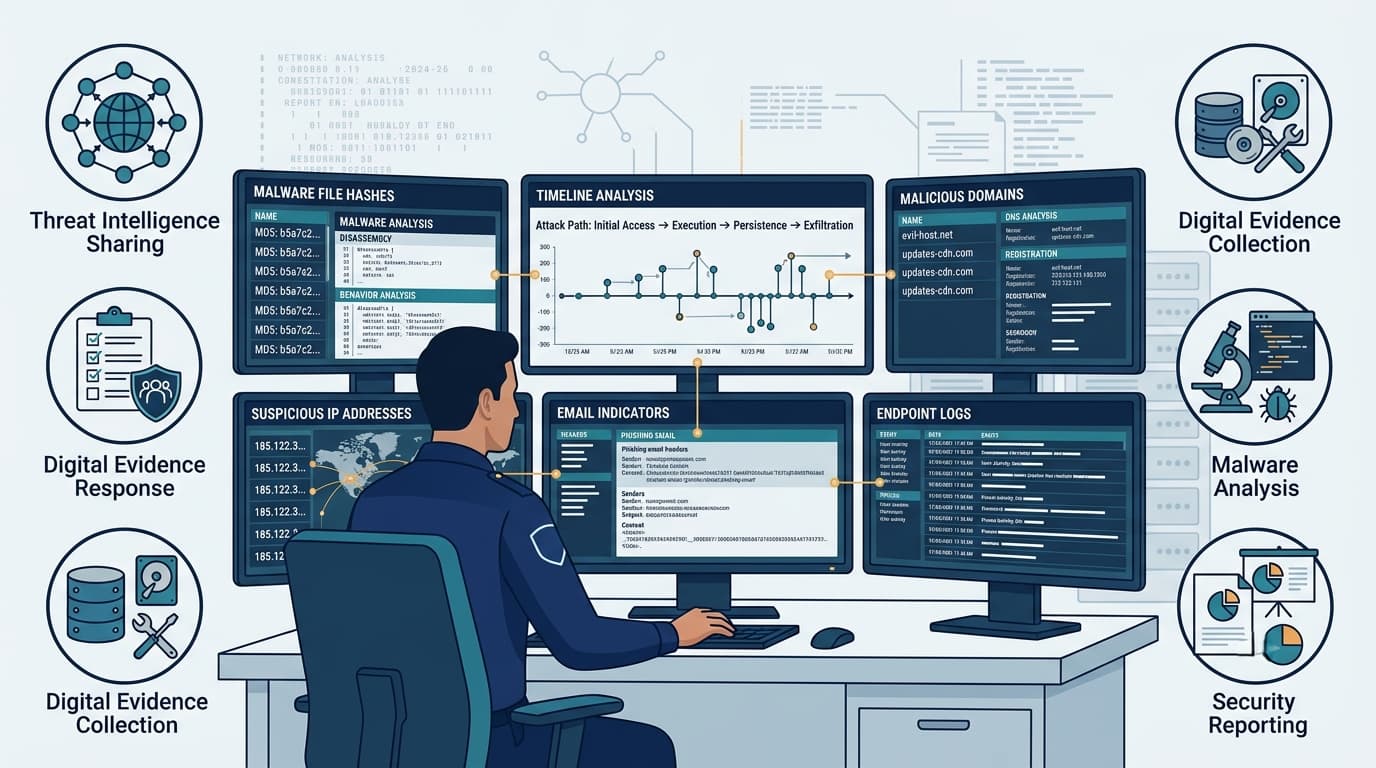
An Indicator of Compromise (IOC) means you’ve already been hit. It’s like finding a broken window after the thief is gone. An Indicator of Attack (IOA) means you’re seeing the break-in happen, right as someone tries to jimmy the lock.
That distinction is everything. It’s the difference between a long, costly cleanup and actually stopping the crime. For Network Threat Detection, focusing on IOAs is how you slash an attacker’s head start from weeks down to minutes. See how it works in practice.
At a Glance: IOC vs. IOA
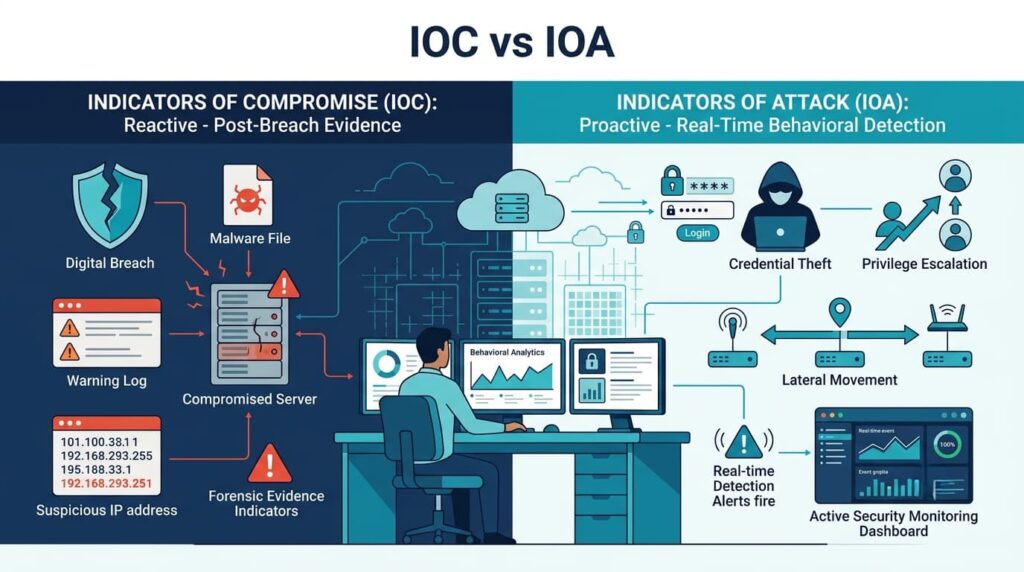
- IOCs are forensic evidence of a past or current breach, static artifacts like a malicious file hash.
- IOAs are behavioral warnings of an attack in progress, patterns like credential dumping or lateral movement.
- Prioritizing IOAs leads to earlier detection, but IOCs are essential for validation and investigation.
The Static Truth of an Indicator of Compromise
An IOC is digital shrapnel, the hard evidence left on the network after a breach. We treat these as “known-bad” signatures, something concrete we can write in a report. They’re vital breadcrumbs, but they point to where an attacker was, not where they are now.
In our daily work, we see the same common IOCs, with many indicators of compromise appearing as malicious file hashes (SHA-256, MD5) from identified malware or known bad IPs and domains used for command and control.
- Specific registry key changes made by persistent threats.
- Suspicious filenames or paths tied to attacker tools.
Their power is in confirmation. When a new phishing tip comes in, we load the domain as an IOC and hunt. Finding it means we’ve confirmed the compromise and can start containment. They’re perfect for building a case. The weakness, though, is their static nature. An IOC tells us what happened, but it rarely explains how or pinpoints when. For that, we need to look deeper.
The Behavioral Signal of an Indicator of Attack
If an IOC is a spent shell casing, then an IOA is the sound of the gun being cocked. It focuses on the attacker’s behavior and intent, the steps in their process. This makes it proactive. An attacker can change a malware hash in seconds, but their goal, to steal data or move laterally, is much harder to change. Their methods leave a behavioral signature.
According to the Cybersecurity & Infrastructure Security Agency (CISA)
“Based predominantly on detecting cyber incidents at the early or later stages of a cyberattack cycle but seldom prior to the delivery of a weaponized payload.” – Cybersecurity & Infrastructure Security Agency (CISA)
We pivoted to this approach after seeing the same attack patterns succeed with totally different tools. The malware was new, so its hash was clean. But the behavior was textbook.
An IOA looks at the sequence of events. It sees a benign application like word.exe spawning powershell.exe. It flags that PowerShell process executing a heavily encoded command. It notes the subsequent outbound connection to a newly registered domain.
That chain, that story, is your IOA and reflects the behavior behind common indicators of attack, often aligned with attacker TTPs rather than a single malicious file. It doesn’t need to know the final payload to know something malicious is unfolding.
By focusing on these early phases, defenders shift the battlefield. The fight moves from remediation to early prevention. Traditional reactive strategies fall short because they are always one step behind.
The Core Difference: Evidence vs. Intent
The distinction is a simple, practical one. IOCs are about the artifact left behind, while IOAs focus on the malicious activity itself. Understanding the difference between IOC and IOA indicators makes it easier to choose the right detection strategy because timing, evasion, and response all depend on whether you’re tracking evidence or attacker behavior.
| Aspect | Indicator of Compromise (IOC) | Indicator of Attack (IOA) |
| Core Question | “What bad thing is present?” | “What bad thing is happening?” |
| Nature | Static artifact, forensic evidence. | Behavioral pattern, malicious intent. |
| Primary Timing | During or after a breach. | During the attack, before it succeeds. |
| Best Used For | Incident confirmation, forensics. | Real-time detection, attack interruption. |
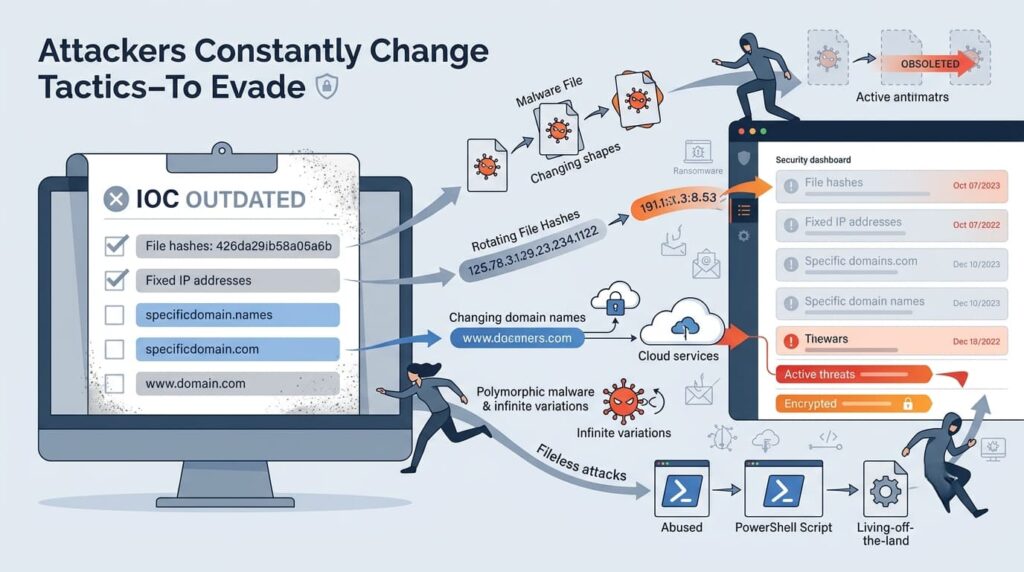
| Evasion Difficulty | Easier (change the hash, rotate IP). | Harder (changing core methods is complex). |
In our work, we see this play out constantly. An IOC tells you a system was compromised. An IOA tells you a system is being compromised right now. The first one starts the investigation. The second one can start the prevention.
Why Timing Is Everything in Your Defense
The timeline of a modern attack is brutally fast. The “breakout time”, from initial access to lateral movement, can be minutes. If your primary detection is waiting for a known-bad IOC to appear, you’re already hours or days behind. You’re playing catch-up from the first alert.
Take a ransomware attack. An IOC detection might be the encryption binary or the ransom note itself. By the time you see that, the damage is done. An IOA detection looks for the precursor behavior: the mass file renaming, the disabling of volume shadow copies, the rapid, sequential file encryption.
According to International Journal of Engineering Research and Technology
“Mass file encryption, registry changes, abnormal process creation, and C2 network traffic” – International Journal of Engineering Research and Technology
This behavioral sequencing is what lets modern detection systems intervene. We’ve seen tools successfully identify and block a running ransomware process within seconds. Spot that IOA, and you have a chance to isolate the endpoint before the final, destructive payload deploys. This shift in timing, from post-breach to mid-attack, is what shrinks dwell time from weeks to moments.
The Evasion Problem: Why IOCs Have a Short Shelf Life
IOC-based detection is a frustrating game of whack-a-mole where the mole changes its appearance every time. Threat actors know this well. They build infrastructure designed to rotate, use domain generation algorithms, and slightly tweak malware code for each campaign. That new SHA-256 hash you just added is already stale.
This creates real operational pain for us. We get constant alerts for IOCs tied to infrastructure that’s already dead. Analysts waste time chasing ghosts. Worse, there’s a false sense of security because an IOC feed looks “up to date,” while novel attacks slip right through.
The behavioral patterns of an IOA, mapped to frameworks like MITRE ATT&CK, are a more stable target. An attacker might change their malware, but they cannot easily change their fundamental reliance on techniques like credential dumping or lateral movement to achieve their objectives. That’s the signature we look for.
The Unshakeable Value of IOCs in Response
Are IOCs obsolete? Not at all. They’re the bedrock of the response and intelligence work that comes after detection. While an IOA sounds the alarm, IOCs provide the proof and the scope. We need them to answer critical questions after an IOA alert: Was this a true positive? What specific malware was used? What other systems might be infected?
Their enduring value for us lies in a few key areas:
- Forensic Investigation: Providing concrete evidence for root cause analysis.
- Threat Hunting: Proactively searching for known-bad artifacts across the network.
- Intelligence Sharing: Communicating precise, actionable data with partners.
- Incident Validation: Turning a behavioral alert into a confirmed security event.
An IOA might tell you an attacker is trying to move laterally. The correlated IOC, a specific hacker tool hash found on the source machine, tells you who might be behind it and what to hunt for elsewhere. One starts the fight, the other helps finish it.
The Practical Headache of IOC Management
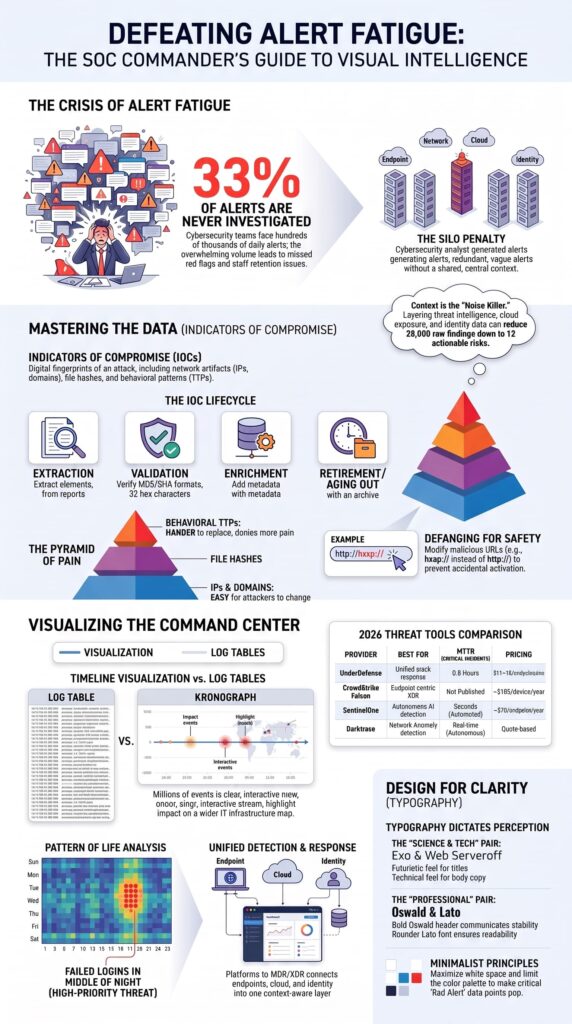
Managing IOCs is messy work. You pull in feeds with thousands of new indicators daily. SIEM rules fire constantly, and the result is alert fatigue, analysts get desensitized by the noise. The biggest issue is the lifecycle. An IP address used for phishing one day is dead the next, but your rule might keep alerting on it for weeks, wasting cycles.
We learned to treat IOCs like perishable goods. They have an expiration date. You need a process to review, validate, and retire them. This means regular tuning, deduplication, and adding context. A malicious file hash from a targeted attack against a bank might be low priority for a hospital network, unless it’s part of a broader, wormable exploit.
Without this active management, your IOC program becomes a burden, not a shield. It creates more work than it prevents.
Building a Detection Engine That Thinks in Layers
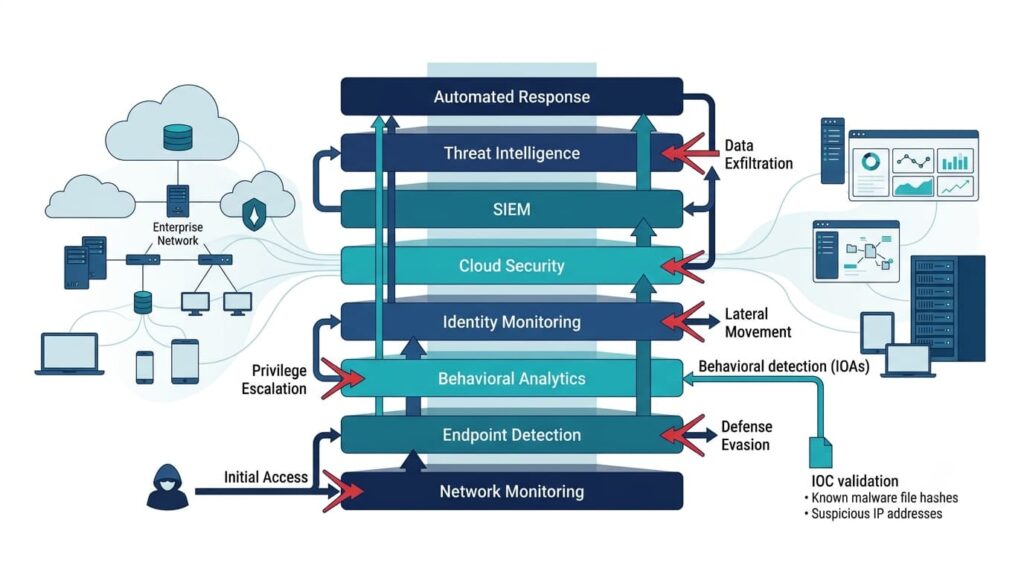
The winning strategy isn’t to choose between IOC and IOA. It’s to layer them, letting each do what it does best. Think of IOA as your triage nurse, spotting the symptoms. IOC is your lab tech, running tests to confirm the diagnosis. One without the other gives you an incomplete picture.
A modern workflow looks like this. Your behavioral analytics engine flags an IOA, like a suspicious process injection. This automated detection triggers a response playbook that immediately collects forensic artifacts from the endpoint: running processes, network connections, file changes. Those artifacts are then checked automatically against your threat intelligence platforms, your IOC databases.
Now you have it. The behavior that signaled the attack, and the evidence that confirms it, often identifying the threat actor’s specific tools. This correlation is the heart of what we build into our models. It turns a detection into a contained incident.
Where Network Threat Detection Fits In
Credits: House Of Secure Network
This layered approach is where robust network detection becomes non-negotiable. Endpoint telemetry is great, but it’s a single perspective. The network doesn’t lie. It sees the east-west lateral movement, the beaconing to command and control servers, the anomalous data transfers an endpoint agent might miss.
In our work, correlating endpoint IOAs with network IOC data changed everything. An endpoint might show a suspicious PowerShell script. The network logs show that script calling out to a known malicious domain. That’s high-fidelity detection.
The network provides the connective tissue between isolated events, turning alerts into a coherent attack story. It gives you the context to separate malicious behavior from simple user error. Without it, you’re only seeing half the picture.
FAQs
Can an indicator of compromise exist without malware being present?
Yes. An indicator of compromise does not always require malware to be present. Attackers may leave behind registry changes, suspicious processes, unauthorized user accounts, or unusual command and control (C2) connections instead of malicious files.
Many modern attacks also rely on fileless malware, so security teams examine forensic artifacts and perform post-compromise analysis to confirm whether a system has been compromised.
Which indicators of attack examples usually appear before a successful breach?
Common indicators of attack examples include suspicious login activity, PowerShell abuse, credential dumping, privilege escalation, living off the land (LOLBins), and lateral movement. These attack indicators reveal malicious behavior while an attack is unfolding.
Organizations use behavior-based detection, early attack detection, and proactive threat detection to identify these activities and stop attackers before they achieve their objectives.
How does IOC vs IOA affect threat hunting and incident response?
The IOC vs IOA distinction influences how security teams investigate and respond to threats. Threat hunting often begins with threat intelligence and known compromise indicators, while incident response combines behavioral evidence with forensic findings to reconstruct the attack.
Using signature-based detection alongside behavioral detection improves visibility and helps analysts identify attacks that bypass traditional detection methods.
Why is MITRE ATT&CK useful when comparing IOA vs IOC?
The IOA vs IOC comparison becomes more practical with MITRE ATT&CK because the framework organizes attacker tactics techniques and procedures (TTPs) throughout the attack chain.
Security teams can detect adversary behavior, defense evasion, and reconnaissance detection instead of relying only on static artifacts. This approach strengthens detection engineering and supports a more effective cyber defense strategy.
What tools help analyze indicators of compromise examples in real environments?
Organizations often combine endpoint detection and response (EDR), extended detection and response (XDR), security information and event management (SIEM), and security orchestration automation and response (SOAR) to investigate indicators of compromise examples.
These platforms collect endpoint telemetry, perform network traffic analysis, support continuous monitoring, apply security analytics, and integrate threat intelligence feeds to improve cyber threat detection, IOC management, and real-time detection across the environment.
Making the Call: What Your Team Should Prioritize
Strong detection starts with knowing what you’re trying to stop. If your goal is prevention, focus on behaviors that reveal attacks before damage is done. When it’s time to investigate, trusted indicators help you move faster and understand what happened. The right approach depends on the job.
If you want clearer visibility into risk and stronger detection across your environment, NetworkThreatDetection.com can help. From real time threat modeling to automated risk analysis and MITRE ATT&CK mapping, the platform helps security teams make better decisions with confidence. Explore the platform at Network Threat Detection.
References
- https://ccdcoe.org/uploads/2019/06/CyCon_2019_BOOK.pdf
- https://www.ijert.org/dynamic-ransomware-detection-using-behavioral-analysis-ijertv15is042132