
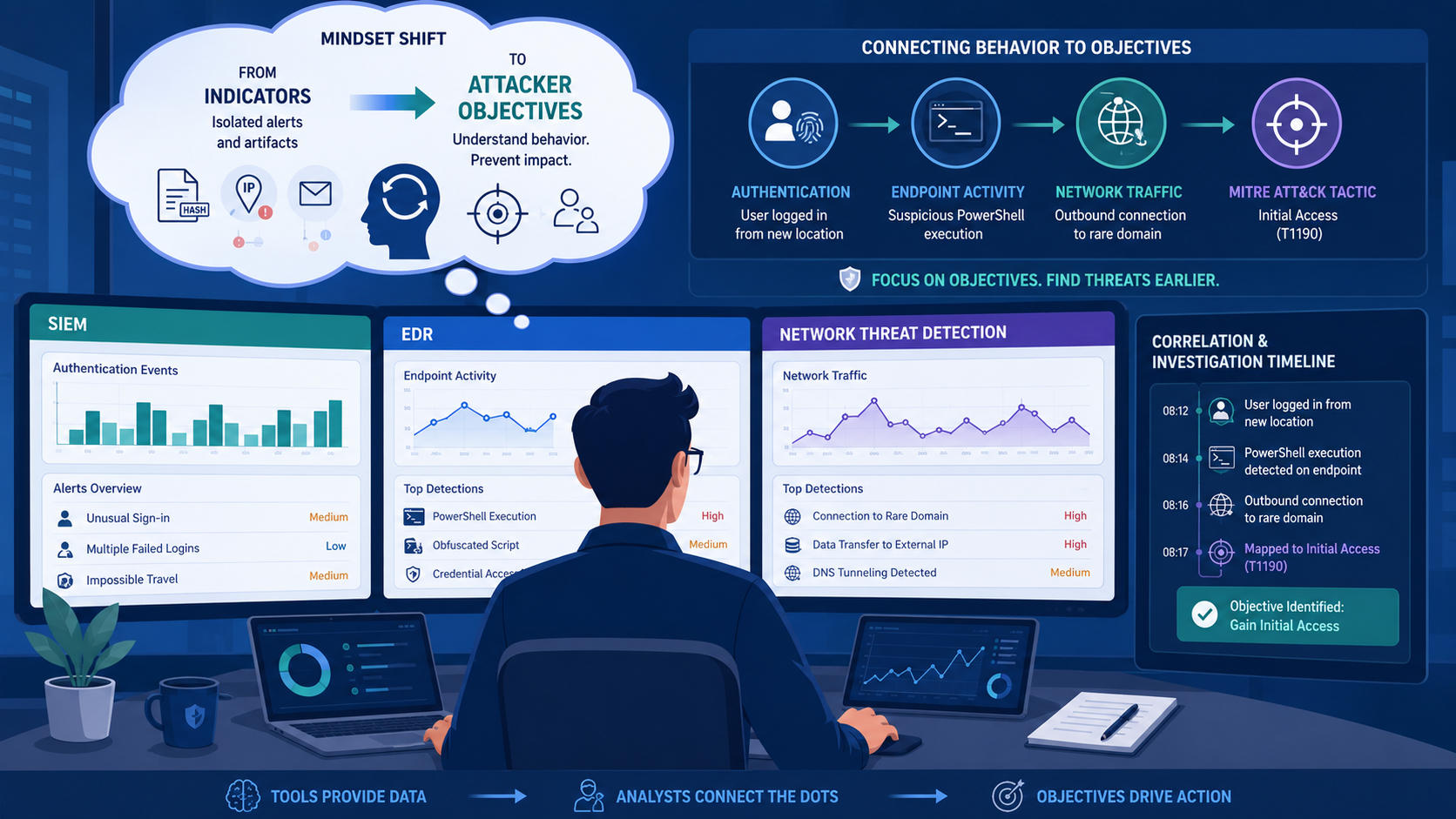
Finding IOAs MITRE ATT&CK framework helps security teams move beyond isolated alerts and understand attacker behavior as it unfolds. At Network Threat Detection, we use this approach to connect observed activities with adversary objectives, making investigations faster and detection strategies more effective.
Instead of relying only on static indicators, defenders can recognize behavioral patterns that reveal what attackers are trying to accomplish next. That shift enables earlier, more confident response decisions. Keep reading.
Finding IOAs MITRE ATT&CK Framework Explained
Understanding finding IOAs in the MITRE ATT&CK framework helps security teams see the bigger picture behind attacker behavior. Here are the main ideas you’ll learn in this guide:
- Connect Behavior to Intent – Learn how to map observed activity to attacker objectives instead of focusing only on individual events.
- Turn MITRE ATT&CK into a Detection Guide – Use the framework to understand adversary behavior and strengthen detection coverage.
- Prioritize What Matters Most – Focus engineering efforts on techniques that support the highest-impact attacker goals.
What Exactly Is an Initial Objective of Attack (IOA)?
Most security teams hunt for Indicators of Compromise (IOCs). A file hash. A bad IP address. These are forensic breadcrumbs, useful but ephemeral. Attackers change them constantly.
Understanding indicators of compromise alongside IOAs helps analysts distinguish short-lived evidence from persistent attacker objectives.An IOA is different.It describes the immediate tactical goal an adversary must achieve to progress their attack. Think of it as the “why” behind the “what.”
For instance, an attacker doesn’t run PowerShell just to see pretty blue text scroll by. They run it to achieve an objective, like “Execution” or “Discovery.” The IOA is that intent. It’s more durable than an IOC because while tools change, core objectives in a cyber attack chain remain surprisingly consistent.
“In contrast, IoAs represent observable events associated with Tactics, Techniques, and Procedures (TTPs) that will be consistent across many cyber-physical environments and intrusion events.” – IEEE Xplore
The MITRE ATT&CK framework catalogs these techniques and the objectives they serve, giving us a shared language for this intent.
| Focus | Indicators of Compromise (IOCs) | Initial Objectives of Attack (IOAs) |
| What it is | Forensic artifacts of past activity | The immediate tactical goal of the adversary |
| Nature | Tactical, ephemeral | Strategic, persistent |
| Example | A specific malware hash, a malicious IP | Gaining initial access, establishing command & control |
| Analogy | Finding a specific bullet casing | Understanding the sniper is trying to control the high ground |
Why Is the MITRE ATT&CK Framework Your Best Map for This Hunt?
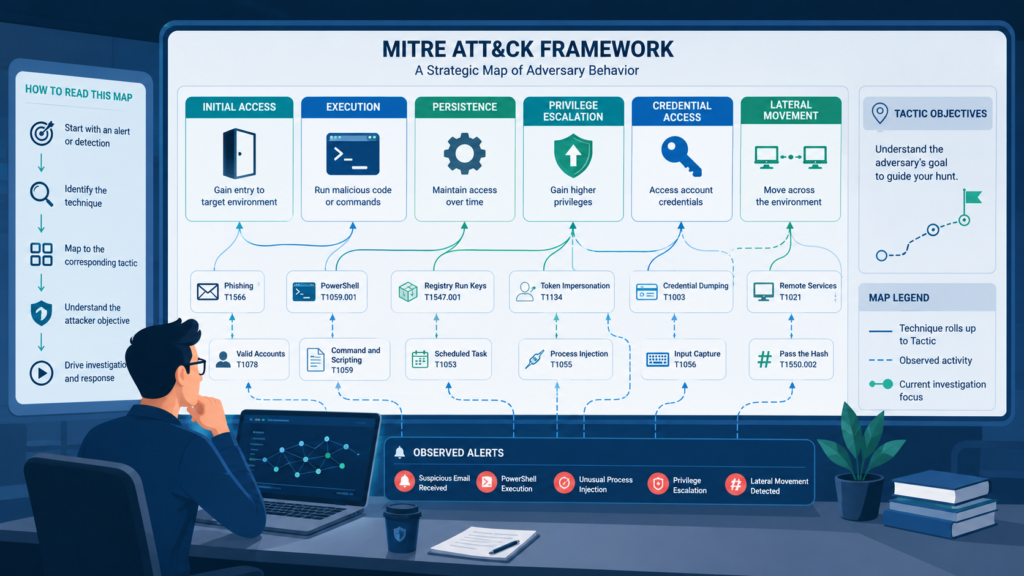
MITRE ATT&CK isn’t a compliance checklist. It’s a behavioral map. It documents the “how” based on real-world observations. When you start with an alert, you can trace it to a technique in the framework. But you shouldn’t stop there. You have to ask, “Which broader tactic does this technique serve?”
“The MITRE ATT&CKⓇ for ICS matrix was developed to provide a common lexicon for cybersecurity professionals to describe adversarial activity in ICS/OT systems. Tactics describe the reason for the adversary to take action. In other words, a tactic represents the goal of the adversary’s action.” – iscap
That tactic is your IOA. The framework groups techniques under tactical categories like Initial Access, Execution, Persistence, and Privilege Escalation.
By linking your event to a technique and then its parent tactic, you shift from “we found a suspicious script” to “the attacker is attempting to achieve persistence.” Recognizing the difference between IOC and IOA helps analysts prioritize attacker intent instead of isolated artifacts. This mindset transforms your response.
You stop looking for more of that one script and start hunting for any activity that could serve that same persistence objective across your environment.
How Do You Start Finding IOAs in Your Own Data?
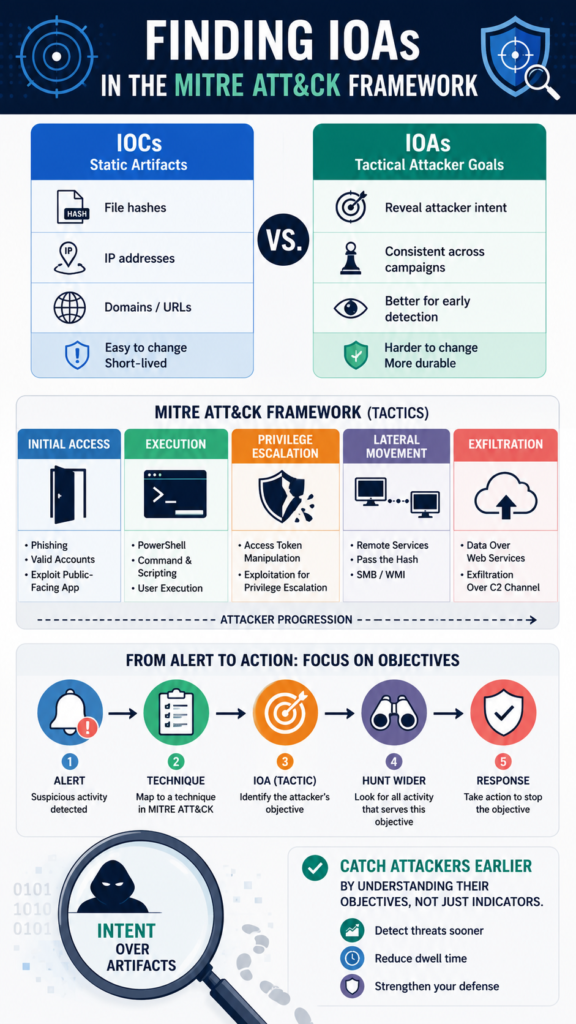
It starts with a question, not a tool. When you see an alert, pause. Ask: “What would the attacker need to accomplish here to move forward?” Then, open the MITRE ATT&CK matrix. Find the technique that best matches the activity. Look at the tactic column. That’s your suspected IOA.
From our own experience building Network Threat Detection, we learned to engineer detections for IOAs, not just IOCs. We might see a rare, failed RDP attempt. The IOC is the source IP. The technique might be “Brute Force.” The IOA? It’s clearly “Initial Access.” So our next action isn’t just to block that IP.
It’s to look for other, more subtle signs of initial access attempts that the same actor might be using. We hunt for the objective, not just the first failed attempt.
What Are the Most Critical IOAs to Monitor?
Credits: The Intel Lab
Not all objectives are created equal. Some are early warning signals, others indicate deep compromise. Based on the frequency and impact seen in the framework, a few stand out.
- Initial Access: This is the front door. Everything starts here. Techniques like phishing or exploiting public apps are your first chance to stop the kill chain.
- Privilege Escalation: The moment a standard user account tries to become an admin, the game changes. Detecting this objective limits the blast radius.
- Lateral Movement: This is how a contained breach becomes a network-wide event. Finding this IOA is about spotting abnormal internal traffic and access.
- Exfiltration: The end goal for many. Detecting data staging and unusual outbound flows can stop the theft, even late in the game.
Focusing on these creates a defensive funnel. You catch them early at Initial Access, sound the alarm at Privilege Escalation, contain them during Lateral Movement, and block the prize at Exfiltration.
Can You Give a Real-World Walkthrough of an IOA Hunt?
Let’s walk through a hypothetical, but common, scenario. You get an alert: a user downloaded a .scr file from a webmail service. The sandbox says it’s clean. Old you might have closed the ticket. IOA-thinking you starts connecting dots.
First, you identify the technique. A screen saver file executed via a user double-click? That’s likely “User Execution” under the Execution tactic.
The IOA is Execution. But an attacker doesn’t execute code just for fun. They execute to do something next. You check the process. It spawned cmd.exe, which quickly made a network call. That’s “Command and Control” (C2). A new IOA is achieved.
Now you’re not investigating a file, you’re investigating an established foothold.
You hunt for follow-on techniques tied to new IOAs: is it attempting “Discovery” by running whoami /all? Is it trying “Privilege Escalation” via a service manipulation? By framing each step as an objective, you build the attacker’s playbook in real time and can anticipate where they go next. Your investigation has direction.
How Does Focusing on IOAs Change Your Security Posture?
It moves you from a culture of reaction to one of prediction. Your team starts speaking the language of intent. Daily stand-ups change from “we had 500 malware alerts” to “we saw 15 attempts at credential access, and here’s how we’re hunting for the associated persistence.” Your detection engineering improves dramatically.
Instead of writing a rule for every new malware variant, you write rules for techniques that serve high-value IOAs. While using IOCs still supports reactive threat detection, behavior-focused detections built around IOAs remain effective even as attacker artifacts change.
For example, a rule that detects unusual scheduled task creation (Persistence IOA) will catch a thousand different malware families that use that method.Your defenses become more resilient and less noisy. You’re not waiting for the next signature update, you’re defending against the underlying behaviors that all attackers must use.
What Tools and Mindset Shifts Support This Approach?
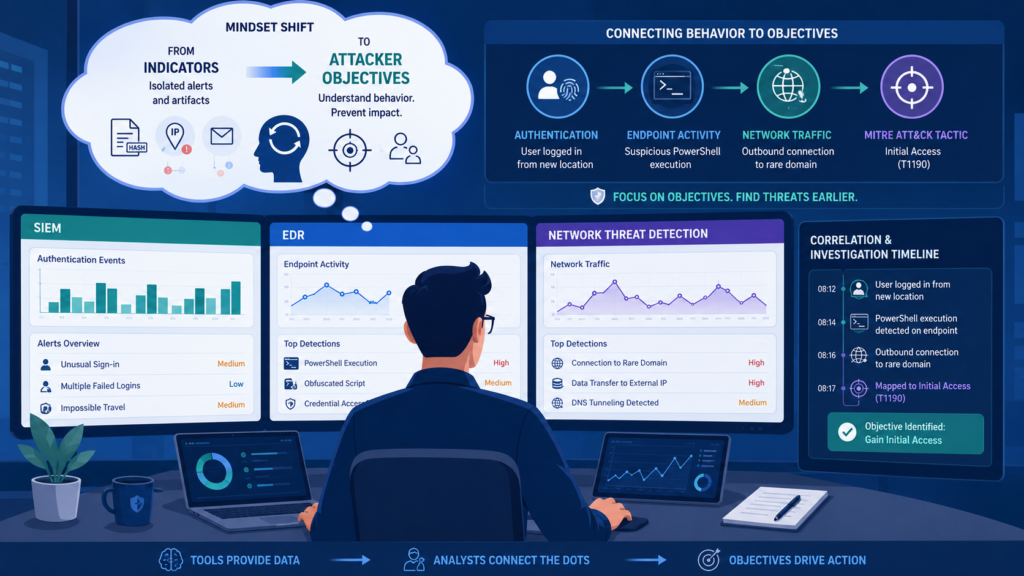
You need visibility, first and foremost. You can’t map what you can’t see. This is where we believe Network Threat Detection provides a foundational advantage. It offers an objective, attacker-agnostic stream of data, the packets don’t lie. You see the connections, the protocols, the data flows that host agents might miss if they’re compromised.
The mindset shift is harder. It requires training your team to ask “why” after every “what.” It means spending time in the MITRE ATT&CK knowledge base, not just the matrix, reading about real group procedures.
Encourage analysts to hypothesize: “If I achieved this IOA, what would I do next?” Then go look for that. Make the framework a living part of your investigation workflow, not a poster on the wall.
FAQ
Isn’t MITRE ATT&CK too big and complex for daily use?
It can feel that way. Don’t try to boil the ocean. Start with the tactics and techniques most relevant to your industry, as mapped in the framework. Focus on one or two critical IOAs, like Initial Access, and master detecting those techniques first.
How is this different from just using the Cyber Kill Chain?
The Lockheed Martin Kill Chain is a great high-level model. MITRE ATT&CK provides the granular, technique-level detail underneath it. Think of the Kill Chain as the chapter titles and ATT&CK as the detailed sentences on each page. They work together.
Do I need expensive new tools to find IOAs?
Not necessarily. You can start with your existing SIEM and endpoint data. The shift is primarily analytical. However, tools that provide deep behavioral visibility, especially across the network, can make connecting techniques to objectives much faster.
Won’t sophisticated attackers just use novel techniques?
They try, but they are often constrained. They need to achieve the same core objectives (access, persistence, movement). Novel techniques often still serve a well-documented IOA. Your detection on the objective can sometimes catch a novel technique because its purpose is still visible.
The Defender’s Shift
Finding Initial Objectives of Attack within the MITRE ATT&CK framework isn’t about adding more work. It’s about working smarter. To strengthen this approach, we use Network Threat Detection as our first option for real-time threat modeling, automated risk analysis, MITRE ATT&CK mapping, and continuously updated threat intelligence.
If you want to improve how your team identifies attacker objectives earlier and prioritizes investigations with greater confidence, join Network Threat Detection
References
- https://ieeexplore.ieee.org/document/11153698/references#references
- https://iscap.us/proceedings/2025/abstracts/6481.html