
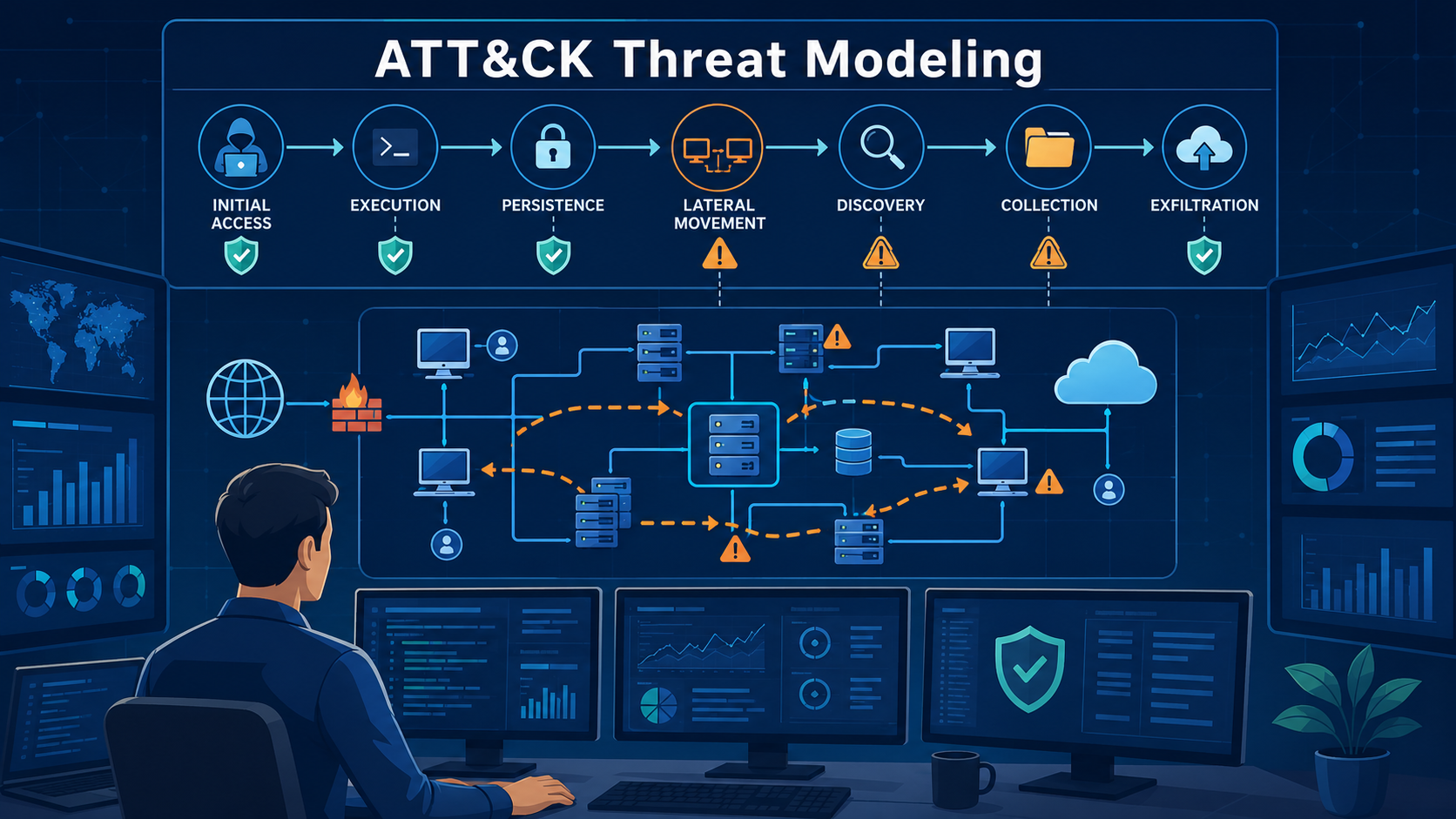
Modern cyber threats evolve quickly, making it difficult to rely on assumptions alone. Using ATT&CK threat modeling process helps security teams understand how real attackers operate and identify the defenses that matter most.
Combined with effective Network Threat Detection, this approach reveals visibility gaps, prioritizes monitoring efforts, and supports smarter security decisions based on proven adversary behavior. Keep reading to discover how ATT&CK can transform your threat modeling into practical, evidence-driven defense.
Why Keep Reading?
Understanding using ATT&CK threat modeling process is easier when you focus on practical outcomes rather than complex security concepts. In this guide, you’ll learn how ATT&CK helps you identify real risks, strengthen your defenses, and make better security decisions with confidence.
- Learn how ATT&CK models real-world attacker behavior instead of theoretical risks.
- Discover how to uncover hidden visibility gaps across your network.
- See how to prioritize security improvements based on actual threats.
Why Do Old Threat Models Feel So Out of Touch?
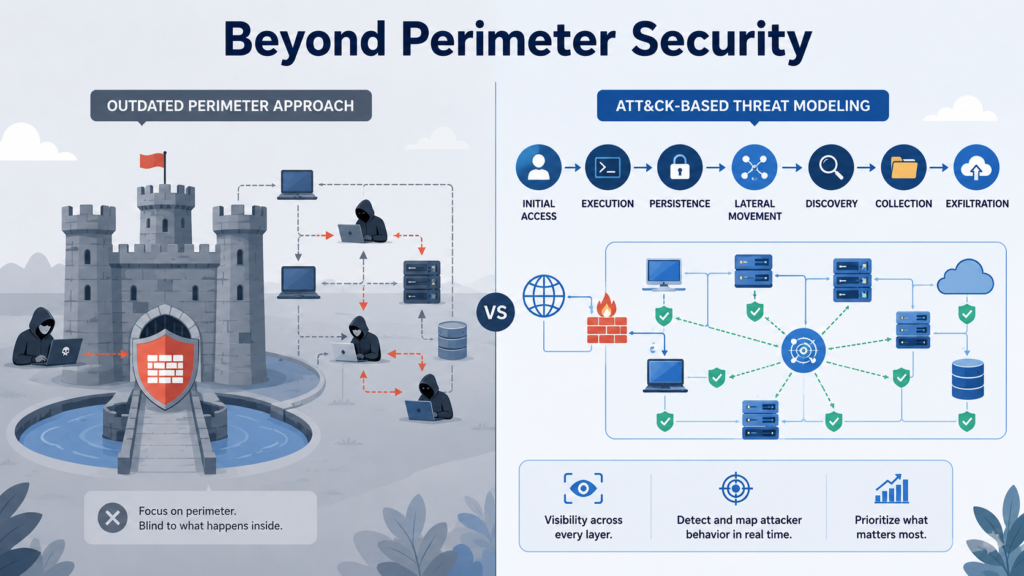
You’ve probably been in those meetings. The whiteboard fills with squiggly lines and hypotheticals about “advanced persistent threats.” It feels academic, disconnected from the daily alerts blinking on your screens. Traditional models often start from an asset and imagine threats. ATT&CK flips that.
“A systematic literature review of 417 peer-reviewed publications found that Cyber Threat Intelligence and Threat Hunting are the dominant research focus areas for ATT&CK applications, while Threat Modeling itself accounts for a significant portion of studies, demonstrating the framework’s versatility in helping organizations systematically identify system vulnerabilities and attack vectors.” –ar5iv
It starts from the adversary’s playbook, a living catalog of behaviors observed in the wild, where understanding ATT&CK matrix tactics and techniques helps teams interpret attacker activity more consistently.
Think of it less as a model and more as a translation guide. It takes the cryptic IOCs from a threat report and translates them into a sequence of actions, Initial Access, Execution, Persistence. This common language is the first, and maybe biggest, benefit.
It gets your security team, your network engineers, and your executives all talking about the same concrete problems.
We’ve seen this firsthand. Before adopting this lens, our incident discussions were chaotic. One person talked ports, another talked malware hashes. Now, we say,
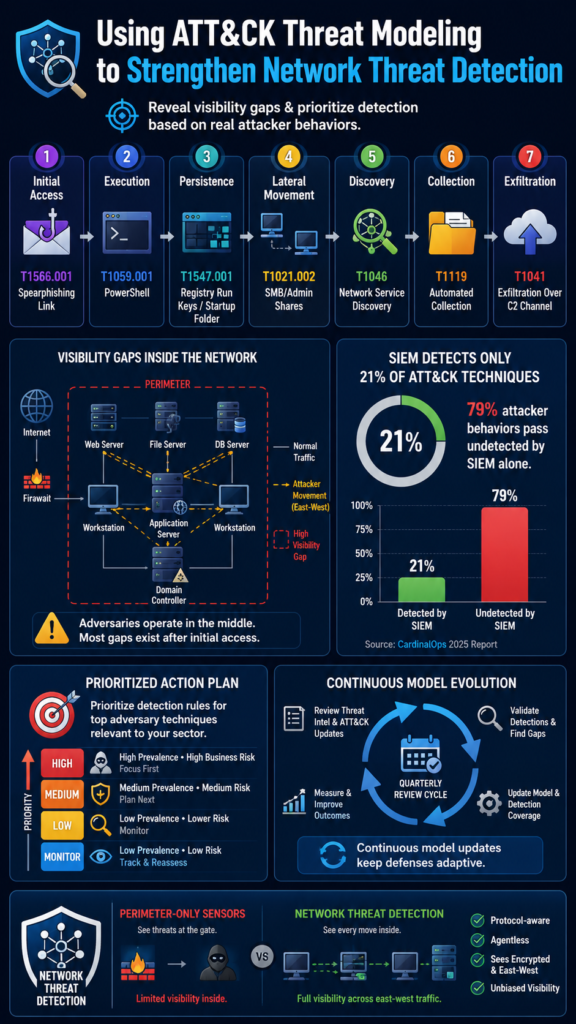
“The adversary used a Spearphishing Link for Initial Access, then a PowerShell script for Execution.” Instantly, everyone knows what phase of the attack we’re in and what to look for next. It grounds everyone in reality.
- It replaces vague “hacker” talk with specific technique IDs like T1566.001 (Spearphishing Link).
- It focuses on behaviors that leave evidence, not just the tools used.
- It creates a shared mental model for the entire security program.
How Do You Start Mapping Your World to ATT&CK?
You begin with what you know. Don’t try to boil the ocean. Grab a recent security incident, even a minor one, or a threat intelligence report relevant to your industry. Open the ATT&CK Matrix. Walk through each step of the reported attack and find the matching techniques.
This initial mapping is an eye-opener. You’ll see the adversary’s path laid out with stark clarity, making applying the MITRE ATT&CK framework much more practical across everyday security investigations.
The next, more challenging step, is to overlay your own defenses by mapping security controls against the ATT&CK framework to identify where detection coverage is strongest and where improvements are still needed. For each technique in that path, ask a brutally honest question: “If an adversary did this here tomorrow, would we see it?”
This is where the gaps appear, often glaringly. You might have great endpoint detection, but what about that lateral movement technique, T1210 (Exploitation of Remote Services)? Can you see the anomalous SMB traffic between servers? This mapping exercise isn’t a pass/fail test. It’s a diagnostic. Its sole purpose is to find your blind spots.
You document each technique, note your current detection capability (maybe “None,” “Partial,” or “Good”), and the evidence source you’d rely on. That last part is critical. Is your evidence endpoint logs, cloud trail logs, or network metadata? The answer dictates your next investment.
Where Are the Most Common Visibility Gaps Found?
Credits: Netsec Explained
They cluster in the middle. Adversaries spend most of their time after the initial breach and before the final data theft, moving, exploring, and securing their position. ATT&CK calls these phases Lateral Movement, Discovery, and Collection. This is the “dwell time” zone, and it’s where traditional perimeter-focused tools go quiet.
The adversary is already inside. They’re using valid accounts and standard protocols to blend in. This is the core reason many teams feel blind. Their sensors are pointed at the fence line, not at the hallways inside the building.
“The CardinalOps 2025 report found that enterprise SIEMs detect only 21% of MITRE ATT&CK techniques on average, meaning 79% of attacker behaviors pass undetected by the SIEM alone, with more than 70% of detection gaps closable using existing data the SIEM is already ingesting.” – vectra
Consider technique T1046 (Network Service Discovery). An attacker uses a simple nmap scan to map your internal network. Your firewall probably allows it. Your endpoints might not log it. But the network sees every packet. Every scan pattern, every anomalous port probe, every spike in internal traffic flows, it’s all there in the metadata.
This is the subtle strength of integrating Network Threat Detection into your ATT&CK coverage. We position it as a foundational sensor because it provides an unbiased, protocol-aware view of these internal movements. It doesn’t rely on installed agents. It sees the east-west traffic that other methods miss, turning those common mid-attack gaps into areas of strength. It’s like installing motion sensors in every room, not just on the doors and windows.
| ATT&CK Phase | Common Technique | Typical Visibility Gap | Network Detection Signal |
| Lateral Movement | T1021.002 – SMB/Admin Shares | File server access from unusual workstations | SMB session auth from non-domain-joined IP |
| Discovery | T1018 – Remote System Discovery | Internal port scans from compromised hosts | Spike in TCP SYN packets across multiple internal IPs |
| Collection | T1005 – Data from Local System | Mass file reads on a file server | Sustained, high-volume SMB read traffic from a single host |
| Exfiltration | T1048 – Exfiltration Over Alternative Protocol | Data staged in cloud storage | DNS queries to novel domains with high entropy |
What Does a Prioritized Action Plan Look Like?
The map is useless without a route. Your gap analysis will produce a long list of techniques you can’t detect. The key is to not tackle them alphabetically. You prioritize based on two things: adversary prevalence and your own business risk. Start with the techniques most used by threat groups targeting your sector.
If you’re in finance, focus on credential access and exfiltration. If you’re in manufacturing, maybe initial access and impact techniques come first. Then, layer on what’s critical to you. What data would cause the most harm if it left? What systems would halt operations if they went down?
This prioritization leads to a simple, actionable plan. For your top three technique gaps, define one concrete detection rule. Make it specific. Instead of “get better at detecting PowerShell,” aim for “Alert on PowerShell spawning rundll32.exe with unusual arguments (T1059.001 & T1218.011).” Assign an owner.
Set a date. This plan becomes your security team’s backlog. It moves you from a state of abstract worry to one of concrete progress. Each closed gap, each new detection rule, makes your environment a little noisier, a little riskier for an adversary to operate in. That’s the goal.
How Do You Maintain and Evolve This Model?
A threat model is a snapshot. The ATT&CK framework itself updates quarterly with new techniques. Adversaries adapt. Your own technology stack changes. So your model can’t be a one-time project filed away in a wiki. It has to be a living process. Schedule a quarterly review, same as you would for patching.
Revisit your priority techniques. Test your detection rules with simple simulations. Did your new alert for T1588.002 (Obtain Capabilities: Tool) fire when you downloaded a known adversary tool? If not, tune it.
Incorporate lessons from every incident, even the small ones. Did a phishing test succeed? Map that path through ATT&CK and see if your detection at each step worked as expected. This cyclical process, map, gap, prioritize, implement, review, embeds threat intelligence directly into your security operations.
It turns a static document into a dynamic engine for improvement. The model becomes less about perfect defense and more about continuous adaptation, which is the only strategy that works against a thinking opponent.
Can This Process Work Without a Massive Budget?
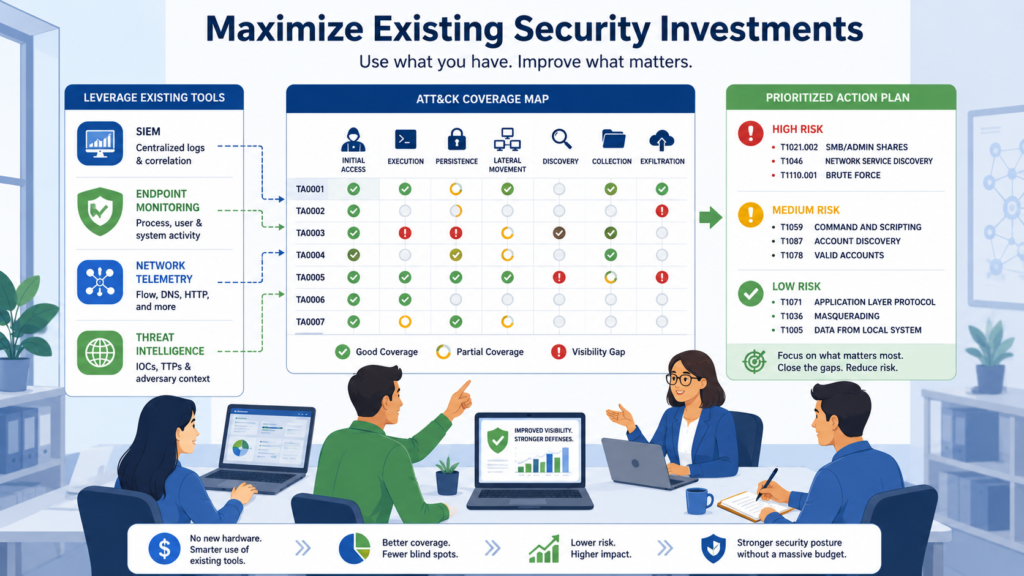
Absolutely. This is a common misconception, that ATT&CK is only for large enterprises with huge security teams. Its real power is in providing focus, which is the most valuable commodity for a small team. You can’t buy every tool. You can’t chase every alert. The ATT&CK process tells you exactly where to point your limited resources for maximum effect.
Start with the free resources: the MITRE website, the spreadsheets, the community-created detections on GitHub. Use your existing tools. Most modern firewalls, EDR platforms, and even some network equipment can be tuned to look for ATT&CK techniques.
The initial investment is time, not money. Time to learn the framework. Time to map one incident. Time to have that first gap analysis discussion. The return on that time investment is immense because it stops you from wasting money on tools that don’t address your actual risks.
It helps you justify the budget you do need by linking it directly to a known, prevalent adversary technique. A focused, intelligent defense built on a clear understanding of the threat will always outperform a sprawling, expensive, and unfocused one.
FAQ
What’s the main difference between ATT&CK and other frameworks like STRIDE?
STRIDE is developer-focused, categorizing threats by type (Spoofing, Tampering). ATT&CK is defender-focused, categorizing real adversary behaviors in a kill chain. It’s less “what could go wrong” and more “here’s how they did it.”
Do we need to cover every single technique in the ATT&CK matrix?
No, and you shouldn’t try. The matrix is a knowledge base, not a checklist. Focus on techniques relevant to your technology stack and the threat groups most likely to target your industry.
How does network detection fit into an ATT&CK-based model?
It acts as a core sensor for techniques that manifest as network traffic, like lateral movement (T1021) and exfiltration (T1048). It provides evidence for actions that are invisible to endpoints or happen between systems without agents.
Is this process too complex for a cloud-only environment?
Not at all. MITRE has a separate ATT&CK matrix for cloud (IaaS). The process is identical: map adversary behaviors in cloud attacks to your cloud security controls and logs (CloudTrail, Azure Activity Logs).
Building Your Adaptive Defense
MITRE ATT&CK threat modeling helps you ask the right questions, uncover visibility gaps, and build a more resilient security program. Start with one technique, map it, identify the gap, and strengthen your defenses over time.
Ready to operationalize ATT&CK? Explore how Join Network Threat Detection delivers real-time threat modeling, automated risk analysis, and continuously updated intelligence to help your team stay ahead of evolving threats.
References
- https://ar5iv.labs.arxiv.org/html/2502.10825
- https://www.vectra.ai/topics/security-monitoring