

Security teams often understand the technical details of cyber threats, but executives need to understand how those threats affect the business. At Network Threat Detection, we’ve found that communicating security risks business stakeholders becomes much more effective when technical findings are translated into financial.
This approach helps leadership prioritize investments, reduce uncertainty, and respond faster to meaningful risks. The following guide explains practical ways to build that communication bridge. Keep reading.
Speak Security So Your Business Actually Listens
Security professionals spend countless hours identifying vulnerabilities, monitoring threats, and responding to incidents. Yet many of those efforts lose momentum when presented to executives because the conversation focuses on technical details instead of business outcomes.
- Turn technical findings into business consequences executives immediately understand.
- Replace complex security terminology with simple, outcome-focused communication.
- Support every identified risk with clear priorities and practical recommendations.
Why Do Business Leaders Tune Out Technical Security Talk?

You’ve seen it happen. A room goes quiet, but it’s not a focused quiet. It’s the quiet of disengagement. Eyes glaze over as you detail the latest CVE or a sophisticated persistent threat. It’s not that they don’t care about security. They care deeply about the consequences of a breach. But the technical pathway there feels like static to them.
Their world is measured in KPIs, ROI, quarterly goals, and market share. Yours is measured in patch cycles, intrusion attempts, and vulnerability scores. The disconnect isn’t just about vocabulary, it’s about fundamental priorities. When you lead with the tool, the IPS, the SIEM, the latest protocol, you’re speaking about the “how.”
We learned this early on. Presenting a complex threat matrix to a COO once, we watched his attention drift to his phone after 90 seconds. The next week, we came back with a different approach.
We showed a simple timeline: “Threat Actor Phishes Employee > Gains Access to Design Server > Exports Upcoming Product Plans > Competitor Releases Clone in 4 Months.” Below that, we listed the projected impact: “6-Month Revenue Shortfall: $2.1M. R&D Write-off: $850k. Market Share Erosion: Estimated 5%.” He put his phone down.
- Translate every technical term into a business outcome.
- Lead with the impact, not the mechanism.
- Use their metrics, not yours.
How Can You Translate Technical Jargon into Business Impact?
So how do you perform this translation? It starts long before the meeting. You must become a student of the business itself. What are this quarter’s big initiatives? Where is the company most vulnerable operationally? What would cause the most pain: a leak of customer data, intellectual property, or financial records?
Let’s take a real example. Instead of reporting, “We observed a 40% increase in brute-force attacks against our VPN gateway,” try this: “Our primary method for remote employee access is under sustained attack. A successful breach here would give an attacker the same access as any of our 500 remote staff.
“A key issue is the technical and language ‘barrier’ between the technical and business teams (e.g., business stakeholders and board members), which prevents a shared understanding of the impact of cyber risks. This miscommunication prevents timely cyber risk assessment and strategic level decisions on cyber risk mitigations and investment strategies, which often leads to delays, budget issues that limits effective responses to cybersecurity incidents.” – Sciencedirect
They could target our financial systems, customer databases, or product code repositories. The likelihood is medium, but the impact, considering data loss and system disruption, is high.” You’ve just connected a technical event to assets the business understands.
A useful tool here is a simple translation table. It doesn’t need to be fancy.
| Technical Finding | Potential Business Impact | Likely Outcome for the Business |
| Unpatched vulnerability in customer database server. | Unauthorized access to 2.3 million customer records. | Regulatory fines (GDPR, CCPA), class-action lawsuits, catastrophic loss of customer trust. |
| Lack of segmentation in production network. | Lateral movement from a compromised workstation to core manufacturing systems. | Complete production halt, inability to fulfill orders, massive revenue loss and contractual penalties. |
| Phishing campaign targeting finance department. | Compromise of employee credentials for wire transfer systems. | Direct financial theft, fraudulent transactions, reputational damage with banking partners. |
This reframing turns abstract threats into concrete business scenarios. It answers the question they’re all thinking: “What’s the worst that could happen?” And you’re showing them, in terms they can’t ignore.
What’s the Most Effective Way to Present a Security Risk?
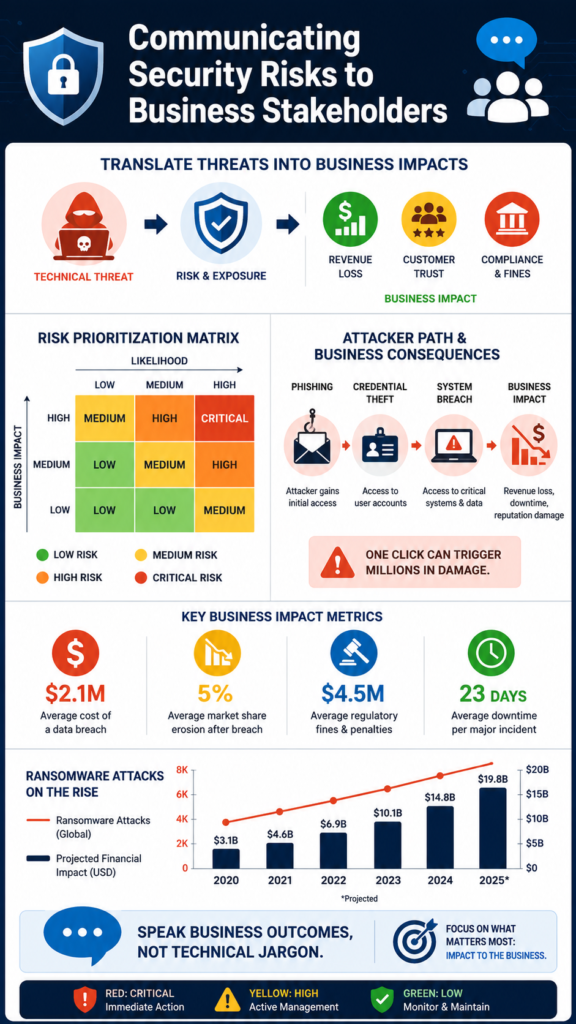
Structure is everything. A rambling, technically dense presentation will fail, no matter how critical the risk. You need a narrative. Think of it like a business case, because that’s what it is. You are proposing an investment, of time, money, or resources, to mitigate a potential loss.
We structure our risk briefings in a consistent, four-part format. First, The Headline. One sentence stating the risk in business terms.
“We face a high likelihood of a ransomware attack that could shut down our e-commerce platform for a week.” Second, The Evidence. This is where technical data lives, but presented cleanly. A graph showing the rise of ransomware against similar companies.
A brief explanation of the common entry points (phishing, unpatched systems). Third, The Business Impact. Quantify it. “A 7-day outage during peak season projects to $4.7M in lost sales, plus an estimated $1.2M in brand remediation costs.” Finally, The Recommendation.
Be specific. “We recommend an immediate project to isolate and back up our transaction databases, funded at $150k. This reduces the projected loss from $5.9M to an estimated $200k recovery cost.”
Use colors consistently: red for high risk, yellow for medium, green for low. The goal is to make the risk feel real and urgent, not just intellectually understood.
- Start with a business-risk headline.
- Support it with clear, concise evidence.
- Quantify the impact in dollars and downtime.
- End with a clear, costed recommendation.
How Do You Prioritize Which Risks to Communicate First?
Credits: Adriana Girdler
You can’t present every single vulnerability. The business would drown in noise, and truly critical issues would get lost. You need a ruthless prioritization framework, and it must be based on business criteria, not just CVSS scores. A critical vulnerability in a test server no one uses is less important than a medium vulnerability in your live payment processor.
We use a modified model that blends traditional security scoring with business context. We call it Business Impact Scoring. For any identified risk, we score two dimensions: Likelihood (based on threat intelligence, exposure, and existing controls) and Business Impact (based on the asset’s value to operations, revenue, legal compliance, and reputation).
The risks that score high on both are the ones that go to the top of the list for executive communication.
For example, a phishing threat against all employees has high likelihood. Its business impact depends on threat prioritization. A campaign aimed at the executive assistant team might have a higher business impact score than one aimed at the warehouse, due to the assistants’ access to sensitive communications and calendars.
This model forces you to think like the business, not just like a security analyst. It also provides a defensible, logical reason for why you’re bringing one risk forward and not another. You’re not just crying wolf, you’re presenting a calculated assessment of which wolves are closest to the flock.
When Should You Bring in Tools Like Network Threat Detection?
This is where the conversation becomes practical. After you’ve explained the risk, measured its impact, and recommended a response, the next step is improving visibility. After all, you can’t manage what you can’t see.
Instead of introducing security tools as a standalone purchase, connect them directly to the risks you’ve already discussed. This makes the recommendation more relevant and business-focused.
- Start with the business risk. Tie the conversation back to a specific scenario, such as lateral movement after a successful phishing attack.
- Highlight the visibility gap. Explain that while existing controls may detect the phishing email, they often provide little insight into what happens afterward.
- Focus on outcomes, not products. Describe the need as the ability to detect unusual internal activity, reduce attacker dwell time, and minimize business impact.
- Use simple analogies. Rather than leading with technical terms like “Network Detection and Response (NDR),” compare the capability to a burglar alarm detecting movement inside a building.
- Position detection as the solution. Frame network threat detection as the capability that identifies suspicious callbacks, abnormal file transfers, or lateral movement in real time, enabling faster response and reducing financial damage.
By framing detection capabilities around measurable business risks instead of product names, stakeholders are more likely to see the value. The conversation stays focused on outcomes, faster response, less damage, and lower financial impact, rather than technology for its own sake.
It wasn’t about custom risk scoring for its own sake, it was about answering the question, “What’s happening inside our walls right now?” before that question was asked with panic after a breach.
What Does a Successful Risk Communication Meeting Look Like?
The meeting itself should feel like a collaborative strategy session, not a technical lecture. You are the subject matter expert guiding the business leadership through a landscape of potential dangers. Your goal is not to scare them, but to empower them with clear choices.
A successful meeting ends with a decision. Did you secure the budget for the recommended control? Did you get alignment on accepting a specific risk eksposure? Did you get approval to delay a project to fix a security flaw? If you walk out with just “Thanks for the update,” you’ve failed.
Successful security discussions should always have a clear objective. Let stakeholders know exactly what decision or approval you need from the start, rather than waiting until the end of the meeting.
- State your ask upfront. For example: “Today, I need your approval to reallocate $50k to patch these critical servers by the end of the month.”
- Listen more than you speak. The questions stakeholders ask often reveal what concerns them most.
- Adapt your explanation. If they’re confused, pause and explain differently using simpler language, diagrams, or a whiteboard.
- Focus on collaborative problem-solving. Make the discussion about reducing business risk together, not delivering a technical presentation.
- Confirm understanding. A strong indicator of success is when a non-technical stakeholder can explain the risk back in their own words. That shows they’ve moved from simply hearing the information to understanding and taking ownership of the issue.
How Do You Build Lasting Credibility and Trust?

Credibility is your most important currency. It’s built over time by being consistently accurate, relevant, and business-aware. Never sensationalize. If you cry “fire” over every minor smoke alarm, no one will listen when the building is actually ablaze. Be honest about likelihoods. Admit when a threat is emerging but not yet imminent. This builds trust.
Also, share wins. When your team detects and blocks a major phishing campaign, communicate it in business terms. “This morning, we prevented a coordinated phishing attack targeting our accounting team.
Based on the attacker’s methods, we assess the goal was to initiate fraudulent wire transfers. We estimate this prevented a potential loss in the range of $500k.”
This does two things: it demonstrates the value of the security program in concrete financial terms, and it shows the stakeholders that the risks you talk about are real. You’re not just theorizing, you’re actively defending their bottom line.
“Board oversight and expertise are associated with more detailed, clearer, and more specific cybersecurity risk disclosures, though this effect is diminished when oversight is symbolic and lacks dedicated committees.” – Hstalks
Finally, speak their language every single time. Drop the acronyms. Avoid “cyber.” Talk about business continuity, customer trust, legal compliance, and financial loss. Over time, you become not just the security officer, but a trusted advisor who helps them navigate a dangerous part of the business landscape.
FAQ
How often should I report risks to stakeholders?
Establish a regular, predictable rhythm, like a monthly risk review, for ongoing issues. Reserve immediate, ad-hoc briefings for truly emergent, high-impact threats that require urgent decisions. Consistency prevents surprise panic.
What if leadership decides to accept a high risk I’ve presented?
Your job is to inform, not to decide. If leadership accepts a risk after understanding the full impact, document the decision formally. This ensures accountability and protects the team if the risk materializes later.
How do I handle a stakeholder who just says “Make it secure” without providing budget?
Push for specificity. Ask, “What level of risk are you comfortable accepting? A breach with a 1% chance of $10M loss, or a $500k control that reduces that chance to 0.1%?” Force the trade-off into financial terms they must engage with.
Can I use fear to get my point across?
Fear causes short-term spikes in attention but long-term erosion of trust. Focus on factual, quantified business consequences. Respect their intelligence. A calm, evidence-based presentation of a $5M risk is far more persuasive than dramatic doom-saying.
Making the Business Case for Vigilance
Communicating security risks isn’t about sharing problems, it’s about enabling smarter business decisions. By translating technical threats into clear business impacts, security teams become trusted partners.
Network Threat Detection helps organizations strengthen this approach with real-time threat modeling, automated risk analysis, and executive-ready insights. Start your next risk discussion with why it matters and discover how to prioritize threats more effectively: Join Network Threat Detection
References
- https://www.sciencedirect.com/science/article/pii/S0167404826000490?via%3Dihub
- https://hstalks.com/article/8630/improving-cyber-risk-governance-through-storytelli/?business&noaccess=1