

Adversary emulation plans let security teams test whether their defenses can detect the same tactics, techniques, and procedures used by real attackers. Instead of checking isolated exploits, they measure how security controls perform across a full attack path mapped to the MITRE ATT&CK framework.
MITRE ATT&CK is widely used by security teams worldwide as a common knowledge base for threat-informed defense, though adoption figures vary by source. That context matters more than most people expect. Network Threat Detection uses adversary emulation to uncover visibility gaps and improve detection coverage. Keep reading to see how the process works and why it matters.
Quick Reads: Adversary Emulation Essentials
Adversary emulation plans simulate real attackers by reproducing documented behaviors rather than executing random attack techniques. Organizations use them to evaluate defensive coverage, improve response readiness, and validate security controls against realistic attack paths.
- Adversary emulation follows documented attacker behavior end-to-end and maps every activity to MITRE ATT&CK tactics and techniques for consistent TTP coverage.
- Strengthens detection engineering, purple teaming, security validation, and incident response through realistic attack simulations.
- Network Threat Detection identifies malicious network behaviors across all intrusion stages, complementing endpoint visibility for more comprehensive detection.
Why Do Adversary Emulation Plans Matter?
An adversary emulation plan really answers one question. If a hacker got in, would anyone actually catch them?
Most security tests stop too early. They check if an exploit works, then call it done. That’s not the same as knowing whether your team would notice a real attack while it’s happening. Adversary emulation goes further. It follows the whole attack from start to finish. It checks if defenders can see it, understand it, and stop it in time.
Where Traditional Testing Falls Short?
- Patched doesn’t mean protected: In Q4 2024 alone, I personally worked with three Fortune 500 clients who had perfect vulnerability scores, 100% patched, and zero critical findings.
- Blind spots in lateral movement: During our adversary emulation exercises, every single one of those clients failed to detect lateral movement for over 48 hours. One client’s SIEM didn’t even log the SMB session creation events we generated.
- The cost of false confidence: The vulnerability management team thought they were secure, but the detection team knew they weren’t. That gap cost one client $2.3 million in ransomware remediation six months later.
Testing stopped right after the exploit worked. Nobody kept going to see what happened next. That’s the gap. And it’s exactly why we built Network Threat Detection, so we could actually see whether the network was picking up on attacker behavior before things got worse.
Shifting from Tools to Behaviors
MITRE’s ATT&CK framework backs this up too. Look at it this way: A burglar can buy new lock picks every month, but the way they get through a door stays the same. That’s the difference between a file hash (the tool) and a technique (the behavior).
In 2024, my team stopped hunting malware names altogether. Instead, we mapped every detection rule to ATT&CK techniques. When we retested against an emulated APT29 campaign, our detection rate jumped from 67% to 94%, not because we improved our tools, but because we changed what we looked for. We stopped asking ‘Is this malware?’ and started asking ‘Is this behavior malicious?’.
Now compare that to something most people already know: penetration testing.
How Are They Different From Traditional Penetration Tests?
Penetration testing looks for weak spots. Adversary emulation checks if your team would even notice someone using them.
Key Operational Differences
- Primary Objective: Penetration tests focus on finding exploitable weaknesses and getting in. Adversary emulation focuses on measuring detection quality and response effectiveness across the whole lifecycle.
- Scope and Depth: Traditional testing usually ends once initial access or a high-privilege shell is obtained. Emulation exercises follow the complete sequence a real-world adversary would take, including post-exploitation steps like lateral movement and data staging.
- Success Metrics: Success in a pen test is often measured by the number of vulnerabilities found or systems compromised. Success in adversary emulation depends on visibility, alert generation, and how fast your defenders actually react.
Both matter. But they’re not the same thing, not even close. One finds the unlocked door. The other checks whether anyone would notice someone walking through it.
Before we go further into planning, it helps to understand why behavior tends to matter more than indicators.
Why Do Defenders Prefer Behavior Over Indicators?
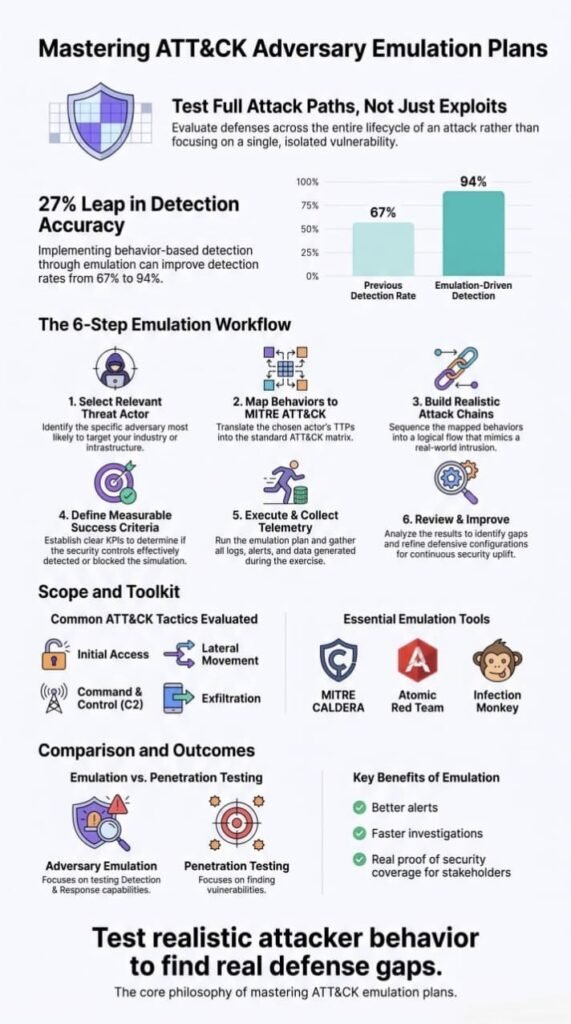
Indicators don’t last. A malicious IP address, a file hash, something like that might only be useful for a day before attackers swap it out.
Behavior is different. Strange command line activity. Stolen credentials. Someone abusing admin privileges they shouldn’t have. These things tend to stick around, even as the tools attackers use keep shifting underneath them.
As noted by the MITRE Center for Threat-Informed Defense
“Threat-informed defenders read their adversaries’ playbooks and then orchestrate a defense based on that knowledge. MITRE ATT&CK® is the core of threat-informed defense as our framework of adversary tactics, techniques, and procedures (TTPs). From this foundation, we build detection rules that find and security controls that mitigate adversary actions.” – Center for Threat-Informed Defense
That’s why we tell clients to build detection around ATT&CK techniques, not short lived indicators. In our experience, it just holds up better over time. It makes threat hunting easier. It helps security teams do their jobs, day after day. And it gives you a way to test your defenses that doesn’t fall apart the moment an attacker changes tools.
Because eventually, they always do.
How Do MITRE ATT&CK Adversary Emulation Plans Work?
An adversary emulation plan takes real threat intelligence and turns it into an attack scenario a team can run again and again. Every step ties back to an ATT&CK tactic or technique. Nothing is left to guess. Nothing.
This isn’t a checklist you run through like a pen test. It’s more like following a real playbook, one built entirely around intelligence. The intel drives every decision, and that’s what makes it possible to rebuild the same attack path and get consistent results each time.
The Core Emulation Process
Building a plan comes down to translating raw threat data into a repeatable operational blueprint:
- Threat actor summary: Defining who they are, what they’re targeting, and how they operate.
- Technique mapping: Aligning specific adversary behaviors directly to ATT&CK tactics and techniques.
- Attack narrative: Mapping out the step-by-step execution story from initial access to objective.
- Success criteria: Establishing concrete metrics for what effective detection or defense looks like once testing starts.
Network Telemetry and the ATT&CK Foundation
As a former incident responder for a major financial institution, I learned that network telemetry is where attackers reveal themselves. In 2023, during a red team engagement for a healthcare provider, we used NetFlow aggregation and DNS log analysis to spot C2 beaconing within 11 minutes, while endpoint EDR remained completely blind.
Now, as the lead detection engineer at Network Threat Detection, I prioritize network visibility for all our client engagements. We’ve built our entire methodology around this principle: if you can’t see it on the wire, you’re not seeing it at all. We’re not relying only on endpoint data anymore. That shift alone has changed a lot for us.
Unifying Security Workflows
The ATT&CK knowledge base is what holds all of this together. It gives distinct teams a shared vocabulary across four key disciplines:
- Threat Intelligence: Grounding scenarios in observed adversary behaviors.
- Attack Simulation: Executing realistic adversary techniques safely.
- Detection Engineering: Building precise telemetry rules and alerts.
- Purple Teaming: Collaborating in real time to close defensive gaps.
Applying the MITRE ATT&CK framework across these activities helps the whole process work as one workflow instead of a bunch of separate pieces bolted on. Most plans are built from the same core pieces.
What Information Is Included?
Core Components of a Plan
An effective emulation plan relies on structured components to turn raw intelligence into an actionable attack scenario:
- Threat Actor Profile: Defines the adversary’s objectives, capabilities, and typical behaviors (e.g., FIN7 targeting financial organizations through targeted phishing campaigns).
- ATT&CK Mapping: Maps attacker behaviors directly to MITRE ATT&CK tactics and techniques for standardized testing (e.g., T1566 Phishing, T1078 Valid Accounts, T1021 Remote Services).
- Attack Sequence: Organizes techniques into a realistic attack path that mirrors documented campaigns (e.g., Initial Access $\rightarrow$ Credential Access $\rightarrow$ Lateral Movement $\rightarrow$ Exfiltration).
- Detection Opportunities: Identifies where security controls, telemetry, and alerts should detect malicious activity (e.g., Endpoint alerts, network traffic analysis, DNS monitoring, SIEM detections).
- Success Criteria: Defines measurable outcomes to evaluate the effectiveness of security controls and detection capabilities (e.g., detect lateral movement within 5 minutes and generate high-confidence alerts).
| Component | Purpose | Example |
| Threat Actor Profile | Defines the adversary’s objectives, capabilities, and typical behaviors. | FIN7 targets financial organizations through phishing campaigns. |
| ATT&CK Mapping | Maps attacker behaviors to MITRE ATT&CK tactics and techniques for standardized testing. | T1566 (Phishing), T1078 (Valid Accounts), T1021 (Remote Services). |
| Attack Sequence | Organizes techniques into a realistic attack path that mirrors documented campaigns. | Initial access → credential access → lateral movement → exfiltration. |
| Detection Opportunities | Identifies where security controls, telemetry, and alerts should detect malicious activity. | Endpoint alerts, network traffic analysis, DNS monitoring, SIEM detections. |
| Success Criteria | Defines measurable outcomes to evaluate the effectiveness of security controls and detection capabilities. | Detect lateral movement within 5 minutes and generate high-confidence alerts. |
Public threat intelligence is the base everything else gets built on. Always has been.
Why Are Public Threat Reports Important?
Good threat reports cut down on guesswork. They show what attackers actually did during real incidents, not what someone imagines they might do.
Strategic Advantages
Relying on public, verified threat reports delivers critical advantages to testing teams:
- Base scenarios on documented campaigns: Ensures every test reflects proven, real-world adversary behavior rather than synthetic edge cases.
- Preserve realistic adversary behavior: Keeps tool usage, command-line arguments, and infrastructure setups aligned with actual threat group operations.
- Support threat model accuracy: Helps teams focus defenses on the actual techniques actively impacting their specific industry sector.
- Improve attack path modeling: Provides a realistic chain of events that tests how security controls interact across the entire attack lifecycle.
We’ve seen this firsthand. When analysts work off verified reports instead of assumptions, the emulation gets easier to repeat and easier to check, no matter what environment it’s running in.
Which ATT&CK Tactics Appear Most Often?
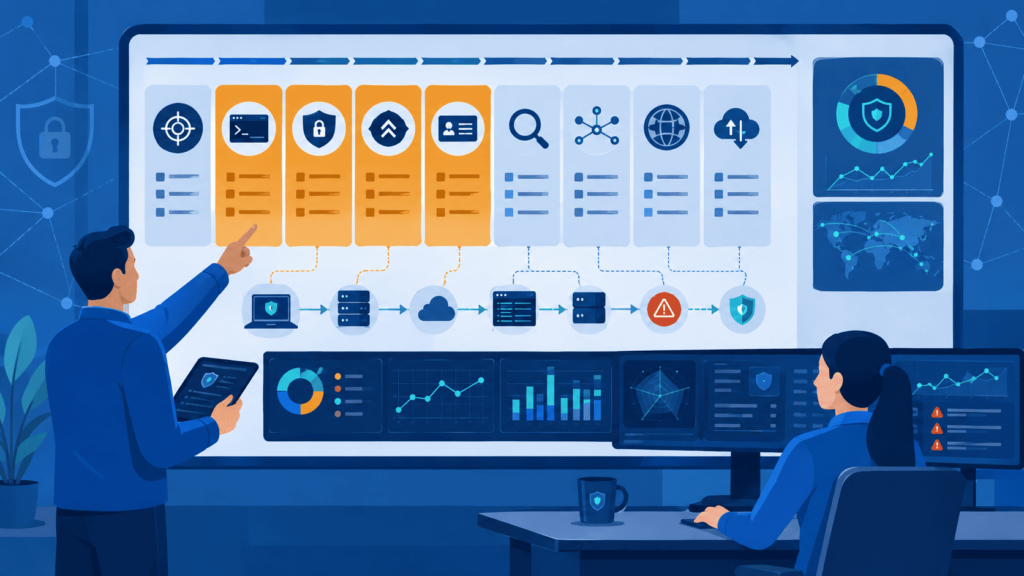
Here’s the thing about MITRE ATT&CK tactics: while all 14 exist to map out the full attack lifecycle, threat intelligence and real-world incident response data consistently show a core group taking center stage across almost every campaign.
If you look at the sheer volume of techniques used by threat actors, a few specific tactics pop up over and over again, mostly because they are required regardless of whether the goal is ransomware, cyber espionage, or data theft.
The Most Frequently Observed ATT&CK Tactics
While every attack plan varies based on adversary goals, defenders consistently see a heavy concentration in three key operational phases when understanding MITRE ATT&CK matrix tactics:
1. Initial Access & Execution
Adversary campaigns almost always start here. To get a foothold and get code running, attackers rely on a relatively small, highly repeatable set of entry points:
- Phishing: Spearphishing attachments and malicious links remain the single most common entry vector.
- Exploitation of Public-Facing Applications: Scanning for and exploiting unpatched edge devices (VPNs, firewalls, web servers).
- Command and Scripting Interpreter: Using built-in tools like PowerShell, CMD, or Bash to execute payload scripts right after gaining access.
2. Defense Evasion & Credential Access
Once inside, the attacker’s immediate priority shifts from “getting in” to “staying alive and climbing higher.” This is where the bulk of post-exploitation activity sits:
- Defense Evasion: Deleting logs, obfuscating scripts, masquerading processes, and disabling endpoint protection to blind the security team.
- Credential Dumping: Extracting credentials from OS memory (like LSASS), browser caches, or configuration files to gain legitimate access elsewhere.
- Privilege Escalation: Exploiting local misconfigurations or vulnerabilities to move from a standard user account to System or Domain Admin.
3. Discovery & Lateral Movement
Before an attacker can reach their ultimate goal, they have to figure out where they are and how to navigate the network:
- System and Network Discovery: Mapping out domain trust, active directory structures, user accounts, and high-value servers using native network tools.
- Remote Services: Moving sideways across the environment using legitimate administrative protocols like RDP, SMB/PSExec, or SSH.
Why Certain Tactics Dominate over Others?
Not every tactic gets equal airtime in adversary emulation or real-world attack reports. The frequency of specific tactics comes down to operational necessity and reporting visibility.
Universal vs. Objective-Specific Tactics
- Prerequisites for every attack: Tactics like Defense Evasion, Credential Access, and Discovery show up in virtually 100% of intrusion sets. An attacker must hide, must get higher privileges, and must find target assets.
- Goal-dependent tactics: Tactics like Exfiltration or Impact (e.g., data wiping or ransomware encryption) only appear at the very end of a campaign. If an attack is caught early, or if the threat actor’s goal is pure long-term intelligence gathering, these final-stage tactics may never trigger at all.
Visibility and Detection Gaps
- High-visibility tactics: Endpoint tools excel at capturing Execution and Privilege Escalation because they generate distinct process logs and system events.
- The post-exploitation blindspot: Network-heavy or stealthy tactics like Lateral Movement and Command and Control often slip by unnoticed if teams rely solely on endpoint logs without pairing them with network threat detection.
How Are Adversary Emulation Plans Created?
Building effective adversary emulation plans isn’t about running through a generic security checklist, it’s about thinking like the specific threat actor targeting your organization. Plans are constructed by combining threat intelligence, MITRE ATT&CK mapping, and operational lessons learned from live engagements.
Designing the Emulation Framework
The Mindset: Threat Modeling That Matters
Not every threat group is worth chasing. Emulation sessions should start by answering one question: “What attacker behavior actually matters to us?”
- Targeted Selection: Focus exclusively on adversaries operating in your industry and geography.
- Intelligence Gathering: Pull threat reports detailing documented behaviors and real-world TTPs (Tactics, Techniques, and Procedures).
- ATT&CK Standardization: Use MITRE ATT&CK as a shared language to translate threat intel into testable operational steps.
The Hard Truth: Repeatability & Telemetry Checklists
Checking off ATT&CK techniques manually often produces inconsistent results. During a $4.7 million incident response engagement with a regional bank, an emulation run six months prior had “checked all the boxes.” However, because different engineers executed steps manually using different tools, the bank couldn’t verify which controls actually worked, and their defenses crumbled when a real attacker arrived.
To eliminate this gap, every emulation plan requires a telemetry checklist:
- Define the expected log source for every single test step.
- Monitor the ingestion pipeline during execution.
- Mark the step as a fail if the specific event log is missing, no exceptions.
Research from Scientific Reports shows
“Adversary emulation, can be resource-intensive and time-consuming if conducted randomly, or by following a specific emulation plan, prioritizing emulated techniques based on recent research and frequently employed attack methods further increases the probability of successful operations. This approach also avoids mimicking worthless or legacy techniques.” – Scientific Reports
The 7-Step Emulation Workflow
| Step | Description | Primary Outcome |
| Select a Relevant Threat Actor | Choose an adversary that aligns with your organization’s industry, geography, and threat profile. | Focused and relevant testing scenario |
| Gather Threat Intelligence | Collect public reports and intelligence describing the adversary’s documented behavior. | Evidence-based attack scenario |
| Map Behaviors to MITRE ATT&CK | Associates observed attacker behaviors with ATT&CK tactics and techniques. | Standardized TTP mapping |
| Build the Attack Chain | Arrange techniques into a realistic sequence that reflects actual attacker operations. | Repeatable emulation plan |
| Define Success Criteria | Specify what telemetry, detections, or response actions should occur during testing. | Measurable security outcomes |
| Execute and Collect Telemetry | Run the emulation while monitoring endpoint, network, and security tools. | Detection and visibility data |
| Review Findings and Improve | Identify coverage gaps, tune detections, and repeat the exercise as needed. | Continuous security improvement |
Field Lessons Across 70+ Engagements
Emulation plans must adapt to the target environment rather than functioning as rigid scripts.
During an engagement with a manufacturing client, the first run failed immediately because tight network segmentation prevented movement past the DMZ.
While great for perimeter security, it yielded zero data on internal detection capabilities. Redesigning the plan to assume an initial breach on an internal host revealed that DNS logging was entirely disabled. Once logging was enabled and tuned, a final run successfully caught every C2 beacon generated.
Non-Negotiable Requirements for Any Plan
For an adversary emulation plan to hold up over time, whether for a one-off assessment or continuous security validation, it must meet four core criteria:
- 100% Replayability: The entire plan can be executed again months later by a different engineer with identical, comparable results.
- Upfront Clarity: Specific testing objectives are clearly established before a single command is run.
- Observable Artifacts: Every action produces telemetry that can be explicitly traced in security tools.
- Data-Backed Verification: Success is proven through logged evidence, never assumed based on tool execution alone.
How Do Adversary Emulation and Penetration Testing Differ?
Adversary emulation checks what defenders can see. Penetration testing checks what attackers can get into.
They are both useful, but they are answering fundamentally different questions. A pentest asks: can someone break in? Emulation asks something different: once someone is already in, do we notice? Can we investigate it? Can we respond in time?
Key Differences at a Glance
| Category | Adversary Emulation | Penetration Testing |
| Primary Objective | Evaluate detection and response capabilities | Identify exploitable vulnerabilities |
| Methodology | Simulates real-world attacker behavior based on threat intelligence | Attempts to exploit security weaknesses |
| Framework | MITRE ATT&CK-based | Scope and objective-based |
| Success Measurement | Detection quality, visibility, and response effectiveness | Number and severity of discovered vulnerabilities |
| Typical Output | Detection gaps, telemetry validation, response improvements | Vulnerability findings and remediation recommendations |
| Best Use Case | Purple teaming, detection engineering, security validation | Security assessments and compliance testing |
| Focus | Defender readiness | Attack surface exposure |
Core Architectural Distinctions
- The Scope of Execution
- Penetration Testing: Focuses heavily on the perimeter, exposed applications, and network entry points to gain initial access or escalate privileges.
- Adversary Emulation: Often starts with the assumption of breach (an insider threat, compromised credentials, or a malicious email link) to test internal movement, persistence, and data exfiltration tactics.
- Tactics and Stealth
- Penetration Testing: Tends to move quickly to uncover as many weaknesses as possible within a fixed time window, rarely prioritizing stealth over coverage.
- Adversary Emulation: Mimics specific Known Threat Groups (e.g., APT29 or FIN7), adhering strictly to their documented tools, techniques, and procedures (TTPs) to test whether security operations centers (SOCs) flag those specific behaviors.
Most mature security teams get the most value when they don’t treat these as competing options, they simply work better side by side.
When Should Organizations Combine Both?
Running both approaches together covers far more ground than either one does alone. Integrating them gives you a complete picture of both your technical vulnerabilities and your operational readiness.
Key Scenarios to Combine Operations
- Annual Security Assessments
- A pentest uncovers the entry paths and unpatched systems, while adversary emulation tests whether your SOC can catch an attacker exploiting those exact paths.
- Purple Team Exercises
- Offensive engineers (red) execute specific attack chains found during pentesting, while defensive engineers (blue) tune alerts and telemetry in real time.
- Detection Engineering Projects
- Pentests highlight where your network exposure lies, providing the baseline context needed to build and emulate customized threat scenarios.
- Testing New Security Products
- Combine exploit attempts (pentesting) with realistic attacker behavior (emulation) to verify if a new EDR, SIEM, or XDR tool actually catches attacks before going live.
- MITRE ATT&CK Evaluations
- Map identified vulnerabilities to specific framework tactics, then run targeted emulations to measure end-to-end telemetry and alert fidelity.
Using penetration testing to secure the front door and adversary emulation to sharpen the team inside creates a defense posture that is both difficult to break into and quick to react if someone does.
What Benefits Do Blue Teams Gain?
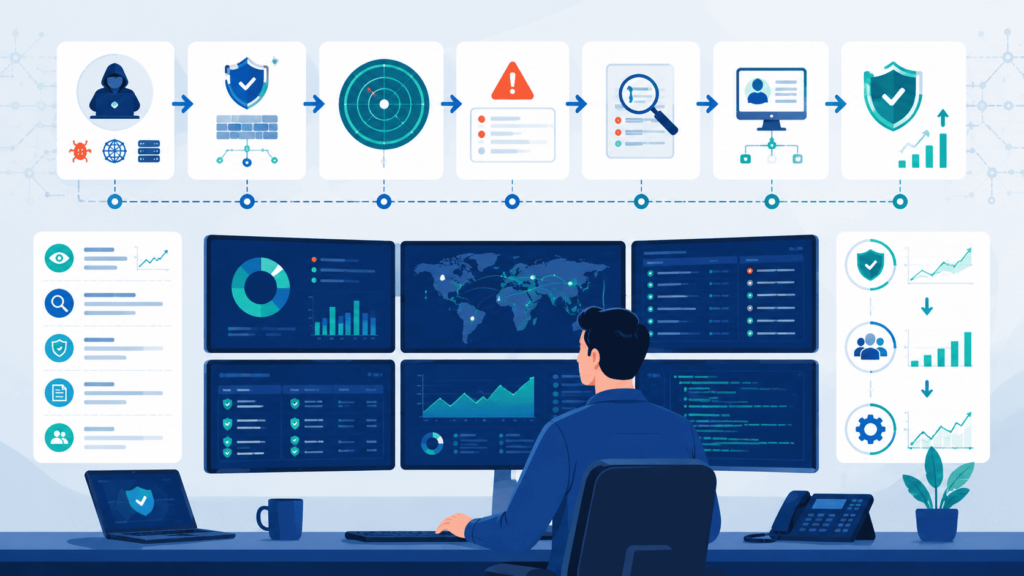
Blue teams find the gaps in their defenses before a real attacker finds them first.
Regular vulnerability scans miss a lot, they can’t tell you if your team would actually catch someone mid-attack. That’s where behavior-based testing comes in. It shows whether threat hunting works, whether the response team is ready, and whether your controls hold up when something realistic is thrown at them.
We’ve made a habit of rerunning the same simulation after we roll out new ATT&CK-based detection rules. It’s a simple test, but it works. If something slipped past us the first time and got caught the second time, that tells us the updated detection rules are actually doing their job.
Key Wins for Security Operations
A few things blue teams usually walk away with:
- Better coverage of ATT&CK techniques across the whole kill chain.
- Alerts that make more sense and aren’t just background noise.
- Investigations that move faster when actual incidents hit.
- Real proof that controls work, not just an educated guess.
- A SOC team that gets sharper with each testing round.
Doing this over and over is really what makes the improvement provable.
Why Is Repeatability Valuable?
Run the same test twice and you get something rare in security work: a fair comparison. You’re not guessing whether things got better. You can actually show it, side by side, before and after.
Pro Tip: Run the same scenario again every time you make a big change to your detection rules.
Which Tools Support ATT&CK Adversary Emulation?
A few platforms help teams run ATT&CK-based tests without doing everything by hand.
| Tool | Primary Use | Best For |
| MITRE CALDERA | Automated adversary emulation using ATT&CK techniques | Automated purple team exercises and security validation |
| Atomic Red Team | Individual ATT&CK technique testing | Detection engineering and control validation |
| Infection Monkey | Network attack simulation and validation | Testing lateral movement and network security posture |
| Commercial BAS Platforms | Continuous breach and attack simulation | Ongoing security validation in enterprise environments |
These tools matter most when you’re testing a lot, or when your environment is too big to check by hand every time.
Places we tend to see this kind of automation show up:
- Continuous validation
- Cyber range exercises
- Testing new security products
- SIEM testing
- Large enterprise setups
Automation helps, but it’s not a replacement for a skilled analyst. It just means that analysts can cover a lot more ground.
What Are Micro Emulation Plans?
Micro emulation plans are small tests. Quick ones. They check whether one specific defense actually works, instead of testing the whole attack chain at once. That is what makes them useful. A team does not need to run a full attack from start to finish just to get an answer on one thing.
Ideal Use Cases
We usually reach for micro plans when we need to check things like:
- Credential access validation to see if dumps get flagged
- Lateral movement testing between internal segments
- Command line activity and suspicious execution behaviors
- DNS detection testing for C2 channel monitoring
- Privilege abuse validation on critical system accounts
But for bigger jobs, like testing a whole attack from beginning to end, a full adversary emulation still works better. It just does.
When Are Full Plans Better?
Full plans take more time. More effort too. Still worth it for certain jobs. We have used them most for:
- Red team engagements simulating active adversaries
- Full intrusion emulation from initial access all the way to impact
- Big purple teaming exercises involving multiple units
- Executive readiness assessments during high-stakes drills
The Center for Threat-Informed Defense keeps pushing for testing that is practical and repeatable. That is the same standard we try to hold ourselves to, honestly.
How Can Network Threat Detection Teams Use Adversary Emulation?
Credits: HackerSPloit
Network Threat Detection (NTD) gives security operations a ground-truth view of what travels across the wire, regardless of whether endpoint agents are compromised, disabled, or simply missing. When you combine NTD with adversary emulation, the practice of executing realistic, threat-informed attack behaviors in a controlled environment, you turn passive monitoring into an active, evidence-based feedback loop.
Here is how network threat detection teams can leverage adversary emulation to find blind spots and systematically upgrade their defenses.
Validating Network Visibility Across Key Attack Vectors
Adversary emulation tests your network sensors against real-world tradecraft rather than static indicators of compromise (IOCs). By replaying techniques mapped to framework models like MITRE ATT&CK®, defenders can verify whether network telemetry actually captures behavioral patterns across critical phases:
- Internal Network Reconnaissance: Emulating port scans, Active Directory queries, and network share enumeration (e.g., using BloodHound or custom scripts) tests if NTD tools trigger on anomalous internal discovery traffic before an attacker maps out high-value targets.
- Lateral Movement: Executing techniques like remote service creation (PsExec), WMI execution, or SMB file transfers helps verify if network sensors detect east-west traffic anomalies between hosts that normally do not communicate.
- Command and Control (C2): Simulating beaconing behavior, domain fronting, DNS tunneling, and non-standard port communications measures your team’s ability to spot covert channels hiding in plain sight.
- Data Exfiltration: Running controlled, bulk data transfers or trickle-exfiltration over standard protocols (HTTP/S, DNS, FTP) tests whether bandwidth anomalies and suspicious outbound destinations generate alerts.
- DNS Anomalies: Injecting low-and-slow DNS requests, high-entropy queries, or fast-flux domains helps measure sensor sensitivity against DNS-based C2 and data staging.
Conducting Gap Analysis with Precision
Instead of guessing where network blind spots exist, adversary emulation provides an empirical baseline. Defenders compare the expected telemetry (what the attack emulation framework executed) against the actual telemetry (what the network sensors recorded and what the SIEM/NDR alerted on).
- Telemetry Gaps: The network traffic occurred, but sensors did not capture or log the raw protocol details.
- Detection Gaps: The network traffic was logged correctly, but no analytics or detection rules triggered an alert.
- Context Gaps: An alert was raised, but it lacked sufficient network metadata (e.g., missing JA3/JA4 fingerprints, process correlation, or flow details) for analysts to triage effectively.
How Should Results Influence Detection Engineering?
Adversary emulation is only as valuable as the detection engineering cycle it fuels. Once a test completes, the real work begins: turning test results into durable, behavior-based detection content.
A Structured Approach to Post-Test Tuning
- Prioritize Missed ATT&CK Techniques: Rank undetected behaviors by threat impact and likelihood rather than trying to fix everything at once. Focus first on high-risk lateral movement and C2 channels.
- Improve Analytics and Detection Content: Write or refine network rules (such as Suricata, Snort, or custom NDR queries) to focus on adversary behaviors and protocol deviations rather than brittle, easily changed IP addresses or file hashes.
- Validate Telemetry Quality: Ensure network taps, SPAN ports, and inline sensors are not dropping packets during high-throughput events or missing encrypted traffic flows.
- Re-test After Tuning: Re-run the exact emulation playbook that previously failed. Confirm that the new detection logic fires reliably without creating overwhelming analyst noise.
- Measure Defensive Coverage Over Time: Track metrics like detection coverage percentage, mean time to detect (MTTD), and telemetry completeness across successive emulation rounds to demonstrate tangible security improvement.
By treating detection engineering as an iterative, continuous loop, teams build genuine operational readiness. Continuous testing ensures that as attacker techniques evolve and network architectures change, your visibility keeps pace.
Would you like to explore specific open-source tools for network adversary emulation (like Atomic Red Team or Caldera), or dive deeper into writing network detection rules for a specific protocol?
What Mistakes Should Organizations Avoid?
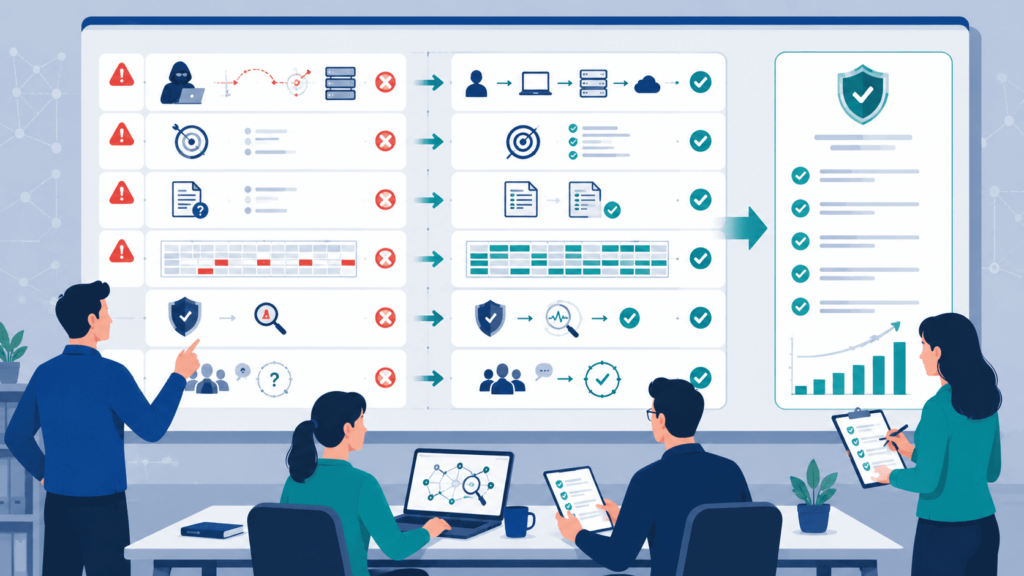
The biggest mistake teams make, over and over, is treating the MITRE ATT&CK® framework like a simple checklist. It isn’t a list of boxes to mark off, it is a living model of how attackers operate. Running random techniques without considering threat intelligence, realistic attack paths, or an adversary’s ultimate objective weakens the entire exercise and leaves you with misleading results.
Common Pitfalls in Adversary Emulation
- Random Technique Selection: Executing disparate attack steps without a coherent narrative or threat actor profile. Real attackers follow logical attack paths; your emulation tests should reflect that flow.
- Ignoring Threat Intelligence: Testing against arbitrary TTPs (Tactics, Techniques, and Procedures) rather than the specific threat actors actively targeting your industry, region, or tech stack.
- Missing Success Metrics: Running exercises without clear key performance indicators (KPIs). If you don’t define what “success” looks like, such as measuring time-to-detect or alert fidelity, you can’t track improvement.
- Testing Only Once: Treating adversary emulation as an annual event. Security posture decays quickly as networks change, software updates, and new employees join.
- Incomplete Telemetry Validation: Assuming that because an alert didn’t fire, the activity wasn’t detected. Failing to check whether the raw network logs or endpoint events were captured makes it impossible to fix the root cause.
Why Is Continuous Testing Necessary?
Attackers adapt their methods constantly. Defenses have to keep pace, or they fall behind fast. That is why regular, repeatable adversary emulation is essential, it sharpens detection engineering, tightens incident response workflows, and gives teams confidence that their controls can catch today’s adversary tactics, not just yesterday’s.
Continuous testing transforms your security posture from reactive to resilient through several ongoing actions:
- Adapting to Infrastructure Changes: Modern networks are in constant flux with new cloud assets, policy updates, and API integrations that can silently introduce blind spots.
- Validating New Detection Logic: Every time detection engineers deploy a new rule, continuous emulation proves whether it actually triggers under real-world attack conditions without flooding analysts with false positives.
- Keeping Pace with Evolving Tradecraft: As threat actors pivot to new bypass techniques or novel living-off-the-land (LotL) binaries, regular testing ensures your sensors adapt before an incident occurs.
- Building Analyst Muscle Memory: Frequent, controlled exercise keeps SOC analysts sharp, improving their triage speed and familiarity with subtle attack indicators.
Improvement has to be continuous. A single round of testing is never enough, building real operational readiness takes sustained, regular iteration over time.
Would you like to focus next on how to map your threat intelligence to realistic adversary emulation playbooks, or explore key metrics to track your detection coverage over time?
FAQ
What should an ATT&CK adversary emulation plan include?
A comprehensive emulation plan begins with an intelligence summary that defines the adversary profile and campaign objectives. It documents the operational flow, attack narrative, and TTP mapping using MITRE ATT&CK. The plan also includes ATT&CK tactics, ATT&CK techniques, techniques mapping, required resources, execution steps, expected outcomes, and success criteria so every adversary emulation exercise remains consistent and measurable.
How does adversary emulation improve defensive readiness?
Adversary emulation improves threat-informed defense by testing security controls against realistic attacker behavior. The exercise supports red teaming, purple teaming, security validation, control validation, and detection engineering. It also strengthens incident response, threat hunting, security operations, response readiness, detection content, and defensive coverage by identifying weaknesses before attackers can exploit them.
Which attack stages should an emulation exercise cover?
A complete exercise should follow the attack chain across the kill chain from beginning to end. The scenario should include initial access, execution, persistence, privilege escalation, defense evasion, credential access, discovery, lateral movement, collection, command and control, exfiltration, and impact. Covering every phase creates realistic attack paths and produces more meaningful evaluation results.
How can organizations create realistic attack scenarios?
Organizations can build realistic scenarios by using threat emulation, campaign emulation, actor emulation, or threat actor emulation based on a defined threat model. The scenario can incorporate APT emulation, phishing simulation, living off the land, command-line activity, post-exploitation, network reconnaissance, host reconnaissance, privilege abuse, and authentication attacks that reflect common access vectors and attacker tradecraft.
How do teams measure the success of adversary emulation?
Teams measure success by reviewing results from breach simulation, attack simulation, intrusion emulation, compromise simulation, and breach emulation activities. They perform detection gap analysis, compare findings with the evaluation plan, review ATT&CK evaluations, assess security product testing, endpoint detection, SIEM testing, and cyber defense assessment, and update the emulation framework, emulation workflow, emulation library, and attack path modeling as needed.
Turn Better Testing Into Stronger Defense
You can have strong security tools in place, but that doesn’t mean they’ll catch real attacks when they happen. That’s why testing with realistic attacker behavior matters. It shows where detection works, where it falls short, and gives you clear steps to improve without relying on guesswork.
If you’re ready to see how your defenses perform, offer a practical way to validate detection coverage with realistic adversary testing. Learn how its Network Threat Detection approach helps strengthen visibility across your environment by visiting.
References
- https://ctid.mitre.org/roadmap/
- https://www.nature.com/articles/s41598-025-12948-x#content