

Analysis, intelligence & context (provider focus) shape how modern teams approach network threat detection. Watching for suspicious traffic alone no longer works when attackers rely on stolen credentials, blend into legitimate activity, and move through environments without deploying malware.
Effective detection combines network visibility with threat intelligence, behavioral insights, and an understanding of which systems matter most to the business. Network Threat Detection helps security teams prioritize what deserves attention, understand potential impact, and respond with greater confidence. Keep reading to learn how to build this approach.
Detection in Focus: What Matters Most
Modern threat detection depends on more than alerts and logs. The sections below highlight the core ideas that help security teams find meaningful threats, reduce noise, and make faster decisions.
- Threat detection works better when you combine behavior analysis, outside intelligence, and your own business risks.
- Attackers now focus on stealing credentials and moving sideways through networks, which older tools often miss.
- Using intelligence and context helps teams focus on real threats, cut down on false alarms, and respond faster.
How Can Proactive Network Threat Modeling Reduce Risk?

Good security teams do not wait for attackers to reveal weak spots. They look for them first.
In our work with organizations across different industries, we have found that Network Threat Detection becomes much stronger. When teams understand how an attacker could move through the environment before an incident occurs.
Several proven frameworks support this process, including STRIDE, Attack Trees, and Attack Graphs. These methods help security teams evaluate risks such as spoofing, privilege abuse, unauthorized data access, service disruption, and weak segmentation controls.
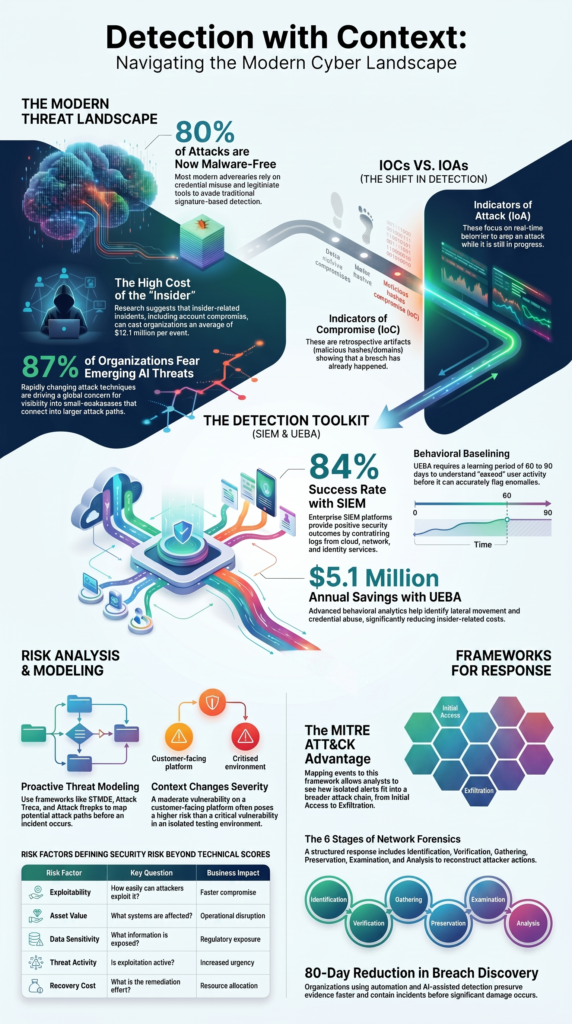
The World Economic Forum reports that 87% of organizations are increasingly concerned about emerging cyber threats, including attacks supported by AI. That concern is well founded. Attack techniques continue to change, and many organizations struggle to see how small weaknesses can connect into larger attack paths.
Common outputs from threat modeling include:
- Attack path identification
- Critical asset mapping
- Security control validation
- Risk exposure analysis
We provide network threat modeling and risk analysis tools because visibility is often the first challenge. Organizations that build threat modeling into regular security reviews usually uncover weaknesses earlier and make better decisions about where to strengthen defenses.
Why Do Network Security Risk Analysis Techniques Need Context?
One lesson we have learned over the years is that technical severity alone rarely tells the full story. Effective risk analysis looks beyond vulnerability scores and considers how an issue could affect business operations, sensitive data, and critical systems.
For example, a moderate vulnerability on a customer-facing platform may create far more risk than a severe vulnerability isolated inside a testing environment. Context changes everything.
Human behavior also plays a major role. Research from Mimecast estimates that insider-related incidents can cost organizations around $13.1 million per event. That makes credential misuse, account compromise, and insider threats important parts of any risk analysis process.
Security teams often evaluate risk using several factors:
| Risk Factor | Security Question | Business Impact |
| Exploitability | How easily can attackers exploit it? | Faster compromise |
| Asset Value | What systems are affected? | Operational disruption |
| Data Sensitivity | What information is exposed? | Regulatory exposure |
| Threat Activity | Is exploitation active? | Increased urgency |
| Recovery Cost | What is the remediation effort? | Resource allocation |
Network security risk analysis becomes more useful when historical attack trends, asset context, and current threat activity are evaluated together. This approach helps organizations focus resources where they matter most instead of chasing every alert equally.
How Does Security Information and Event Management (SIEM) Improve Visibility?
Modern environments generate an enormous amount of security data every day.
Logs arrive from firewalls, cloud platforms, applications, endpoints, identity services, and network devices. Without a central system, finding meaningful threats can feel like searching for a needle in a haystack. This is where Security Information and Event Management (SIEM) platforms play an important role.
A SIEM brings security data into one place and helps analysts connect events that might otherwise appear unrelated. When configured correctly, it provides broader visibility into suspicious activity and supports faster investigation.
We often see organizations struggle with alert fatigue during early SIEM deployments. Large numbers of alerts can overwhelm analysts if log sources are not tuned properly. Data normalization, alert refinement, and ongoing monitoring adjustments are essential parts of a successful implementation.
Studies show that 84% of enterprises report positive security outcomes after adopting SIEM technologies. At the same time, many organizations now use AI-assisted monitoring to improve detection speed and reduce manual effort.
Core SIEM capabilities include:
- Security log management
- Threat detection automation
- Incident response automation
- Security event correlation
While SIEM provides visibility, understanding whether activity is truly suspicious often requires behavioral analysis. That is where UEBA becomes valuable.
Why Is User and Entity Behavior Analytics (UEBA) Essential Today?
Attackers increasingly rely on stolen credentials and legitimate access instead of malware.
Because of this shift, traditional detection rules do not always catch suspicious behavior. User and Entity Behavior Analytics (UEBA) helps fill that gap by learning how users, devices, applications, and servers normally behave over time.
Rather than looking only for known signatures, UEBA focuses on patterns. It builds behavioral baselines and identifies activity that falls outside expected behavior. In most environments, meaningful baselines develop during a learning period of roughly 60 to 90 days.
We have seen UEBA uncover threats that generated little or no attention from conventional monitoring tools. An employee accessing systems at unusual hours, a service account suddenly moving laterally across the network, or a user downloading large amounts of sensitive data can all stand out through behavioral analysis.
According to the Ponemon Institute, organizations using advanced UEBA capabilities can save approximately $5.1 million annually in insider-related costs.
Common detection scenarios include:
- Account compromise detection
- Credential abuse prevention
- Insider threat detection
- Lateral movement detection
When combined with Network Threat Detection, UEBA provides valuable context that helps security teams identify risky behavior sooner and investigate incidents with greater confidence.
How Can Threat Intelligence Feeds Strengthen Detection?
Threat intelligence becomes far more useful when it helps analysts make better decisions, not when it simply adds more data.
Many organizations collect large volumes of security information but still struggle to understand which threats deserve attention. Threat intelligence feeds help close that gap by providing outside context. They allow teams to compare internal activity against known malicious infrastructure, active attack campaigns, and newly observed techniques used by threat actors.
In our experience, the quality of intelligence matters more than the quantity. A smaller set of reliable intelligence sources often produces better results than dozens of feeds that generate noise. Analysts need information they can trust, especially when responding to potential incidents under time pressure.
Research published by the Association for Computing Machinery (ACM) identifies data quality as one of the biggest challenges in threat intelligence sharing. Poor-quality intelligence can increase false positives and distract teams from real threats.
Security teams often evaluate intelligence using metrics such as:
- True positive rates
- False positive rates
- Detection delay
- Threat intelligence quality metrics
When combined with behavioral analytics and Network Threat Detection, threat intelligence helps organizations spot emerging threats earlier and focus investigations on activity that carries real risk.
Should Security Teams Prioritize IoAs Over IoCs?
Many security teams still rely heavily on indicators of compromise, but attackers are leaving behind fewer traditional signs than they once did.
Indicators of Compromise (IoCs) point to evidence that a breach has already occurred. Examples include malicious file hashes, known malware signatures, suspicious domains, or unauthorized registry changes. These indicators remain valuable during investigations, but they often appear after damage has started.
Indicators of Attack (IoAs) focus on behavior instead of artifacts. They look for actions that suggest an attack is underway. This approach gives security teams an opportunity to intervene before attackers reach their objectives.
The difference of Indicators of Compromise (IoCs) vs. IoAs is becoming more important as threat actors increasingly use legitimate tools and stolen credentials. Industry research suggests that around 80% of attacks now involve malware-free techniques linked to account misuse.
The comparison below highlights the distinction:
| Category | IoC | IoA |
| Timing | After compromise | During attack |
| Focus | Evidence | Behavior |
| Purpose | Investigation | Prevention |
| Detection Style | Retrospective | Real-time |
Examples of IoAs include unusual login activity, privilege escalation attempts, abnormal access patterns, and suspicious data transfers. Organizations that incorporate IoA-driven detection often gain earlier visibility into attacks and reduce the time adversaries remain active in the environment.
How Does the MITRE ATT&CK Framework Improve Detection?
Credits: SANS Digital Forensics and Incident Response
Security teams need a consistent way to understand how attackers operate. The MITRE ATT&CK Framework provides that structure.
Rather than focusing on individual threats, ATT&CK organizes known adversary behaviors into tactics and techniques observed in real-world attacks. This allows analysts to connect security events to larger attack patterns and understand where activity fits within an intrusion.
We often use ATT&CK mapping during detection reviews because it exposes gaps that might otherwise go unnoticed. A company may have strong visibility into initial access attempts yet lack monitoring for lateral movement or credential abuse.
Insights from Medium indicate
“Think of ATT&CK as a dictionary or reference mechanism that your team can use to understand threat actor techniques and tactics. But keep in mind that the context of how and when techniques are used is equally important to effective testing.” – Medium
Analysts can track activity across multiple attack stages, including:
- Initial Access
- Execution
- Persistence
- Privilege Escalation
- Lateral Movement
- Exfiltration
Several practical benefits come from ATT&CK adoption:
- Faster threat triage
- Consistent attack classification
- Improved threat hunting
- Better incident response planning
Organizations that align detections with ATT&CK techniques gain a clearer picture of attacker behavior. Instead of responding to isolated alerts, security teams can see how events fit into a broader attack chain and prioritize investigations more effectively.
What Does an Effective Network Forensics Investigation Process Look Like?
Once a security incident occurs, understanding exactly what happened becomes critical. Network forensics provides the evidence needed to reconstruct events, determine attacker actions, and support future improvements.
In a recent analysis by Chris Sanders
“A question well stated is a problem half solved. There should always be time to stop and consider the investigative question you’re trying to answer before you go diving into evidence.” – Splunk
From what we have seen during investigations, the first hours after an incident are often the most important. Evidence can disappear quickly if systems are modified before proper collection procedures begin.
Most forensic investigations follow a structured process that includes:
- Identification
- Verification
- Gathering
- Preservation
- Examination
- Analysis
During these stages, investigators examine network traffic, review logs, reconstruct activity timelines, and document findings. Network packet analysis often reveals details that are difficult to see through log data alone.
Common forensic activities include:
- Network packet analysis
- Data breach investigation
- Traffic reconstruction
- Evidence documentation
Organizations using automation and AI-assisted detection have reportedly shortened breach discovery timelines by around 80 days. Faster detection helps preserve evidence and improves the chances of containing an incident before significant damage occurs.
Asset Management and Vulnerability Context
Many organizations manage thousands of vulnerabilities at any given time. Treating every issue as equally important quickly overwhelms security teams and slows remediation efforts. Context helps separate routine findings from risks that could seriously affect the business.
We regularly see situations where a lower-severity vulnerability presents greater danger than a critical one. A flaw on an internet-facing system that stores sensitive customer information may deserve immediate attention, while a higher-scoring vulnerability in an isolated environment may pose little short-term risk.
Effective vulnerability management goes beyond CVSS scores and technical ratings. Teams need to understand how each asset supports business operations and whether attackers can realistically reach it.
Useful asset context often includes:
- Business criticality
- Data sensitivity
- User exposure
- Internet accessibility
- Asset ownership
- Known exploit activity
Research continues to show that many organizations face protection and compliance gaps despite significant investments in security controls. Without context, remediation efforts often focus on the wrong priorities.
We provide threat modeling and risk analysis tools because vulnerability data alone rarely tells the full story. When asset context is combined with Network Threat Detection, security teams gain a clearer understanding through longer-term planning.
How Does Threat Prioritization and Risk Scoring Improve Response?
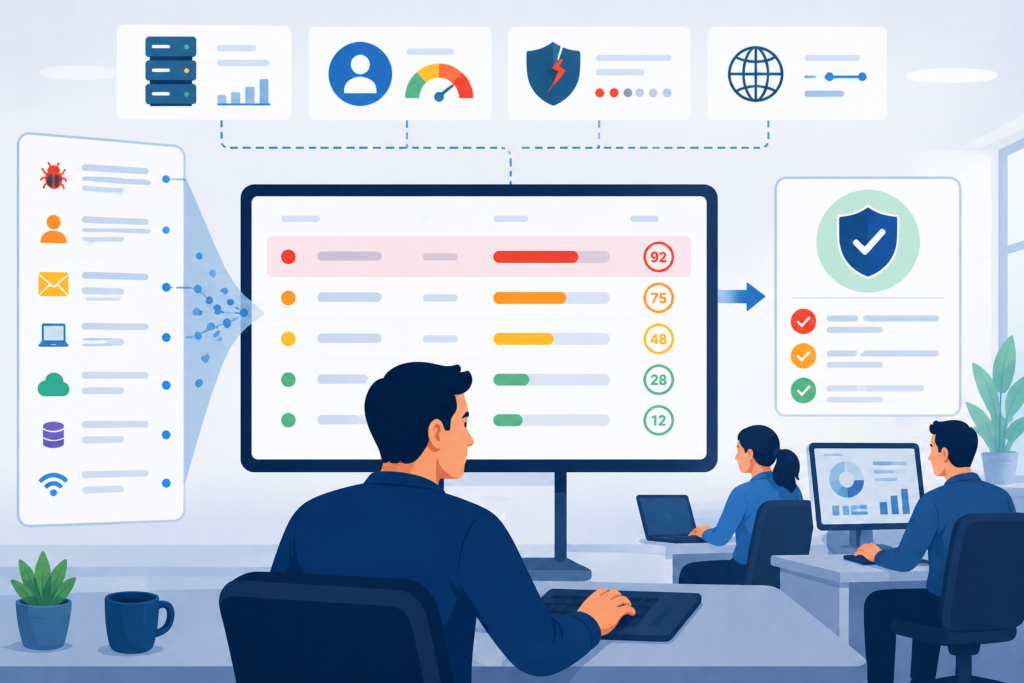
Security teams receive far more alerts than they can realistically investigate. This challenge has grown as environments become larger, more connected, and more dependent on cloud services. Even mature security operations centers can struggle to distinguish high-risk threats from routine noise. Risk scoring helps solve that problem.
Rather than evaluating alerts in isolation, modern risk models combine multiple sources of information. They look at attacker behavior, asset value, identity risk, vulnerability exposure, and threat intelligence to determine which events deserve attention first.
In practice, this approach allows analysts to focus on incidents that present the greatest business risk instead of spending time on low-impact activity.
Most organizations classify alerts using categories such as:
- Critical
- High
- Medium
- Low
Advanced detection platforms increasingly use machine learning and behavioral analytics to improve scoring accuracy. While technology helps, context remains the most important factor. An alert tied to a critical business system often carries more urgency than a technically severe event affecting a low-value asset.
Organizations that adopt structured prioritization typically improve response times, allocate resources more effectively, and reduce analyst fatigue.
FAQ
How does threat intelligence feeds integration improve detection accuracy?
Threat intelligence feeds integration gives security teams information about emerging threats, suspicious domains, and known attacker techniques. When combined with security event correlation and real-time threat monitoring, it helps analysts identify which alerts need immediate attention.
This approach also supports false positive reduction cybersecurity efforts by adding context before teams escalate an investigation.
Why are user entity behavior analytics important for modern detection?
User entity behavior analytics help teams identify unusual activity that rule-based tools may overlook. Through behavioral baseline establishment, peer group analysis UEBA, and UEBA machine learning detection, organizations can detect changes in user behavior more quickly.
These methods improve account compromise detection and strengthen credential misuse prevention before serious damage occurs.
How do organizations prioritize thousands of security alerts?
Organizations often use threat prioritization risk scoring to determine which alerts require action first. Asset management vulnerability context, CVSS scoring risk assessment, and vulnerability assessment prioritization help teams understand business impact and potential risk.
This process creates prioritized security alerts and enables security operations center SOC teams to focus on the most important threats.
What role does network forensics play after a suspected breach?
The network forensics investigation process helps investigators understand how an incident happened and what systems were affected. Analysts use digital forensics network traffic, network packet analysis, and historical security data analysis to trace attacker activity.
This information supports data breach investigation efforts and helps improve future detection and response strategies.
How can organizations detect malware-free attacks effectively?
Malware-free attack detection requires organizations to look beyond traditional signature-based methods. Teams use cybersecurity anomaly detection and behavioral analysis network security to identify suspicious activity.
They also monitor indicators of attack IoA, lateral movement detection, exfiltration detection methods, and insider threat detection systems activity. Threat hunting methodologies further help uncover hidden threats that evade conventional defenses.
The Future of Smarter Threat Detection
Modern attacks don’t always look suspicious, which makes context just as important as visibility. The right mix of intelligence and analysis helps teams spot threats sooner, cut through false alerts, and respond with greater confidence. That’s the reality security teams face every day.
As risks continue to shift, stronger decisions depend on seeing the bigger picture before damage is done. Ready to strengthen your defenses? Explore how Network Threat Detection can help.
References
- https://medium.com/@sehgalrudra07/mitre-tryhackme-walkthrough-dba43b764965
- https://www.splunk.com/en_us/pdfs/gated/ebooks/bluenomicon-the-network-defenders-compendium.pdf