
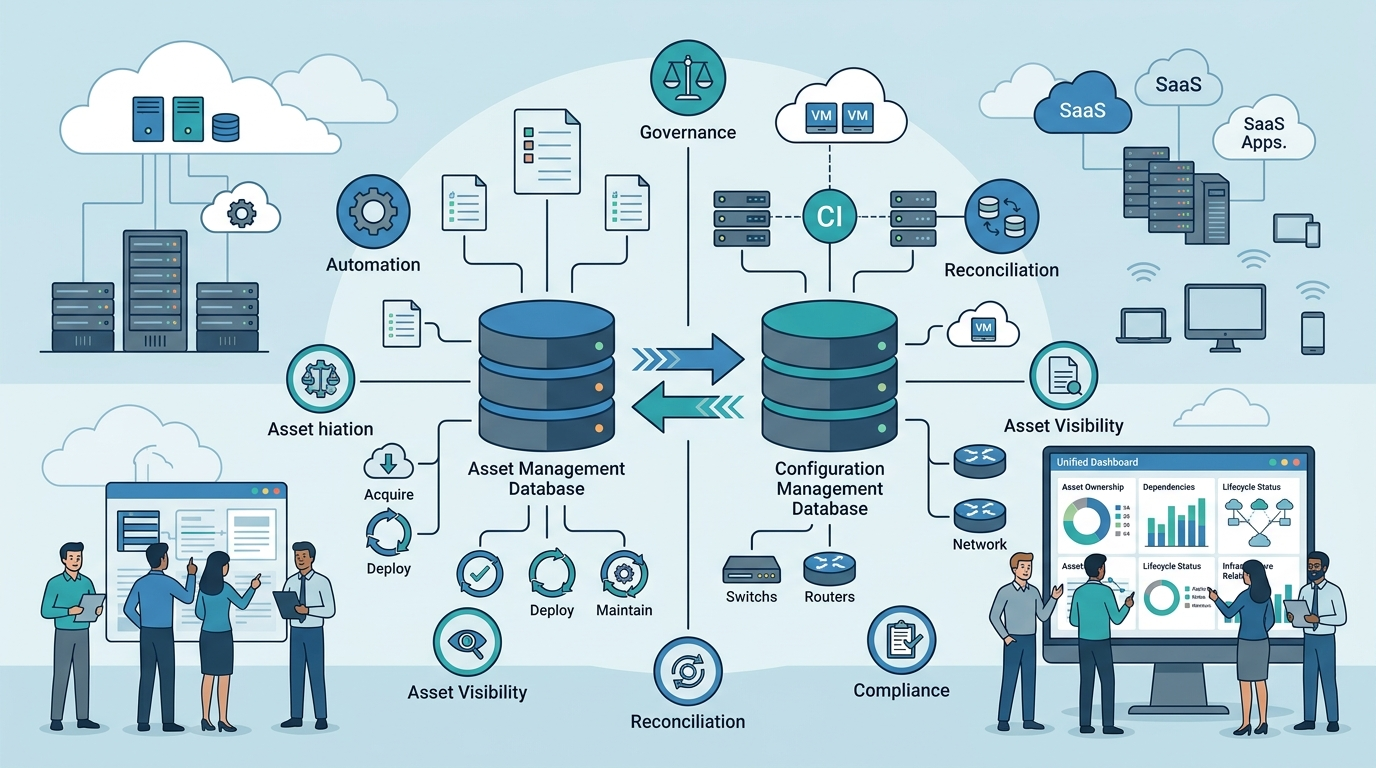
Asset management database integration CMDB helps organizations create a reliable view of assets by connecting lifecycle records with operational configuration data. When financial, operational, and security information is stored in separate systems, teams often face inconsistent records, unclear ownership, and limited visibility.
Integrating AMDB and CMDB data improves asset accuracy, governance, compliance, and decision-making. It also strengthens asset tracking as environments grow across cloud, hybrid, and on-premises infrastructure. At Network Threat Detection, we often see better security outcomes when asset data is consistent and accessible. Keep reading to learn how to build effective integrations and avoid common pitfalls.
CMDB Integration at a Glance
Together, these practices help organizations build a trusted source of truth that supports operations, security, compliance, and long-term asset governance.
- Asset management database integration CMDB connects financial asset records and operational configuration data to create a more complete view of IT assets and infrastructure.
- Governance, normalization, and automation improve CMDB asset data accuracy, lifecycle management, and audit readiness.
- During security assessments, we often find unmanaged assets before inventory teams do. Network threat detection can uncover those gaps early and support reconciliation efforts.
What Is the Difference Between an Asset Management Database and a CMDB?
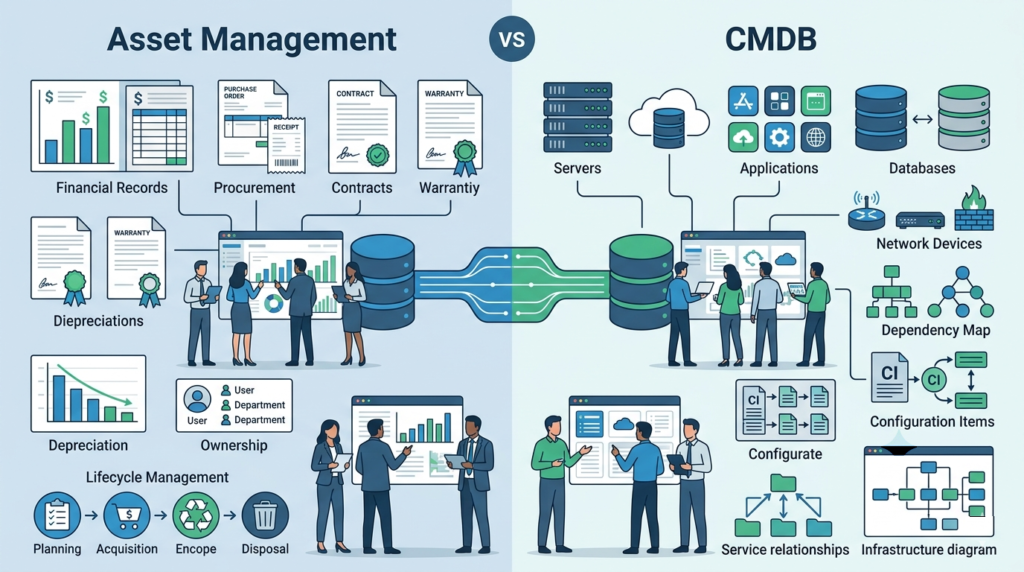
An AMDB manages financial and lifecycle information. A CMDB manages technical configurations, dependencies, and operational relationships. Both are important, but they solve different problems.
Many organizations assume the two systems serve the same purpose. In practice, they answer different questions. Finance teams want to know what assets cost, who owns them, and when they should be replaced. Operations teams need to understand how systems connect, what services depend on them, and how changes affect production environments.
The ITIL 4 framework separates asset management from service configuration management for this reason. One focuses on business value and lifecycle control. The other focuses on service reliability and operational awareness.
AMDB vs. CMDB Comparison
| Area | AMDB | CMDB |
| Primary Focus | Financial management | Operational management |
| Owner | Procurement and Finance | IT Operations |
| Core Records | Assets | Configuration Items (CIs) |
| Key Metrics | Cost, warranty, depreciation | Dependencies, versions, relationships |
| Lifecycle | Procure to retire | Discover to change |
| Business Purpose | Asset value optimization | Service stability |
| Primary Users | Procurement teams | Infrastructure teams |
A Configuration Item (CI) can be a server, application, database, network device, or another managed component.
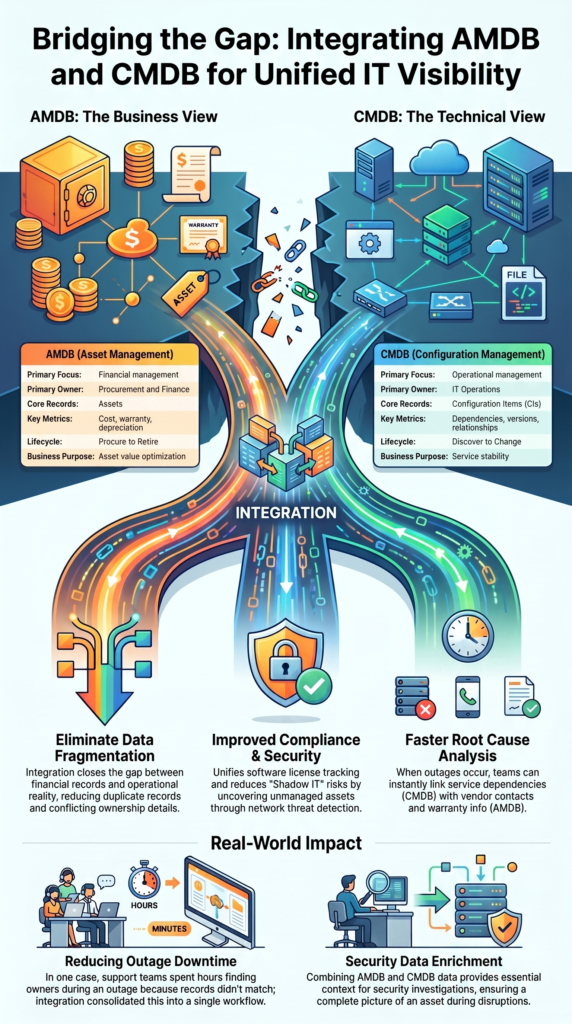
The AMDB tracks ownership, contracts, depreciation, and warranties. The CMDB tracks relationships, software versions, dependencies, and configuration changes. When both systems work together, organizations gain a stronger and more complete infrastructure inventory.
Why Are Organizations Integrating AMDB and CMDB Systems?
The biggest reason is visibility. Integration closes the gap between financial ownership and operational reality.
Organizations often discover duplicate records, conflicting ownership details, and outdated asset information when the two systems operate independently. We regularly see assets listed as active in one platform while appearing retired in another.
Bringing the data together creates several practical benefits:
- Fewer duplicate asset records
- Better IT service management database accuracy
- Improved software license compliance
- Faster root cause analysis
- Reduced shadow IT risk
- Stronger lifecycle tracking
- Better audit preparation
A CMDB can show service dependencies and affected systems. The AMDB can provide vendor contacts, contract details, warranty information, and ownership records. Combining these sources also reinforces the importance of security data enrichment context when teams need a complete picture of an asset during investigations or operational disruptions.
In one environment we reviewed, support teams spent hours identifying the correct owner during outages because operational and financial records did not match. After integration, that information was available in a single workflow.
The result is less confusion, faster decisions, and better coordination between operations, security, procurement, and finance teams.
How Does an Integrated AMDB-CMDB Architecture Work?
Credits: Knewget
Most organizations keep the AMDB and CMDB as separate systems. The goal is synchronization, not merging everything into one database.
A mature integration approach uses shared identifiers, reconciliation rules, and automated synchronization processes. Each platform remains responsible for its own data while exchanging information with the other.
Typical Integration Workflow
- Asset procurement
- Asset registration in AMDB
- Automated asset discovery CMDB process
- CMDB Configuration Item creation
- Asset reconciliation CMDB matching
- Continuous synchronization
- Retirement and archival
Consistent identifiers make the process work.
Common shared fields include:
- Asset ID
- Serial number
- Lifecycle status
- Business owner
- Device owner
- Location
- Service relationships
When a new server enters production, discovery tools detect it and create a configuration item. Reconciliation rules then match the CI with the correct financial record using a serial number or asset identifier.
We have found that organizations achieve better results when synchronization rules are simple and clearly documented. Complex matching logic often creates errors that become difficult to troubleshoot later.
A structured architecture supports asset-to-CI mapping, lifecycle tracking, and relationship management without creating unnecessary complexity.
Why Does Auto-Discovery Often Create a CMDB Data Swamp?
Auto-discovery can improve visibility, but it can also damage data quality if organizations lack governance controls.
This problem appears frequently during large infrastructure projects. Discovery tools collect thousands of records in a short period. The volume looks impressive, but the quality often tells a different story.
Common issues include:
- Duplicate records
- Inconsistent naming standards
- Retired asset conflicts
- Orphaned cloud resources
- Unowned virtual machines
- Missing ownership data
Discovery Sources That Frequently Conflict
| Source | Common Issue |
| SCCM | Duplicate endpoints |
| Microsoft Intune | Naming differences |
| AWS Discovery | Cloud tagging gaps |
| Azure Discovery | Resource duplication |
Infrastructure teams often describe this situation as a “CMDB swamp.” Data keeps growing while trust in the data declines.
We have seen organizations collect information from cloud platforms, endpoint management tools, vulnerability scanners, and monitoring systems without first defining standards. The result is confusion rather than visibility.
Before adding new data sources, organizations should establish:
- Naming standards
- Normalization rules
- Ownership validation
- Asset classification controls
- Reconciliation workflows
Discovery works best when governance comes first. Otherwise, automation can spread bad data faster than teams can correct it.
How Should Organizations Design the AMDB-to-CMDB Relationship Model?
The most effective designs separate financial ownership from operational ownership while connecting both through governed relationships.
Many failed projects try to store every attribute in one location. That approach usually creates ownership disputes and synchronization problems.
Experienced architects often rely on a Golden Record strategy. Each field has a defined system of record, and other systems consume that information rather than overwrite it.
Recommended Relationship Structure
| Record Type | System of Record |
| Cost | AMDB |
| Warranty | AMDB |
| Vendor Contract | AMDB |
| IP Address | CMDB |
| Software Version | CMDB |
| Service Dependency | CMDB |
| Application Relationship | CMDB |
A strong governance model should:
- Define field ownership
- Prevent overwrite conflicts
- Set reconciliation priorities
- Create validation workflows
- Maintain audit history
For example, depreciation belongs in the AMDB. Configuration and dependency data belong in the CMDB. Relationship mapping becomes even more valuable when organizations apply data enrichment for contextual analysis to connect technical assets with business ownership, service dependencies, and operational risk factors.
We have found that organizations with clear ownership rules spend less time resolving synchronization conflicts. Teams know where information originates and who is responsible for maintaining it. That clarity improves data quality and makes long-term management far easier.
How Can Organizations Prevent API Bottlenecks and Synchronization Failures?
Large-scale integrations can place significant pressure on APIs, databases, and synchronization services.
As discovery programs expand, infrastructure teams often run into performance issues. These problems may not appear during testing but become obvious in production environments.
Common risks include:
- API rate limits
- Large payload processing
- Database lock contention
- Synchronization loops
- Reconciliation failures
Several practices consistently reduce these risks:
- ETL staging layers
- Batch synchronization jobs
- API throttling
- Validation before updates
- Continuous monitoring
Rather than sending discovery data directly into production systems, many organizations use a staging environment. We recommend this approach because it creates a safe place to validate records before they affect operational workflows.
Our assessments have shown that staging environments reduce failed updates, improve reconciliation accuracy, and limit service disruptions during large synchronization jobs.
The objective is not speed at any cost. Reliable synchronization matters more than rapid synchronization. A slower process that produces accurate records is far more valuable than a fast process that introduces errors across thousands of assets.
How Do Cloud, Containers, and Modern Infrastructure Change CMDB Integration?
Cloud and containerized environments have changed how organizations think about asset management.
Traditional CMDB designs assumed servers remained online for years. Modern infrastructure behaves very differently. Resources may appear, disappear, and scale automatically within minutes.
Examples include:
- Virtual machines
- Containers
- Kubernetes workloads
- Docker environments
- Serverless functions
- Cloud-native services
Tracking every temporary resource as an individual configuration item can create overwhelming database growth.
Instead, many organizations focus on persistent assets and meaningful relationships.
Recommended practices include:
- Track parent infrastructure assets
- Group transient resources
- Avoid CI explosion
- Define retention thresholds
- Use relationship-based modeling
We have seen environments generate thousands of short-lived containers every day. Storing every instance as a long-term CI provided little operational value and significantly increased administrative overhead.
A better approach is to track the infrastructure that supports those workloads and maintain the relationships that matter for service delivery, security analysis, and operational visibility.
Insights from O’Reilly Media indicate
“The reason most CMDB initiatives fail is ambition… They try to track every switch port, virtual machine, and SaaS license simultaneously. The result is a data swamp, too much noise, not enough signal. We took a different approach. We drew a small circle around a specific domain: Kubernetes workloads.” – O’Reilly Media
What Governance Practices Keep Integrated Databases Accurate?
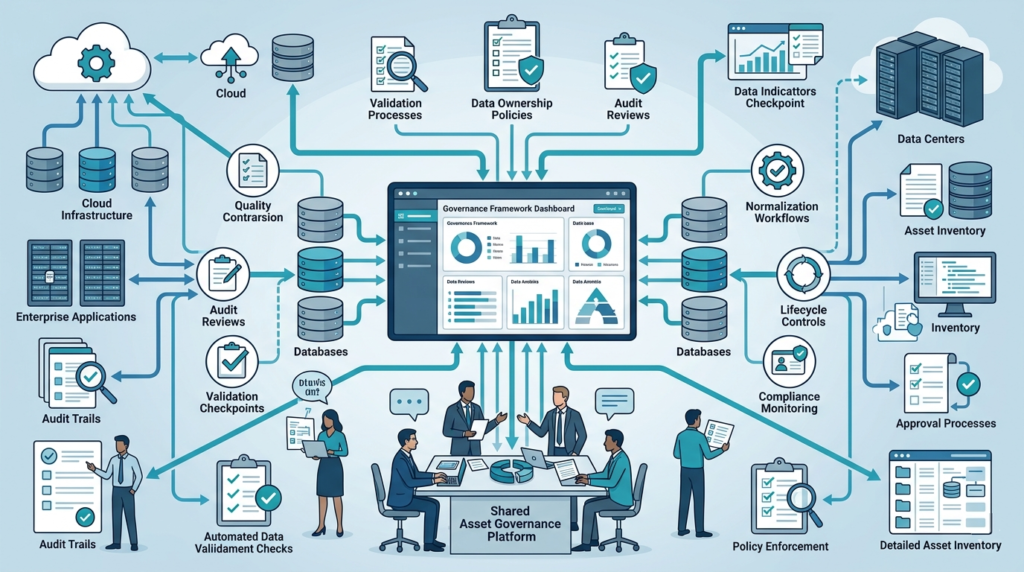
Many integration challenges begin with unclear ownership, inconsistent standards, and weak lifecycle controls. In our experience, governance failures create more problems than technical limitations.
An effective governance framework should include:
- Data ownership policies
- Normalization standards
- Retirement procedures
- Audit processes
- Data quality reviews
Each team should own specific data domains.
For example:
- Finance owns depreciation data
- Procurement owns contract data
- Operations owns configuration data
- Security owns classification policies
Our threat modeling and risk analysis work often uncovers unmanaged devices, undocumented systems, and inventory gaps that affect both security and compliance. Governance efforts also benefit from adding user identity information to logs because ownership and accountability become easier.
Strong governance creates accountability. It also helps organizations maintain accurate records as infrastructure grows across cloud, hybrid, and on-premises environments.
Without clear ownership, even the most advanced integration platform will struggle to maintain reliable data over time.
As noted by Solix Technologies
“Effective governance is critical for ensuring the accuracy and reliability of CMDB tools. Key requirements include: 1. Data Entry Protocols… 2. Regular Audits… 3. Change Management… Integrate change management processes to ensure that updates to configuration items are reflected in the CMDB in real-time.” – Solix Technologies
FAQ
How can asset management database integration CMDB improve audit readiness?
Asset management database integration CMDB helps organizations keep financial and operational records aligned. Auditors often need proof of asset ownership, lifecycle history, configuration changes, and retirement status.
When data is synchronized across systems, teams can produce accurate records faster. Strong asset inventory synchronization CMDB processes and a reliable IT asset database management system help reduce missing information, improve record consistency, and support compliance requirements.
What makes asset to CI mapping difficult in large environments?
Asset to CI mapping becomes difficult when organizations manage assets across multiple platforms, locations, and cloud environments. Duplicate records, inconsistent naming standards, and missing identifiers can prevent accurate matches.
Effective CMDB asset relationship mapping and asset reconciliation CMDB processes help connect assets with CMDB configuration items CI. This creates a more reliable IT infrastructure inventory database and improves visibility into how assets support business services.
Why is CMDB asset data accuracy important for daily operations?
CMDB asset data accuracy affects many day-to-day IT activities, including incident response, change management, and capacity planning. When records contain outdated or incorrect information, teams may spend extra time troubleshooting problems or assessing system impacts.
Organizations can improve accuracy through CMDB asset data validation, asset metadata management CMDB practices, and strong configuration item database management controls that keep information current and reliable.
How does automated asset discovery CMDB support inventory management?
Automated asset discovery CMDB continuously identifies devices, applications, and infrastructure components as they enter the environment. This reduces the need for manual inventory updates and helps organizations maintain better visibility.
When combined with CMDB automated asset ingestion, ITAM database synchronization, and CMDB asset data synchronization processes, discovery tools help keep the IT asset configuration database and asset lifecycle management database accurate and up to date.
What should organizations consider before starting ITAM CMDB integration?
Before starting ITAM CMDB integration, organizations should review data quality, ownership responsibilities, and integration requirements. Teams should identify which system serves as the source of truth for specific data fields and establish clear governance rules.
A well-defined asset database integration strategy, supported by a scalable asset management database architecture and asset management database governance framework, helps improve long-term data consistency and operational efficiency.
Build a CMDB Your Teams Can Actually Trust
Asset management database integration CMDB delivers the most value when data remains accurate, governed, and consistently maintained over time. Strong integration depends on reliable records, clear ownership, and regular validation of relationships across your environment.
To strengthen asset visibility and uncover hidden risks, explore how Network Threat Detection helps identify unmanaged assets and improve security oversight. Its threat modeling and risk analysis capabilities provide valuable context that supports a more accurate, resilient, and trusted CMDB strategy.
References
- https://www.oreilly.com/radar/the-end-of-the-sync-script-infrastructure-as-intent/
- https://www.solix.com/blog/cmdb-tools-the-accuracy-problem-that-makes-every-downstream-decision-unreliable/