
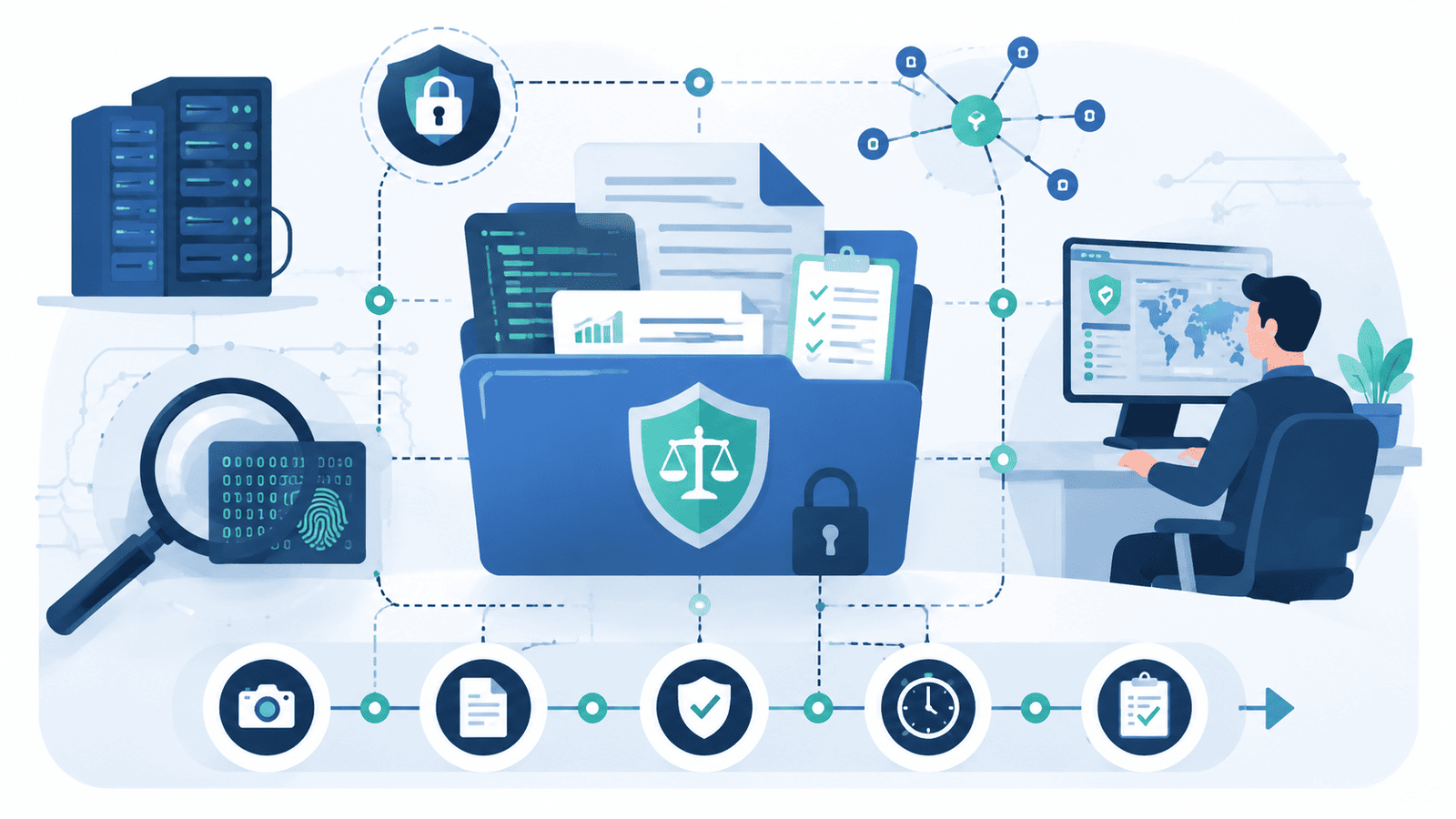
Network evidence is strongest when its collection, scope, integrity, and source are documented from start to finish. For Network Threat Detection, this means treating evidence as a process, not a folder full of logs. Before collecting anything, define what you can collect, why you need it, and how you’ll protect it. Record each step so investigators can trace the evidence later. Keep reading for a practical workflow Network Threat Detection can use during internal investigations and network security reviews.
Evidence Collection Essentials: Legal Network Forensics Quick Wins
- Establish legal authority first. Define the scope, purpose, and authorization before collecting any network evidence.
- Preserve evidence before analysis. Prioritize volatile network data that can disappear quickly, such as active connections and memory-related information.
- Maintain integrity and provenance together. Use SHA-256 hashing and a clear chain of custody to prove evidence has not been altered.
What Makes Network Evidence Legally Defensible?
Network evidence is inherently fragile, highly volatile, and easily challenged in court or regulatory proceedings. To be legally defensible, network evidence must withstand rigorous scrutiny regarding how it was identified, collected, preserved, and documented.
Here is what makes network evidence legally defensible, grounded in established forensic standards and operational best practices.
Legal Permission and Scope Authorization
Before any packets or logs are captured, the legal and organizational authority to collect that data must be explicitly established. Scope creep or unauthorized collection can instantly disqualify otherwise solid technical proof.
- Explicit Legal Basis: Collection must align with statutory requirements, judicial warrants, or clear terms of service/internal consent agreements.
- Role-Based Authorization: Technical access to network traffic does not equate to authorization for evidentiary capture. Only personnel explicitly designated by policy (or authorized by legal counsel) should execute collection.
- Defined Target Parameters: Evidentiary requests must specify target systems, IP addresses, protocols, and precise time windows rather than broad, speculative captures.
- Documentation as Evidence: The authorization form, detailing who authorized the capture, who executed it, and under what mandate, must be preserved as part of the evidence package itself.
Methodological Rigor and Least Intrusiveness
The process of collecting network data should answer specific investigative questions using the least intrusive technical means possible to protect privacy and preserve system integrity.
- Targeted Capture vs. Full PCAP: Collecting targeted flow records, specific firewall logs, or filtered packet captures (PCAP) is often preferred over unfiltered full-packet captures containing unneeded, sensitive payload data.
- Forensic Non-Interference: Collection methods must be passive (e.g., network taps, SPAN/mirror ports) to ensure the network traffic itself is not altered or degraded by the collection mechanism.
- Standardized Tools: Use validated, standard forensic tools and record tool names, version numbers, and configuration settings used during acquisition.
- Clear Investigative Purpose: Define the specific hypothesis or incident scope beforehand to justify why particular network segments or logs were targeted.
Provenance and Unbroken Chain of Custody
As noted by National Institute of Standards and Technology (NIST)
“The preservation of digital evidence (DE) presents unique problems beyond traditional evidence preservation.” – National Institute of Standards and Technology (NIST)
Guidelines from NIST and the National Institute of Justice (NIJ) emphasize that digital evidence requires strict proof that it remains identical to its original state from acquisition to courtroom presentation.
- Cryptographic Hashing: Generate cryptographic hashes (e.g., SHA-256) immediately upon capturing PCAP files or log exports. Verify these hashes at every transfer and analysis step.
- Detailed Chain of Custody Logs: Document every transfer of the evidence files, including timestamps, exact file names, storage locations, and the identity of every individual who accessed or analyzed the data.
- Write-Blocking and Secure Vaulting: Master copies of raw network captures must be stored in write-once/read-many (WORM) repositories or secure, access-controlled environments, working solely off validated forensic working copies.
- Repeatable Process: The collection workflow must be sufficiently documented so an independent third-party expert could recreate the acquisition steps and achieve identical results.
Accounting for Technical Limitations and Environmental Variables
Network data rarely presents a flawless picture. Legally defensible evidence acknowledges and documents system anomalies rather than ignoring them.
- Time Synchronization (NTP): Prove that capturing devices, firewalls, and servers were synchronized to a reliable time source (such as Stratum 1 NTP servers) and document any offset or drift.
- Acknowledged Missing Records: Explicitly document known issues such as dropped packets, buffer overflows, or log truncation during high-traffic periods.
- Metadata Integrity: Preserve all original packet headers, TCP sequence numbers, and interface metadata without alteration.
- Network Topology Mapping: Maintain accurate diagrams of the network architecture at the time of capture to explain routing, NAT (Network Address Translation), and proxy points.
Operational Visibility vs. Evidentiary Collection
A critical distinction in legal defensibility is separating daily administrative troubleshooting from formal investigative collection.
Operational Visibility
Network administrators view live traffic, inspect firewall flows, or review connection spikes to maintain operational health and resolve technical issues. This data is handled in fluid, real-time environments without strict chain-of-custody controls.
Evidentiary Collection
When an anomaly turns into an investigation, standard administrative viewing stops. Evidentiary collection requires formal case authorization, locked-down roles, cryptographic hashing, and a strict audit trail. Administrators preserve raw data in place, while authorized forensic personnel handle extraction, preservation, and analysis.
Separating these roles protects employee privacy, prevents internal policy breaches, and ensures that evidence presented in arbitration, regulatory inquiries, or court remains untainted and fully admissible.
Which Evidence Should You Preserve First?
Grab the stuff that disappears fastest. That means live system data, short-lived network records, logs that only stick around for a little while, and anything sitting in a buffer that could get erased soon.
Digital evidence doesn’t sit still. NIST points out that digital files change easily, and a lot of them live in the cloud, where you can’t even point to where they’re physically stored.
When working on a live network case, the first question isn’t “what do we look at?” It’s “what could we lose while we’re still figuring out what to do?” That question matters more than people think.
A router might overwrite its own log tonight. A firewall clears out old events on its own schedule. A DHCP lease runs out. A packet sensor loops around and writes over its buffer. Cloud platforms only keep audit records for so long. And if someone reboots an infected computer, all the active sessions and live network data are gone. Just gone.
Evidence Preservation Priority
We preserve evidence in this specific order, based on how fast it disappears and how useful it is:
- Live network data: Active connections, sessions, routing state, and other real-time network activity.
- Packet capture data: Current packet captures and short-lived sensor buffers.
- Network & security logs: Firewall, VPN, DNS, DHCP, NAT, and proxy logs subject to short rotation schedules.
- Cloud & identity records: Cloud audit logs and identity provider records bound by platform retention limits.
- SIEM events: Raw SIEM events before retention settings or normalization change them.
- Endpoint volatile data: Process lists, memory, and network data, collected when authorized and necessary.
- Security configuration data: System and security tool settings that provide context for the incident.
| Evidence Type | Why It Should Be Preserved Early | Example Sources |
| Live Network Data | Can disappear immediately when systems change, restart, or sessions expire. | Active connections, routing state, session information |
| Packet Capture Data | Network sensors may overwrite older traffic stored in temporary buffers. | PCAP files, packet sensor captures |
| Security and Network Logs | Retention policies may remove important records after a limited period. | Firewall, VPN, DNS, DHCP, NAT, proxy logs |
| Cloud and Identity Records | Cloud providers may restrict storage duration and access availability. | Cloud audit logs, identity provider records |
| Endpoint Volatile Data | Memory and running processes can change after shutdown or containment actions. | Process lists, memory captures, active network connections |
| Security Configuration Data | Configuration changes can affect how events are interpreted later. | Firewall rules, logging settings, security tool configurations |
NIJ guidance backs this up. Electronic evidence is fragile, and their network investigation material covers tracing network addresses, chain of custody, and the legal steps involved.
Still, this isn’t a checklist you run through every single time. A small internal incident might be explained just fine using existing login logs, DNS records, firewall data, and endpoint history. No need to pull memory or grab a full packet capture for something that small.
Containment vs. Preservation Trade-offs
Here’s the tricky part. Stopping an attack and preserving evidence don’t always agree:
- Immediate containment: Pulling a compromised machine off the network stops active damage instantly.
- Evidence alteration: Disconnecting or shutting down a system alters or destroys the exact network state you were trying to save.
- Defensible choices: The best approach is documenting the reasoning behind every action rather than pretending the environment remained untouched.
Research from Computer Forensics Lab shows
“Investigators should operate on the assumption that every action will be challenged in court. That is not paranoia; it is the professional standard that ENFSI guidance and NIJ practice both reflect.” – Computer Forensics Lab
Essential Documentation Requirements
Whenever possible, write down these key details before or during the preservation process:
- Investigator time & UTC conversion: Exact local time mapped directly to UTC.
- Device clock status: The system clock time and what NTP server it’s synced to.
- Collection window: Precise collection start and end times.
- Timestamp details: Time zone settings and timestamp precision level.
- System context: Relevant system state and planned containment actions.
- Authorization records: Who approved any action that could disrupt the system.
A timestamp alone doesn’t prove much. Seeing “03:14:22 UTC” next to an event means little unless you know how that timestamp was made, whether the clock was actually synced, and whether the logging system changed it somewhere along the way. Small detail. Big consequences.
How Should You Collect PCAP Without Weakening Its Evidentiary Value?
Collecting Packet Capture (PCAP) data without weakening its evidentiary value requires treating the network file like physical evidence. A raw .pcap or .pcapng file alone is rarely enough in court or a formal audit. To make it hold up under scrutiny, you must prove its chain of custody, verify its integrity, and clearly document its physical and technical collection environment.
Following structured network forensics investigation steps and methodology helps teams collect the right evidence, document limitations, and avoid drawing conclusions from incomplete network data.
Here is how to structure your PCAP collection process to ensure it retains full evidentiary weight:
- Establish Authority and Legal Right
Before touching a single sensor or running a packet capture tool, ensure you have explicit, documented legal standing to monitor and record that network traffic.
- Verify Authorization: Obtain written consent, internal authorization, or a legal warrant before capturing network traffic.
- Respect Privacy Laws: Check compliance against local privacy frameworks (such as GDPR, CCPA, or wiretap statutes) regarding the collection of payload data versus header metadata.
- Document Scope: Define exact boundary parameters, specifying which IP ranges, subnets, and networks are authorized for monitoring.
- Document the Acquisition Environment
A packet capture is not an all-seeing record; it is merely one sensor’s view of the network under specific conditions. To prevent opposing parties or auditors from challenging the capture’s completeness, thoroughly document the environment.
The acquisition record must capture the following core details:
- Capture Timestamps & Synchronization: Exact start and stop times, including time zone offsets and verification that the host used an accurate time source (like an authenticated NTP server).
- Network Topology & Source Setup: Identifiers for the sensor host, interface name, and physical access points (such as SPAN/mirror ports, inline network TAPs, or virtual switches).
- Capture Configuration & Limitations: Capture filters used (BPF), snap length limits (e.g., full packet vs. headers only), and software tools with their exact version numbers.
- Sensor Performance Metrics: Recorded packet loss counters, dropped packet statistics, and available storage capacities during the run.
- Verify Hardware and Software Integrity
You must prove that the system capturing the packets did not manipulate, drop, or corrupt the data during acquisition.
- Check Driver and Interface Settings: Ensure promiscuous mode settings, offloading mechanisms (like GRO, LRO, or TSO), and queue settings are documented, as hardware offloading can alter how packets appear in the capture file.
- Record Dropped Packets: Run tools that report kernel or NIC-level dropped frame counts (tcpdump summary outputs or ethtool stats) to account for any blind spots during high-throughput events.
- Export Configurations: Save copies of system configuration files, environment variables, and command-line arguments used to execute the capture.
- Secure File Integrity and Establish Chain of Custody
Once the capture completes, immediate cryptographic hashing protects the file from tampering claims. Following guidance from standards like NIJ (National Institute of Justice) or ISO/IEC 27037, record every interaction with the file.
- Generate Hashing Immediately: Run cryptographic hashing functions (SHA-256 or SHA-512) on the raw file immediately upon capture completion.
- Lock Master Copy: Store the original file in a write-once read-many (WORM) environment or read-only directory structure.
- Work Exclusively Off Copies: Always duplicate the original PCAP file to a separate working environment before running forensic analysis tools (like Wireshark, Zeek, or TShark).
- Maintain the Custody Log: Record who created the file, who accessed or copied it, the date/time of each interaction, and the purpose of the access.
- Account for Technical Limitations
A hash proves a file wasn’t altered after the fact, but it cannot prove the file was complete or accurate when recorded. You must proactively acknowledge and document technical limitations before an opposing party highlights them.
Common collection gaps to account for include:
- Asymmetric Routing: Traffic entering through one interface and exiting another, resulting in one-sided TCP sessions.
- Encrypted Payload Boundaries: Unreadable content caused by TLS/SSL or IPsec without available session keys.
- Dropped Frames: High-bandwidth spikes exceeding sensor memory buffers, leading to unrecorded packets.
- VLAN Tagging & Encapsulation: Stripped or altered QinQ, 802.1Q, or VXLAN headers caused by improper switch port configuration.
- Contextualize PCAP within the Broader Investigation
PCAP data is rarely the start and end of an investigation, it is one piece of a larger puzzle. To build an ironclad case, integrate network captures with peripheral evidence to corroborate your findings.
- Cross-Reference System Logs: Match packet timestamps against host-based audit logs, endpoint detection and response (EDR) telemetry, and authentication servers.
- Correlate NetFlow/IPFIX: Use flow data to validate the broader scope of connection volume and bandwidth usage surrounding the specific capture window.
- Map to Threat Frameworks: Align observed packet indicators with recognized threat models (such as MITRE ATT&CK) to explain what the network evidence actually means in real-world operational terms.
Why Is PCAP Only One Part of the Evidence?
Network evidence gets significantly stronger when multiple records back it up. A single packet capture (PCAP) shows raw network traffic, but it leaves critical gaps regarding host identity, specific process executions, and long-term user context. Building reliable threat models and conducting forensic investigations requires synthesizing PCAP data with corroborating evidence across the entire network ecosystem.
Why a Single PCAP Is Never Enough?
While a PCAP captures actual payload and packet headers, it only answers a subset of the questions required during an incident response investigation. Relying solely on PCAP presents several key limitations:
- Missing Host Context: A packet capture sees an IP address, but it cannot independently verify which specific local process or binary generated the outbound packet.
- Transient IP Assignments: In dynamic environments, an IP address captured at 10:00 AM may belong to a completely different physical or virtual machine by 10:15 AM.
- Encrypted Payloads: Modern network traffic relies heavily on TLS/SSL. Without session keys or endpoint inspection, the contents of the PCAP remain unreadable.
- Lack of Identity Mapping: Network traffic indicates destination and origin, but it lacks direct visibility into human account credentials or active session tokens.
To turn raw network traffic into actionable forensic evidence, security teams must cross-reference PCAP data by correlating network host forensic data with secondary log sources that answer specific operational questions.
The Role of Correlating Forensic Evidence
Correlating network and host forensic data connects disparate log streams by matching timestamps, MAC addresses, hostnames, and user credentials.
| Evidence | What it can help corroborate |
| DHCP logs | IP to device assignment |
| NAT logs | Internal to public address mapping |
| Authentication logs | Account activity |
| EDR or endpoint telemetry | Process responsible for traffic |
| DNS logs | Name resolution activity |
| VPN logs | Remote access session |
| Firewall logs | Allowed or blocked network connection |
| Cloud audit logs | Activity within a hosted service |
Overcoming Log Retention and Timing Challenges
Forensic investigations frequently encounter timing discrepancies and missing primary data. Handling these scenarios requires strict evidentiary standards rather than assumptions.
Handling Clock Drift and Timestamp Discrepancies
Network systems and host devices often stamp time slightly differently due to NTP drift, timezone mismatches, or parsing variations.
- Expect Slight Offsets: A few seconds of variance between firewall logs and endpoint telemetry does not inherently invalidate evidence; it often reflects system processing delay.
- Document the Mismatch: Rather than forcing timestamps to align artificially, record clock drift as an explicit finding.
- Reconstruct Real Timelines: Identifying a fixed offset (e.g., a clock skewed by four minutes) can instantly re-align a sequence of events that initially appeared out of order.
Reconstructing Evidence When Primary Logs Expire
Primary log repositories (such as SIEM platforms) may purge raw data before an investigation begins due to strict retention limits. When primary network logs are unavailable, investigations can pivot to alternative and tertiary log repositories:
- Local System Storage: Edge devices, firewalls, and proxies often store compressed local logs for longer periods than centralized SIEM platforms.
- Configuration and Backup Snapshots: Backup servers and configuration management platforms retain historical rule changes, network state histories, and route tables.
- Long-Term Infrastructure Databases: Network infrastructure servers (like DHCP lease databases or Active Directory domain controllers) frequently retain transactional records past standard log retention windows.
By establishing a pre-event forensic data map, identifying log locations, retention windows, and fallback sources across the environment, investigators can fill evidence gaps and build defensible conclusions based on the complete chain of evidence.
How Should You Preserve SIEM, Firewall, DNS, and Cloud Records?
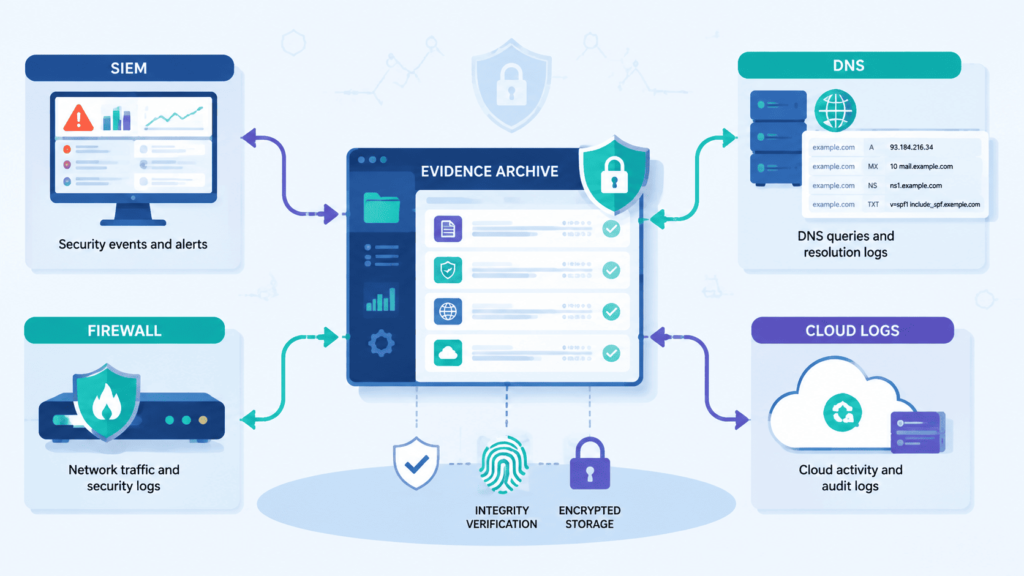
Preserving SIEM, firewall, DNS, and cloud records properly requires moving beyond simple screenshots or high-level summaries. For evidence to hold up during an incident investigation or in a legal proceeding, you need the native records, full context, system configurations, and clear documentation of any limitations encountered during collection.
Grab Native Records over Screenshots
Screenshots and analyst summaries lose critical metadata required to verify authenticity later.
- Native Export: Preserves exact Event IDs, UTC timestamps, source/destination IP addresses, account identifiers, and precise authentication methods.
- Contextual Events: Keeps surrounding log lines intact, allowing investigators to see pre- and post-event activity.
- Analyst Screenshot: Useful for quick communication at the moment, but carries little technical or legal weight during formal verification.
Document Query and Collection Details
Whether querying a central SIEM or a cloud provider’s API, the exact parameters used to retrieve the data must be recorded alongside the output.
SIEM Collections
When exporting from a SIEM, record the following metadata:
- Environment: Source system name, tenant, and account IDs.
- Query Mechanics: Exact query syntax (not a paraphrase), applied filters, and time bounds.
- Output Details: Export file format, total record count, generation timestamp, and any parsing/normalization rules applied.
Cloud Collections
When gathering logs from cloud platforms (AWS, Azure, GCP, etc.):
- Target Metadata: Tenant ID, subscription/project ID, region, and specific resource IDs.
- Identity Context: Account or service principal used to execute the query, along with its specific permissions.
- API Details: Exact parameters, pagination handling, and provider-supplied timestamps.
Capture Underlying System Configurations
A log entry is only as meaningful as the system configuration that generated it. To defend what an event actually means, preserve the supporting environment settings:
- Log Settings: Firewall rule bases, DNS logging levels, and SIEM parsing configurations.
- Time Synchronization: Clock sync configurations (e.g., NTP sources and offset status).
- Retention Policies: Stated retention schedules and auto-purge settings at the time of collection.
NIST guidance on digital evidence emphasizes understanding and preserving evidence characteristics across its entire lifecycle, not just at the point of capture.
Handle Third-Party and Partial Evidence
When records reside outside direct operational control, additional administrative and legal steps are necessary.
Third-Party Infrastructure
Third-party platforms introduce specific constraints around data ownership and location:
- Limited Control: Systems may feature fixed retention windows or non-standard export mechanisms.
- Jurisdiction: Data may reside across multiple legal jurisdictions.
- Legal Escalation: Legal counsel often needs to determine whether a formal request, subpoena, or warrant is required to secure the native data.
Documenting Gaps and Failures
Always record limitations encountered during collection:
- API Truncation: Document instances where an API limits historical exports (e.g., returning only 30 days when 90 days were requested).
- System Outages: Record periods where logging services failed or dropped packets.
- Defensible Auditing: Writing down what could not be obtained—and why—ensures the overall collection effort remains defensible under scrutiny.
What Should a Network Evidence Chain of Custody Record?
A chain of custody record needs to answer a few simple questions: What was the evidence? Where did it come from? Who touched it? When did it move? How was it protected? And what happened to it along the way?
A signature on a form doesn’t tell you much by itself. Paperwork often looks official while failing to specify which exact file moved, which copy people worked from, or who held access later. A good record does real work, not just shows.
Core Evidence Attributes
For every piece of evidence, a proper log captures the technical specifics from the second it is acquired:
- Identification & Source: Unique evidence identifier alongside the source hostname, interface, account, tenant, or device.
- File Details: Original filename, file size, collection date, and exact UTC time.
- Personnel & Tooling: Collector’s name, role, organization, acquisition method, and specific forensic tools used.
- Execution Parameters: Tool version, exact command line, script, and settings applied during capture.
- Integrity Metrics: Cryptographic hash, the hashing algorithm used, and verification results.
- Handling Context: Classification (original, master copy, working copy, or derivative), storage location, access controls, transfers, and any logged errors, packet loss, or clock drift.
NIJ guidance treats this kind of record-keeping as a core part of tracking where evidence went and who handled it. It’s not an extra step tacked on at the end.
The Three Layers of Evidence
Dividing evidence into distinct operational layers prevents accidental damage during an investigation:
- Original Evidence: The raw material exactly as collected. It receives the strictest lock-down and should almost never be touched for day-to-day analysis.
- Master Copies: Verified duplicates used as the baseline for operational work. These are periodically validated against the initial collection record to confirm no data has drifted.
- Working Copies & Derivatives: Everything generated during analysis—parsed logs, filtered PCAPs, rebuilt sessions, timelines, screenshots, and extracted files.
Keeping these layers apart matters because things go wrong during analysis. A parser might corrupt a file, or an analyst might accidentally edit a record. When that happens, the original and master copies remain untouched, letting you reset and verify the work.
Storage, Transfers, and Auditability
Storage infrastructure requires tight controls: robust encryption, role-based access rules, and detailed audit logs. In major cases, standard admin access should be completely cut off to keep the baseline clean.
Documenting Custody Transfers
Every time evidence changes hands, the record needs explicit details:
- Who released the evidence and who received it
- The exact timestamp and purpose of the handoff
- What specific files or physical media changed hands
- The integrity checks performed to verify nothing was altered
Another investigator should be able to pick up your notes and rebuild the whole story without asking you to remember anything. That’s really the test. It’s the difference between saying “we had the file” and actually being able to prove it.
What Does a Hash Prove and What Doesn’t It Prove?
A hash tells you one thing: the data hasn’t changed. It doesn’t prove the evidence was collected legally. It doesn’t prove it’s complete. It doesn’t prove where it really came from.
A SHA-256 hash turns a file into a fixed string of characters. If we hash a file when we collect it, and it produces the same string later, we know the file hasn’t changed in between.
That’s useful. But people read too much into it sometimes.
| Claim | Reality |
| “The hash proves admissibility.” | No. |
| “The hash proves lawful collection.” | No. |
| “The hash detects changes.” | Yes, compared to what we recorded. |
| “The hash proves provenance.” | No. |
| “The hash supports evidence integrity.” | Yes. |
| “The hash proves the capture was complete.” | No. |
This distinction isn’t just picky. Integrity is only one part of what makes evidence hold up.
What Hashes Miss in Practice?
Say we collect a PCAP the right way and hash it right away. Later, the hash checks out. Good, the file didn’t change. But a valid hash still leaves massive blind spots:
- Incomplete Scope: It doesn’t tell us if our capture filter missed critical traffic.
- Network Visibility: It doesn’t tell us if the sensor actually saw the whole network segment.
- Identity Attribution: It doesn’t tell us if an IP address really belonged to one specific person.
- Legal Authorization: It doesn’t tell us if the collection was authorized or lawful in the first place.
So we never rely on a hash by itself. We back it up with authorization records, timestamps, metadata, access logs, and chain-of-custody notes.
The same goes for forensic imaging. A bit-for-bit copy gives us a solid technical starting point, but we still write down:
- Collection Procedures: How we created the image step-by-step.
- Hardware Safeguards: Write-blocking verification to prove no writes occurred during capture.
- Tool Validation: Software version checks and test runs.
- Repeatability: A documented process another analyst could mirror if challenged.
Our take: a hash is an integrity check. It’s not proof of where evidence came from, and it’s not proof the collection was legal.
How Can You Preserve Evidence Without Collecting Too Much Personal Data?
Credits: Sudaisahmaddurani
Preserving evidence while respecting privacy comes down to targeted scope, strong context, and strict access. If you collect everything, you create a privacy nightmare and a massive pile of noise. If you trim too aggressively, you destroy the context needed to prove what actually happened.
Here is how to strike that balance effectively:
Scope Before You Sniff
Before pulling a single log or taking a disk image, define the exact technical or security question you need to answer.
Core Minimization Steps
- Set precise boundaries: Filter collection by specific usernames, hostnames, IP addresses, MAC addresses, protocols, or strict time windows.
- Target existing logs first: Before running full packet captures, check existing authentication logs, VPN sessions, DNS queries, and firewall events.
- Avoid full content capture: Focus on metadata (headers, timestamps, source/destination) rather than full payload or message contents unless strictly necessary for the investigation.
For instance, if you are investigating a single account compromise that occurred between 02:00 and 04:00 UTC, pulling 30 days of raw network pcap for the entire subnet adds zero value to your case, it just exposes unrelated employee traffic.
Preserve Context, Not Unrelated Content
Minimization doesn’t mean stripping data until the evidence becomes useless. To prove a sequence of events later in court or to an auditor, you need the surrounding technical context.
- Keep the adjacent DNS queries to show domain resolution prior to an outbound connection.
- Retain the session start and end times to prove duration, not just a single snapshot.
- Include surrounding authentication events to establish a baseline of normal user behavior versus the anomaly.
If you redact or strip too much, a suspicious outbound connection loses its background, making it impossible to explain six months later whether it was malware or a normal background process.
Secure and Restrict Access
Once the minimized dataset is collected, protect it as strictly as you would any sensitive personal data.
Controls to Apply Immediately
- Encrypt at rest and in transit: Use AES-256 for stored evidence files and secure protocols for any transfer.
- Enforce least-privilege access: Limit access exclusively to the primary investigators assigned to the case.
- Log all access to evidence: Maintain an automated audit trail of who viewed, exported, or modified the evidence container.
Redact with Documentation
When you must strip out personal identifiers, such as non-relevant user emails, full IP addresses, or medical/financial metadata, never do it silently.
- Keep the original hash: Always generate a cryptographic hash (e.g., SHA-256) of the raw, unredacted source before making a working copy.
- Log every modification: Document exact tools, scripts, or manual methods used to redact data.
- Record the justification: Note why specific fields were masked (e.g., “Redacted non-party PII pursuant to internal privacy policy”).
Establish Clear Retention Rules
Evidence should not live on a server indefinitely just because a case is closed.
- Set clear retention schedules based on legal requirements and regulatory obligations.
- Automate secure destruction (overwriting or cryptographic wiping) once the retention period expires.
- Document the secure disposal process to maintain a complete lifecycle record.
A lean, well-scoped evidence package is faster to analyze, cheaper to store, easier to hash, and far more convincing when presented. Treating data minimization as a core part of digital forensics, rather than an afterthought, makes your investigation stronger on both legal and privacy grounds.
What Happens When Live Collection Changes the Evidence?
A running computer never sits still long enough to yield a completely “clean” image. The moment an analyst interacts with a live endpoint or network switch, the system’s state shifts. Every executed command can spawn a new process, modify file timestamps, update connection tables, append log entries, or alter memory structures.
Instead of claiming zero impact on a running system, effective forensics relies on documenting five key elements:
- What was executed
- Why it was necessary
- When it occurred
- How it was carried out
- What specific state changes were likely introduced
Live Collection Workflow
Before touching a live endpoint, analysts must identify high-risk volatile data and assess how collection methods will affect the host state.
Key Steps in the Collection Process
- Identify Volatile Evidence: Prioritize RAM, active network connections, and unwritten caches at immediate risk of disappearing.
- Verify Authorization: Confirm legal scope, search warrants, or explicit operational consent before execution.
- Capture Baseline State: Record initial observable configurations and timestamps where feasible.
- Select Low-Impact Tooling: Use scripts and binaries designed to minimize process footprint and memory contamination.
- Log All Execution Details: Record exact command strings, flags, administrative accounts, and tool version numbers.
- Extract System Output: Save raw command results and state captures directly to trusted external media.
- Document Inevitable Changes: Note specific system modifications introduced by the execution process itself.
- Provide Plain-Language Reporting: Explain actions and trade-offs clearly in the final forensic analysis.
Standards, Authority, and Trade-Offs
Guidelines from the National Institute of Justice (NIJ) emphasize that digital evidence is inherently fragile. Legal compliance, preservation protocols, and chain of custody must guide every stage of live collection.
Assessing the Impact of Forensics Actions
- Routine Reconnaissance Commands
Running a basic command like netstat to view active connections slightly alters host memory and process activity. This minor alteration does not invalidate the evidence, provided the action is logged with time, operator identity, tooling version, and purpose.
- Network Isolation Measures
Severing an infected host’s network link stops active data exfiltration or lateral movement. However, it also terminates live sessions, clears dynamic routing tables, and alters network traffic flow. The final report must detail both the containment action and the specific evidence lost as a result.
Maintaining Integrity and Defensibility
Claiming a live collection left a system completely untouched is factually inaccurate and creates significant legal risk under cross-examination or peer review.
Full transparency makes an investigation defensible. Documenting exact actions allows external reviewers, courts, and incident managers to evaluate system impacts independently, building trust in the investigation’s overall conclusions.
How Should You Report Network Findings Without Overstating Them?

Reporting network findings accurately requires strict distinction between facts, interpretations, and conclusions. To prevent overstating results, a forensic or analytical report must maintain clear boundaries between what was observed and what can be inferred.
The Three-Tier Reporting Framework
To keep findings grounded, break down your analysis into three distinct layers:
- Observation: State only the raw, unvarnished facts. For example, a firewall logged a connection from an internal IP address to an external endpoint at a specific time in UTC.
- Interpretation: Contextualize the raw data using supporting records. For instance, DHCP logs, login records, and endpoint telemetry tie that internal IP address to a specific device and user account during that exact timeframe.
- Conclusion: State what the evidence actually proves while explicitly defining its boundary. The combined evidence indicates the device generated network traffic during that window, but it does not independently prove who was physically typing on the keyboard.
Maintaining this separation prevents a report from claiming more than the logs can legally or technically back up.
Evidentiary Rigor and Methodology
Every key finding in a report must link directly to a specific, preserved piece of evidence. Documenting your methodology clearly ensures your findings are repeatable and defensible:
- Tooling: List the exact tools used, including build numbers and software versioning.
- Time Normalization: Document how timestamps were converted and aligned across disparate log sources.
- Data Processing: Detail all filter parameters, aggregation rules, and correlation methods applied.
- Quality Assurance: Explain the verification steps used to validate the results and rule out processing errors.
Accounting for Alternative Explanations
Always highlight alternative technical explanations when they are plausible. Overlooking network anomalies can lead to misattribution:
- Identity & Access Factors: Shared credentials, active VPN tunnels, reverse proxies, or compromised accounts.
- Network Dynamics: Reassigned DHCP leases, NAT overlaps, spoofed source IP addresses, or automated background processes.
- Time Dynamics: Clock drift across unsynchronized domain controllers or endpoints.
Flagging these variables demonstrates thoroughness and prevents premature conclusions.
Documenting Gaps and Limitations
Transparent reports explicitly call out missing information or technical blind spots rather than hiding them:
- Log Coverage: Missing, expired, or truncated event logs.
- Capture Drops: Packet loss at the TAP/SPAN port or encrypted payloads without available keys.
- Visibility Boundaries: Unmonitored network segments, missing cloud provider telemetry, or unparsed proprietary file formats.
- Collection Issues: Drifted system clocks, failed export routines, or volatile memory changes caused by live response actions.
Addressing these gaps upfront makes the overall findings far more reliable.
Building a Defensible Narrative
When called to explain or defend a report, a disciplined structure protects the examiner. You can walk through your process, acknowledge technical boundaries, and present your reasoning without overstepping the evidence.
The strongest network reports rely on multiple independent data points pointing to the same outcome, while remaining completely upfront about where residual uncertainty lives.
Which Collection Mistakes Can Undermine a Network Investigation?
Network investigations fail far more often from poor collection practices than from bad analysis. When evidence handling breaks down at the intake stage, even the most compelling forensic findings become indefensible under scrutiny.
Critical Collection Mistakes and Better Practices
| Mistake | Better Practice |
| Collecting before approval | Establish legal or administrative authority first |
| Capturing everything | Define a proportional, relevant scope |
| Analyzing originals | Work strictly on verified forensic copies |
| Relying on screenshots | Preserve native records with raw metadata |
| Hashing only at the end | Calculate hashes immediately at acquisition |
| Ignoring time drift | Document system clocks and NTP synchronization state |
| Hiding packet loss | Explicitly report acquisition limits and dropped frames |
| Treating one log as conclusive | Correlate findings across independent sources |
| Omitting failed exports | Preserve the record of failed collection attempts |
| Mixing evidence and analysis copies | Maintain strict separation between primary and working evidence |
Flaws in Scope, Authorization, and Strategy
Grabbing network traffic without clear authorization or a defined scope creates legal liability and massive operational friction. Over-collection burdens investigators with noise and introduces serious privacy risks.
- Unauthorized intake: Collecting packet captures or device logs before establishing formal authority invalidates the evidence from day one.
- Scope creep: Gathering entire network segments without target filters floods the repository with irrelevant, potentially sensitive data.
- Single-source reliance: Treating one firewalled log or SIEM alert as absolute truth leaves blind spots that attackers easily exploit.
Technical Artifact and Integrity Errors
Forensic integrity relies on preserving data in its rawest form while documenting the exact state of the environment during capture. Small shortcuts early on ruin credibility later.
- Relying on screenshots:
- Misses underlying protocol metadata and full packet headers.
- Omits export parameters and local display configurations.
- Captures only a visual surface layer that is easily challenged in court or arbitration.
- Late-stage hashing: Calculating cryptographic hashes after processing or analysis only proves the working copy didn’t change during analysis, it says nothing about whether the original data was altered during extraction.
- Unresolved time drift: Converting inconsistent local timestamps to UTC simply standardizes skewed numbers. If a firewall clock was three minutes behind the DNS server, that temporal drift persists despite the timezone conversion.
Deficiencies in Documentation and Limitations
An investigation is only as reliable as its record of gaps, failures, and chain of custody. Attempting to smooth over collection flaws often destroys the credibility of the entire case.
- Concealing collection gaps: Suppressing dropped packet counters or interface buffer overruns leaves the investigation open to unrecorded traffic.
- Discarding failed exports: Omitting broken scripts, timed-out queries, or partial log pulls obscures whether missing data resulted from threat actor tampering or system error.
- Overlooking NIJ standards: Leaning heavily on a single safeguard, like generating a hash, while ignoring physical custody, detailed chain-of-custody logs, or contextual documentation violates fundamental forensic principles.
Addressing these collection mistakes requires a repeatable, documented workflow that prioritizes data integrity over sheer volume. What specific types of network artifacts (e.g., full packet captures, flow logs, or firewall event logs) are you currently collecting for your investigation?
How Can Network Threat Detection Build a Defensible Evidence Workflow?
Network Threat Detection builds a defensible evidence workflow by embedding legal, technical, and operational rigor into everyday detection rather than treating forensics as an afterthought. When network detection platforms integrate evidence handling directly into the analyst workflow, following a structured network forensics investigation process, every alert carries the potential to become a legally sound, audit-ready artifact.
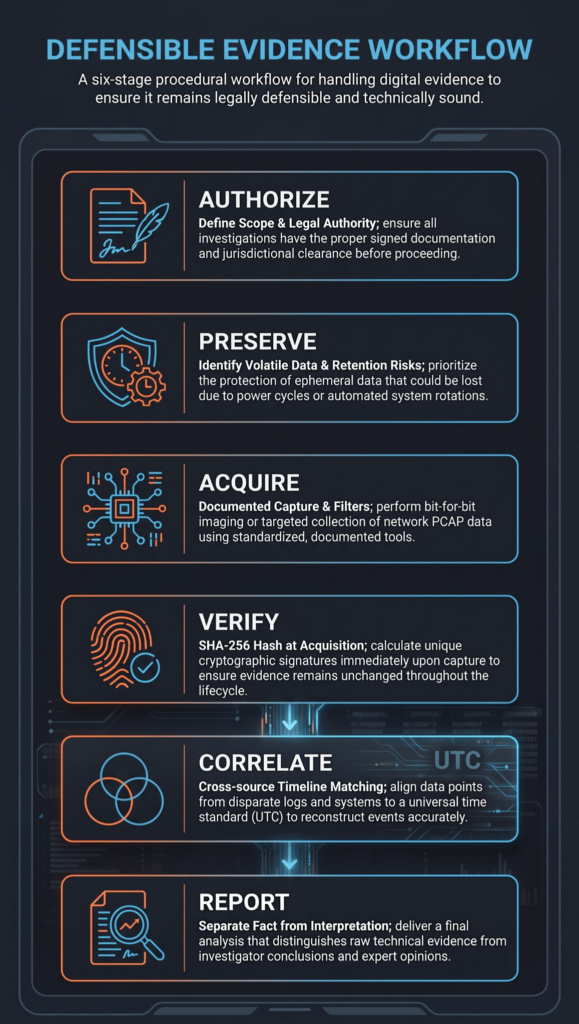
Here is how each of the six core stages functions to build an unbroken chain of custody and analysis.
A defensible investigation starts before a single packet is captured. Without explicit authorization, evidence collected during an investigation, no matter how damning, can be rendered inadmissible or create legal liability around privacy and wiretapping laws.
Core Requirements
- Purpose & Scope: Clearly state what incident is being investigated and set hard boundaries on which systems, networks, or user accounts are included.
- Authority Tracking: Document exactly who approved the investigation (e.g., CISO, Legal Counsel, HR) along with the timestamp of approval.
- Regulatory & Privacy Check: Verify applicable interception rules, regional privacy mandates (such as GDPR or CCPA), and works council constraints.
- Third-Party Oversight: Define and document any required third-party coordination, such as notifying cloud providers, ISP coordination, or external retainers.
Preserve
Network data is volatile. Ephemeral connections, short-lived DNS caches, and rolling packet buffers mean critical evidence disappears within minutes or hours if not intentionally frozen.
Preservation Protocols
- Triage Volatile Data: Identify volatile traffic streams, active session state tables, and short-retention PCAP buffers that face immediate overwrite.
- Issue Freeze Instructions: Send explicit preservation notices to cloud providers, infrastructure teams, or third-party log vendors to pause automated purge cycles.
- Lock Existing Telemetry: Write-protect existing PCAP files, SIEM logs, firewall logs, and EDR records associated with the scope.
- Document Retention Risks: Log known retention limits, missing log sources, or storage constraints that could impact the historical record.
Acquire
Acquisition is the physical or digital collection of the target network telemetry. The goal is to collect complete, uncompressed, and untampered datasets using standardized procedures.
- Targeted Collection: Gather relevant network traffic (PCAP/Flow), system logs, endpoint context, identity provider records, and cloud audit logs.
- Standardized Tools: Rely strictly on battle-tested, documented acquisition methods and scripts rather than ad-hoc commands.
- Audit Logging: Automatically record exact acquisition commands, capture filters, collection timestamps, system settings, and any runtime errors.
- Scope Compliance: Ensure capture filters adhere strictly to the authorized scope to avoid illegally collecting out-of-scope employee traffic.
Verify
Integrity verification ensures that the evidence presented in court or an audit is identical to what was captured on the wire at the moment of collection.
Integrity & Custody Steps
- Immediate Hashing: Calculate cryptographically secure hashes (SHA-256) at the exact moment of acquisition, not later during analysis.
- Master Copy Isolation: Store master evidence files in read-only write-once-read-many (WORM) storage. Work exclusively on working copies.
- Access Control: Enforce strict role-based access control (RBAC) and maintain an automated access log for every file view, copy, or export.
- Master Verification: Periodically re-hash master files against their original checksums to prove no alteration occurred over time.
Correlate
Isolated network logs rarely tell the full story. Correlation stitches raw network packets back into human actions while accounting for ambient network translation (NAT, DHCP, VPNs).
- Identifier Resolution: Map dynamic IP addresses back to specific hostnames, MAC addresses, dynamic DHCP leases, and VPN user identities at the exact millisecond of activity.
- Time Synchronization: Align timestamps across disparate log sources using verified NTP sources, documenting known clock drifts or timezone offsets.
- Discrepancy Logging: Document conflicting timestamps, missing log gaps, or unexpected NAT behavior instead of ignoring or overwriting them.
- Cross-Domain Mapping: Connect network capture data directly with firewall logs, identity provider authentication streams, and endpoint process executions.
Report
The final report must translate technical findings into a clear, objective account of events. It needs to withstand challenges from opposing counsel, external auditors, regulatory bodies, or internal executive reviews.
Structure of a Defensible Report
- Observations vs. Inferences: Keep hard technical facts (IP addresses, packet payloads, verified timestamps) clearly separated from analyst hypotheses and conclusions.
- Alternative Hypotheses: Document alternative explanations for the observed behavior (e.g., misconfigured software vs. malicious exfiltration) and explain why they were ruled out.
- Gaps & Limitations: Be completely transparent about missing logs, encrypted traffic blind spots, or incomplete capture windows.
- Chain of Custody Documentation: Attach full authorization records, file hashes, tool output logs, and custodian handoff records to support expert witness testimony.
By weaving these six steps directly into network threat detection platforms, security operations transform routine alert triage into an audit-proof, repeatable process.
What Should the Final Legal Evidence Checklist Include?

A rock-solid legal evidence checklist covers authorization, preservation, acquisition, integrity, privacy, custody, analysis, reporting, and disclosure, all signed off long before a case ever reaches a courtroom.
The Core Checklist Phases
1. Before Collection: Legal Groundwork & Scope
Establishing your legal right to collect and defining what you are targeting must happen before touching any live system:
- Authority & Purpose: Document legal authorization, define the specific investigative objective, and establish clear scope boundaries.
- Legal Vetting: Check your processing basis, review relevant wiretap/interception laws, and verify compliance requirements.
- Preservation Holds: Issue formal legal holds, map volatile evidence (RAM, active network sockets), and verify NTP time-source synchronization.
- Third-Party Data: Identify external logs or infrastructure (ISPs, SaaS providers, cloud hosts) requiring formal preservation requests.
2. During Collection: Acquisition & Chain of Custody
Protecting the original artifact while capturing verifiable metadata is critical during the actual collection pass:
- Protect original evidence from any writes or modifications.
- Log exact acquisition methods, terminal commands, and capture filters.
- Record tool names, build numbers, and software versions used.
- Calculate cryptographic hashes (preferably SHA-256) immediately upon acquisition.
- Document any hardware errors, stream corruptions, or dropped packets.
- Preserve full file and system metadata (MAC timestamps, permissions, headers).
- Log every physical and digital chain-of-custody transfer in real time.
3. After Collection: Analysis, Storage & Disclosure
Maintaining a strict boundary between original evidence and working copies prevents spoliation claims:
- Master Verification: Re-verify master copy hashes against initial acquisition hashes before storing them.
- Working Isolation: Conduct all forensic analysis exclusively on verified working copies, never on originals.
- Traceable Findings: Link every analytical finding directly back to specific evidence identifiers.
- Quality Assurance: Run independent peer reviews on critical findings and explicitly document technical limitations.
- Redaction & Storage: Explain all data redactions, apply data minimization, and store physical and digital evidence in access-controlled environments.
- Legal Vetting: Vet all disclosures or evidence transfers through legal counsel before sharing outside the core team.
Operationalizing the Checklist
A checklist is useless if it stays buried in a shared drive until a subpoena hits your desk. Waiting until litigation is underway makes reconstructing missing timestamps, authorization logs, retention rules, and custody handoffs vastly harder than it needs to be.
Real-World Training Drills
Building these processes into routine team workflows requires periodic, stress-tested drills:
- The Onboarding Drill (90 Minutes): Provide new hires with a corrupted PCAP file, a SIEM log export containing inconsistent timestamps, and an incomplete chain-of-custody form. Ask them to identify the gaps, reconstruct the event sequence, and determine what evidence remains legally defensible. Almost no one gets it 100% right on their first attempt, which highlights real-world procedural gaps right away.
- The Quarterly Full-Scale Simulation (2 Hours): Simulate a full incident scenario complete with a mock legal hold, third-party preservation notices, and an unexpected demand from opposing counsel requesting complete collection logs.
These drills consistently catch technical and procedural failures before a trial does. In one quarterly exercise, a team discovered their automated collection tool had silently defaulted to MD5 instead of SHA-256 hashes for three weeks, a flaw that would have compromised evidence integrity in court if left undetected.
Investing a couple of hours each quarter to scenario-based exercises costs far less than discovering missing logs or broken custody chains during active litigation.
FAQ
How do you collect network evidence legally?
Collecting network evidence legally requires proper authorization, documented procedures, and respect for privacy requirements. A network evidence collection process should follow lawful evidence acquisition practices, identify the purpose of collection, and protect evidence integrity. Proper evidence identification, documentation, and handling procedures help ensure that collected data can support a forensic investigation and meet legal requirements.
Why is chain of custody important in digital evidence collection?
Chain of custody records who collected, accessed, transferred, and stored evidence throughout the investigation. During digital evidence collection, maintaining a clear chain of evidence helps prove that data was not altered, removed, or contaminated. Detailed evidence documentation, evidence labeling, and evidence transfer records support evidence authentication and improve the reliability of court admissible evidence.
What steps help preserve network evidence without altering it?
Network evidence preservation requires protecting original data from modification, loss, or contamination. Investigators use write protection, write blocking, secure evidence storage, and evidence preservation procedures to maintain digital evidence preservation. Techniques such as cryptographic hashing, SHA-256 hashing, and evidence hash verification confirm that evidence copies remain identical to the original evidence.
What network data should be collected during a forensic investigation?
A network investigation may require collecting network traffic evidence, network logs, and other digital records that show suspicious activity. Common sources include firewall logs, router logs, DNS logs, proxy logs, VPN logs, authentication logs, and security event logs. Collecting packet capture evidence and PCAP files can support packet capture analysis during network forensics.
How can organizations prepare for legal network evidence collection?
Organizations can improve forensic readiness by establishing evidence handling procedures before security incidents occur. A defensible forensic process includes validated forensic tools, evidence access controls, metadata preservation, and repeatable forensic processes. Proper preparation helps teams perform lawful evidence collection, maintain evidence lifecycle records, and create reliable forensic reporting that supports legal review and expert testimony.
Building a Legally Defensible Network Evidence Program
You need more than packet captures and hashes when building network evidence. If authority, preservation, and integrity are unclear, your evidence may not hold up when it matters. The process needs structure.
Network Threat Detection helps you build a stronger evidence workflow with clear collection practices and better readiness before incidents happen. It’s a practical step toward handling investigations with confidence while respecting evidence limits.
References
- https://www.nist.gov/publications/digital-evidence-preservation-considerations-evidence-handlers
- https://computerforensicslab.co.uk/investigation-steps-in-a-crime-scene-investigation/?noamp=mobile