
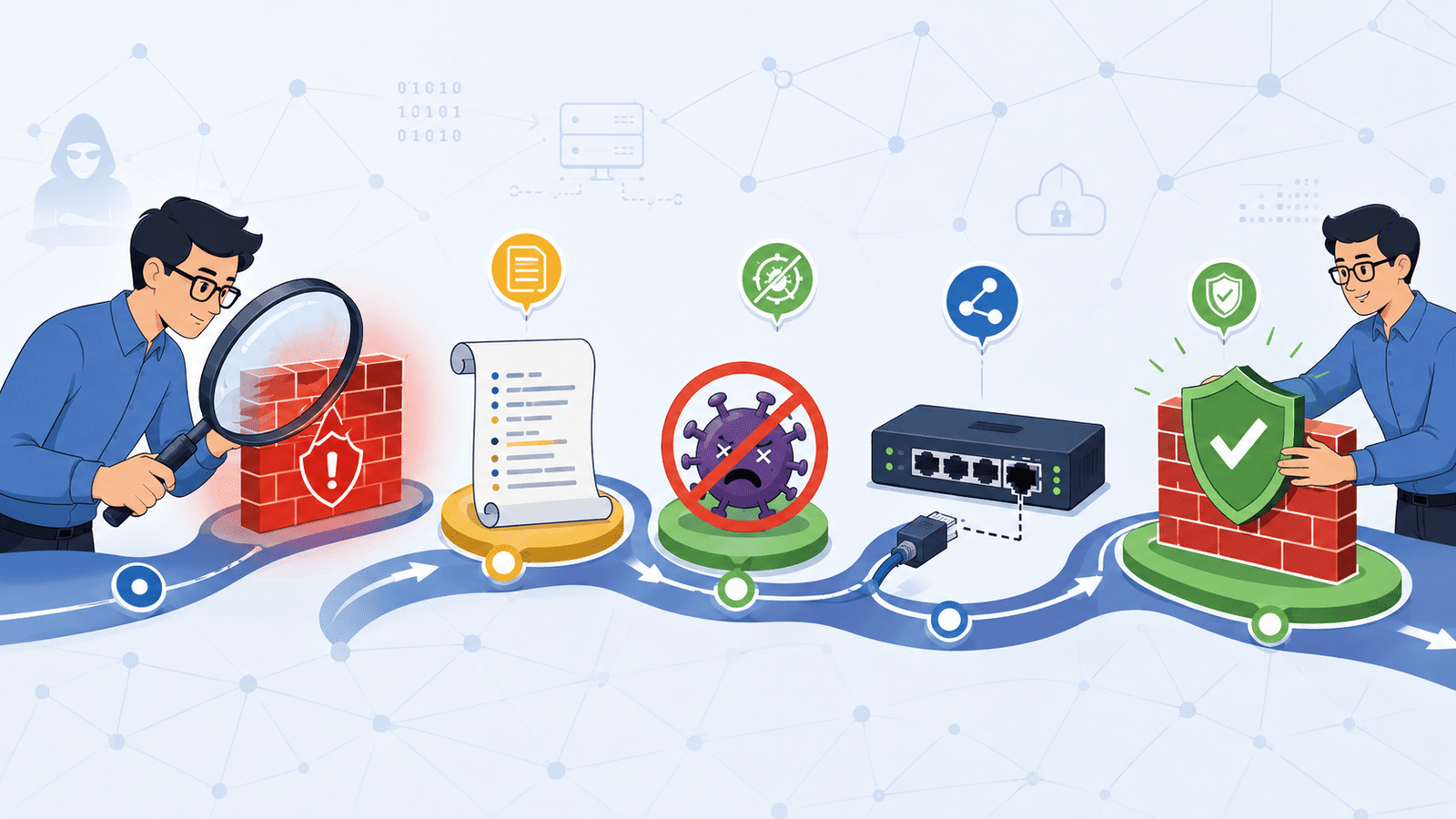
Network forensics follows a clear process to preserve, collect, review, and report network evidence so findings can stand up to scrutiny. Each step matters because small mistakes can affect the outcome. Network Threat Detection helps investigators work through packet captures, rebuild timelines, and spot activity that might otherwise go unnoticed.
It’s a practical approach, not guesswork. Good evidence handling also makes results easier to verify and explain later. This guide walks through every stage of the investigation process and shows how Network Threat Detection fits into real-world forensic work. Keep reading to see the full methodology.
Network Forensics Investigation at a Glance
- OSCAR methodology provides a repeatable framework: Obtain, Strategize, Collect, Analyze, and Report.
- Strong investigations combine packet captures, logs, metadata, and endpoint evidence instead of relying on one source.
- Evidence preservation, timeline analysis, and reporting determine whether findings can be validated.
Why Does Network Forensics Matter During Incident Response?
Network forensics matters during incident response because it bridges the gap between knowing that a compromise happened and understanding how it happened, what was compromised, and how to prevent it from happening again. While real-time monitoring generates alerts when anomalies occur, network forensics provides the deep, packet-level evidence needed to reconstruct an attacker’s steps chronologically and defensibly.
Why Network Forensics Is Essential in Incident Response?
When a security incident occurs, organizations face immediate pressure from stakeholders, legal counsel, and regulatory bodies to provide concrete answers. Network forensics provides those answers by analyzing packet captures, flow records, and system logs to build an unbroken chain of custody and a precise timeline of events.
Primary Threats Identified Through Network Forensics
- Data Exfiltration: Uncovering hidden or encrypted outbound channels where sensitive data is being quietly transferred outside the network perimeter.
- Command and Control (C2) Communication: Detecting malware “phoning home” to attacker-controlled infrastructure for instructions or updates.
- Lateral Movement: Tracking an attacker’s movement across internal systems after their initial compromise point.
- Anomalous Authentication: Pinpointing suspicious login patterns, credential abuse, or unauthorized access to sensitive segment zones.
- Phishing Footprints: Tracing initial entry vectors back to malicious email links or payload downloads.
Aligning Network Forensics with the NIST Incident Lifecycle
NIST Special Publication 800-61 (Computer Security Incident Handling Guide) structures incident response into four main lifecycle phases: Preparation, Detection & Analysis, Containment/Eradication/Recovery, and Post-Incident Activity. Network forensics plays a vital role across each stage.
+———————————————————————–+
| 1. PREPARATION |
| • Establish full packet capture retention & log aggregation |
| • Implement forensic toolchains & evidence preservation policies |
+———————————————————————–+
|
v
+———————————————————————–+
| 2. DETECTION & ANALYSIS |
| • Filter detection signals to prioritize critical evidence |
| • Reconstruct attacker movements & extract Indicators of Compromise |
+———————————————————————–+
|
v
+———————————————————————–+
| 3. CONTAINMENT, ERADICATION & RECOVERY |
| • Identify all compromised nodes to prevent partial containment |
| • Verify eradication by monitoring for persistent C2 beacons |
+———————————————————————–+
|
v
+———————————————————————–+
| 4. POST-INCIDENT ACTIVITY |
| • Build defensible timelines for legal, regulatory, & audit needs |
| • Refine threat models using root-cause forensic findings |
+———————————————————————–+
- Preparation
Setting up network visibility before an intrusion occurs is critical. Retaining packet captures, DNS logs, and flow data ensures evidence is readily available when an investigation begins. As NIST highlights, delayed evidence collection is one of the most common reasons investigations fail. In one notable 2022 manufacturing firm breach, attackers remained undetected for 147 days. Because the client had maintained long-term full packet capture retention, investigators were able to inspect the exact commands executed by the adversaries, helping the firm avoid up to $50 million in regulatory fines through verifiable evidence preservation.
- Detection & Analysis
Continuous traffic monitoring acts as the initial trigger, alerting analysts to suspicious connections. Network forensics then takes over to isolate specific traffic streams, analyze payloads, and determine the scope of the intrusion across the environment.
As noted by NIST
“Effective forensics activities require understanding different data sources, including files, operating systems, network traffic, and applications, to support incident response and troubleshooting.” – NIST
Threat modeling and risk analysis tools help filter out background noise so investigators can focus on high-priority signals, combining network packet data with host and application logs to reconstruct the complete attack narrative.
- Containment, Eradication, & Recovery
Effective containment requires knowing every host the attacker touched. Network forensics maps out all lateral connections to ensure no backdoors or compromised accounts are left behind. During recovery, ongoing network inspection confirms that malicious activity has ceased entirely before bringing systems back online.
- Post-Incident Activity
After the threat is remediated, forensic artifacts form the foundation of the post-incident report. This documentation provides regulatory auditors, legal teams, and executive leadership with an objective narrative of the incident, while identifying root vulnerabilities to strengthen future defenses.
Monitoring vs. Network Forensics
Understanding the operational differences between continuous network monitoring and network forensics highlights why both are necessary for a comprehensive security posture:
| Functional Aspect | Network Monitoring | Network Forensics |
| Primary Goal | Real-time threat detection & alert generation | Post-incident investigation & timeline reconstruction |
| Time Horizon | Present focus (live traffic streams) | Historical focus (retained logs, pcap, flow records) |
| Core Question | “Is something suspicious happening right now?” | “What happened, how did it occur, and what was impacted?” |
| Output | Alerts, dashboards, & metric spikes | Forensic reports, evidentiary timelines, & root-cause analysis |
How Is Network Forensics Different From Network Monitoring?
Network forensics and network monitoring are often confused because both operate on network traffic, but they serve fundamental, distinct purposes in cybersecurity operations.
Here is how the two disciplines compare in purpose, data collection, and practical execution.
Core Operational Differences
- Network Monitoring acts as your real-time situational awareness. It constantly scans traffic streams, evaluates network telemetry, and generates alerts the moment an anomaly or policy violation occurs.
- Network Forensics acts as your digital crime scene investigation. It steps in after an alert triggers, retrieving historical raw packet captures (PCAP), session records, and log artifacts to reconstruct step-by-step what occurred.
| Area | Network Monitoring | Network Forensics |
| Primary goal | Detect suspicious activity | Reconstruct events |
| Time focus | Real time | Historical |
| Main data | Alerts and telemetry | Evidence and artifacts |
| Outcome | Investigation trigger | Defensible findings |
Why Forensics Complements Monitoring?
Monitoring tells you that something unusual is happening; forensics reveals why it happened and whether it poses a real threat.
In practice, this relationship unfolds through several key operational phases:
- Eliminating False Positives: An Intrusion Detection System (IDS) might flag a massive spike in outbound SSL/TLS traffic as an exfiltration attempt. Forensic analysis of packet headers, handshake certificates, and internal host logs might reveal it was simply an automated system backup to an updated cloud endpoint.
- Mapping Threat Actor Footprints: When a true positive occurs, monitoring only captures the edge behavior. Forensic reconstruction allows analysts to trace lateral movement, command-and-control (C2) communication frequencies, and specific payload transfers across internal subnets.
- Building Legal and Regulatory Evidence: Real-time metrics and alerts are fleeting. Network forensics preserves full evidentiary integrity (including cryptographic hashes of captured packets), ensuring findings withstand compliance audits or legal proceedings.
Integrating Network and Endpoint Evidence
Analyzing network packets in isolation rarely tells the complete story. The most effective security teams cross-examine network forensic artifacts with endpoint logs, authentication events, and threat intelligence.
Combining these datasets delivers key operational advantages:
- Validating Credential Misuse: Correlating a strange outbound network connection with concurrent endpoint login records helps determine if valid credentials were compromised.
- Refining Threat Models: Lessons learned from forensic investigations feed directly back into monitoring rulesets, closing visibility gaps and reducing future response times.
- Differentiating Benign Anomalies from Exploits: Endpoint process trees paired with network payload data quickly verify whether a connection was initiated by a legitimate process or a malicious script.
What Is the OSCAR Methodology for Network Forensics?
OSCAR is a five step process investigators use when they dig into network attacks. The steps are Obtain, Strategize, Collect, Analyze, and Report. Simple enough. It gives analysts an order to follow instead of jumping around and hoping something sticks. A structured network forensics investigation process helps analysts keep evidence collection, analysis, and reporting in the right order.
The OSCAR method is also used in cybersecurity training programs, including O’Reilly. It helps prevent investigators from collecting disconnected evidence without a clear process. Each step defines what to examine and provides a structure for validating conclusions.
| OSCAR Phase | Primary Goal | Example Activities |
| Obtain | Gather investigation context | Identify affected systems and indicators |
| Strategize | Plan evidence collection | Select sources and preservation methods |
| Collect | Acquire evidence | Capture PCAP files and logs |
| Analyze | Reconstruct activity | Perform traffic and timeline analysis |
| Report | Document findings | Create forensic reports |
Investigations need structure. Without it, things fall apart fast. Analysts might grab too much data, miss evidence that only lasts a few hours, or end up with findings nobody else can check.
Using OSCAR helps teams in a few ways. They get a workflow they can repeat every time. They keep a stronger chain of custody. They lower the risk of messing things up. They can talk to other teams more clearly too.
A fundamental rule in digital forensics is to preserve original evidence before analysis begins. Investigators should avoid modifying original files and should work from verified copies whenever possible. This principle supports evidence integrity throughout the investigation.
Why Is OSCAR Widely Used in Investigations?
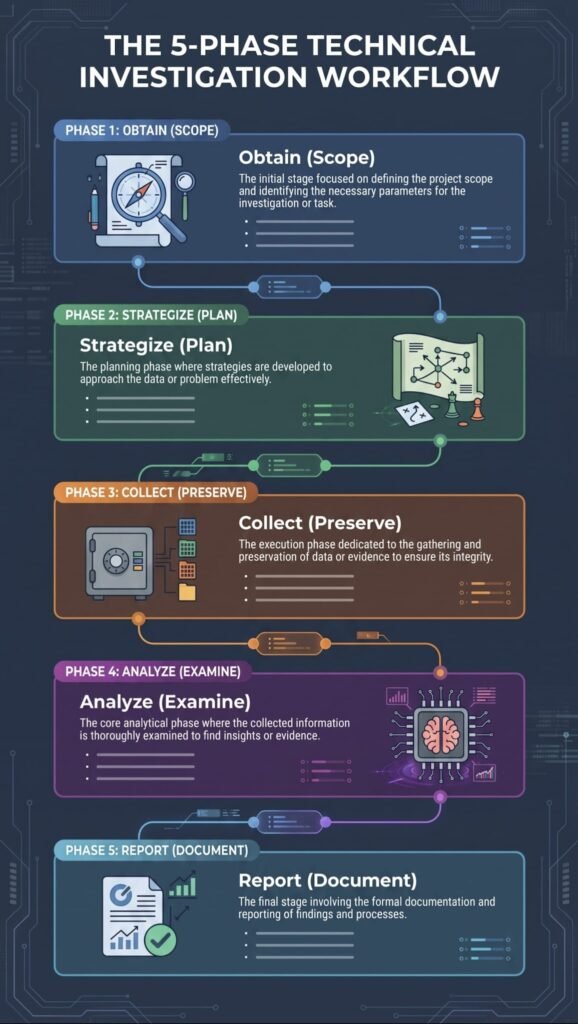
OSCAR works because it separates handling evidence from figuring out what it actually means. Investigators gather facts first. Then they build a plan, collect the data, study it closely, and finally write it all up.
We’ve watched teams stumble when they skip the early steps and jump straight to analysis. A strange IP address might look scary at first glance. So might a piece of malware. But without context, you really can’t tell if it’s a genuine threat or just noise.
EC Council’s training material says something similar. Handle evidence properly, keep your process repeatable. That’s just good practice, honestly. OSCAR breaks it into five steps, and that’s exactly why so many analysts stick with it.
How Should Investigators Scope an Incident First?
Scoping means figuring out which systems got hit, what time period matters, and where the evidence actually sits. Before anyone touches a single file.
This first step shapes the whole case. Analysts need to find which computers were affected, how the network is laid out, what users were doing, and what triggered the alert in the first place.
Skipping this step can lead to unnecessary data collection. Large organizations can generate terabytes of network data each day, making precise scoping essential for identifying which evidence should be collected and analyzed.
Early scoping usually covers:
- When the problem was first noticed.
- Which IP addresses and devices were affected.
- Which user accounts were involved.
- What firewall and proxy logs exist.
- Any alerts already flagged by intrusion detection tools.
Research from the SANS Institute backs this up. Good incident response comes down to preparation, visibility, and a process you can repeat. Teams that stay ready lose less time when something actually happens.
Before we pull any evidence, we check what monitoring tools are already running. Some companies already have strong systems in place. NetFlow data, DNS logs, DHCP records, SIEM alerts. That information is often ready to use right away.
What Information Should Be Collected Initially?
Context comes before volume. Investigators need to understand the situation first. That’s what points them toward the evidence actually worth collecting.
The first questions usually look like this. When did the suspicious activity start? Which systems talked to suspicious destinations? Which accounts touched the affected resources? Which logs still hold anything useful?
| Evidence Category | What to Collect | Why It Matters |
| Timeline Information | Time the suspicious activity was first detected | Establishes the investigation timeline and scope. |
| Affected Systems | Impacted servers, endpoints, and IP addresses | Identifies which assets require investigation. |
| User Activity | User accounts, login history, and authentication records | Helps determine compromised accounts and attacker access. |
| Network Logs | Firewall, proxy, DNS, DHCP, and VPN logs | Provides visibility into network communications and suspicious activity. |
| Security Alerts | IDS/IPS alerts, SIEM events, and endpoint detections | Supplies initial indicators of compromise and investigation starting points. |
But jumping to conclusions too early can leave gaps. We’ve seen cases where a “hacked” server turned out to be just one small piece of something bigger. An attack that actually started with a phishing email, stolen passwords, or someone quietly moving through the network step by step.
How Do Investigators Preserve Evidence Correctly?
Proper evidence preservation boils down to three fundamentals: controlled collection, synchronized timestamps, and an unbroken record of custody. Skip any of these steps, and an entire legal case can collapse under scrutiny.
Digital evidence is volatile, active network connections and volatile memory (RAM) vanish in seconds. When speed and precision dictate whether evidence holds up in court, investigators rely on strict forensic frameworks like ISO/IEC 27037.
Core Standards & Best Practices
To satisfy legal review, evidence must be supported by cryptographic hashing, write-blocked media preservation, and detailed access logging.
| Best Practice | Purpose | Risk if Ignored |
| Document the Collector | Records who acquired the evidence | Weakens the chain of custody and reduces investigation credibility. |
| Record Accurate Timestamps | Maintains a reliable investigation timeline | Creates inconsistencies that complicate event reconstruction. |
| Generate Hash Values | Verifies that evidence remains unchanged throughout the investigation | Makes it difficult to prove evidence integrity. |
| Preserve Original Evidence | Keeps the original data untouched for verification | Original evidence may become altered or inadmissible. |
| Track Chain of Custody | Documents every transfer and access to evidence | Reduces the defensibility of forensic findings. |
The Standard Preservation Workflow
When handling network captures, logs, or system memory dumps, investigators follow five sequential steps:
- Document ownership: Record exactly who collected the evidence, including their role and method of acquisition.
- Synchronize time logs: Record collection timestamps aligned to a verified reference clock (such as UTC/NTP).
- Calculate cryptographic hashes: Run SHA-256 or MD5 algorithms on the raw source immediately upon capture.
- Isolate original media: Store the primary evidence on write-blocked, hardware-isolated storage.
- Maintain custody logs: Document every single handoff, storage move, or access attempt without gaps.
Crucial Rule: Never analyze original media directly. Analysts must work exclusively on verified, bit-stream working copies to prevent accidental modification of the original evidence.
Which Mistakes Can Damage Evidence?
Small operational oversights often ruin otherwise solid technical work. A clock drift of a few seconds or a missing handoff note can throw an entire incident timeline into question.
The most common errors that compromise digital evidence include:
- Unsynchronized clocks: Discrepancies in system time across routers, servers, and workstations make log correlation impossible.
- Missing packet timestamps: Capturing network traffic without precise temporal metadata.
- Gaps in log retention: Overwritten firewall or proxy logs that leave unexplainable blind spots.
- Direct file manipulation: Mounting or opening source files on an active OS without hardware write-blockers.
- Incomplete custody records: Failing to log who accessed evidence storage or transferred files between analysts.
When evidence is clean, complete, and properly preserved from the start, forensic analysts spend their time investigating the incident rather than defending their collection methods.
Which Network Evidence Sources Provide the Best Visibility?
Network evidence sources vary significantly in depth, scale, and operational overhead. Broadly speaking, Packet Captures (PCAP) provide the absolute highest level of visibility for individual sessions, while flow data (NetFlow/IPFIX) and DNS logs offer the best high-level visibility across large, distributed networks.
Network Evidence Sources & Primary Investigation Value
While every log source adds context, balancing capture depth against storage capacity dictates which sources take priority during an incident.
| Evidence Source | Primary Investigation Value |
| Packet Capture (PCAP) | Detailed traffic inspection |
| NetFlow/IPFIX | Connection summaries and traffic patterns |
| Firewall Logs | Allowed and blocked connections |
| DNS Logs | Domain activity and lookup history |
| DHCP Logs | IP address ownership tracking |
| Proxy Logs | Web access visibility |
| VPN Logs | Remote access investigation |
| IDS Alerts | Threat detection signals |
| Authentication Logs | Account activity tracking |
| Cloud Network Logs | Distributed infrastructure visibility |
Key Trade-offs in Evidence Collection
- Full-content visibility vs. resource constraints: Full PCAP delivers complete payload reconstruction, but high network speeds make long-term storage expensive.
- Scalability over granular depth: NetFlow and cloud flow logs scale effortlessly across massive infrastructure, offering top-tier broad visibility at a fraction of the storage footprint.
- Layer 7 context vs. network transport: Application-aware logs (DNS, HTTP/Proxy) often reveal attacker intent faster than raw TCP/UDP connection records alone.
Tools like Zeek bridge the gap between PCAP and flow logs by converting raw packet streams into structured, high-level application logs (like conn.log, dns.log, or http.log). According to the EC-Council, combining metadata-level logging with targeted packet capture reduces false positives and dramatically improves forensic precision.
Why Is Correlation Essential During Evidence Collection?
A single log entry rarely proves an intrusion. A rogue DNS query to a newly registered domain might seem benign on its own. However, when correlated with a firewall bypass alert, an unapproved authentication spike, and an oversized outbound payload, that isolated query becomes a critical indicator of Command and Control (C2) activity or data exfiltration.
Core Data Points to Correlate During Analysis
- Network Anchors: Map source and destination IP address relationships directly to MAC addresses and DHCP lease histories to identify physical host systems over time.
- Service Identifiers: Cross-reference non-standard port activity with application layer protocol analysis to flag protocol evasion or hidden tunnels.
- Identity Mapping: Pair user authentication timestamps across VPN and domain controllers with endpoint network connections to spot stolen credential usage.
- Temporal Patterning: Analyze session duration, beaconing frequency, and data transfer volumes against baseline behavior to catch automated exfiltration loops.
Because adversaries routinely manipulate, tunnel, or obscure their traces, relying on a single telemetry source leaves critical blind spots. Effective network forensics relies on aggregating these distributed signals into a unified timeline, ensuring that even faint, seemingly disconnected anomalies reveal the full attack lifecycle.
How Do Investigators Analyze Network Evidence?

Analyzing network evidence requires looking past isolated events to reconstruct entire sequences of activity. Because modern attackers routinely clear local logs or blend in with standard enterprise traffic, investigators must correlate data across multiple network layers, analyze behavioral timing, and reconstruct dynamic communication streams to uncover malicious actions.
1. Capturing and Preserving Network Data
Before analysis begins, investigators must establish a reliable source of truth. Unlike traditional host forensics, network data is transient, once a packet traverses a switch or router, it disappears unless proactively logged or captured.
- Full Packet Capture (PCAP): Captures complete frames, headers and payloads included. Highly detailed, but storage-heavy and often used for targeted monitoring or critical choke points.
- Flow Data (NetFlow, IPFIX, sFlow): Metadata summaries containing source/destination IPs, ports, timestamps, byte counts, and protocols. Provides long-term visibility without massive storage demands.
- Network Infrastructure & Appliance Logs: Server access logs, DNS query logs, firewall records, and proxy logs that record connections, domain requests, and traffic decisions.
2. Packet and Protocol Deep-Dives
Once raw data is captured, analysts perform targeted analyzing network traffic forensic investigation tasks to inspect traffic at a granular level. The goal is to separate legitimate administrative actions or background system noise from covert attacker behavior.
- Inspecting Header Anomalies: Checking for unusual TCP flags (like NULL or Xmas scans), spoofed IP addresses, or malformed protocol fields used to bypass detection.
- Decoding Application Payloads: Examining unencrypted protocol contents (such as HTTP, SMTP, or DNS) for embedded shellcode, malicious commands, or unexpected file transfers.
- Identifying Dynamic Tunneling: Spotting non-standard protocols running over common ports, such as SSH or custom C2 (Command and Control) channels hidden inside standard HTTPS or HTTP/2 traffic.
3. Reconstructing Traffic Sessions and Flows
Single packets rarely tell a complete story. Investigators group individual packets into unified TCP or UDP streams to view interactions as they occurred in real time.
- Reassembling Stream Payloads: Extracting transferred files, scripts, or executables directly from PCAPs to perform offline malware analysis and hash generation.
- Mapping Connection Timelines: Sequencing two-way handshakes, payload transfers, and session termination to track the exact progression of an intrusion.
- Determining Session States: Identifying whether a connection was successfully established, blocked by security controls, or terminated abruptly due to dynamic defense rules.
4. Behavioral and Timing Analysis
Modern threat actors often avoid triggering traditional signature-based alerts. Uncovering sophisticated activity, such as Advanced Persistent Threats (APTs) or subtle ransomware staging, requires analyzing traffic pacing and multi-source relationships.
- Detecting Beaconing Patterns: Identifying periodic, automated outbound calls to C2 servers by evaluating strict or jittered time intervals between outgoing connections.
- Exposing DNS Anomalies: Detecting DNS tunneling, dynamic fast-flux domains, or unusual resolution delays (such as microsecond anomalies signaling malicious proxy chains or redirection).
- Tracking Lateral Movement: Spotting internal recon, elevated SMB/RDP traffic between workstations, or abnormal remote administrative tool usage across internal subnet boundaries.
For example, in three separate cases last year, the tell wasn’t a malware signature or an IOC. It was a user account authenticating from two geographically impossible locations within seconds of each other. That pattern showed up in authentication logs, not packet captures, which is why we now prioritize multi-source correlation above everything else. Some common things investigators check:
- PCAP analysis should follow a structured workflow rather than relying only on manual inspection in Wireshark. A practical workflow includes:
# Extract all HTTP requests from a PCAP
tshark -r capture.pcap -Y “http.request.method” -T fields -e http.request.method -e http.request.uri
# Identify all TLS handshakes and extract SNI
tshark -r capture.pcap -Y “tls.handshake.extensions_server_name” -T fields -e tls.handshake.extensions_server_name
# Find beaconing patterns (connections to same destination every 60 seconds)
tcpdump -r capture.pcap -nn -ttt ‘host 10.0.0.5’ | uniq -c | sort -n
# Generate a connection timeline sorted by first packet time
editcap -t capture.pcap capture_timeline.pcap
wireshark -r capture_timeline.pcap
This approach can reduce analysis time by filtering out noise before opening a graphical interface. Automating repetitive tasks allows analysts to spend more time on investigation and interpretation.
- Going through network logs from different sources.
- Watching for beaconing patterns.
- Spotting weird DNS behavior.
- Looking into malware traffic.
- Tracking attacker activity as it moves around the network.
Timeline work ties everything together. Investigators line up timestamps, check login activity, and match network events to what happened on individual devices.
A basic timeline process looks like this:
- Normalize timestamps from all evidence sources.
- Identify unusual communications.
- Map attacker actions.
- Validate findings with additional artifacts.
- Document conclusions.
In our experience, building a clear timeline cuts down on confusion. Especially when things are moving fast and everyone wants answers yesterday. One strange connection doesn’t prove much on its own. But when the same thing shows up on more than one system, that’s usually when the real story starts to show itself.
How Does Packet Capture Analysis Reveal Attacker Activity?
Credits: Simply Cyber – Gerald Auger, PhD
Packet capture analysis is about looking closely at what’s actually happening between two systems. When traffic isn’t encrypted, it can show suspicious sessions, protocols that don’t belong, payloads that just seem wrong somehow.
Analysts usually check:
- Packet timestamps.
- Source and destination info.
- Protocol headers.
- Session tracking data.
- Payload details.
But here’s the catch. Most attacks now use encrypted traffic. And that changes everything about how this work gets done.
Why Is Encrypted Traffic Changing Network Forensics?
Encryption blocks a lot of what investigators could once see inside a session. So now, more of the work depends on metadata and behavior, not actual content.
Encryption is great for privacy. But it also gets in the way of traditional packet checks. Analysts often can’t see what’s inside an HTTPS session, so they have to find other ways in. There’s always another way in, if you look long enough.
That’s why TLS analysis matters so much now. Investigators look at:
- Certificate information.
- Server Name Indication (SNI).
- Connection timing.
- Traffic volume.
- Destination reputation.
- Session frequency.
Research from the Association for Computing Machinery (ACM) backs this up too. Encrypted traffic analysis is leaning more on patterns now, not direct payload checks. Researchers study flow behavior and other signals when they can’t see the content itself.
We’ve seen this shift firsthand in our own work. Investigations now rely more on:
- Metadata analysis.
- Traffic fingerprinting.
- Flow analysis.
- DNS investigation.
- Certificate analysis.
Still, encryption doesn’t shut investigators out completely. It just changes what evidence is out there. Which means analysts have to pull from more places to get the full picture. That’s the kind of shift we keep in mind when we build our threat models. Always has been, honestly.
How Does Process-Chain Thinking Improve Investigations?
Process-chain thinking elevates cyber investigations by shifting the focus from isolated alerts to an interconnected timeline of activity. When you treat security events as links in a chain rather than standalone incidents, you transform raw telemetry into an accurate narrative of an adversary’s actions.
Here is how process-chain thinking directly improves investigations:
Uncovering the Root Cause and Entry Vector
Isolating a single symptom, like an outbound beacon, only addresses the end result. Process-chain thinking forces you to work backward to find out how the attacker gained their initial foothold.
- Traces the infection path: Tracks malicious activity from the network alert back to the original execution event, such as a phishing attachment or drive-by download.
- Eliminates blind spots: Reveals non-persistent execution methods, such as fileless PowerShell scripts running in memory, that leave no disk footprint.
- Prevents incomplete remediation: Ensures you do not just block a single IP address while leaving the initial access mechanism open to re-exploitation.
Detecting Low-and-Slow Attack Dynamics
Modern attackers deliberately bypass simple threshold triggers by blending into daily noise. Analyzing events as a linked sequence makes subtle anomalies stand out.
- Contextualizes normal traffic: Highlights suspicious details, such as self-signed TLS certificates or mismatched Server Name Indication (SNI) headers, within routine HTTPS communication.
- Exposes hidden patterns: Reveals low-volume data exfiltration, such as small 2MB bursts sent every hour, which look harmless on their own but form a clear pattern when aligned chronologically.
- Identifies evasion tactics: Correlates seemingly minor system changes to detect covert behaviors designed to bypass signature-based tools.
Mapping Persistence and Scope of Movement
An attack rarely stops at initial execution. Linking endpoint artifacts to network behavior helps map the full extent of an intruder’s presence across the environment.
Key Tracking Objectives
- Persistence Mechanisms: Pinpoints how malware survives system reboots, such as scheduled tasks, registry modifications, or service installations.
- Cross-Layer Telemetry: Correlates network logs, memory artifacts, endpoint events, and user authentication histories to build a single composite timeline.
- Blast Radius Control: Delineates exactly which systems were compromised versus which remained clean, dramatically shrinking containment timelines and limiting impact.
Streamlining Forensics with Purpose-Built Tools
Executing process-chain investigations relies on combining network visibility, log correlation, and rapid endpoint artifact collection into a unified workflow.
- Zeek: Generates detailed protocol logs to track network connections, certificate details, and anomalous HTTP/HTTPS behaviors.
- Splunk / ELK Stack: Aggregates logs across endpoint, network, and security controls to correlate timestamps and build macro-level attack timelines.
- Velociraptor / KAPE: Performs targeted forensic collection directly on endpoints to retrieve memory, scheduled tasks, and execution artifacts.
What Challenges Make Network Forensics Difficult?

Network forensics remains one of the most demanding disciplines in cybersecurity. Analysts must reconstruct complex digital events, preserve strict evidentiary integrity, and translate obscure technical artifacts into clear business impact, all while working against hostile actors and aggressive timelines.
Here is a detailed breakdown of the challenges that make network forensics difficult and the exact standards investigators must follow when documenting findings.
What Challenges Make Network Forensics Difficult?
Network forensics is tough. There’s too much data, encryption hides a lot, and it’s often hard to prove who’s really behind an attack. A big company can produce millions of network events in a single day. Someone has to figure out which ones actually matter, without throwing away the details that might solve the case later.
Research from sources like the Wiley Online Library reinforces that high data volumes, encryption, and attribution remain universal struggles across the field.
| Challenge | Investigation Impact |
| High data volume | More work to store and sort through everything |
| Encryption | Can’t see what’s actually inside the traffic |
| Limited retention | Old evidence gets deleted before anyone can use it |
| Cloud environments | Evidence is spread across different places |
| Anonymous networks | Hard to trace who did it |
| Ephemeral systems | Evidence disappears fast |
Core Operational Bottlenecks
Beyond high-level categories, analysts face distinct operational hurdles on the ground:
- Triage vs. Exhaustive Analysis: Filtering through gigabytes of full-packet captures (PCAPs) without inadvertently dropping critical command-and-control (C2) beacons.
- Visibility Blind Spots: Blind spots caused by encrypted protocols (TLS 1.3, DoH) where SSL/TLS decryption proxying is not deployed.
- Clock Drift and Desynchronization: Misaligned system clocks across distributed devices make cross-log correlation nearly impossible during timeline reconstruction.
Practical Mitigation Strategies
To combat these friction points, security teams focus on specific foundational practices:
- Centralize Log Aggregation: Stream network flow logs, firewall events, and DNS queries into a SIEM or data lake to prevent isolated blind spots.
- Extend Selective Retention: Maintain full packet captures for high-value segments short-term, while retaining netflow and metadata longer for trend analysis.
- Automate Volatile Evidence Capture: Deploy automated scripts to capture active connections, memory, and transient state data before systems reboot or terminate.
- Enforce Time Synchronization: Standardize every endpoint, server, and network appliance to Network Time Protocol (NTP) tied to a reliable stratum clock.
- Conduct Regular Readiness Testing: Run simulated incident response tabletop exercises to verify that logging configurations actually capture required artifacts.
At the end of the day, no company can save everything forever. Every team has to weigh storage costs, privacy concerns, and what they actually need to catch threats before it’s too late.
How Should Investigators Document Findings?
A 2023 ransomware case demonstrated the importance of complete documentation. The attacker’s lateral movement was tracked successfully, but hash values were not recorded before a memory analysis tool was run. The oversight led to a three-week legal dispute over evidence admissibility. To reduce this risk, investigation teams should verify documentation before analysis and consider recording critical CLI sessions.
Data from UNODC demonstrates
“To be forensically sound, acquisition and analysis must preserve data in the state it was first discovered and not diminish evidentiary value through technical, procedural, or interpretive errors.” – UNODC
The report isn’t just paperwork, it’s your only defense when opposing counsel or an external auditor asks, “How do you know you didn’t change anything?” A report needs to explain what happened, how the evidence was gathered, and why the conclusions hold up under scrutiny.
Key Principles of Forensics Reporting
To ensure evidence withstands legal or executive review, investigators adhere to three fundamental rules:
- The Reproducibility Test: If another investigator cannot follow your documented methodology and land on the exact same results, the documentation is incomplete.
- Evidence-Backed Conclusions: Never guess. Every assertion must point directly to an artifact, a packet capture, a log entry, or a verified hash value. If you can’t point to the artifact, it doesn’t belong in the report yet.
- Audience Translation: Technical findings must bridge the gap between deep packet analysis and executive decision-making. Leadership rarely needs raw log dumps; they need clear context and actionable risk assessment.
Essential Components of a Complete Forensic Report
Frameworks like those from the EC-Council emphasize structured, standardized reporting. A complete forensic report typically includes these eight essential pieces:
- Executive Summary: High-level narrative outlining the incident, business impact, and key takeaways for non-technical leadership.
- Investigation Scope: Boundaries of the engagement, including specific systems, IP ranges, timeframes, and authorized parameters.
- Evidence Inventory: Detailed record of collected artifacts, including cryptographic hashes (MD5/SHA-256), acquisition dates, and chain-of-custody tracking.
- Timeline of Events: Chronological breakdown of attacker activity, mapped using normalized timestamps across all involved systems.
- Technical Findings: In-depth forensic analysis explaining attack vectors, lateral movement, protocol anomalies, and exploited vulnerabilities.
- Indicators of Compromise (IoCs): Compiled list of malicious IP addresses, domain names, file hashes, and registry modifications.
- Root Cause Analysis: Explanation of the initial access vector and structural security gaps that allowed the compromise to occur.
- Recommended Actions: Prioritized remediation and containment steps to prevent recurrence and patch identified vulnerabilities.
How Can You Perform Network Forensics in Network Threat Detection?

Network Threat Detection plays a big role in network forensics. It helps analysts spot suspicious activity, pull in the right telemetry, and work through investigations using a process they can repeat every single time.
In large financial environments, Network Threat Detection can become essential for handling high volumes of network data. Organizations processing hundreds of terabytes of network data daily need reliable detection signals to prioritize investigations. However, detection is only as effective as forensic readiness. Even organizations with significant investments in detection tools can struggle when critical logs are not preserved.
A useful principle for new analysts is: “Start with detection, but build your case on evidence.” Detection helps security teams prioritize activity before an incident escalates. However, detection signals should guide evidence collection rather than replace deeper forensic analysis.
Here’s what a typical workflow looks like for us:
- Scope the incident.
- Preserve digital evidence.
- Collect network telemetry.
- Analyze traffic and logs.
- Reconstruct attacker activity.
- Validate findings.
- Create the final report.
We’ve built our threat models and risk analysis tools around this kind of workflow, because it’s what actually holds up when a real incident hits. Not in theory. In practice, under pressure, when things are moving fast. Modern investigation teams don’t treat detection, forensic methodology, and incident response as separate boxes to check. They blend together. That’s what lets analysts go from “we got an alert” to “here’s exactly what happened, and here’s the proof.”
A workflow like this makes life easier too. When SOC analysts, threat hunters, and forensic investigators are all working off the same structure, collaboration stops being a headache. It just becomes second nature.
FAQ
How Can a Network Forensics Investigation Be Started Without Becoming Overwhelming?
You should begin by defining the scope of the case and using a basic forensic framework like OSCAR, which stands for Obtain, Strategize, Collect, Analyze, and Report. This structure provides a logical workflow to follow. You should not jump directly into packet capture analysis. Instead, you first need to understand whether you are responding to an active breach or a historical incident. Your initial priority must be to preserve volatile data and to avoid accidentally destroying potential digital evidence.
What Is the First Data to Collect During an Incident?
You should focus on collecting volatile data first because this information disappears when a machine reboots. This includes memory analysis results and details about active network connections. After that, you should move on to nonvolatile data such as firewall logs and authentication logs. Your network evidence collection strategy must prioritize information that is hardest to recover. This approach ensures you do not lose crucial artifacts from the network perimeter or active sessions before you begin your packet capture analysis.
How can I spot malware traffic in a sea of network data?
You should focus on anomaly detection within your network traffic analysis. Look for beaconing patterns that connect to external IP addresses and conduct careful port analysis. You also need to perform encrypted traffic analysis to identify suspicious TLS certificates. Effective threat hunting involves inspecting payload analysis for known indicators of compromise. You should leverage intrusion detection alerts, but you must also validate each alert. Additionally, you should check for data exfiltration signs by monitoring outbound connections and command and control communication patterns.
What is the best way to handle the huge amount of logs and packets?
You should not attempt to analyze everything at once. Instead, you should use packet filtering to narrow your focus by source IP address or destination IP address. You should also correlate your packet capture analysis with log analysis from SIEM correlation tools to add meaningful context. Focus your protocol analysis on suspicious services and perform session tracking for unusually long connections. You should conduct timeline analysis to reconstruct the exact sequence of the attack. This investigative workflow helps you pinpoint relevant events and prevents data overload during your forensic investigation steps.
How Can Digital Evidence Be Made Defensible in Court?
You must rigorously maintain the chain of custody throughout the entire investigation. This means you need to document every step you take, every device you handle, and every time you access evidence. Your forensic reporting must include evidence validation, which means you should show the cryptographic hashes both before and after analysis. You should also establish forensic readiness well before an incident occurs. For network evidence collection, you must ensure that packet timestamps are accurate and reliable. The final report should clearly link your findings from attack attribution to the root cause analysis, ultimately proving that the evidence has not been tampered with.
Build a Stronger Investigation Process
When a security incident happens, every minute matters. You need clear evidence that helps you understand what happened and supports the right response. That’s why a structured investigation process makes such a big difference. It gives your team confidence, reduces guesswork, and helps you reach findings you can trust.
If you want to improve your investigation workflow, Network Threat Detection offers practical tools that help you detect threats earlier and make evidence based decisions faster. Learn how it can strengthen your security operations by joining here.
References
- https://www.nist.gov/publications/guide-integrating-forensic-techniques-incident-response
- https://www.unodc.org/cld/fr/education/tertiary/cybercrime/module-4/key-issues/standards-and-best-practices-for-digital-forensics.html