

A well-written documenting risk analysis findings report does more than record risks, it helps decision-makers understand what matters most and what actions to take next. Even the most thorough assessment can lose value if findings are presented in a confusing or overly technical way.
With support from a strong Network Threat Detection strategy, organizations can turn complex security data into clear business insights, prioritize critical risks, and justify investments that strengthen their overall security posture and resilience.
What You’ll Learn
Before diving into the report structure, remember that effective risk reporting is not about listing every vulnerability.
- A risk report must connect technical findings directly to business impact.
- Clarity and a logical narrative are more important than exhaustive detail.
- The report should end with clear, actionable options for leadership.
What’s the Goal of a Risk Analysis Report?

The goal is singular: to enable a sound business decision. It’s not to show off how much you know, or to cover every possible contingency. It’s to present a clear picture of a potential problem and the viable paths forward.
“Cyber risk reporting is part of actual risk work and is essential for effective risk management as it raises awareness of the risks that inform decision-making processes.” – LinkedIn
Think of it as a briefing document for a general. The general doesn’t need to know the metallurgy of the tank’s armor. She needs to know the threat’s strength, our vulnerability, the probable cost of engagement, and her options.
A successful report does three things. It establishes credibility with clear methodology. It builds understanding with a logical narrative. And it drives toward a decision by presenting balanced choices.
Selecting the right network security risk analysis techniques is vital here; when we started documenting findings from our Network Threat Detection insights, we learned to lead with the business context.
Instead of “10,000 brute-force attempts,” the report said, “We see sustained targeting of our customer portal credentials, creating a probable loss scenario involving account takeover and fraud.”
What Belongs in the Executive Summary?
Credits: ProjectManager
This is the only page some people will read. Make it count. The executive summary is not an introduction. It’s the entire report, condensed into 300 words or less. It must stand alone and answer the core questions immediately.
A good structure is direct:
- The Risk: In one sentence, what are we worried about? (e.g., “Ransomware infection disrupting our primary manufacturing system.”)
- The Probable Impact: What’s the likely financial/operational cost? Use the dollar range from your analysis.
- Key Findings: The 2-3 most important data points that led to that conclusion. (e.g., “We lack segmentation on that network, and our backup recovery time is 72 hours.”)
- Recommended Actions: The 1-2 next steps you propose. (e.g., “We recommend funding the network segmentation project in Q3 and initiating a backup solution evaluation.”)
It should be skimmable, in plain language, and devoid of acronyms. If the reader only reads this, they should grasp the essence of the problem and the proposed path out.
How Do You Structure the Main Body for Clarity?
The body supports the summary. It provides the evidence. But it must flow like a story. A common, effective structure follows a natural logic:
1. Scope and Methodology: Briefly state what was analyzed and how (e.g., FAIR model, data sources). This builds trust. “We analyzed the risk of data exfiltration from the HR database using the FAIR framework, incorporating internal log data and threat intelligence feeds.”
2. Risk Scenario Description: Paint the picture. “An external attacker phishes an HR employee, gains access to the corporate network, moves laterally to the database server, and extracts sensitive employee records.”
3. Analysis and Findings: This is your evidence chapter. Use clear sub-headings. Break down the components of risk. A table can make this digestible.
| Risk Component | Our Analysis | Key Supporting Data |
| Threat Likelihood | Estimated at 2-4 events/year. | Mapping threats onto a risk analysis matrix by probability and impact can clarify this baseline. Our Network Threat Detection observed 15 credential phishing campaigns targeting our domain last quarter. |
| Vulnerability | Control strength is moderate. | MFA is enabled, but simulated phishing tests show a 15% click-through rate in the HR department. |
| Probable Loss Magnitude | $500k – $2M per event. | Based on estimated regulatory fines, notification costs, and legal fees from comparable industry incidents. |
4. Conclusions: Synthesize the findings. Don’t just repeat them. “The combination of frequent, targeted threats and a vulnerable access path creates a significant financial exposure that exceeds our risk tolerance for this asset.”
How Should You Present the Treatment Options?
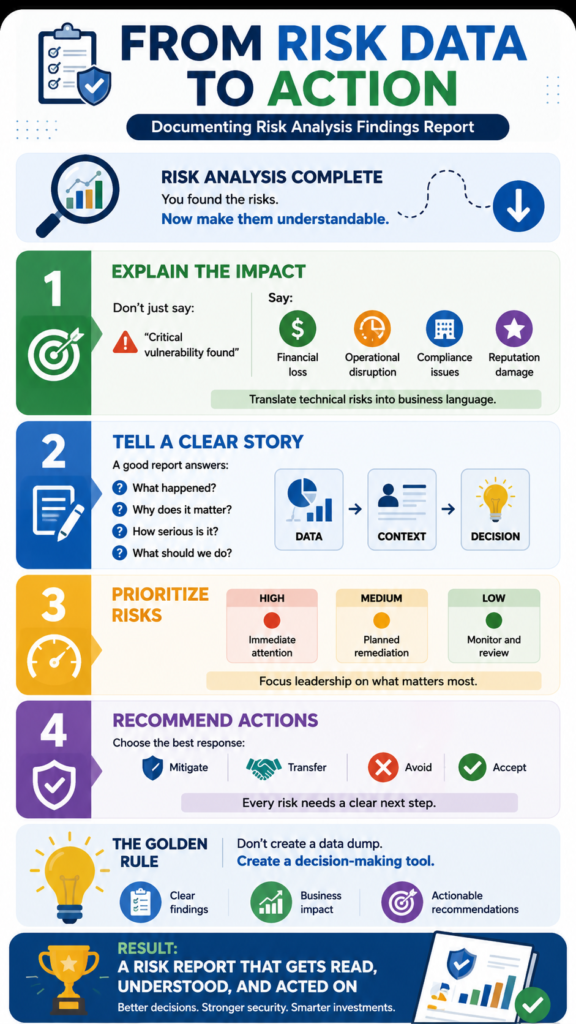
This is the call to action. Present the accept, mitigate, transfer options you’ve developed, but frame them as business choices. For each option, you must include:
- The Action: What would we actually do?
- The Cost: The estimated investment (time, money, effort).
- The Residual Risk: The probable loss magnitude after implementing this option.
- Pros and Cons: A quick, balanced look.
For example:
- Option 1 (Mitigate – Enhance Detection & Response): Implement tighter monitoring on the HR network segment and a dedicated incident response playbook.
- Cost: $80k initial, $20k/year.
- Residual Risk: Reduces probable loss to $200k-$800k.
- Pros: Directly addresses the attack path, improves overall security posture.
- Cons: Requires ongoing staffing commitment.
This format gives leadership a clear comparison. They can weigh investment against risk reduction.
What Are the Common Pitfalls to Avoid?
The pitfalls are usually about pride and fear. We include too much because we’re afraid of being questioned. We use jargon to sound authoritative. We bury the lead.
- The Data Dump: Including every log snippet, every chart from your tool. Appendices are for that. The body is for curated evidence.
- The Jargon Jungle: Using terms like “lateral movement,” “exfiltration,” or “zero-day” without a one-sentence plain-English explanation. Assume your reader is smart but not a specialist.
- Ambiguity: Using “high risk” or “should be considered.” Use numbers and clear statements. “We recommend” is stronger than “It is advisable to…”
- No Clear Owner or Next Step: The report dies if it doesn’t say who does what by when. A simple “Recommended Actions & Owners” section with names and quarters is vital.
How Do You Make Technical Data Understandable?
You translate. Constantly. A finding isn’t “Alert volume increased 300%.” It’s “Our systems are under three times more automated attack pressure than last quarter, indicating we are a target of increased interest.” A finding from a tool isn’t just its output.
When we report findings from our Network Threat Detection, we say, “The system identified three instances of an attacker attempting to mimic normal system administrator behavior to move unseen, a tactic that standard defenses missed. This shows a gap in our ability to detect stealthy, post-compromise activity.”
Use analogies related to the business. Prioritizing remediation starts with properly identifying network assets, vulnerabilities, and threats to frame the conversation.
After all, a risk of system downtime isn’t just an IT issue; it’s “a freeze on our production line” or “a closure of our digital storefront.” Connect the technical dot to the business consequence with a straight, clear line.
What Makes a Report “Actionable”?

An actionable report leaves the reader with a clear understanding of the choices and their implications. It doesn’t just say “there’s a problem.” It says “here is the problem, here is what it will likely cost us, and here are three ways to handle it, with the costs and benefits of each.”
“Most cybersecurity conversations fail in the boardroom not because the risk is small, but because the message is wrong. Boards do not need logs, alerts, or technical jargon. They need clarity on business risk, financial impact, regulatory exposure, and decision urgency.” – ScienceDirect
The final section should be a decision memo. It can literally have a line that says: “We request approval to proceed with Option 2: Mitigate via enhanced monitoring, with an allocated budget of $80k.”
This transforms the document from an interesting read into a tool for governance. It moves the conversation from “What does this mean?” to “Should we sign the purchase order?”
FAQ
How long should the report be?
As short as possible, but long enough to justify the decision. For a single risk scenario, 3-5 pages total is often sufficient, with detailed data in appendices. The executive summary must be one page.
Who should be the audience for the report?
Write for the most senior decision-maker who needs to act on it. Typically, this is a business leader (CFO, COO) or a risk committee. Write in their language, not the language of the security team.
How often should we update or re-issue reports?
Whenever a material assumption changes, or at least annually. If the threat landscape shifts, a new technology emerges, or the business process changes, the risk changes. The report is a snapshot, not a monument.
What if leadership ignores a well-documented report?
That is a formal acceptance of the risk. Ensure your report includes an option for “Accept: No action taken.” If they choose that path, document their approval. This creates an audit trail and formally transfers responsibility for the residual risk to the business.
The Final Draft
Documenting risk analysis findings is the last mile of your work, the difference between being a technician and an advisor. A great report translates complex cyber threats into a manageable business discussion, providing the clarity needed to solve them.
Before exporting that 45-page PDF, stop. Think of your CFO. Tell a story, present a clear choice, and make it easy to say “yes” to safety. Turn your analysis into action: Join Network Threat Detection today.
References
- https://www.linkedin.com/posts/asifcyberfort_struggling-activity-7422492446447583232-LZMB
- https://www.sciencedirect.com/science/article/abs/pii/S0950423019307405