
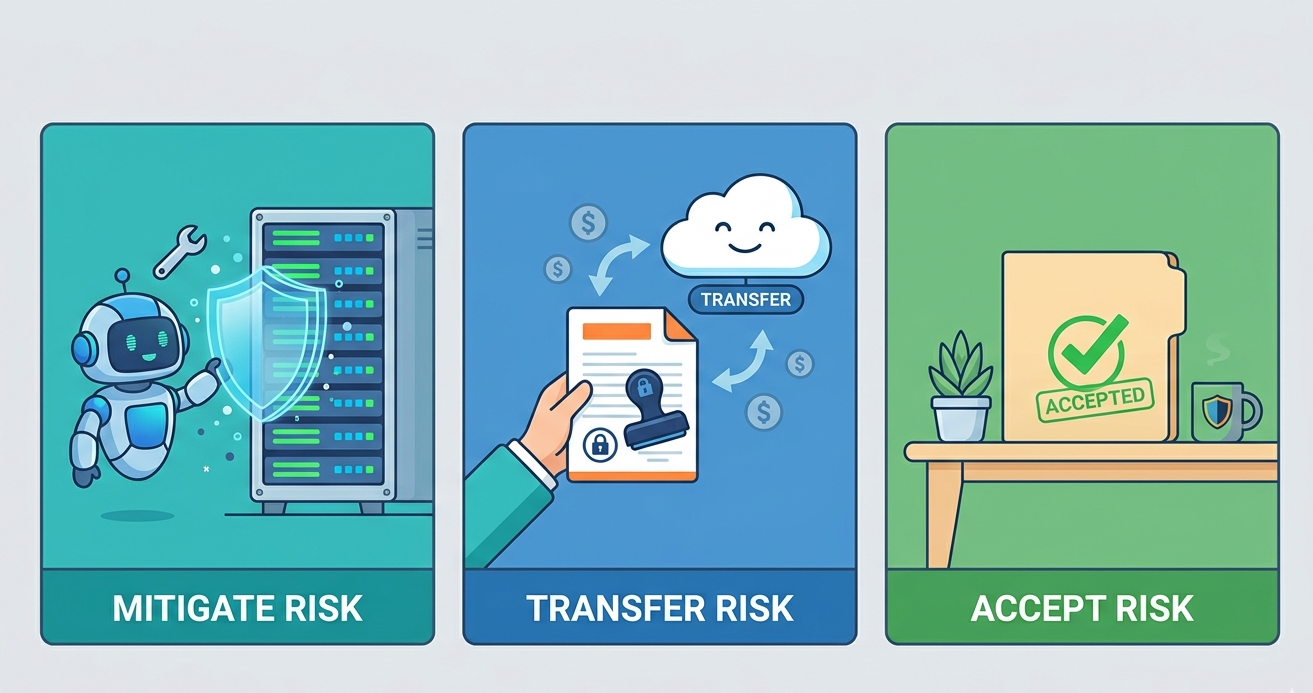
A risk appears on your dashboard. Now what? You have three core risk treatment options accept mitigate transfer. Combined with strong Network Threat Detection, businesses can identify risks early and decide whether to accept them, reduce them, or shift the financial impact elsewhere.
Picking wrong wastes money or leaves you exposed. Let’s break down how to think about each option so you can move from panic to plan. Keep reading to make your next risk decision a confident one.
Your Risk Response Playbook
Before choosing a treatment option, remember that every risk is different. Some are too small to justify spending money on.
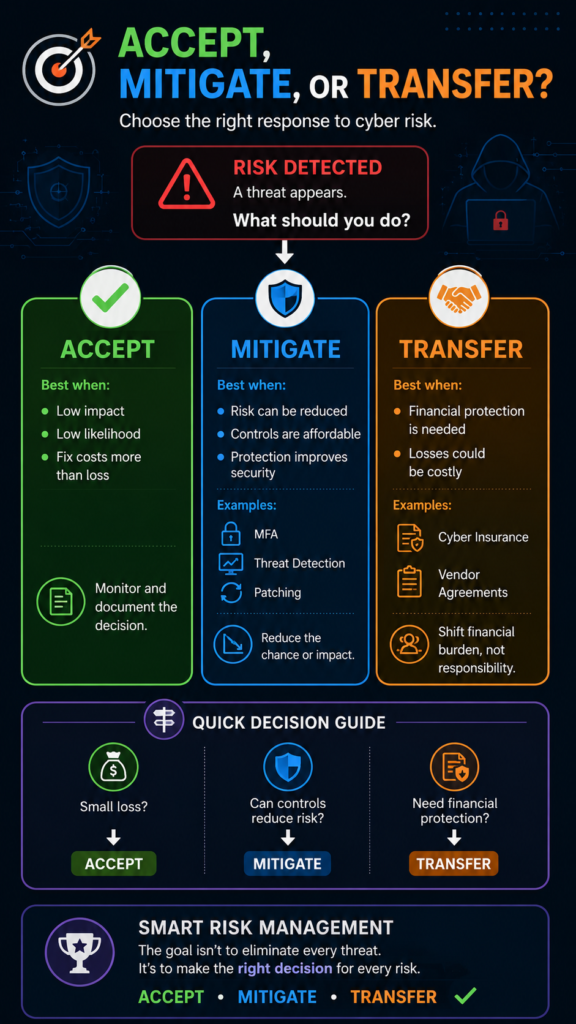
- Accept risk when the cost of treatment outweighs the probable loss.
- Mitigate risk by reducing its likelihood or impact with controls like detection.
- Transfer risk by shifting the financial burden, typically through insurance.
When Does Accepting Risk Make Sense?

Acceptance gets a bad rap. It sounds like surrender, like negligence. It isn’t. Accepting risk is a formal, documented decision that the cost of addressing the risk exceeds the probable loss if it materializes. It’s a business calculation, not an oversight.
“Cyber risk treatment is a crucial stage of cyber risk management. During the risk treatment stage, countermeasures are applied to reduce the impact and likelihood of cyber risks.” – Springer
You accept risk when the math checks out. A $10,000 control to address a $1,000 annualized loss doesn’t make financial sense. You also accept risk when mitigation is impossible or disproportionate.
That legacy system from the story? The business decided the operational disruption of patching was a greater certainty, and cost, than the unlikely breach. The key is that this must be conscious. It’s written down, approved by someone with authority, and revisited if conditions change.
How Do You Effectively Mitigate a Threat?
Credits: Project Management
This is the option most people jump to first. Mitigating risk means taking action to reduce either its likelihood of occurring or its impact if it does. It’s the bread and butter of security programs. But effective mitigation is targeted. You aim your resources at the most probable or most costly loss drivers identified in your analysis.
Mitigation isn’t just buying a tool. It’s a spectrum. You can reduce likelihood with stronger authentication or patch management. You can reduce impact with robust, tested backups and incident response plans. Often, the most powerful first step is simply knowing what’s happening.
This is where we’ve seen the deepest returns. By implementing Network Threat Detection, we shifted from hoping our perimeter would hold to actively seeing and stopping attacks inside it. This directly mitigates risk by dramatically reducing the probability a threat actor’s actions will succeed, and it gives us the data to make our other mitigation efforts smarter.
What Does It Mean to Transfer Risk, Really?
Transfer shifts the financial burden of a risk to another party. The classic example is cyber insurance. You pay a premium, and the insurer agrees to cover certain losses if an event occurs. But transfer is more than a policy.
It can include contracts with service providers that include indemnification clauses, or using a SaaS platform where the provider assumes the risk of securing the underlying infrastructure.
Crucially, transfer rarely means you transfer all the risk. Insurers have exclusions. Contracts have limits. You often retain a deductible or share the burden. And you almost never transfer the operational headache or reputational damage.
A data breach might be insured for direct costs, but your customers still lose trust. The goal of transfer is to make a potentially catastrophic, unpredictable loss into a predictable, manageable operating expense, the insurance premium.
How Do You Decide Between the Options?
This is the art. You weigh them against each other using the data from your risk analysis. A strategic risk analysis matrix can help. You look at the probable loss magnitude using advanced quantitative risk analysis, the cost of each treatment option, and the residual risk you’d be left with.
| Treatment Option | Best For… | Key Consideration |
| Accept | Low-probability, low-impact risks; risks where treatment cost > loss. | Requires formal, documented approval and periodic review. |
| Mitigate | High-probability or high-impact risks where controls are cost-effective. | Aim for the biggest reduction in probable loss for your investment. |
| Transfer | High-impact, lower-probability “catastrophic” risks (e.g., major breach). | Understand policy exclusions and that reputational risk remains with you. |
The process is iterative. You might mitigate what you can, transfer what’s left that’s too big to carry, and consciously accept the rest. For example, you mitigate ransomware risk with backups and Network Threat Detection.
You transfer some of the financial risk with a cyber insurance policy that covers incident response costs. You accept the residual risk of a multi-day recovery because further mitigation would be exorbitant.
What’s the Biggest Mistake Teams Make?
The default is to mitigate everything. It feels proactive. But it leads to control fatigue, wasted budget, and a brittle security program that’s hard to manage. You burn out your team patching every minor vulnerability while potentially missing the broader attack patterns a smarter detection strategy would catch.
“In general, the risk treatment options available to the management of an organization fall into four broad categories: avoidance, mitigation, acceptance, and transfer (AMAT).” – Sage Publishing
The other mistake is treating these options as permanent. They’re not. The world changes. A threat that was low-probability last year might be high-probability now. A new, affordable mitigation technology might emerge.
Your insurance costs might skyrocket, making transfer less attractive. Your treatment plan must be a living document. That legacy system we accepted risk on? Six months later, a new integration made it a central piece. We re-evaluated, and the math changed. Mitigation became the right answer.
Can You Combine Risk Treatment Options?
Almost always. In fact, you usually should. Pure acceptance, mitigation, or transfer is rare for significant risks. A layered approach is stronger. This is called a treatment plan.
For a web application handling sensitive data, your plan might look like this:
- Mitigate: Implement a WAF, rigorous code testing, and multi-factor authentication.
- Transfer: Purchase a cyber insurance policy with a sub-limit for application security failures.
- Accept: Formally acknowledge the residual risk of a novel, zero-day attack that bypasses all controls.
The combination is key. The mitigation reduces the likelihood, which should lower your insurance premium (cost of transfer). The transfer caps your worst-case financial loss. And the acceptance is for the truly unforeseeable, allowing you to move on without chasing perfect security.
How Does This Fit Into a Larger Security Program?

Risk treatment isn’t a one-off event. It’s the output of your foundational risk analysis techniques and the input for your security roadmap. Each “mitigate” decision becomes a project or an operational task.
This cycle turns your security program from a reactive cost center into a business-aligned risk management function. You’re not just blocking threats; you’re making strategic investments to protect business value.
You can explain to any leader, in clear terms, why you’re spending money on X instead of Y. You have a rationale, grounded in the probable loss and the cost of treatment. It’s defensible, it’s logical, and it finally makes security a part of the business conversation, not a separate, scary domain.
FAQ
Isn’t “accept” just another word for ignoring the problem?
No. Ignoring is passive and unaware. Formal acceptance is an active, documented business decision made by responsible parties after analysis. It’s acknowledging a risk exists and consciously choosing not to act, with a rationale.
Does cyber insurance (transfer) make us less careful about mitigation?
It can, a problem called “moral hazard.” Good insurers require certain security controls (like MFA, backups) for coverage. Your goal should be to mitigate first to reduce likelihood, using insurance as a financial backstop for severe events.
How do we measure if our mitigation is working?
You track metrics that align with the risk. If you mitigated a phishing risk with training, track reduced click rates. If you mitigated intrusion risk with Network Threat Detection, track mean time to detect and respond. The goal is to see a reduction in the key drivers of your probable loss calculation.
Can we change a treatment decision later?
You must. Risk is dynamic. Schedule regular reviews (annually, or after major incidents) of your accepted risks and treatment plans. New technology, threat intelligence, or business changes can make a different option more viable.
The Strategic Choice
The strategic choice between risk acceptance, mitigation, and transfer marks the shift from fear-based reactions to running a rational, resilient business. Instead of trying to stop every threat, you must determine the smartest way to deal with it. The power lies in making a conscious, deliberate choice.
To proactively map, analyze, and prioritize these critical business risks before attackers exploit them, explore how Network Threat Detection transforms threat modeling into actionable security intelligence.
References
- https://link.springer.com/article/10.1007/s10586-024-04899-1
- https://sk.sagepub.com/ency/edvol/embed/encyclopedia-of-crisis-management/chpt/risk-treatment