
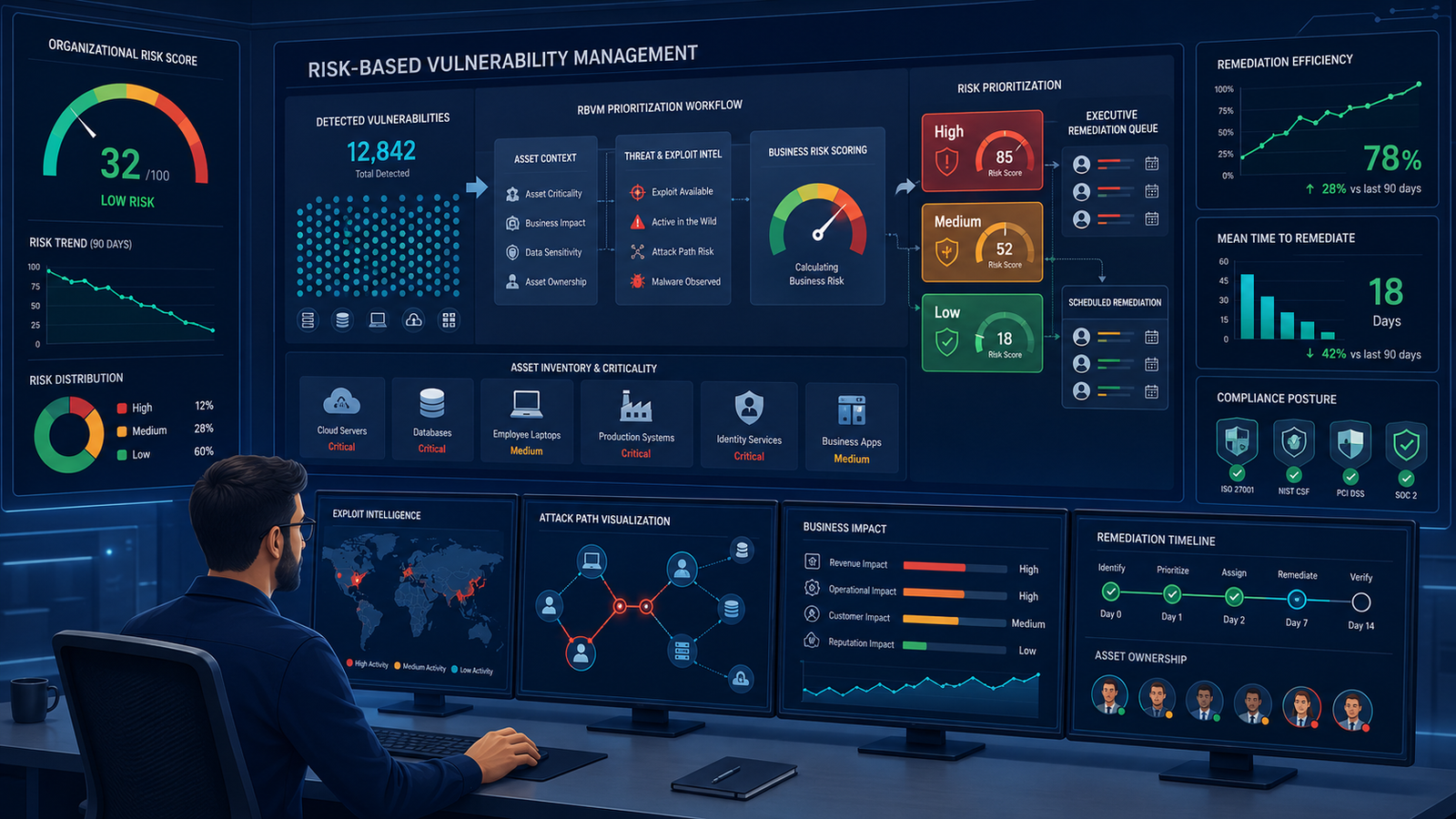
Every organization collects vulnerability data, but not every organization knows which findings deserve immediate attention. At Network Threat Detection, we believe the risk based vulnerability management RBVM approach helps security teams focus on vulnerabilities that create the greatest business risk instead of chasing endless critical alerts.
By combining threat intelligence, asset context, and exploitability, teams can make smarter remediation decisions and reduce risk faster. Keep reading.
What You’ll Learn
Instead of treating every vulnerability as equally urgent, this guide explains how to prioritize the issues that attackers are most likely to exploit. You’ll learn how business context, threat intelligence, and asset criticality work together to create a practical remediation strategy that improves security while reducing alert fatigue.
- Stop prioritizing vulnerabilities using severity scores alone.
- Combine exploit intelligence with business context for smarter decisions.
- Focus remediation efforts on vulnerabilities that create measurable business risk.
Why Does Traditional Vulnerability Scanning Fail Us?
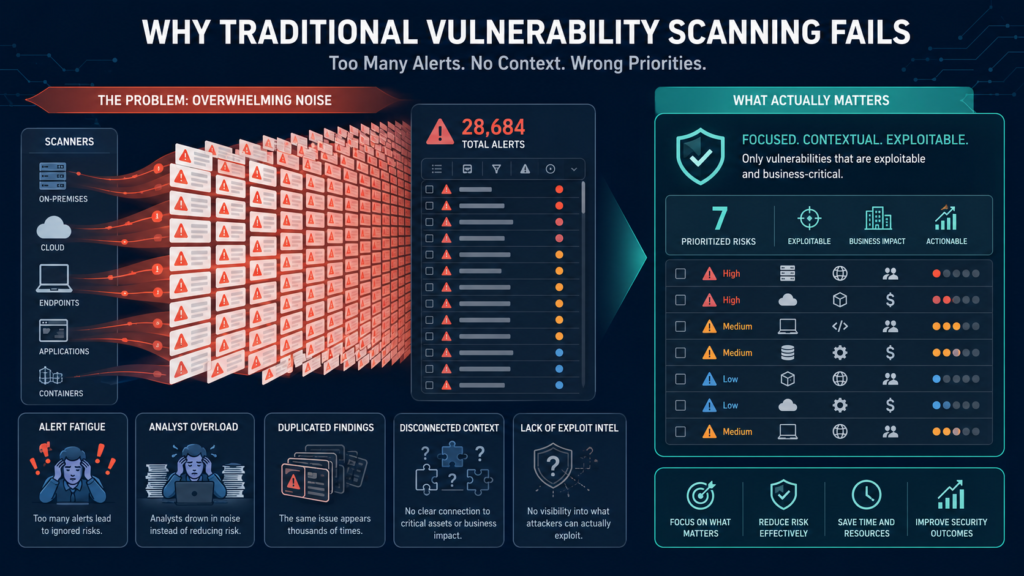
You run a scan. The report comes back, a hundred pages thick, filled with red “CRITICAL” flags. It feels urgent, but also hopeless. Where do you even start? This is the classic failure mode of checklist security. It treats every vulnerability the same, ignoring the crucial context of your specific world.
That critical flaw in an old marketing server sitting in a isolated subnet? It gets the same panic-inducing rating as a fresh exploit in a public-facing web server handling customer payments.
The scanner doesn’t know the difference. It can’t. It just sees software versions and Common Vulnerabilities and Exposures (CVE) IDs.
So teams burn cycles patching things that pose little real danger, while the true time bombs tick away unnoticed. The workload is immense, the progress feels negligible, and the actual risk to the business remains a mystery.’
“Inadequate Vulnerability Management (VM) techniques, relying solely on metrics such as the Common Vulnerability Scoring System (CVSS), may lead to overestimating the risk of vulnerability exploitation” – ScienceDirect
The core problem is a lack of prioritization based on real risk.
- It wastes limited security resources on low-impact issues.
- It creates alert fatigue, leading to critical issues being ignored.
- It provides no clear line of sight into whether the organization is actually getting safer.
What Changes When You Adopt a Risk Based Lens?
The shift is fundamental. Instead of asking “What’s vulnerable?” you start asking “What can be exploited to cause the most damage to us?” Risk is the product of threat, vulnerability, and consequence. An RBVM approach forces you to weigh all three.
A vulnerability matters more if there’s an active threat. Think of it like your home. A faulty lock on your backyard shed (vulnerability) is less of a risk than the same faulty lock on your front door, because a burglar (threat) is more likely to try the front.
In digital terms, a flaw being actively exploited in the wild by ransomware gangs elevates its priority instantly. The consequence piece is about your business. A breach in your development environment might be bad, but a breach in your customer database could be catastrophic.
This lens changes everything. It turns a giant, static to-do list into a dynamic, intelligent action plan. You’re no longer securing software, you’re protecting business operations. The metrics change too, from “patches applied” to “risk score reduced.” It’s a move from busywork to strategy.
How Do You Actually Calculate Risk for a Vulnerability?
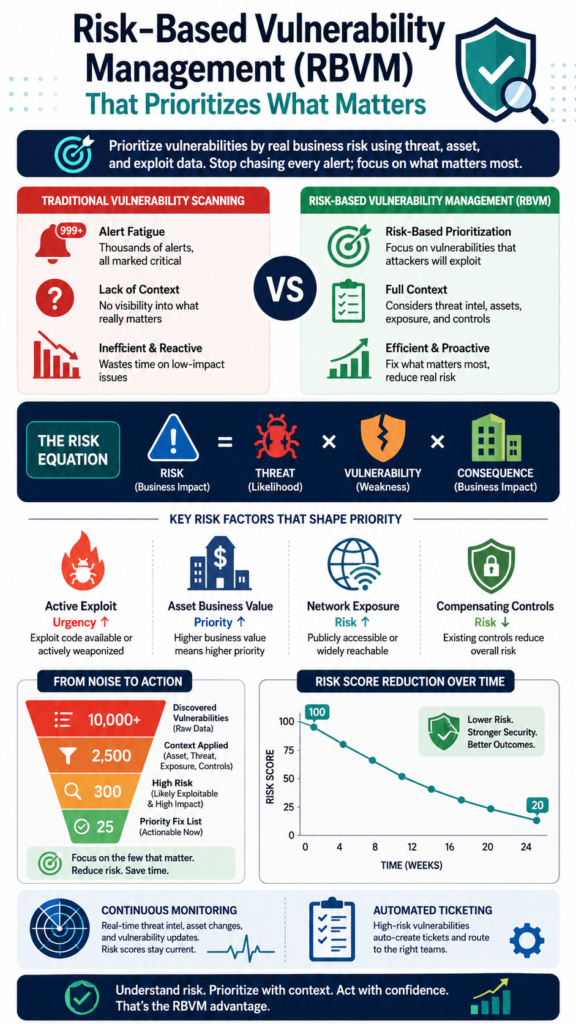
This is where the rubber meets the road. You need data, and lots of it. You start with the base, the Common Vulnerability Scoring System (CVSS) score gives you a severity rating, say an 8.5. That’s a decent starting point, but it’s generic. Effective risk scoring adds layers of your own context by combining severity with asset importance, active threats, and real-world exposure.
First, asset criticality. Is this vulnerability on a CEO’s laptop, a public web server, or a decommissioned test machine? You tag your assets with business value. A critical flaw on a mission-critical server gets its risk score multiplied.
Next, threat intelligence. Is there a proof-of-concept exploit code available? Are threat actors actively weaponizing this CVE? This data, which we monitor continuously through our Network Threat Detection, directly influences the “threat” variable in your risk equation.
“Entail a significantly higher risk reduction than criticality-based ones, and thwart the majority of risk in the wild by addressing only a small fraction of the patching work prescribed by current practices” – Semantic Scholar
Finally, you consider exploitability. Is the vulnerable service remotely accessible? Does it require user interaction? Are there existing compensating controls, like a firewall rule blocking the specific attack vector?
Weaving these threads together, asset value, active threats, and environmental factors, gives you a true risk score. It’s a number that means something specific to your company, not the whole internet.
| Risk Factor | Description | Impact on Priority |
| Active Exploit in Wild | Threat groups are using this flaw in real attacks. | Dramatically Increases. Patching becomes urgent. |
| Asset Business Value | The importance of the affected system to revenue or operations. | Direct Multiplier. High-value asset = higher risk score. |
| Network Exposure | Is the vulnerable service accessible from the internet? | Significantly Increases. Remote access lowers attacker effort. |
| Compensating Controls | Existing security measures that block the exploit path. | Can Reduce. A well-configured WAF might lower immediate risk. |
Can This Approach Work Without Overwhelming My Team?
Credits: Action1
It’s a fair fear. Adding more data points sounds like more work. But a proper RBVM platform does the heavy lifting. It’s not another dashboard to watch, it’s an automation engine for decision-making. The goal is to take the thousand vulnerabilities and boil them down to the ten you need to deal with this week.
The integration is key. Your vulnerability scanner finds the holes. Your asset management system provides the business context. Threat intelligence feeds, especially those gleaned from your own network traffic via Network Threat Detection, add the real-world danger level.
The RBVM system correlates all of it, applies your company’s unique risk formula, and spits out a prioritized list based on custom risk scoring models tailored to the organization’s environment.
This doesn’t eliminate human judgment, it empowers it. Analysts spend less time sifting and correlating, and more time on the nuanced work that matters, investigating complex threats, architecting controls, and advising the business. It turns the team from firefighters overwhelmed by every alarm into a surgical unit addressing precise, diagnosed problems.
What Role Does Continuous Monitoring Play?
Vulnerability management is not a quarterly scan. It’s a continuous process. Your network changes daily. New servers spin up, employees install software, cloud configurations drift. The threat landscape changes hourly. A flaw that was theoretical yesterday can have a weaponized exploit today.
This is why the “set it and forget it” scan model fails. Your risk assessment is only as good as your data’s freshness. Continuous monitoring, particularly of network traffic, provides a live pulse.
It can detect scanning activity that suggests an attacker is probing for a specific weakness you know you have. It can identify unexpected connections to or from a vulnerable asset, indicating potential compromise.
This live threat data is the most powerful ingredient in the risk calculation. It moves a vulnerability from a theoretical “should fix” to a defensive “are under attack” emergency.
Without this stream of real-time context, your risk scores are educated guesses. With it, they become a dynamic reflection of your actual defensive posture. You’re not just patching known bugs, you’re responding to the live intentions of your adversaries.
How Do You Measure the Success of an RBVM Program?
Forget the vanity metrics. The number of vulnerabilities closed is meaningless if they were all low risk. The success of an RBVM program is measured in one thing: reduction of material risk to the business.
You track this through trends. Risk exposure dashboards can help security teams visualize whether overall risk levels are improving over time, identify changes in critical assets, and communicate remediation progress.
Are you reducing the “dwell time”, how long critical vulnerabilities exist before being patched? Are you seeing fewer high-severity vulnerabilities on your most critical assets? Another key metric is efficiency.
Is the IT team able to patch the highest-risk items faster, because they’re not distracted by low-priority noise?
Ultimately, the best measure is a business conversation. You should be able to say, “Here is the top risk we mitigated this month, and here’s how it could have impacted our revenue or operations.” You move from a cost center to a risk advisor.
The program is successful when leadership understands the value because you’re speaking their language, protecting the business, not just running scans.
Is This Only for Large Enterprises?
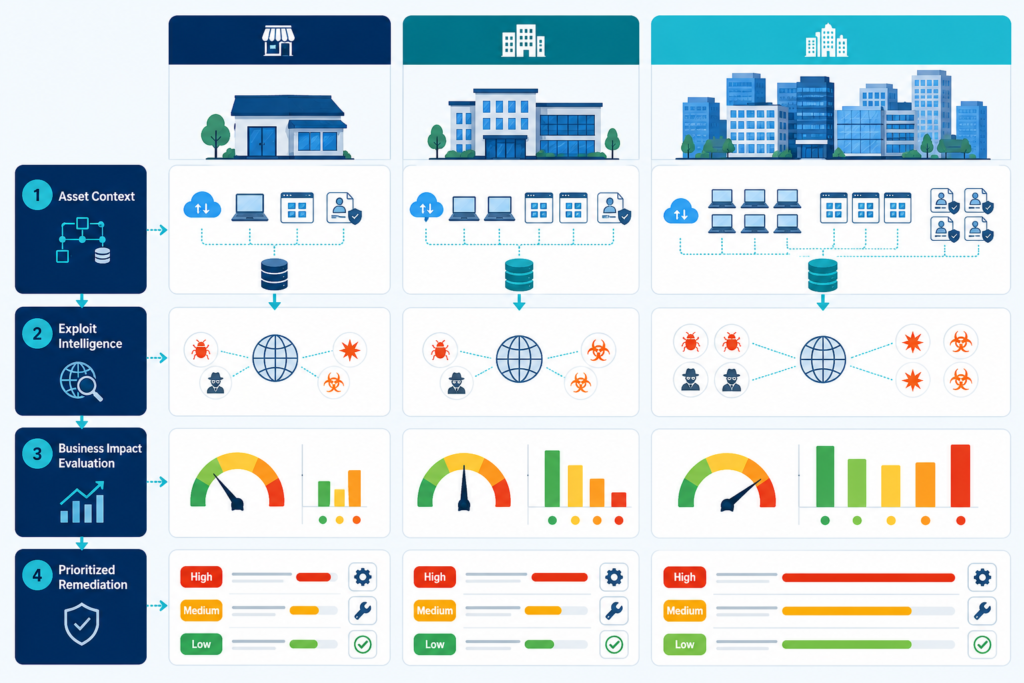
It’s a common myth that risk-based approaches are too complex for smaller teams. In reality, it’s the opposite. Smaller teams have fewer resources to waste. They can’t afford to chase every medium-severity CVE. For them, RBVM isn’t a luxury, it’s a survival tactic.
The principles are the same regardless of size. You still must identify your crown jewels, maybe it’s your e-commerce server and your customer database. You still need to know if those assets are vulnerable to active threats.
The scale of the tooling might be different, but the mindset is critical. A small team using a risk-based lens will be far more effective and secure than a large team lost in a sea of unprioritized alerts. It brings focus where it’s needed most.
FAQ
Does RBVM mean I can ignore low-severity vulnerabilities?
Not ignore, but deprioritize. They stay in your backlog. The focus is on ensuring the high-risk items are resolved first. Sometimes, low-severity flaws on critical assets get elevated due to context.
How does threat intelligence fit into RBVM?
It’s the fuel. Intelligence about active exploits, attacker tactics, and real-world campaigns is what transforms a static vulnerability into a dynamic risk. It tells you which holes the bad guys are actually trying to squeeze through.
What’s the first step in moving to an RBVM approach?
Inventory your critical assets. You can’t assess risk if you don’t know what you’re protecting. Then, start enriching your vulnerability scans with just one extra piece of context, like “is this system internet-facing?” Build from there.
Can I implement RBVM with the tools I already have?
Partially. You can apply the mindset manually by using spreadsheets and threat feeds. But to scale and be continuous, you’ll likely need a platform designed to correlate these disparate data sources automatically.
Making the RBVM Approach Your New Reality
Risk-Based Vulnerability Management turns vulnerability management into a focused, strategic practice. By understanding assets, threats, and exposure, teams can prioritize risks that truly matter.
Network Threat Detection helps security teams improve risk visibility with real-time threat modeling, automated risk analysis, and CVE mapping. Build a smarter vulnerability strategy and strengthen your defenses with confidence. Join Network Threat Detection
References
- https://www.sciencedirect.com/science/article/abs/pii/S2214212625000092?via%3Dihub
- https://www.semanticscholar.org/paper/Risk-Based-Vulnerability-Management.-Exploiting-the-Allodi/d2fa01e774b6211d129a8a8730cce0b10d0666c4/figure/27