
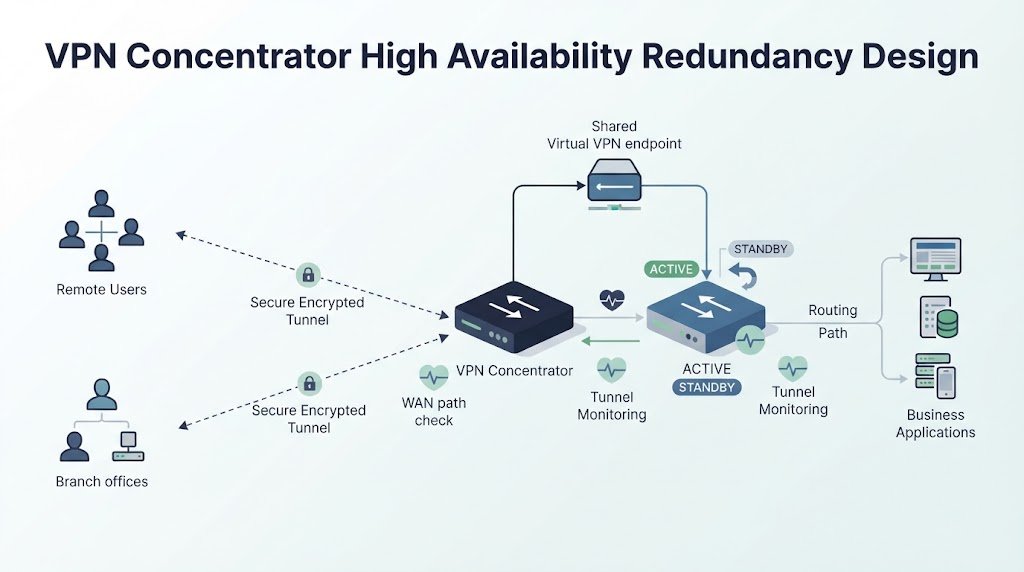
VPN concentrator high availability redundancy should keep the VPN reachable and recover sessions when the active concentrator or its network path fails. The design goes beyond shifting a virtual IP to a standby device. IPsec tunnels, NAT states, routes, and application sessions may still need to recover cleanly.
Cisco ASA documentation covers active/standby, active/active, and stateful failover, while pfSense uses CARP for HA and automatic OpenVPN reconnection. We focus on whether users, branches, and applications meet the VPN SLA after failover. Network Threat Detection can help identify abnormal traffic during recovery. Keep reading to see how to design the setup.
Quick Reads for VPN HA Resilience
Here are the three points that matter most when designing VPN concentrator high availability redundancy for real-world failures:
- Protect more than the VPN endpoint: A virtual IP can move to the standby, but tunnels, NAT states, routes, and application sessions may still need to recover.
- Monitor the full failure path: Combine HA heartbeats with WAN health checks, DPD, VPN peer monitoring, and dynamic routing so failover responds to actual connectivity problems.
- Test recovery at the application level: Measure device detection, failover, tunnel reconnection, route convergence, and recovery of workloads such as VoIP, VDI, and long-running TCP sessions.
What Does VPN Concentrator High Availability Actually Protect?
A VPN concentrator handles tunnel termination, encryption, authentication, routing, and often NAT. If that device fails, users need another path to the same service. One node handles traffic, while the second node waits for a failure or loss of service health.
As highlighted by the National Security Agency (NSA)
“If the implementing organization requires site survivability, then redundant equipment is required for remote sites to maintain connectivity, thereby ensuring access to classified resources.” – NSA
The virtual endpoint matters here. A shared VPN address means branch devices and remote users do not need a new destination every time the active node changes. The backup takes ownership of that address, then new VPN connections can reach it.
But active sessions are another matter. The VPN endpoint can return while an IPsec security association still needs to be rebuilt. A TCP session may also break if its state was tied to the failed node.
We separate the problem into four checks:
- Is the VPN address reachable?
- Can the tunnel reconnect?
- Can routes converge?
- Do applications recover?
That last check often exposes problems that a basic HA test misses. A ping can succeed while a voice call or VDI session has already failed.
Do You Need a Separate VPN Concentrator?
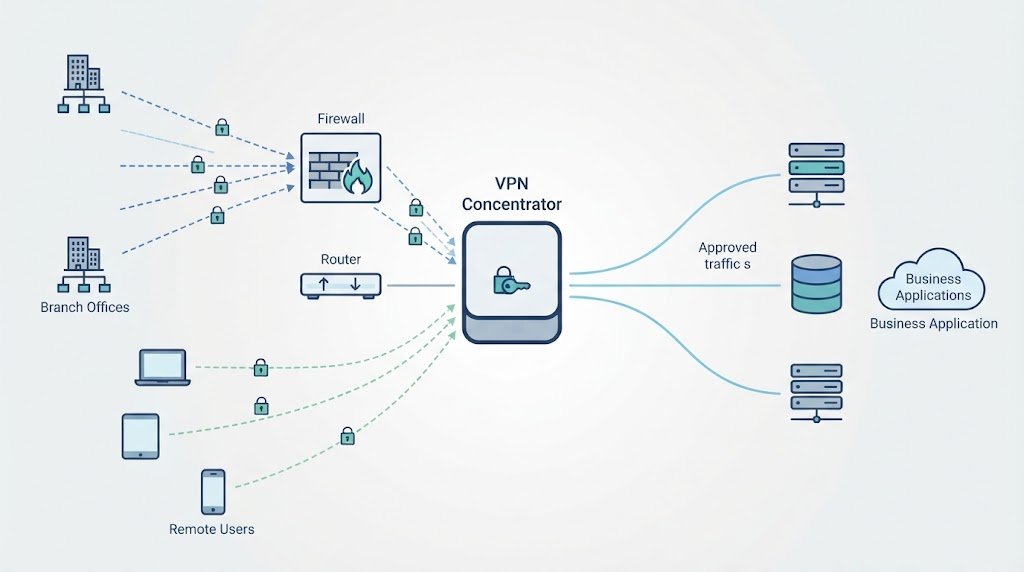
A dedicated concentrator can make sense when a business has many site-to-site tunnels or a large remote-access population. It separates VPN processing from other firewall duties and can make capacity planning easier.
On the other hand, adding another platform creates more infrastructure to operate. Our preference is to begin with the traffic and security requirements rather than the device type. That means reviewing the wider VPN technologies and security concerns before deciding how the concentrator should fit into the architecture.
Ask what the environment needs:
- High tunnel counts
- Large remote-access demand
- Route-based IPsec
- BGP or OSPF
- Multiple WAN paths
- Strong tenant separation
- Independent VPN scaling
A router can terminate VPNs too, but configuration can become harder to manage as tunnel counts rise. That problem gets worse when each site needs its own encryption policy, routing rules, monitoring, and failover behavior.
| Design | Main benefit | Main concern |
| Dedicated concentrator | Clear VPN role | More infrastructure |
| Firewall-based VPN | Fewer platforms | Shared resources |
| Router-based VPN | Flexible routing | More configuration |
We have found that operational simplicity matters as much as raw throughput. If engineers cannot explain what happens during a failure, the design needs more work.
How Does Active/Standby Compare With Active/Active?
Active/standby is easier to reason about. Active/active can use more available capacity, but both designs still need enough capacity for a failure.
With active/standby, one concentrator carries the normal VPN load. The second node waits. If the primary fails, the standby becomes active and takes over the service address.
It is also what gives the design breathing room during a failure. The standby should be sized for the traffic it must handle, not for a quiet afternoon.
Active/active changes that model. Both nodes can handle traffic, which can improve resource use. The numbers should cover more than encryption throughput. VPN encryption overhead and performance considerations should also be included when estimating how much capacity remains during normal operation and failover.
We also check:
- Concurrent VPN sessions
- New tunnel negotiations
- CPU during reconnection
- Memory use
- NAT state
- Routing updates
- Authentication load
A common mistake is sizing each node for normal traffic and forgetting the failure case. If each unit runs at 60% during normal conditions, losing one can push the survivor far beyond its safe operating range.
Our capacity test therefore uses the failure load, not the average load. Active/active may look attractive on paper. Still, active/standby can be the better choice when predictable recovery matters more than squeezing maximum utilization from both nodes.
Why Do VPN Sessions Still Drop During HA Failover?
Credits: Nauman Munir
A stable VPN address does not mean every session will survive the move. During a failover, several things happen in sequence. The active concentrator stops serving traffic. The backup detects the failure and claims the virtual address. Traffic then reaches the new active node. At that point, new VPN connections can start normally.
Existing connections are harder.
An IPsec tunnel contains a security state that may have been created on the failed device. If that state is not synchronized, the remote peer may need to negotiate the tunnel again. OpenVPN HA documentation also notes that connection state is not retained between hosts, so clients reconnect after failover.
For example, a branch router may reconnect within seconds, while an active VDI session dies immediately. A web session may recover after a retry, while a voice call cannot.
Our testing uses three separate measurements:
- VPN endpoint recovery
- Tunnel recovery
- Application recovery
That sounds basic, but it catches a lot.
State synchronization can help with supported traffic. The platform decides which state can move between nodes.
In practice, we design around the sessions that matter most. If a short VPN interruption is acceptable, fast reconnection may be enough.
How Do VRRP, HSRP, and CARP Keep the VPN Endpoint Stable?
Virtual IP mechanisms give the VPN service a stable address while the physical node behind it changes.
The basic idea is easy to understand. Two devices share a virtual IP address. One device owns that address and handles traffic. If it fails, the second device takes ownership. For VPN systems, this is useful because remote peers can continue targeting the same endpoint.
CARP is one example used in HA firewall deployments. IPsec can use the CARP virtual address as its endpoint, allowing the active cluster member to handle the tunnel. The configuration can also synchronize between nodes, although the tunnel state itself may still need to be rebuilt after failover.
The same basic idea applies to other first-hop redundancy methods.
| Method | Main purpose |
| VRRP | Shared virtual IP |
| HSRP | Active/standby gateway |
| CARP | HA virtual IP |
The important point is that the virtual IP solves one problem. It does not solve every problem.
We still need to monitor the WAN, check VPN peers, handle routing, and verify application recovery. A concentrator can own the correct VIP while its upstream path is broken. A stable address is the foundation. It is not the whole HA design.
How Should You Detect WAN and Device Failures?
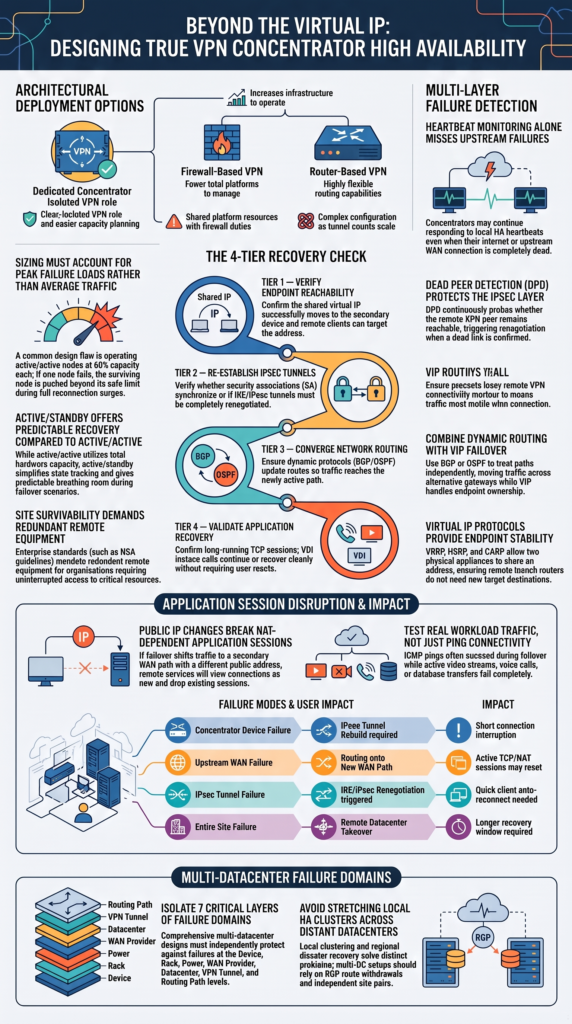
A concentrator might still respond to its HA heartbeat even after its internet path has failed. If the backup sees only the heartbeat, it may assume the primary is healthy and keep waiting. Users then remain connected to a dead path.
Insights from the United States Patent and Trademark Office (USPTO) indicate
“Exchange heartbeat messages between the nodes in the cluster to detect a failure of a node in the cluster of nodes” – USPTO
That is why we monitor several failure points. Device health checks the appliance itself. WAN checks confirm upstream reachability. VPN monitoring checks whether the remote peer is responding. This also makes detecting anomalous VPN connection behavior useful as a separate security visibility layer when connection patterns change unexpectedly.
DPD, or Dead Peer Detection, belongs to the IPsec layer. It checks whether the remote peer remains reachable. A failed DPD check can cause the tunnel to be removed and renegotiated. The exact timing depends on the configured values and VPN implementation.
We usually separate monitoring into these areas:
- Device failure
- HA heartbeat failure
- WAN failure
- Routing failure
- IPsec peer failure
- Application failure
That separation matters because each event needs a different response.
For example, a failed appliance may require HA takeover. A failed WAN path may require route withdrawal or a different gateway. A dead IPsec peer may need tunnel renegotiation.
Get the detection logic right first. Then tune the timers.
Aggressive timers can reduce detection time, but they can also create false failures on unstable links. A VPN that repeatedly drops and reconnects can be worse than one that takes a few extra seconds to recover. Our goal is controlled failover, not the fastest possible reaction.
When Should You Use Dynamic Routing Instead of HA Timers?
Virtual IP failover handles endpoint ownership. Dynamic routing handles the path. That distinction becomes important when a VPN concentrator has more than one WAN link, more than one tunnel, or more than one datacenter. A device can remain healthy while one of its paths fails.
Routing protocols such as BGP or OSPF can react to route changes and move traffic toward an available path. Static routes can also work when the topology is small and predictable. The right choice depends on how much path control the network needs.
Our threat model treats the path as a separate failure domain. We ask what happens if:
- The concentrator fails
- The ISP fails
- The upstream router fails
- The IPsec tunnel fails
- A remote network stops advertising a route
This avoids a common design mistake. Engineers sometimes make HA timers faster without checking whether the actual traffic path has failed.
A better design can combine a virtual IP with route monitoring and VPN peer checks. The VIP handles the service address. DPD checks the tunnel. Routing decides where traffic should go.
That separation also helps during testing. We can fail one layer at a time and see whether the network reacts correctly.
How Do You Prevent NAT, VoIP, and VDI Sessions From Breaking?
VPN recovery and application recovery are two different targets. A tunnel can reconnect while a long-running application session still fails. NAT makes this harder. If traffic moves to another WAN connection, the public source address may change. The remote service can then treat the traffic as a new connection.
We pay close attention to this during testing because users notice application failures more than tunnel status. A branch may reconnect without anyone noticing, while a voice call drops immediately.
The main cases to test are:
| Failure | VPN result | User impact |
| Device failure | Tunnel rebuild | Short interruption |
| WAN failure | New path | Sessions may reset |
| Tunnel failure | IKE/IPsec renegotiation | Reconnect needed |
| Site failure | Remote site takes over | Longer recovery |
State synchronization can reduce disruption for supported connections. Still, it does not mean every IPsec security association or application session transfers to the backup.
For remote users, automatic reconnection may be acceptable. For VDI, voice, or other long-lived sessions, the business may need a tighter recovery target.
We therefore test real traffic, not only pings. Run a video call. Open a VDI session. Transfer a file. Keep a TCP connection open. Then fail the active concentrator.
How Do You Build Multi-DC VPN Concentrator Redundancy?
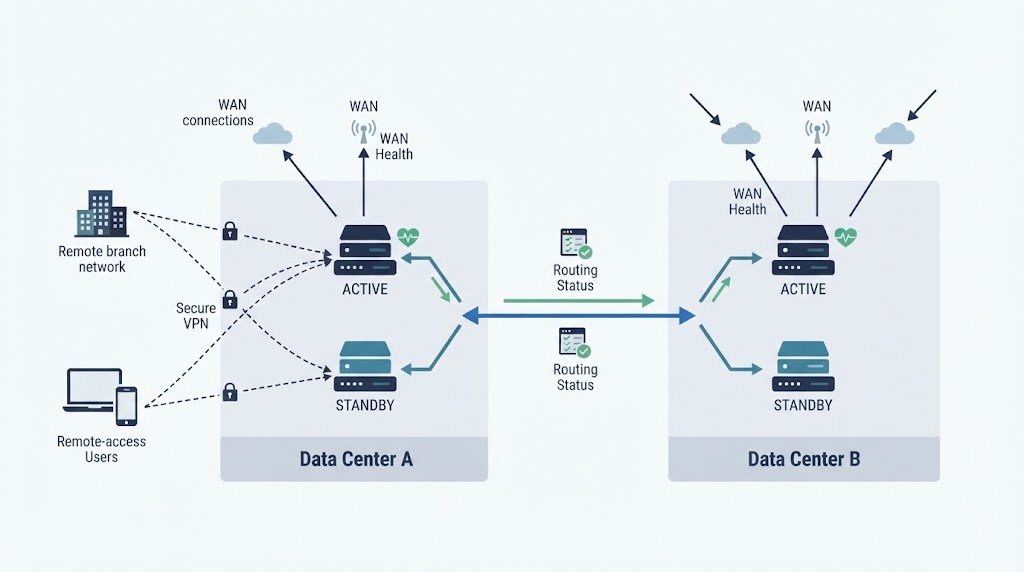
A second datacenter protects against failures that a local HA pair cannot handle. An active/standby pair can protect against an appliance failure, but both devices may still depend on the same building, power system, carrier, or upstream router. If that shared dependency fails, both concentrators can disappear together.
Multi-DC VPN design breaks that dependency.
A typical model has a redundant VPN pair in each site, separate WAN connectivity, and routing that can move traffic toward the available location. Cloud architectures use a similar idea by placing redundant VPN instances across separate availability zones and monitoring both the VPN instances and their connections.
Our design review checks the failure domains:
- Device
- Rack
- Power
- WAN provider
- Datacenter
- VPN tunnel
- Routing path
Each domain should have a known recovery method.
BGP can help advertise preferred paths and withdraw routes when a site fails. Static routing can work for smaller environments. Remote-access VPN may need a different approach because clients often depend on a stable hostname or address.
Do not stretch one HA concept across two distant sites without testing it first. Local clustering and site-level redundancy solve different problems. The goal is not to make two datacenters look like one giant appliance.
FAQ
What should I check first when VPN HA troubleshooting shows repeated failovers?
Start with the event logs and VPN health checks. Check whether the nodes are losing heartbeats, whether VPN path monitoring detects unstable links, or whether VPN tunnel flapping is causing repeated failovers.
Also review CPU usage, memory usage, interface errors, and packet loss. Repeated failovers often indicate an unstable network dependency rather than a failed concentrator.
How can I choose between a warm spare VPN and active standby VPN?
A warm spare VPN can work when the business can tolerate a longer recovery process. An active standby VPN is better when the business needs a predictable VPN failover time. Compare recovery targets, standby capacity, state synchronization, and operating costs. Your VPN SLA should guide the decision. Critical workloads may require a standby that can take over with minimal delay.
What causes VPN session drops even when the VPN endpoint stays available?
A VPN session drop can occur when tunnel state, NAT mappings, or authentication state does not survive failover. VPN session persistence depends on which connection states the architecture can synchronize between nodes.
A public address change can also interrupt connections because of a VPN IP change. Test long-running connections, not only new VPN sessions, before declaring the HA design successful.
How do I test whether VPN auto reconnect works after an outage?
Run controlled VPN connectivity tests during a planned outage. Disconnect the active path, record the VPN convergence time, and measure how long clients and branches take to reconnect.
Confirm that VPN auto reconnect restores tunnels without manual intervention. Test different users, devices, and tunnel types because reconnect behavior can vary. Repeat these tests after major configuration changes.
When should a business add VPN disaster recovery beyond local HA?
Consider VPN disaster recovery when local redundancy cannot protect against a complete site, carrier, power, or shared-network failure. A local VPN cluster can protect against device failure, while a multi-DC VPN can provide another recovery location.
Start with your VPN business continuity requirements. Then compare recovery time, routing changes, available capacity, and operational complexity with the business impact of a site outage.
Build a More Resilient VPN HA Design
VPN concentrator HA is about more than switching a virtual IP. Tunnel state, routing, WAN health, authentication, capacity, and application recovery all affect whether users actually stay connected. The only reliable way to judge resilience is to test failure scenarios and measure recovery time.
A clear VPN SLA and documented failover process can show where shared dependencies remain. For added visibility into abnormal tunnel behavior and unexpected traffic paths, explore Network Threat Detection alongside your existing HA controls.
References
- https://www.nsa.gov/Portals/75/documents/CSfC%20CP%20Updates%202026/(U)%20Enterprise%20Gray%20Implementation%20Requirements%20Annex%20v1.2.0.pdf
- https://patents.justia.com/patent/20220141084