

Network threat modeling helps security teams identify attack paths, prioritize risks, and improve detection coverage before incidents occur. Rather than documenting an idealized network, it focuses on the environment that actually exists and the ways attackers could move through it.
Keep reading to learn the process, common frameworks, key mistakes, and practical best practices for improving network security.
Network Threat Modeling Reality Check
- A threat model is only useful when the asset inventory is accurate. Missing cloud workloads, unmanaged devices, exposed services, or third-party connections create blind spots and false confidence.
- Attack paths matter more than isolated vulnerabilities. A medium-risk weakness can become critical when it provides a route to sensitive systems, privileged accounts, or important business data.
- Threat modeling should improve detection and response capabilities. If it does not strengthen SIEM rules, NDR coverage, alert triage, or mitigation planning, it becomes documentation rather than a security asset.
Understanding the Network Threat Modeling Process in Practice
The network threat modeling process helps teams find likely attack routes across a network. It looks at what exists, how traffic moves, where trust changes, what attackers may target, and which controls should stop or detect them.
What Does a Practical Model Usually Include?
- Important assets
- Sensitive data paths
- Network segments
- Identity and access points
- Exposed services
- Trust boundaries
- Third-party connections
- Likely attacker techniques
- Detection gaps
- Mitigation options
NIST frames threat modeling as a form of risk assessment that looks at both attack and defense sides of a logical entity, such as data, an application, a host, a system, or an environment.
“Threat modeling is a form of risk assessment that models aspects of the attack and defense sides of a particular logical entity.”
— NIST Computer Security Resource Center
That definition fits network defense well. A network is not just a set of devices. It is a living environment with users, services, credentials, cloud links, remote access, logs, and business processes. A useful model has to reflect that.
For example, a flat internal network may not look dangerous on a simple asset list. But once the team maps admin access, file shares, endpoint traffic, and service accounts, the risk may look very different. One compromised workstation could give an attacker a path to internal systems that were never meant to be exposed.
That is where network threat modeling becomes useful. It turns scattered technical details into a clearer risk story.
Network Threat Modeling Process Matters for Network Threat Detection
Source: HackerSploit
This video introduces MITRE ATT&CK and shows how defenders can use attacker tactics and techniques in blue team work. It is useful for connecting network threat modeling to detection engineering and attack path analysis.
The network threat modeling process matters because detection teams cannot protect what they do not understand. Raw alerts rarely explain business impact. A firewall log may show blocked traffic. An endpoint alert may show suspicious execution. A DNS event may show unusual lookup behavior. Each signal helps, but none of them tells the full story alone.
This is why threat modeling connects closely to proactive vs reactive threat detection. Reactive work starts after alerts fire. Proactive work asks where attacks are likely to happen before the noise begins.
In our work with network-focused teams, the biggest gap is often not tool coverage. It is context. Teams may have SIEM rules, NDR alerts, endpoint telemetry, and vulnerability scans. But if they do not know how attackers could chain those weaknesses together, they still struggle to prioritize.
A threat model helps the SOC move from “this alert looks bad” to “this alert matters because it sits on a path to a critical asset.”
That is the difference between monitoring traffic and defending the network.
Key Steps in the Network Threat Modeling Process
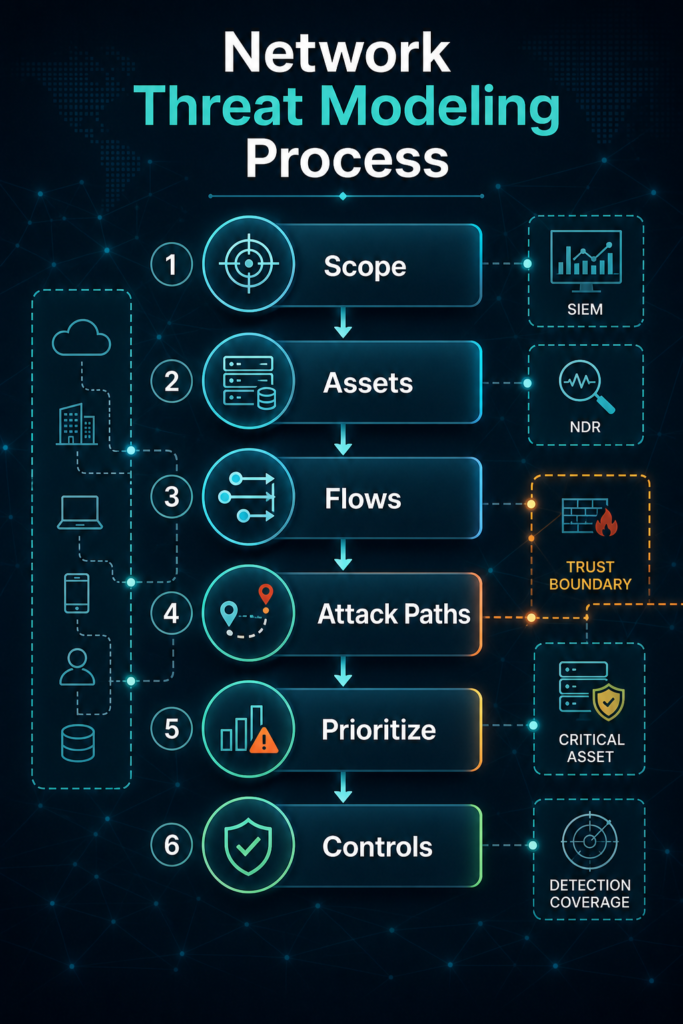
A good network threat modeling process should be simple enough to repeat, but detailed enough to guide real security work. The process below works well for SOC, risk, NTD, and security architecture teams.
Define the scope and business context
Start with a clear scope. Do not model the entire enterprise on the first pass unless the environment is small.
A better starting point is one high-value area, such as:
- a payment system
- an identity platform
- a cloud workload
- a data center segment
- a remote access path
- a critical SaaS integration
- a sensitive business application
The team should also define why the area matters. A system that stores customer data has a different risk profile from a test server. A privileged identity path has a different risk profile from a public marketing site.
Scope keeps the model useful. Without it, the process turns into a long meeting with vague risks and no clear action.
Build an accurate asset inventory
Asset inventory security is the base layer. If the team misses assets, the model misses risk.
Include:
- servers
- workstations
- cloud assets
- containers
- identity providers
- firewalls
- routers
- VPN systems
- APIs
- exposed services
- third-party connections
- privileged accounts
- sensitive data stores
This step often exposes the first real problem: the official inventory does not match the live network.
That is normal. Network environments change fast. New services appear. Old systems stay online. Temporary access becomes permanent. Shadow IT creates blind spots. A threat model should surface those gaps instead of hiding them.
Strong network visibility helps teams build a more accurate model because it shows what is actually communicating, not only what is listed in a spreadsheet.
Map data flows and trust boundaries
Data flow analysis shows how information, commands, and access move across the environment. Trust boundaries show where the security assumptions change.
Common trust boundaries include:
- internet to internal network
- user network to server network
- corporate network to cloud environment
- production to development
This step matters because many attacks succeed at the boundary. Attackers look for places where one zone trusts another too much. A model that ignores trust boundaries will miss lateral movement risk.
Identify threats and attack paths
Threat identification should focus on realistic attacker behavior. Do not list every possible threat. Start with likely paths.
Examples include:
- phishing leading to credential theft
- exposed remote access leading to internal access
- weak segmentation enabling lateral movement
- vulnerable public service leading to server compromise
- stolen service account leading to data access
- command and control traffic leaving the network
- unmanaged device creating a bridge into sensitive zones
Attack path analysis is the practical part. It asks how an attacker could move from entry point to target.
A simple path may look like this:
- User clicks a phishing link.
- Attacker steals credentials.
- Attacker connects through remote access.
- Attacker discovers internal services.
- Attacker moves laterally to a file server.
- Attacker stages data for exfiltration.
The value is not in guessing every move. The value is in seeing which steps the team can prevent, detect, or slow down.
Prioritize risks by exposure and impact
Threat prioritization should not treat every issue equally. A low-severity weakness on a critical attack path may matter more than a high-severity issue on an isolated system.
A practical risk review usually asks:
- Is the asset exposed?
- Is it reachable from a risky zone?
- Does it connect to sensitive data?
- Can it help lateral movement?
- Does it involve privileged access?
- Can the SOC detect abuse?
- Is there a tested response plan?
This gives the team better cyber risk prioritization. It also helps reduce alert noise because the SOC can focus on signals tied to real exposure.
Map controls and detection coverage
The final step is control mapping. This is where the threat model becomes useful for network threat detection.
Map each likely attack path to:
- preventive controls
- detective controls
- response actions
- SIEM correlation rules
- NDR coverage
- firewall policy
- identity controls
- logging requirements
- escalation paths
Detection coverage should be tested, not assumed. If the model says command and control detection exists, the team should know which telemetry supports it. DNS logs? Proxy logs? NDR alerts? Endpoint network events? Firewall logs?
This is where threat model validation matters. The team should confirm that the network defense plan works against the attack paths that matter most.
Network Threat Modeling Frameworks and Methods Compared
A threat modeling framework gives teams a structure. It does not replace judgment. The best method depends on scope, team maturity, and the kind of risk being modeled.
OWASP describes threat modeling as a repeatable process that includes breaking down the system, identifying threats, ranking threats, choosing mitigations, and validating the result.
“The OWASP Threat Modeling Cheat Sheet provides a concise, actionable reference for threat modeling, including decomposition, threat identification, threat ranking, mitigations, and review.”
| Method | Best Use | Strength | Limitation |
| STRIDE threat modeling | Identifying common threat types | Simple structure for spoofing, tampering, repudiation, information disclosure, denial of service, and elevation of privilege | Can feel application-heavy if the team does not adapt it to network paths |
| PASTA threat modeling | Risk-based security planning | Connects threats to business impact and risk decisions | Takes more time and facilitation |
| MITRE ATT&CK mapping | Mapping attacker behavior to techniques | Useful for detection engineering and SOC coverage reviews | Not a full threat modeling process by itself |
| NIST-style risk modeling | Governance and formal risk assessment | Good for structured security programs | Needs operational detail to help SOC teams act |
| Attack path analysis | Network exposure and lateral movement review | Strong fit for NTD and SOC workflows | Requires accurate asset, identity, and traffic data |
A practical team may combine methods. For example, use STRIDE to think through threat types, MITRE ATT&CK mapping to connect threats to attacker behavior, and attack path analysis to see how those behaviors could move through the network.
The framework is not the finish line. The outcome matters more: clearer risks, better controls, and stronger detection coverage.
Product Considerations
Product Description
Network threat modeling can be done with simple diagrams and workshops, but most real environments need tool support. The process may use asset discovery, vulnerability scans, SIEM, NDR, endpoint data, firewall logs, threat intelligence, SOAR, and detection engineering.
The tool stack should help teams answer one question: can defenders see and respond to the attack paths that matter?
A practical setup may include:
- asset inventory tools to identify systems and services
- vulnerability scanners to find known weaknesses
- network telemetry to observe traffic behavior
- SIEM correlation to connect events
Pros
- Helps teams focus on real attack paths instead of isolated issues
- Improves detection coverage across SIEM, NDR, and endpoint tools
- Connects security architecture with SOC operations
- Supports risk-based security decisions
Cons
- Needs accurate asset and traffic data
- Takes time from SOC, network, cloud, and risk teams
- Can become stale after architecture changes
Biggest Dealbreaker
The biggest dealbreaker is poor visibility. If the team cannot see assets, traffic, identities, exposed services, and trust boundaries, the threat model will be incomplete.
This is where some programs fail. They build a model from meetings, diagrams, and assumptions, but never compare it against live telemetry. The result looks clean, but the SOC still misses the risky paths attackers would use.
Network Threat Modeling Best For
Network threat modeling is best for:
- SOC teams improving detection coverage
- MSSPs supporting client risk reviews
- security architects reviewing network design
- risk teams prioritizing exposure
- incident response teams preparing playbooks
It is especially useful when a team wants to connect network defense planning with executive-ready security decisions.
Common Mistakes in Network Threat Modeling

Many threat models fail for simple reasons. The method may be fine, but the input is weak or the output never reaches the SOC.
One common mistake is modeling the ideal network instead of the real network. Architecture diagrams often lag behind reality. A diagram may show clean segmentation, but traffic logs may show direct paths between user systems and sensitive servers.
Another mistake is treating all vulnerabilities equally. A vulnerability scan gives useful data, but it does not always show attack path risk. A finding becomes more important when it helps an attacker move toward sensitive data, privileged access, or high-value systems.
Teams also miss risk when they separate endpoint activity from network behavior. An endpoint event may show suspicious execution. A network event may show unusual outbound traffic. Together, they tell a better story. This is why correlating endpoint host network events can make threat models more useful for detection and response.
Other mistakes include:
- skipping trust boundaries
- ignoring unmanaged devices
- leaving third-party access out of scope
- failing to review cloud routing paths
- using threat intelligence without local context
The trade-off is time. A fast model can help if the scope is tight. A deep model can help if the environment is complex. But a broad model with weak data usually wastes effort.
Best Practices for the Network Threat Modeling Process

Start small. Pick a high-value system or network segment and model it well. A focused model is easier to validate and easier for the SOC to use.
Use these practices to keep the process useful:
- Validate the asset inventory first. Compare known assets with live network visibility, cloud records, identity data, and traffic logs.
- Map data flows before listing threats. Teams often jump into threat lists too early. Data flow analysis shows where the real exposure sits.
- Document trust boundaries clearly. Mark where users, systems, services, and third parties cross into different levels of access.
- Focus on attack paths. Do not stop at vulnerabilities. Ask how an attacker would chain access, movement, and data discovery.
- Use threat intelligence context carefully. Threat intelligence should shape realistic scenarios, not flood the model with every possible technique.
- Connect risks to controls. Every major risk should map to prevention, detection, response, or acceptance.
- Turn findings into detection logic. A good model should improve SIEM correlation, NDR tuning, alert triage, and incident response playbooks.
- Review the model after change. Update it after cloud migrations, new remote access paths, incidents, major firewall changes, or new high-value systems.
- Keep the output readable. SOC teams do not need a 60-page document during an alert. They need clear paths, risks, signals, and actions.
Network Threat Detection can support this kind of planning when teams need to connect attack path visibility, risk analysis, and detection coverage in a way that security leaders can understand.
FAQs
What is network threat modeling process?
The network threat modeling process is a structured way to map assets, data flows, trust boundaries, attack paths, risks, and controls before attackers exploit network gaps.
How does network threat modeling help SOC teams?
Network threat modeling helps SOC teams see which alerts matter most. It connects network activity, risk context, detection coverage, and response planning.
How is threat modeling different from vulnerability assessment?
A vulnerability assessment finds weaknesses. Threat modeling shows how those weaknesses could be used in a real attack path across the network.
Which frameworks support network threat modeling?
Common methods include STRIDE threat modeling, PASTA threat modeling, MITRE ATT&CK mapping, NIST-style risk modeling, and attack path analysis.
How often should teams update a network threat model?
Teams should update a network threat model after major architecture changes, cloud changes, incidents, new exposures, or shifts in attacker behavior.
Network Threat Modeling Process
What is network threat modeling process in practical terms? It is how security teams move from scattered alerts and static diagrams to a clearer view of how attackers could move through the network.
The process helps teams map assets, data flows, trust boundaries, attack paths, risks, controls, and detection coverage. It also helps the SOC focus on what matters instead of chasing every alert with the same urgency.
The best threat models are not perfect. They are usable. They show the real network, the likely paths, the weak controls, and the detection gaps that need work.
Teams that want to connect threat modeling with network visibility, risk analysis, and detection planning can explore Network Threat Detection resources through the JOIN page.
References
- https://csrc.nist.gov/pubs/sp/800/154/ipd
- https://cheatsheetseries.owasp.org/cheatsheets/Threat_Modeling_Cheat_Sheet.html