

STRIDE is a threat modeling method developed by Microsoft that helps teams identify six common categories of security threats during system design, before those issues reach production. As cloud environments, APIs, microservices, and third-party integrations expand, relying on testing after deployment is no longer enough.
STRIDE brings security discussions into architecture reviews, where design flaws are easier and less costly to address. In our experience, combining STRIDE with Network Threat Detection provides valuable context by validating assumptions against actual network activity and communication patterns. Keep reading to see how it can strengthen your security reviews.
STRIDE at a Glance: What You Need to Know
STRIDE gives teams a practical way to identify design flaws before they become production problems. It combines structured threat categories, trust boundary analysis, and ongoing reviews to help security efforts keep pace with modern development.
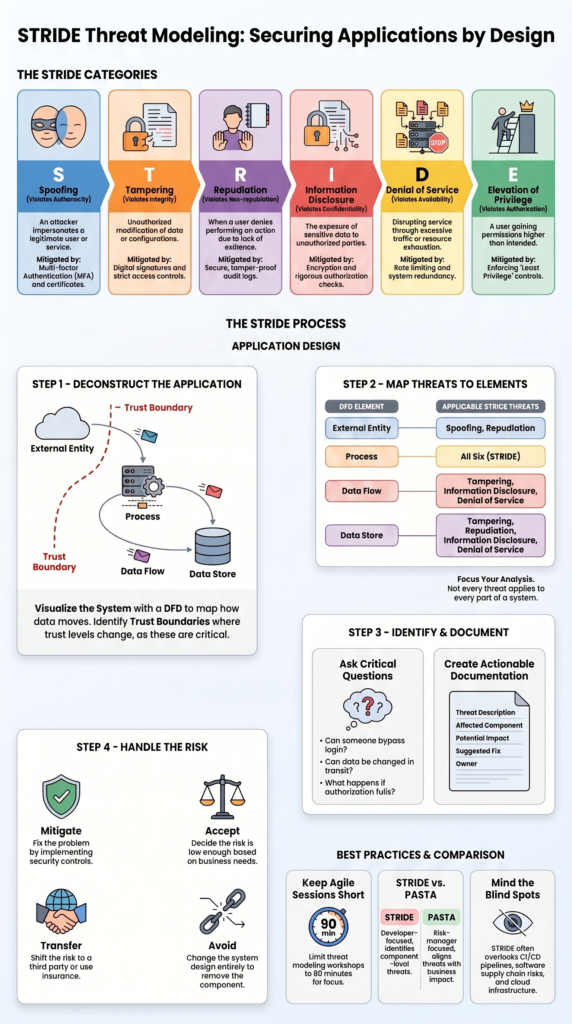
- STRIDE threat modeling sorts threats into six boxes: Spoofing, Tampering, Repudiation, Information Disclosure, Denial of Service, and Elevation of Privilege.
- It’s a Microsoft framework that’s central to their SDL threat modeling and is widely used for cloud reviews and secure development.
- When you combine it with Data Flow Diagrams (DFFs) and a look at trust boundaries, STRIDE gives you a repeatable way to find vulnerabilities early.
What Is STRIDE Threat Modeling?
Think of STRIDE as a structured checklist. It looks at your system’s parts and asks how an attacker could break core security rules.
Microsoft built it to help with security reviews during the design phase. Instead of hunting for bugs in the code, STRIDE focuses on weaknesses in the architecture itself, the kind that could enable big attacks later.
Teams use it when defining security needs, during application security threat modeling, and for software security design. The framework gives everyone, security engineers, developers, architects, a common threat classification language to work from.
A typical STRIDE session looks at:
- Processes
- How data moves (data flows)
- Where data lives (data stores)
- External entities
- Trust boundaries
This structure supports attack surface analysis and risk assessment. It also fits well with the Microsoft SDL and modern OWASP threat modeling practices.
The Security Principles Behind STRIDE
Each STRIDE category connects directly to a basic security goal:
- Authenticity
- Integrity
- Non-repudiation
- Confidentiality
- Availability
- Authorization
These six principles are the bedrock of most security setups. They influence everything from how you manage identities to how you encrypt data.
What Are the Six STRIDE Threat Categories?

Each STRIDE category represents a different type of security threat. During threat modeling sessions, teams use these categories to uncover weaknesses that may otherwise go unnoticed. In our experience, this simple structure helps engineers focus on real risks without getting lost in unnecessary complexity.
STRIDE Category Reference
| Threat | Security Property Violated | Example | Common Fix |
| Spoofing | Authenticity | An attacker impersonates a legitimate user. | Multi-factor authentication, certificates |
| Tampering | Integrity | Data is changed without authorization. | Digital signatures, access controls |
| Repudiation | Non-repudiation | A user denies performing an action. | Secure audit logs |
| Information Disclosure | Confidentiality | Sensitive information is exposed. | Encryption, authorization checks |
| Denial of Service | Availability | Excessive traffic disrupts a service. | Rate limiting, redundancy |
| Elevation of Privilege | Authorization | A user gains higher permissions than intended. | Least privilege controls |
When we conduct threat reviews, these six categories provide a practical checklist. For example:
- Spoofing focuses on impersonation, such as stolen session credentials.
- Tampering involves unauthorized changes to data or configurations.
- Information Disclosure covers accidental or intentional data exposure.
- Elevation of Privilege occurs when attackers gain access beyond their assigned permissions.
Our threat models and risk analysis tools use these categories to help organizations strengthen network security and identify emerging threats before they become serious incidents.
How STRIDE Works With Data Flow Diagrams?
STRIDE is most powerful when you apply it to a picture of your system, a Data Flow Diagram. DFDs show how data moves, where it’s stored, and, most importantly, where the trust levels change.
A Data Flow Diagram threat modeling session breaks your app into understandable parts before you even start looking for threats. This approach closely aligns with the principles behind the network threat modeling process, where teams map assets, data movement, trust boundaries, and potential attack paths before evaluating security controls.
The core pieces of a DFD are:
- External Entities (users, other services)
- Processes (your application logic)
- Data Stores (databases, caches)
- Data Flows (the connections between parts)
- Trust Boundaries (lines where the level of trust changes)
In our experience, analyzing the trust boundaries gives the biggest insights.
For instance:
- An external entity might try to spoof a user.
- A process could have a bug allowing privilege escalation.
- A data store needs protection against tampering.
- A data flow might leak information if it’s not encrypted.
We often use Network Threat Detection tools to see the actual communication paths. This data frequently shows connections the developers didn’t draw, helping us validate or correct our DFD assumptions.
A Step-by-Step Guide to Applying STRIDE
The process is straightforward: map the system, find the STRIDE threats, write them down, and decide what to do about each one.
Step 1: Deconstruct the Application
Create a DFD. Identify all the:
- External entities
- Processes
- Data stores
- Data flows
- Trust boundaries
This step is your security architecture review. It forces you to understand your own attack surface.
Step 2: Map STRIDE to the Diagram
Use a structured approach. Not every threat applies to every part of the diagram.
| DFD Element | Applicable Threats |
| External Entity | Spoofing, Repudiation |
| Process | All six threats |
| Data Flow | Tampering, Information Disclosure, Denial of Service |
| Data Store | Tampering, Repudiation, Information Disclosure, Denial of Service |
This mapping stops you from missing obvious attack paths. You systematically ask, “What STRIDE threats could happen here?”
Step 3: Identify and Document the Threats
Go component by component. Ask questions like:
- Can someone bypass the login?
- Can data be changed while it’s moving?
- Could sensitive info be accidentally exposed?
- What happens if the authorization check fails?
- Is there a way to exhaust a critical resource?
Document each threat clearly. A good record includes:
- A plain-English description
- Which component is affected
- The potential impact
- A suggested fix
- Who owns the problem
Step 4: Decide How to Handle the Risk
You typically have four options for each finding:
- Mitigate it (fix the problem).
- Accept it (decide the risk is low enough).
- Transfer it (use insurance or a third party).
- Avoid it (change the design to remove the threat entirely).
Mature teams bake these decisions right into their engineering backlogs, making threat modeling part of DevSecOps.
Why STRIDE Sessions Sometimes Fail in Agile Teams?
Even experienced teams can struggle with threat modeling when sessions lose focus. Over the years, we have seen discussions drift away from practical security concerns and turn into debates that produce few useful outcomes.
The most successful sessions stay focused on real risks and clear actions. Teams do not need a perfect model. They need findings they can act on.
As noted by the U.K. Home Office (GOV.UK Engineering Patterns)
“Don’t get bogged down with large upfront models…” – U.K. Home Office (GOV.UK Engineering Patterns)
Common mistakes include:
- Debating threat categories instead of discussing mitigations.
- Spending too much time on unlikely attack scenarios.
- Trying to model an entire enterprise system at once.
- Treating threat modeling as a compliance requirement.
- Failing to assign ownership for remediation tasks.
Our workshops are usually limited to 90 minutes or less. The time limit encourages prioritization and helps keep participants engaged.
Security reviews are most effective when they stay connected to development work and produce clear next steps. When teams focus on practical outcomes rather than theoretical discussions, threat modeling becomes a valuable part of the engineering process and contributes to stronger network security over time.
What Are STRIDE’s Blind Spots?
Credits: The B.E.T.A Education
STRIDE is a valuable framework, but it is not designed to uncover every possible security risk. It works best when analyzing application-level threats.
In our work helping organizations improve network security, we often see risks hiding in areas that are not shown clearly on a data flow diagram. A system may appear secure on paper, yet important weaknesses can exist elsewhere in the environment.
Areas that are frequently overlooked include:
- Build systems and CI/CD pipelines.
- Software supply-chain risks, such as compromised libraries or dependencies.
- Infrastructure services that applications rely on.
- Third-party integrations and external service providers.
- Cloud configuration and deployment processes.
An application might have strong controls, but those protections offer little value if an attacker gains access to the pipeline that builds and releases it. Modern environments also introduce risks that traditional diagrams may not capture well, including container escapes, insecure infrastructure-as-code, and compromised CI/CD runners.
Because of this, we often expand STRIDE with operational reviews and continuous monitoring. In many environments, a broader proactive network threat modeling strategy helps teams identify risks across infrastructure, dependencies, and deployment processes.
Fitting STRIDE Into Continuous Delivery
Modern development teams release changes quickly, so threat modeling needs to keep pace. A report created once and never updated loses value as systems evolve. In our experience, teams get the best results when threat modeling becomes part of everyday engineering work rather than a separate security exercise.
The process works best when it stays simple, practical, and easy to repeat. Developers are more likely to participate when reviews fit naturally into existing workflows and tools. As applications grow, the threat model should grow with them.
A Workflow That Works
- Maintain a high-level threat model for the overall architecture.
- Perform feature-level reviews during sprint planning or design discussions.
- Use lightweight templates that teams can easily update.
- Automate checks such as secret scanning and dependency analysis.
- Track remediation tasks directly in the development backlog.
We have found that combining system-level and feature-level reviews provides the clearest view of risk. Many organizations adopt this approach because of the benefits of proactive threat modeling for security between development and security teams.
Our threat models and risk analysis tools support both approaches, helping organizations strengthen network security and respond to emerging threats without slowing delivery.
Should You Choose STRIDE or PASTA?
Choosing between STRIDE and PASTA is not always an either-or decision. Both frameworks help teams understand risk, but they approach the problem from different angles. In our experience, the best choice depends on the goal of the assessment and who will use the results.
STRIDE is often the better fit for development teams. It helps identify and organize threats during architecture reviews, design discussions, and feature planning. PASTA takes a broader approach by connecting technical threats to business impact and attacker behavior.
How They Compare
| Factor | STRIDE | PASTA |
| Main Goal | Identify and classify threats | Analyze business and security risk |
| Complexity | Moderate | High |
| Best For | Developers and AppSec teams | Risk managers and security leaders |
| Risk Prioritization | Basic prioritization | Detailed and structured analysis |
| Fits Agile? | Very well | Can work, but requires more effort |
| Style | Focuses on system components | Focuses on attacker goals and actions |
Over the years, we have found that STRIDE works well for engineering-focused reviews where teams need quick, practical results. PASTA is often more useful when organizations require deeper risk analysis, regulatory support, or executive-level reporting.
How Should You Prioritize STRIDE Findings?

STRIDE finds the threats, but you need another method to decide what to fix first. Not all threats are equal.
Many teams combine STRIDE with scoring systems like DREAD to rank by damage, reproducibility, and other factors. Others link findings directly to control frameworks.
Research from International Journal of Creative Research Thoughts shows
“Prioritized threats can be scored based on the DREAD and/or another risk-ranking model (impact vs. likelihood).” – International Journal of Creative Research Thoughts
For example, you can map a finding to a specific requirement in the OWASP Application Security Verification Standard (ASVS). This turns an architectural observation into a concrete task: “Implement requirement 2.1.1 to mitigate this spoofing threat.” The ASVS provides a great yardstick for what “secure enough” looks like.
Similarly, the National Institute of Standards and Technology (NIST) cybersecurity framework offers a well-respected set of controls to align with. These external standards help convert your STRIDE findings into a prioritized, actionable plan that makes sense to engineers and managers alike.
FAQ
Can STRIDE threat modeling work in cloud and microservices environments?
Yes. STRIDE threat modeling works well in cloud environments and microservices architectures. Teams can use it to assess API security threats, container security threats, and identity access management threats across distributed systems.
The most important step is keeping the threat model up to date as applications, services, and infrastructure continue to change.
How does STRIDE per element improve threat identification?
STRIDE per element helps teams identify threats more accurately during data flow diagram threat modeling. Instead of reviewing the entire system at once, teams assess each external entity threat, process component threat, data flow threat, and data store threat individually.
This structured threat classification framework makes early vulnerability identification more consistent and easier to manage.
When should organizations use DREAD vs STRIDE or other frameworks?
DREAD and STRIDE serve different purposes. STRIDE supports security threat modeling and software security design by identifying threats early. DREAD helps teams prioritize risks based on their potential impact.
Organizations may also use PASTA threat modeling, VAST threat modeling, or attack tree analysis when they need deeper risk analysis or broader business context.
How can teams reduce common STRIDE threats in practice?
Teams can reduce threats by following secure coding practices and implementing effective security controls. They can address authentication bypass threats through stronger identity checks, use encryption for confidentiality protection, and apply input validation to prevent SQL injection tampering and cross-site scripting threats.
Enforcing the least privilege principle also reduces the risk of authorization privilege escalation.
What should threat model documentation include?
Threat model documentation should include security requirements, attack surface analysis findings, threat agent characterization, and remediation ownership. Teams should also document trusted process threats, third-party component threats, and insider threat modeling scenarios when they apply.
Clear documentation improves security team collaboration and supports DevSecOps threat modeling throughout the secure software development lifecycle.
Stronger Security Starts Earlier
Design weaknesses are far easier to address before they become production issues. Teams that revisit their assumptions, update threat models, and connect security insights with day-to-day engineering work can reduce risk without slowing progress. That’s where lasting improvements happen.
As systems continue to evolve, early visibility remains one of the most effective ways to build secure applications. See how Network Threat Detection can support a stronger security approach.
References
- https://engineering.homeoffice.gov.uk/patterns/threat-modelling/
- https://www.ijcrt.org/download1.php?file=IJCRT2507860.pdf