
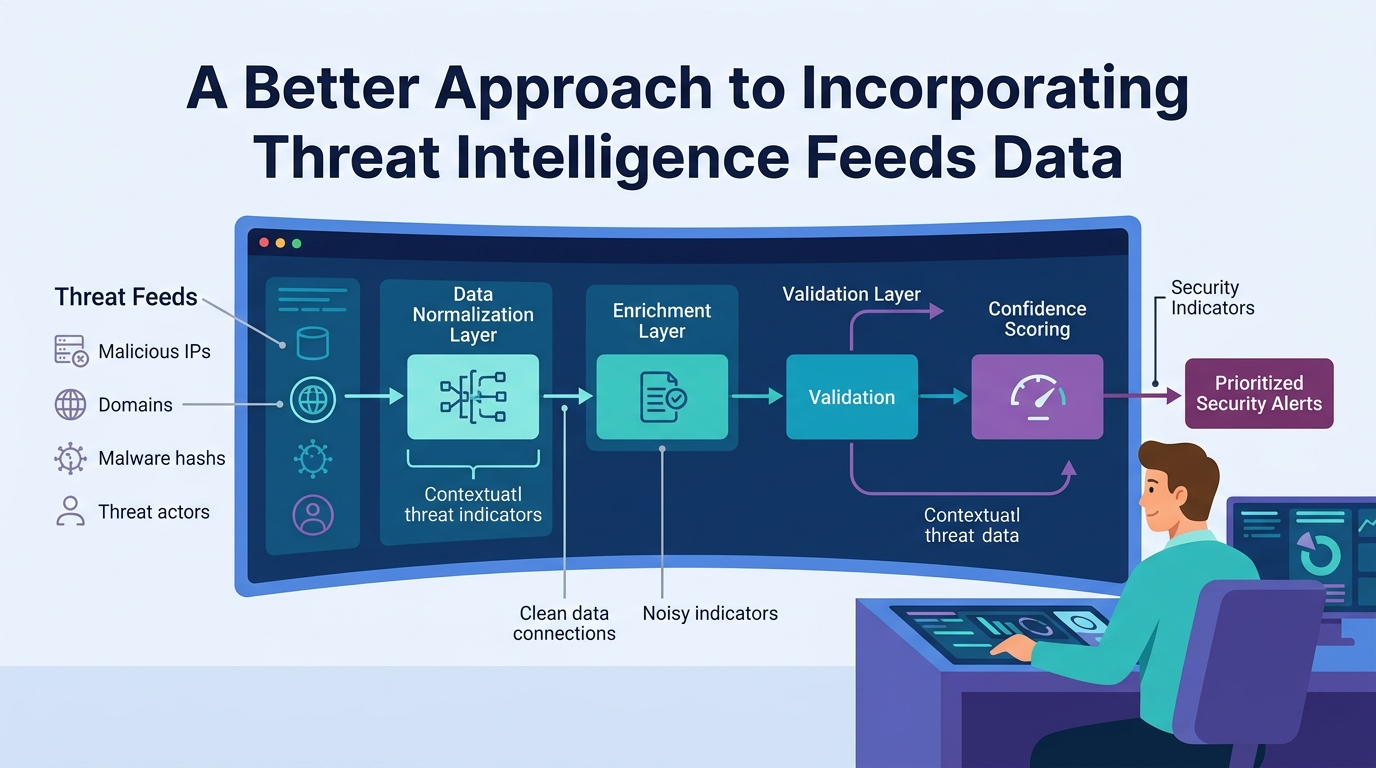
Incorporating threat intelligence feeds data effectively means turning intelligence into actionable context rather than collecting more indicators. Many organizations already have access to large threat intelligence datasets. Attackers frequently rotate infrastructure and tools, but behavioral patterns often remain the same.
Focusing on relevance, asset context, and operational impact helps teams improve detection accuracy and reduce unnecessary alerts. At Network Threat Detection, we see better outcomes when intelligence is integrated into workflows instead of treated as a standalone feed. Keep reading to learn how to build a practical and effective threat intelligence process.
Threat Intelligence Feed Integration at a Glance
Successfully incorporating threat intelligence feeds data is not about collecting the most indicators. It is about improving data quality, adding context, and delivering actionable intelligence that supports faster and more accurate security decisions.
- Quality, built through enrichment and strict checks, matters more than how many feeds you have.
- Effective integration requires normalizing data, scoring its confidence, and adding context before it hits your detection systems.
- Sustainable programs measure success by fewer false alarms and faster investigations, not by gigabytes of data ingested.
What Is Threat Intelligence Feed Data?
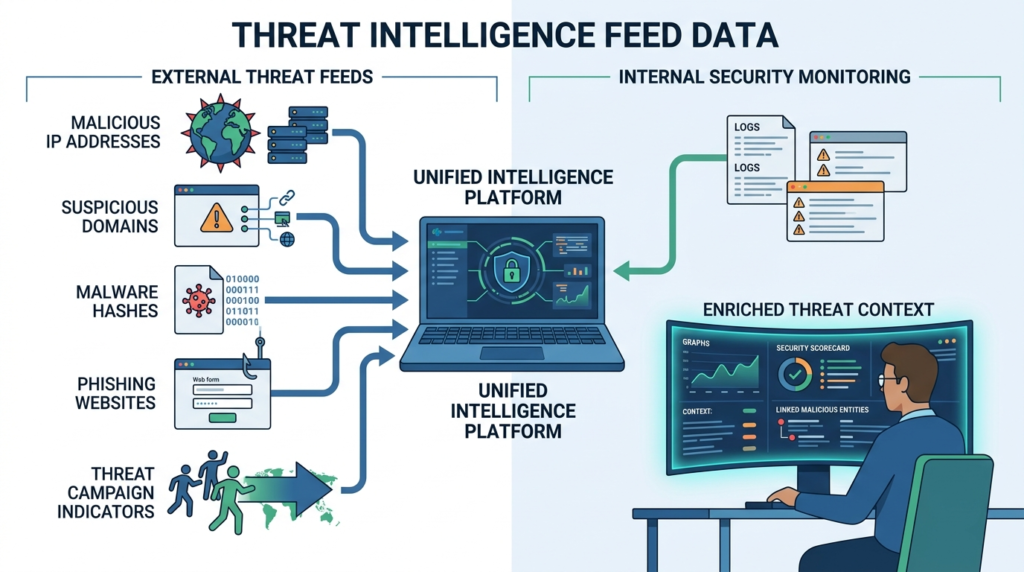
In simple terms, threat intelligence feeds are streams of external security data. They provide information on bad IP addresses, malicious domains, hacker tools, and ongoing campaigns. This outside view helps you spot malicious activity your internal logs might miss.
When we work on network threat detection, the magic happens when you combine this external intelligence with your own network context. A suspicious connection becomes a high-priority alert when we can tie it to a known malicious IP and link it to a specific threat group. This process of enrichment makes investigations faster and more accurate.
The main types of intelligence are:
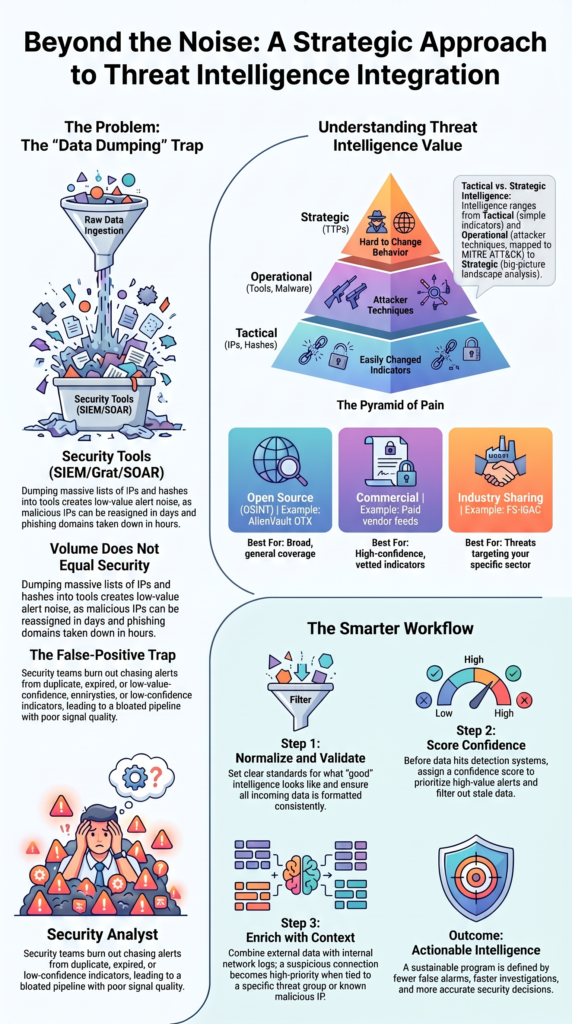
- Tactical: Simple indicators like IPs and file hashes.
- Operational: Insights into attacker behaviors and techniques.
- Strategic: Big-picture analysis of the threat landscape.
Common Feed Sources
| Feed Type | Example | Best For |
| Open Source (OSINT) | AlienVault OTX | Broad, general coverage. |
| Commercial | Paid vendor feeds | High-confidence, vetted indicators. |
| Industry Sharing | Groups like FS-ISAC | Threats targeting your specific sector. |
Before you dive in, set clear standards for what “good” intelligence looks like. As CISA points out, sharing is powerful, but only if the data is actionable and put in the right context.
Why Does Raw Threat Intelligence Data Create More Problems Than It Solves?
Many teams think more indicators mean better security. In reality, dumping massive lists of IPs and hashes directly into your tools creates more problems than it solves. Analysts get buried in low-value alerts from stale or irrelevant data.
We’ve walked into environments where millions of imported indicators did almost nothing. Why? A malicious IP can be reassigned in days. A phishing domain might be taken down in hours. Without validating and prioritizing this data, your detection system just creates noise.
This leads directly to the false-positive trap. Teams burn out chasing alerts from duplicate, expired, or low-confidence indicators. Community practitioners have a name for this: “IP and hash dumping.” The result is a bloated pipeline with terrible signal quality.
To understand value, look at the Pyramid of Pain. IP addresses are easy for attackers to change, so they offer low long-term value. Their behaviors and techniques (TTPs) are much harder for them to alter, making detections based on those far more durable. This is why aligning with frameworks like MITRE ATT&CK is so effective.
How Can You Build a Smarter Threat Intelligence Data Flow?
Credits: SK Tech Training
An effective architecture processes intelligence, it doesn’t just collect it. You need a workflow that normalizes, enriches, scores, and validates data before it ever reaches your analysts or automated tools.
Think of it as a factory line for threat data:
- Collect from your chosen feeds.
- Parse & Normalize into a common language (like STIX/TAXII).
- Deduplicate & Score to remove repeats and assign confidence.
- Enrich with context (geolocation, associated campaigns, etc.).
- Distribute to your SIEM, SOAR, or network sensors.
The normalization step is crucial. Feeds come in different formats. Converting them to a standard schema, like STIX, lets everything work together smoothly. After that, enrichment adds the layers that make intelligence useful.
Knowing an IP is bad is one thing; knowing it’s linked to a ransomware group targeting your industry is another. This type of data enrichment for contextual analysis helps security teams connect isolated indicators to broader attack activity and prioritize investigations more effectively.
We always recommend this structured flow. It turns raw data into actionable intelligence, which is the only kind that helps you.
Why Should You Manage Indicator Aging and TTL Policies?
One of the most common oversights we see is forgetting that indicators get stale. Not all threat data stays valid forever. Cloud IPs get recycled. Malicious domains expire. If you don’t clean out old data, you’re left “chasing ghosts.”
Implementing Time-To-Live (TTL) policies is a straightforward fix. You automatically lower the confidence score or remove an indicator after a set period. This simple practice dramatically cuts down on false positives.
Here’s a basic TTL framework we often suggest:
| Indicator Type | Suggested TTL |
| Malicious IP | Days to a few weeks |
| Domains | Weeks |
| File Hashes | Several months |
| Behavioral TTPs | Keep long-term |
Why this range? Infrastructure-based indicators change quickly. Behavioral patterns, however, persist. Aging out the former while keeping the latter sharpens your detection focus and reduces analyst workload almost immediately.
Research from SANS Institute shows
“Early research into this topic compared the price of retaining IOCs over a set time against the price of responding to an incident, while later research evolved to create decay models that reduce the relevance of an IOC over time.” – SANS Institute
How Can You Improve Threat Intelligence Quality?
Quality isn’t a mystery. You improve it through deliberate controls: scoring confidence, validating sources, removing duplicates, and filtering for relevance to your assets.
We’ve found that strong quality controls are a better predictor of success than the number of feeds. A single high-quality, relevant feed is worth more than ten noisy ones.
Key Quality Controls
| Control | What It Does |
| Confidence Scoring | Prioritizes data from your most trusted sources. |
| Deduplication | Removes identical indicators from multiple feeds. |
| Whitelisting | Prevents blocks on critical business IPs or domains. |
| Asset Context | Filters alerts to what actually exists in your network. |
The last point, asset-aware filtering, is huge. By mapping intelligence against your known assets and business criticality, you ensure analysts spend time on what truly matters.
Understanding the importance of security data enrichment context becomes especially valuable here. It’s because enriched intelligence allows teams to distinguish meaningful threats from background noise.
As noted by Universidade de Lisboa
“In order to improve its quality, such information should be correlated with real-time data coming from the monitored infrastructure, before being further analyzed and shared… This allows the evaluation of a threat score through heuristic-based analysis.” – Universidade de Lisboa
How Should Threat Intelligence Integrate with Detection Tools?
The goal of integration is to support decisions, not to automatically block everything. Immediate, automated blocking based solely on an external feed can cause outages if a critical cloud service gets flagged.
In our network detection work, we push for an “enrich-first” approach. Let the intelligence add context to alerts for your analysts. They can then make informed decisions about containment or blocking.
- SIEM Integration: Use feeds to enrich correlation rules. When an alert fires, the analyst immediately sees related threat actor info or campaign details.
- SOAR Integration: Automate initial investigation steps. A SOAR playbook can use intelligence to gather context, prioritize the incident, and even suggest next steps.
- EDR & Enforcement: Apply blocking cautiously. File hash blocking is usually safe. Network blocks should be more measured, often starting in alert mode.
Many mature teams avoid direct, widespread blocking from feeds. They prefer the control of using intelligence for alerting and investigation first. This balances security with operational stability.
What Technical Challenges Appear When Threat Intelligence Scales?
As indicator volumes grow into the millions, new technical problems start to appear. Teams often run into memory limits, API throttling, duplicate indicators, and unexpected integration failures. What works well at a smaller scale can quickly become difficult to manage.
We’ve worked with organizations facing these challenges firsthand. In many cases, the issue is not the threat intelligence itself but the infrastructure supporting it. Through our experience building threat models and risk analysis workflows, we’ve seen how small gaps in engineering can create major operational disruptions.
Common Scaling Problems
| Challenge | Real Impact |
| Memory Exhaustion | Processing systems run out of resources and stop handling new data. |
| HTTP 429 Errors | Feed providers limit requests, creating delays in data collection. |
| API Changes | Connector integrations fail when vendors modify their APIs. |
| Feed Overlap | Multiple sources report the same indicator, generating duplicate alerts. |
To improve resilience, we typically recommend:
- Processing intelligence data in manageable batches.
- Using incremental synchronization instead of downloading full datasets every time.
- Monitoring feed connector health and performance continuously.
- Building redundancy into ingestion and processing systems.
- Reviewing threat models regularly to identify emerging operational risks.
Strong engineering practices help keep intelligence pipelines stable, even during periods of high data volume. When security teams can rely on consistent data flow, they are better positioned to detect and respond to emerging threats.
Why Is Internal Telemetry Valuable for Threat Intelligence?
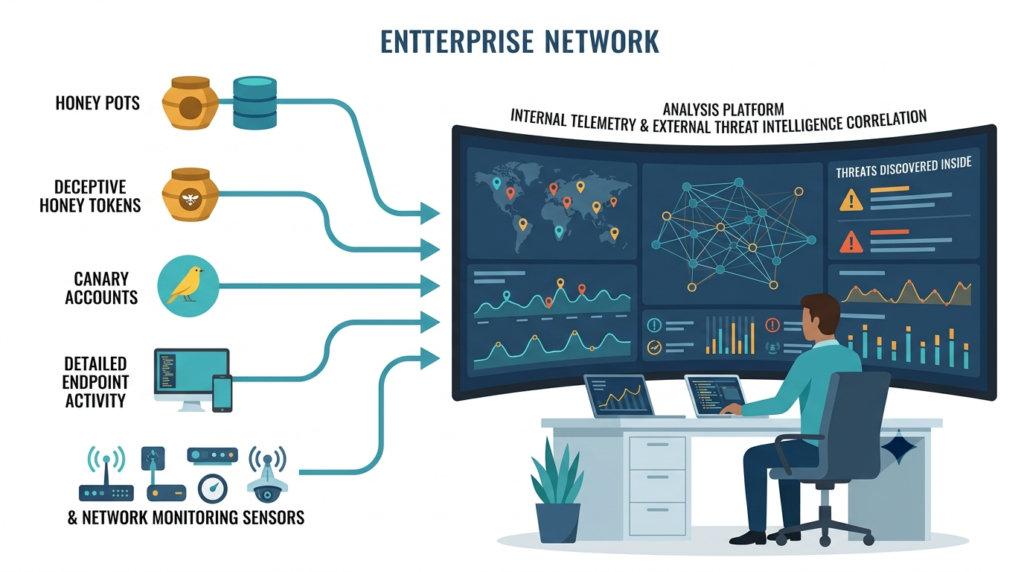
Many security teams focus heavily on external threat feeds, but some of the most valuable intelligence comes from inside their own environment. Data collected from honeypots, deception systems, and threat hunting activities is often more relevant because it reflects attacks aimed directly at their networks.
In our experience, internal telemetry frequently uncovers activity that has not yet appeared in public or commercial intelligence sources. External feeds provide broad visibility across the threat landscape. Combining these insights with techniques such as enriching logs with IP geolocation data can provide additional context during investigations.
Over the years, we’ve helped organizations build practical internal intelligence sources that improve detection quality, including:
- Honeypots that imitate real services and attract scanners or attackers.
- Honeytokens, such as fake credentials or files that trigger alerts when used.
- Canary accounts that generate notifications whenever someone attempts to access them.
Our work with threat models and risk analysis tools has shown that combining these sources produces stronger results. External intelligence helps teams see emerging threats at scale, while internal telemetry adds valuable context. Together, they create a clearer view of risk and support more accurate investigations, threat hunting, and network security monitoring.
How Should You Measure Threat Intelligence Program Success?
Many organizations judge their threat intelligence program by the number of feeds they collect. In practice, that number says very little about how well the program is working. What matters is whether the intelligence helps security teams find threats faster and make better decisions.
From what we’ve seen, the most useful metrics focus on outcomes rather than volume. Teams should look at questions such as:
- True and False Positive Rates: Does the intelligence help identify real threats without creating excessive noise?
- Mean Time to Investigate: Are analysts able to complete investigations more quickly with better context?
- Feed Utilization: Which feeds consistently contribute to actionable alerts and security outcomes?
Our experience supporting threat modeling and risk analysis efforts has shown that regular reviews make a big difference. We often recommend auditing intelligence feeds every quarter and asking:
- Which feeds helped us detect or contain a real incident?
- Which feeds generated the most false alerts?
- Are analysts saving time because of this intelligence?
The answers usually reveal which feeds provide real value. Keeping high-performing sources and removing low-value ones helps reduce noise, improve network security, and make daily operations more effective for everyone involved.
FAQ
How can I tell if a threat feed is reliable?
A reliable threat feed provides accurate, timely, and relevant indicators that support real security investigations. Teams should evaluate threat intelligence quality by reviewing update frequency, threat intelligence accuracy, and threat feed reliability over time.
Regular threat feed validation helps identify outdated or incorrect data. Measuring how often a feed contributes to useful alerts can also reveal whether it adds value or creates unnecessary workload for analysts.
What is the difference between feed ingestion and threat feed normalization?
Feed ingestion refers to collecting threat intelligence from external sources through a threat feed API, automated threat ingestion process, or direct data import. Threat feed normalization happens after collection. It converts different threat feed formats into a consistent structure.
This process supports threat intelligence parsing, threat data transformation, threat intelligence schema alignment, and threat intelligence standardization, making data easier to analyze across multiple security platforms.
How does threat intelligence improve threat hunting activities?
Threat intelligence helps analysts investigate suspicious activity with greater context and confidence. Threat hunting enrichment combines IoC enrichment, threat actor intelligence, APT group indicators, and threat data correlation to identify connections between events.
Analysts can use this information to detect attack patterns that may not trigger security alerts. Strong threat intelligence context also helps teams prioritize investigations and focus on the most relevant threats.
Why do real-time threat feeds sometimes create too many alerts?
Real-time threat feeds can generate excessive alerts when organizations ingest large amounts of cybersecurity threat data without proper filtering. Duplicate indicators, outdated records, and low-confidence intelligence often increase noise.
Threat feed filtering, threat feed validation, threat intelligence scoring, and threat feed prioritization help reduce unnecessary alerts. These practices improve false positive reduction and ensure analysts spend more time investigating meaningful security events.
How does STIX TAXII integration support threat intelligence sharing?
STIX TAXII integration provides a standardized method for cyber threat sharing between organizations and security tools. It simplifies threat intelligence platform integration by supporting threat intelligence ingestion, threat feed synchronization, threat intelligence export, and threat feed consumption.
Standardized data formats reduce compatibility issues and manual processing requirements. As a result, security teams can exchange intelligence more efficiently and maintain a more effective threat intelligence lifecycle.
Turn Threat Intelligence Into Lasting Security Value
Threat intelligence loses value when feeds become outdated, noisy, or disconnected from real-world context. The teams that see the best results focus on high-confidence intelligence, continuous enrichment, and meaningful correlation before taking action. That’s what helps reduce alert fatigue and ensures analysts spend time investigating threats that truly matter.
To build a more effective intelligence-driven defense strategy, explore how Network Threat Detection helps security teams turn threat intelligence into actionable risk insights. By combining threat modeling, automated analysis, and network visibility, it helps organizations improve detection quality, increase analyst efficiency, and strengthen long-term security outcomes.
References
- https://www.sans.org/white-papers/adversary-aware-ioc-retention-analyzing-time-live-patterns-threat-actor-attribution
- https://researchportal.ulisboa.pt/en/publications/enriching-threat-intelligence-platforms-capabilities/