

When evaluating network risk analysis tools software features, most organizations focus on dashboards, alerts, AI-powered analytics, and reporting capabilities. While these features are valuable, they often overlook the most important requirement: complete network visibility.
A strong Network Threat Detection strategy depends on understanding exactly what is happening across your environment. If your security platform only analyzes summaries, sampled traffic, or metadata, critical evidence may never be captured. The result is a network risk analysis process based on assumptions rather than facts. Keep reading.
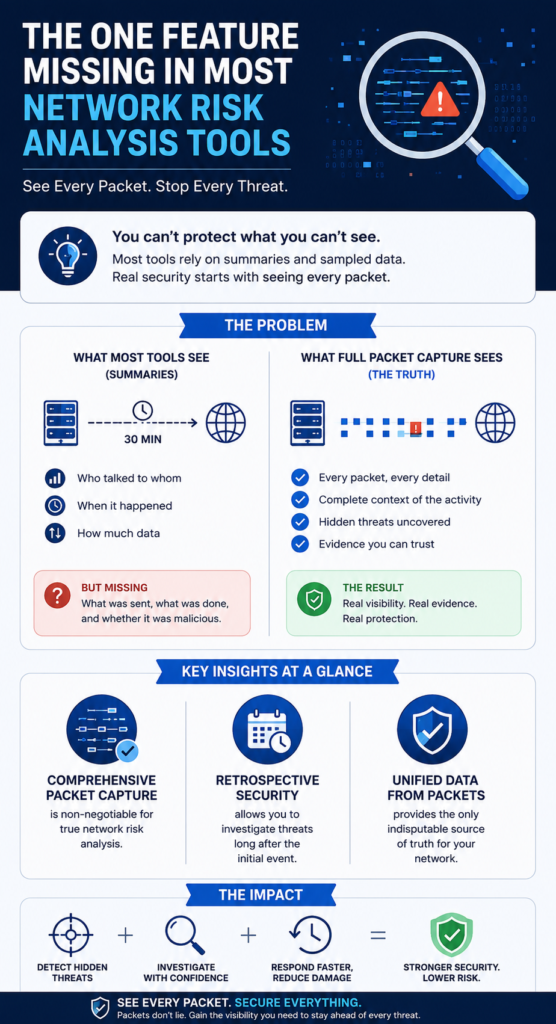
Key Insights at a Glance
Before diving deeper, here are the core ideas you need to understand about modern network risk analysis and why visibility matters more than anything else:
- Comprehensive packet capture is non-negotiable for true network risk analysis.
- Retrospective security allows you to investigate threats long after the initial event.
- Unified data from packets provides the only indisputable source of truth for your network.
The Moment Metadata Wasn’t Enough
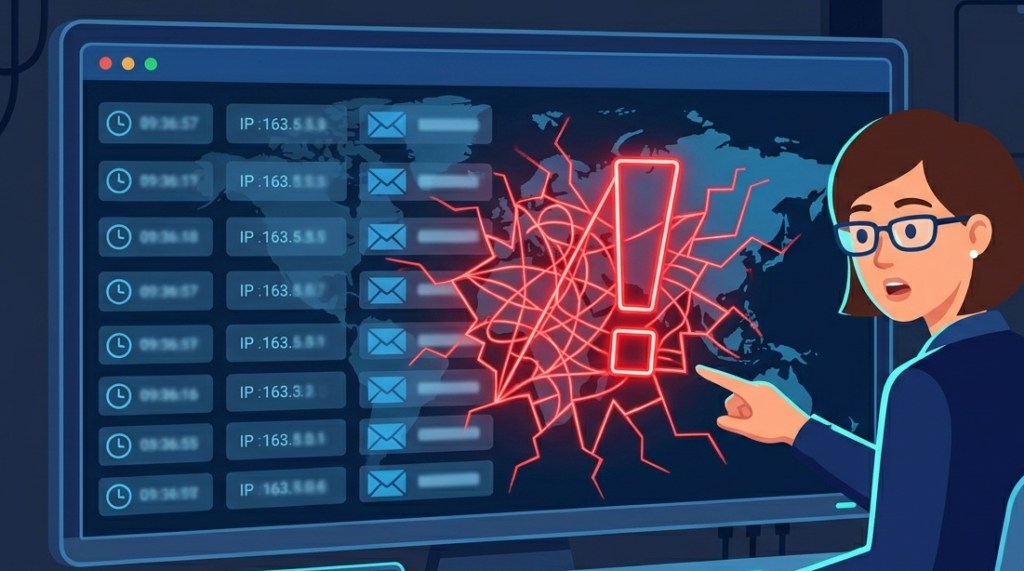
We remember the first time we saw a real network threat. It wasn’t in a dashboard alert. It was buried in a stream of hexadecimal, a subtle anomaly in a TCP handshake that every other tool had normalized into “benign traffic.” We had all the recommended software, the kind that polls devices and analyzes flow data. It showed a clean bill of health.
But the packets told a different story, a slow exfiltration hidden in plain sight. That was the moment the abstraction of modern tools fell away. You can’t analyze a risk you can’t see. And you can’t see what your tools decide to ignore.
Most network risk analysis tools work on summaries. They look at NetFlow, IPFIX, or sFlow data, which is like reading the chapter titles of a book instead of the full text. You get the who and the when, but the crucial what and how are lost.
You might see that Server A talked to IP Address B for 30 minutes. You won’t see that it was transmitting encrypted archives of your customer database. This level of analysis creates a security model built on inference, not evidence. It’s a model that fails under pressure.
Why Is Full Packet Data The Foundation?
Credits: ProjectManager
Think of your network as a crime scene. Flow data gives you the security log, showing who badge in and out. Packet data is the full forensic record, the fingerprints, the DNA, the unedited security footage.
It’s the difference between knowing an unauthorized person entered the building and having the video of what they touched, where they went, and what they took. Without it, your investigation starts with a handicap. You’re relying on second-hand reports.
This foundational visibility expands on standard network security risk analysis techniques by enabling three specific capabilities that summary-based tools simply cannot match.
- Complete Session Reconstruction: See every request and response, from the initial SYN packet to the final FIN, including encrypted handshakes.
- Payload Inspection for Cleartext Protocols: Analyze the actual content of HTTP, DNS, SMTP, and FTP traffic for malicious commands or data leaks.
- Baseline of Normal Network Behavior: Understand not just if traffic spiked, but how the pattern of packets within that conversation deviated from the norm.
A tool that starts with packets doesn’t just report anomalies, it proves them. It turns “this looks suspicious” into “this is what happened, at this millisecond, from this IP, to this port, with this payload.” That shift is everything. It moves conversations from IT theory to legal and operational fact.
How Does Retrospective Analysis Change The Game?
The average dwell time for a threat actor inside a network is still measured in weeks, not minutes. They get in, they hide, they move slowly. A traditional alert-based system might flag the initial intrusion point, if it’s loud.
“[…] packet capture is the only way to reconstruct the exact details of an attack, which makes it an important tool.” – Science Direct
But what about the lateral movement days later? The scheduled data transfer a week after that? If your tool only analyzes live traffic or stores tiny data samples, that history is gone. You’re left with an alert and no context, a starting gun with no racecourse.
Retrospective analysis, or going back in time, is powered by full packet capture. It means you can store that forensic-level data for days, weeks, or months.
When a new threat signature is released, you can pivot back and ask, “Was this in my network last month?” When an internal system starts acting strangely, you can trace its communications back to the exact moment it changed.
What Makes A Unified Data Source So Powerful?
Complexity is the enemy of security. Most security stacks are a patchwork of point solutions, each generating its own logs, its own alerts, its own version of the truth. Your SIEM says one thing. Your endpoint detection says another.
Your firewall logs contradict both. Teams spend more time correlating data than analyzing it. This fragmentation creates blind spots and slows response to a crawl. The noise drowns out the signal.
A network risk analysis tool built on full packet capture offers a unified source of truth. Every analysis, every alert, every dashboard metric derives from the same raw material, the packets on the wire. It’s objective. It doesn’t matter if an endpoint agent was disabled or a cloud log was misconfigured.
The network saw it happen. This unified approach reduces alert fatigue by providing immediate, corroborated context.
Consider this practical comparison of data sources:
| Data Source | What It Provides | Key Limitation for Risk Analysis |
| Flow Data (NetFlow) | Conversation summaries (IPs, ports, volume, timing) | No payload visibility; sampled data can miss brief attacks. |
| Firewall/Proxy Logs | Allow/deny decisions and policy hits. | Limited to configured rules; blind to internal East-West traffic. |
| Endpoint Logs | Activity on a specific host (processes, files). | Siloed view; requires an agent; can be disabled by an attacker. |
| Full Packet Capture | Every bit of every conversation, with full payload. | Provides the complete, unfiltered record for definitive analysis. |
When all your tools can reference back to this single source, your entire security posture becomes more coherent, and frankly, more sane. Investigations have a clear starting point that everyone trusts.
Can These Tools Actually Simplify Operations?
It seems counterintuitive. A tool that captures more data should be more complex, right? In practice, it’s the opposite. The complexity comes from not having answers.
When an alert fires, the scramble begins, logging into five different systems, trying to stitch together a narrative from partial clues. It’s exhausting and inefficient. A platform with built-in packet capture ends that scavenger hunt. The data is already there, integrated.
“Organizations using packet capture rated themselves ‘outstanding’ in preventing and quantifying breach scope far more than those using other telemetry methods.” – Enterprise Management Associates (EMA) Research Report
The operational simplicity comes from convergence. Instead of a tool for threat detection, another for performance analysis, and another for compliance logging, one system can serve multiple teams. The network performance team uses the same packet data to troubleshoot a slow application that the security team uses to hunt for malware.
You also gain simplicity in verification. Questioning a finding? Go to the packet. Need to prove an incident for an audit or legal reason? The packet evidence is there. This evidence base accelerates documenting risk analysis findings for stakeholders. This removes layers of doubt and debate.
How Do You Move From Reactive To Proactive?

The standard security cycle is reactive, a constant loop of alert, triage, and respond. It’s a treadmill. Incorporating packet visibility into your daily continuous risk assessment routine allows you to step off. You move from just responding to alerts to actively hunting for threats that haven’t triggered an alarm yet.
This is the proactive stance. You’re looking for the subtle tactics that bypass signature-based detection, the low-and-slow movements that avoid threshold alerts.
This might involve hunting for DNS tunneling, where data is smuggled out in DNS query requests. A flow-based tool would just see a lot of DNS traffic. A packet-based tool lets you inspect the content of those queries, spotting the encoded data.
Or, you could baseline normal internal RDP or SSH sessions and then hunt for deviations in packet timing, size, or encryption patterns that suggest credential brute-forcing or lateral movement.
Proactive hunting turns your security team from firefighters into detectives. They’re using the rich evidence in the packet data to ask their own questions, to test their own hypotheses about adversary behavior. This mindset change is perhaps the biggest benefit.
FAQ
What’s the main drawback of not using full packet capture?
You lose forensic evidence. Without packets, you can’t reconstruct exact sessions, see payloads, or perform definitive retrospective searches after a new threat is discovered. Your investigations start with a significant evidence gap.
Doesn’t capturing all packets create too much data to store?
Storage is a manageable challenge with modern compression and smart retention policies. The real question is whether you can afford not to have the data when you need it. Most organizations find storing key network segments for 30-90 days is a practical and critical security investment.
Can’t firewalls and intrusion prevention systems do this?
Firewalls and IPS are enforcement points designed to block traffic based on rules. They are not designed for deep, network-wide forensic recording and historical analysis. They are critical controls, but they don’t provide the continuous, full-fidelity record needed for comprehensive risk analysis and hunting.
Is this type of tool difficult for a non-expert to use?
Modern platforms are built for usability. While the underlying data is complex, the interfaces are designed to guide analysts from an alert directly to the relevant packets, with automated decoding and plain-language summaries. The learning curve is in understanding what to look for, not in operating the tool itself.
Final Thoughts on Network Risk Tools
Network risk tools often deliver data instead of insight, leaving critical visibility blind spots. Real security demands evidence over inference, and that requires full packet capture, the immutable record of truth, rather than relying on guesswork or summaries.
Network Threat Detection solves this problem. The platform empowers SOCs and CISOs with real-time threat modeling, visual attack path simulations, and CVE mapping. By eliminating blind spots and prioritizing risks, it ensures you finally see the whole story.
References
- https://www.sciencedirect.com/science/chapter/monograph/abs/pii/B9781597499699000110
- https://www.globalsecuritymag.com/New-Research-from-Enterprise,20190918,90846