

Selecting the choosing right SIEM solution vendor strategy is one of the most important decisions for any security team. A SIEM platform supports threat detection, incident response, compliance reporting, and long-term visibility across your environment.
When paired with strong Network Threat Detection capabilities, the right vendor can help organizations identify risks faster and reduce blind spots before they become serious incidents. Instead of focusing only on feature lists, organizations should evaluate how well a vendor fits their infrastructure, security goals, and future growth plans.
What Separates a Vendor From a True Security Partner?
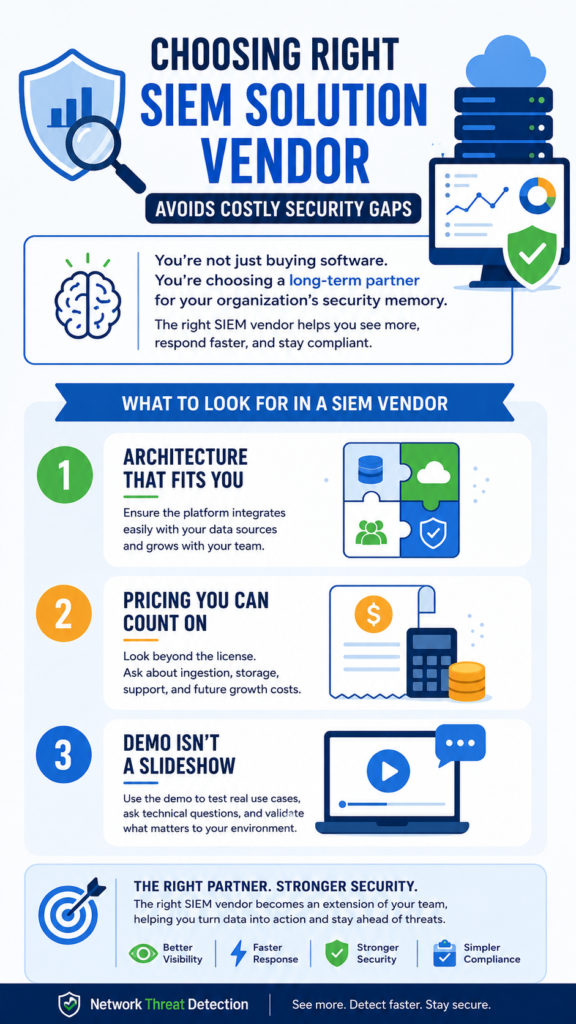
The best providers help your team improve visibility, simplify operations, and adapt to evolving threats over time. Before making a decision, focus on these critical evaluation areas:
- Prioritize vendors whose core architecture aligns with your data sources and team size.
- Demand transparent, predictable pricing beyond the initial license fee.
- Treat the sales demo as a mandatory technical validation, not a slideshow.
Why Does Picking a SIEM Vendor Feel Like a Gamble?
It often starts with a spreadsheet. You list ten vendors, compare rows of features, and end up more confused. Every platform claims “AI-powered analytics” and “real-time correlation.” The marketing blurbs sound identical. The gamble isn’t in the features they promise, it’s in the day-to-day reality they deliver.
“Security buyers managing large-scale data ingestion to support security use cases are often more concerned with better data management options that promise to offload data ingestion from the SIEM to more cost-effective storage and analytic options. Some SIEM vendors offer flexible options for data ingestion that allow the buyer to decide what data goes to the SIEM for the outcomes they desire and utilize lower-cost options for less strategic functions.” — Gartner
Will the platform actually ingest your unique legacy application logs? Will your team of three be able to manage it, or will it demand a dedicated administrator? You’re betting your security posture on answers you often can’t get from a datasheet.
The fear is real: a six-figure investment that becomes “shelfware” because it’s too complex, too slow, or simply a poor fit.
What Are the Non-Negotiable Technical Capabilities to Demand?
Look past the buzzwords. Start with the fundamentals of how the SIEM is built. Its architecture determines everything else.
First, ingestion flexibility. Can it consume data from everywhere you have it? This means cloud-native sources (AWS CloudTrail, Azure Sentinel), on-premises syslog, Windows Event Logs, and APIs from your SaaS tools. Understanding how these logs are centralized is fundamental to optimizing your security information event management SIEM deployment.
A vendor should provide pre-built connectors or parsers for common sources, but more importantly, they should have a straightforward method for you to build custom parsers for your home-grown applications. If they can’t handle your data natively, nothing else matters.
Second, query performance at scale. Ask them to demonstrate a complex search across 30 days of your projected log volume during the proof-of-concept. Does the interface freeze? Does it return results in seconds or minutes? Slow query speeds mean your analysts won’t use it for investigations. It becomes a reporting-only tool, not a live detective.
Core capabilities include:
- User and Entity Behavior Analytics (UEBA): Baselines normal activity to spot insider threats. Evaluating modern platforms requires looking for next generation SIEM capabilities like UEBA and SOAR to ensure automated workflows can handle advanced threats.
- Scalable Storage: A clear path for log retention that meets your compliance needs without astronomical costs.
- Reliable Alerting: Low-latency notifications that won’t drown your team in false positives.
How Do You Decode Pricing Models and Avoid Budget Surprises?
Credits: CyberTutor
The sticker shock rarely comes from the initial quote. It comes in Year 2, when your log volume grows 40% and the true cost of scaling hits. You must understand the unit of measurement. Is it based on gigabytes per day? Events per second? Number of hosts? Each model incentives different behavior.
“First and foremost, the most crucial aspect that most of the literature dealing with the selection process of a fitting SIEM points out at the start is that the procedure is highly individual, and every company needs to perform its own evaluation to maximize the resulting value of a SIEM integration.” – Hase
A per-GB model might make you hesitant to ingest verbose, but critical, security logs. A per-host model could limit your cloud monitoring. Demand a vendor walk through three scenarios: your current state, a 50% growth projection, and a “worst-case” incident scenario where logging is maximized. Get the total cost for each in writing.
The most sustainable pricing we’ve seen is often a hybrid model, combining a base platform fee with predictable, tiered consumption rates. Avoid vendors who are opaque or resistant to modeling this out.
Why is the Proof-of-Concept Your Most Critical Evaluation Step?
The demo is a performance. The proof-of-concept (PoC) is the rehearsal. Never skip it. Your success criteria must be technical, not theatrical.
Define 3-5 use cases you will test. For example: “Ingest logs from our Oracle databases and Apache web servers, then build a correlation rule to detect a brute-force attack pattern across both.” “Generate a weekly compliance report for management from this data.”
Testing automated SIEM compliance reporting features for PCI and HIPAA guarantees the platform can satisfy regulatory audits under real-world conditions. Give the vendor a fixed period, two to four weeks, and dedicated, non-production data feeds.
Watch how their engineers work. Is setup intuitive, or does it require constant professional services? When you hit a problem, is support responsive? The PoC reveals the day-one operational reality. One CISO told me, “We eliminated our top-choice vendor during the PoC.
Their platform couldn’t handle our peak log burst rates without dropping data. The sales deck never mentioned that limitation.”
Where Does Network Threat Detection Fit Into a Modern SIEM Evaluation?
Logs tell you what a system says happened. Network traffic shows you what actually happened. It’s a crucial, independent source of truth.
When evaluating a vendor, ask how their Network Threat Detection is integrated. Is it a separate pane of glass, or are network alerts and flow data seamlessly woven into the same incident timeline as your endpoint and identity logs?
We see it as a first-option data source because it’s pervasive and hard to evade. An attacker can disable logging on a compromised host, but they still generate network traffic. A modern SIEM vendor should offer this visibility natively or through deep, pre-built integrations.
In a PoC, test this: can you see a suspicious outbound connection from a host in the same console where you review that host’s login attempts? The convergence of evidence is what cuts investigation time from hours to minutes.
What Separates a True Vendor Partnership from a Basic Transaction?
This is about culture, not contracts. A transactional vendor sells you a license, provides basic support, and waits for renewal. A partner invests in your success.
Signs of a partner include a dedicated customer success manager who understands your business objectives, not just your ticket count. They offer regular health checks and workshops on getting more value from the platform. Their product roadmap is influenced by customer feedback, and they’re transparent about it.
When a critical vulnerability like Log4Shell hits, do you get a proactive advisory with tailored detection rules, or do you have to search their knowledge base? The difference is profound. A partner’s goal is to make you so successful that you become a reference story. They solve problems with you.
How Should You Evaluate Deployment and Ongoing Management Overhead?
The initial deployment is a sprint. Ongoing management is the marathon. You must plan for both. Ask the vendor for a detailed deployment plan. Will it be cloud-hosted (SaaS), on your infrastructure, or a hybrid? SaaS typically means faster startup but less control. On-premise offers control but requires your staff to handle updates, scaling, and hardware.
Crucially, ask about the “care and feeding” requirements. How many full-time employees (FTEs) are needed to maintain the SIEM, tune rules, and manage upgrades? For a mid-sized organization, if a vendor says you need two dedicated administrators, that’s a major operational cost.
Look for vendors focused on reducing “alert fatigue” through automated tuning and low-code automation. The total cost of ownership is license fee plus your team’s time.
| Evaluation Area | Transactional Vendor Focus | Strategic Partner Focus |
| Implementation | Hands-off after initial setup. | Provides architecture guidance and best practices. |
| Support | Reactive ticket-based system. | Proactive health checks and security advisories. |
| Roadmap | Generic, feature-driven. | Informed by shared customer challenges and threats. |
| Success Metric | License renewal. | Your reduced mean time to detect and respond (MTTD/MTTR). |
What Role Should Scalability and Future-Proofing Play in Your Decision?
Your SIEM must fit you tomorrow, not just today. “Future-proofing” isn’t about buying the biggest system, it’s about choosing an architecture that scales elegantly.
Probe on these points: How does the platform handle a sudden 10x spike in log volume during an incident? Does performance degrade? Can you easily add new data source types (like IoT security logs) years from now? Avoid vendors with rigid, monolithic architectures.
Look for those built on modern, scalable cloud principles, even if you deploy on-premise, because that design inherently supports modular growth. The goal is to avoid a costly “rip and replace” project three years down the line.
How Do You Gauge the Quality of Support and Professional Services?

Assume things will go wrong. The quality of support is your safety net. Test it before you buy.
During the evaluation, file a test support ticket. Time the response. Is it a knowledgeable engineer or a script-reader? Ask for access to their customer community portal. Are other customers actively engaged, sharing use cases? Inquire about professional services.
Are they flexible? Can they help with specific tasks like building custom parsers or complex correlation rules, or is it an all-or-nothing, expensive engagement? A red flag is when all advanced help requires expensive professional services.
You want a vendor that empowers your team to be self-sufficient through good documentation and training, with experts available for truly complex problems.
FAQ
Should we choose a best-of-breed SIEM or one from our existing security vendor?
This is the “suite vs. specialist” debate. A SIEM from your existing firewall or endpoint vendor can offer easier integration and a unified bill. However, it may lack depth or be a secondary product for them.
A best-of-breed, independent SIEM vendor often provides more advanced features, customization, and focus. The right choice depends on your team’s expertise and your priority: convenience or maximum capability. There’s no universal right answer, but you should actively consider both paths.
Is open-source SIEM a viable alternative to commercial vendors?
It can be, for a very specific type of organization. Solutions like the ELK Stack (Elasticsearch, Logstash, Kibana) offer powerful, free core technology. The total cost, however, shifts from licensing to engineering time.
You must build and maintain the parsers, correlation rules, storage scaling, and security hardening yourself. It requires significant in-house expertise. For teams with that skillset and a tight budget, it’s an option. For most organizations, the hidden labor costs outweigh the saved license fees.
How long should a typical SIEM implementation take?
For a cloud-native (SaaS) SIEM with standard data sources, a basic operational deployment can take 4-8 weeks. For a complex, on-premise deployment with many custom applications, it can take 3-6 months.
The timeline is less about the vendor and more about your preparedness: having network access configured, data sources identified, and use cases defined upfront is the biggest time-saver. Beware of any vendor promising “fully operational in 30 days” for a complex environment, it’s likely an oversimplification.
What’s the one question we should ask every vendor in a demo?
“Can you show us your process for tuning alerts to reduce false positives?” This cuts through the hype. Any SIEM can generate thousands of alerts. A mature vendor will have a demonstrated methodology, perhaps using machine learning to baseline behavior or providing guided workflows, to help you refine alerts into actionable incidents.
Their answer reveals their understanding of real-world operational pain and whether their tool is designed to create noise or clarity.
Aligning Your Choice with Long-Term Security Resilience
Choosing the right SIEM solution is ultimately about reducing uncertainty. By focusing on architectural fit, predictable costs, and partnership quality, you select a foundational platform that grows with your capabilities.
Ready to turn fragmented data into coherent, proactive defense? Explore Network Threat Detection to streamline vulnerability management, map CVEs, and expose blind spots before attackers do. Align your choice with long-term resilience and map your security vision today.
References
- https://www.gartner.com/doc/reprints?id=1-2M3N7SNX&ct=251015&st=sb
- https://www.fh-wedel.de/fileadmin/Mitarbeiter/Records/Hase_2024_-_The_Path_to_Choosing_a_SIEM_System_-_A_Systematic_Literature_Review.pdf