
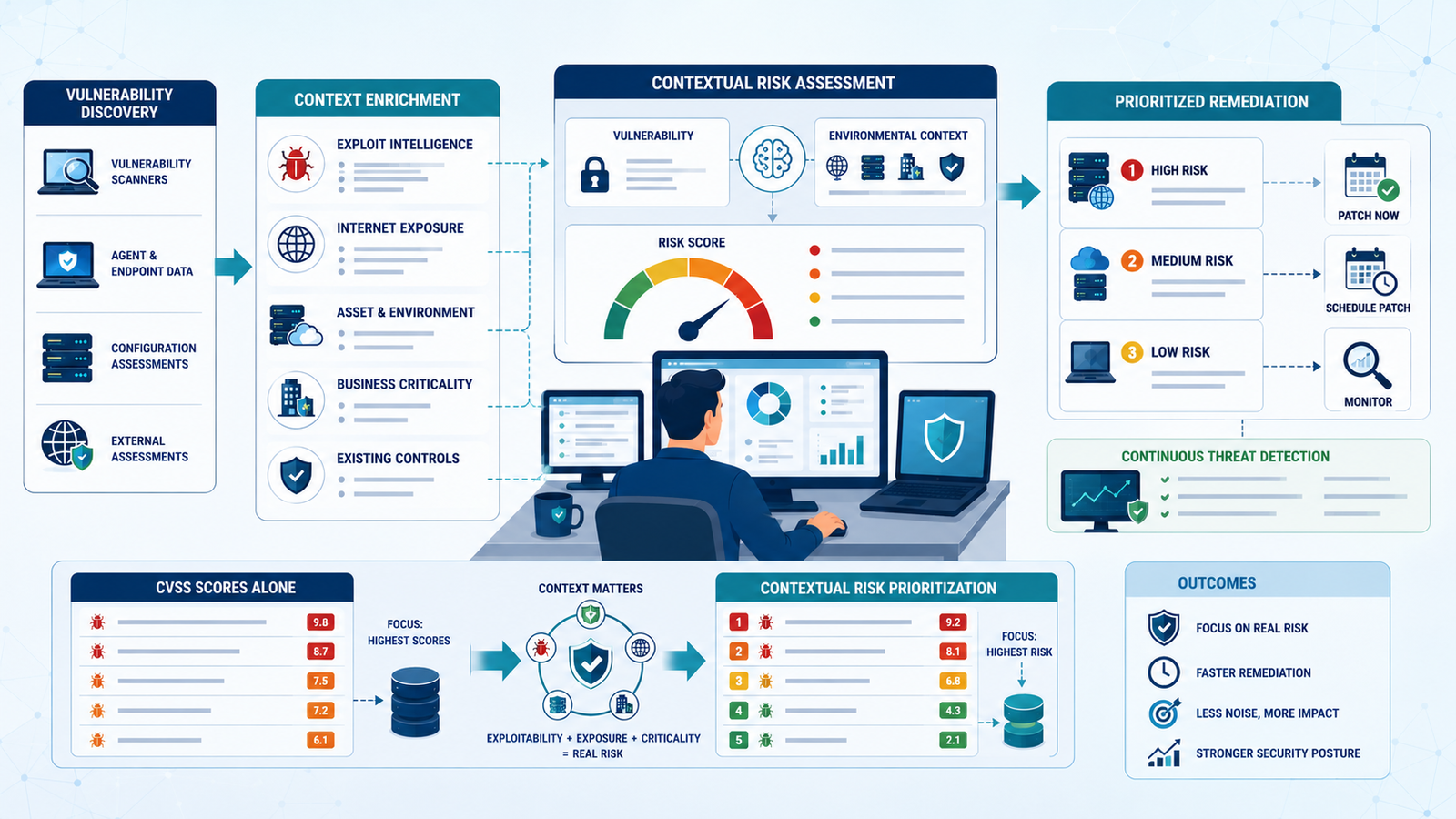
Security teams rarely struggle to find vulnerabilities, they struggle to decide which ones deserve immediate attention. Understanding vulnerability exploitability context helps distinguish theoretical weaknesses from flaws attackers can realistically exploit, allowing organizations to prioritize remediation with confidence.
At Network Threat Detection, we combine exploitability insights with real-time threat intelligence and attack context so teams can focus on risks that truly matter instead of chasing every CVSS score. That shift leads to faster, smarter security decisions. Keep reading.
Beyond CVSS: What Really Demands Your Attention?
Not every high-severity vulnerability represents an immediate business risk. Understanding exploitability context means evaluating whether a vulnerability is actively targeted, accessible within your environment, and capable of causing meaningful impact.
When security teams prioritize context instead of scores alone, they reduce wasted effort and respond faster to threats that genuinely matter.
- Separate Risk from Reality: Evaluate exploitability context instead of relying solely on vulnerability severity scores.
- Prioritize What Attackers Can Use: Focus on vulnerabilities with active exploits, reachable attack paths, and critical business impact.
- Keep Context Current: Continuously monitor exploitability changes so remediation priorities evolve with the threat landscape.
What Does “Exploitability Context” Really Mean Beyond The CVSS Score?
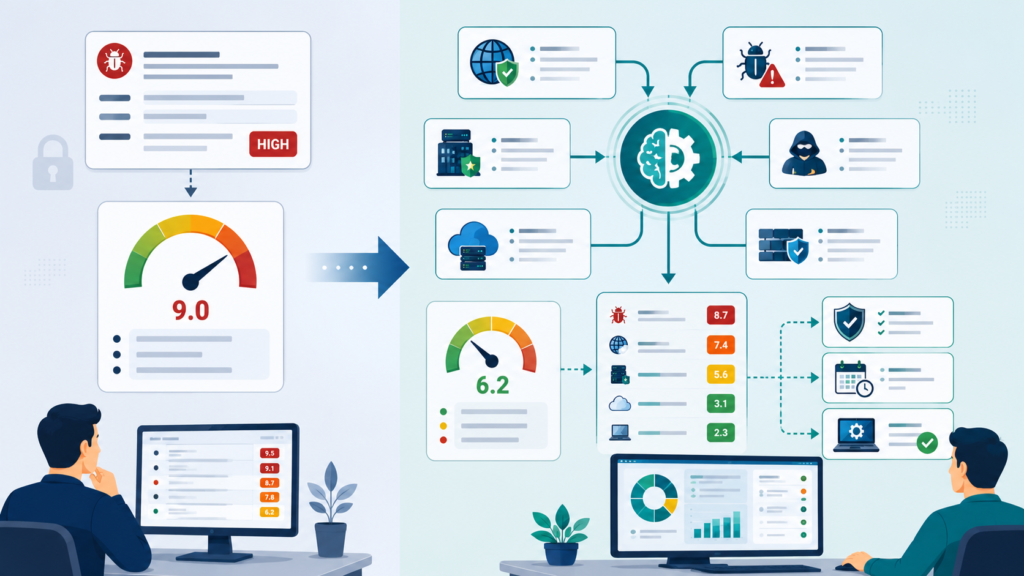
A CVSS score tells you how bad it could be. It’s a laboratory measurement under perfect conditions. Exploitability context asks the messy, real-world questions.
Is the vulnerable software actually exposed to the internet? Are there known, weaponized exploits circulating in criminal forums? Does the vulnerability require an attacker to already be logged in as a user?
“Assessing the exploitability of software vulnerabilities at the time of disclosure is difficult and error-prone, as features extracted via technical analysis by existing metrics are poor predictors for exploit development.” – Aminer
Think of it like a house with a weak lock (the vulnerability). The CVSS score might say the lock is grade 10, easily picked. The context tells you if the house is in a guarded compound (behind a firewall) or on a busy street (internet-facing).
It tells you if lock-picking kits for that model are being sold on the street corner (exploit code available). That’s the difference between a theoretical concern and a pressing alarm.
This context is a combination of factors. It’s about exposure, exploit availability, and attacker prerequisites. Asset management with vulnerability context It’s the environment the bug lives in, not just the bug itself. Ignoring this is like a doctor treating a disease based solely on a textbook description, without examining the patient.
How Do You Gather The Right Context For Your Environment?
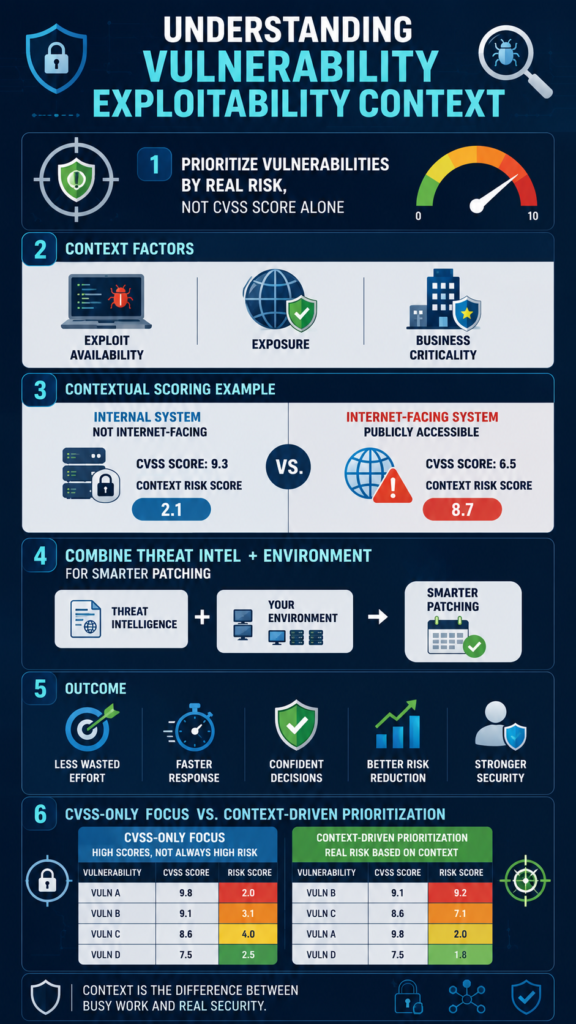
You start by looking outward and inward simultaneously. The external view is about the threat landscape. You need to know if the world is actively trying to break this specific lock.
“A vulnerability may be a candidate for exploitation, but in practice the set of vulnerabilities being actively exploited by malware and other real-world threats is a fraction of all vulnerabilities.” – Sciencedirec
- Exploit Availability: Check if exploit code is public (PoC), if it’s in mainstream penetration testing tools (like Metasploit), or if it’s being actively used in real attacks. Sources include vendor advisories, threat intelligence feeds, and sites tracking exploit development.
- Threat Actor Interest: Is this vulnerability being discussed in underground forums? Is it part of a known ransomware or state-sponsored group’s toolkit? This intelligence moves a bug from “potentially dangerous” to “actively targeted.”
- Vulnerability Age & Patching Status: A fresh flaw with no patch is a ticking clock. An old, well-patched one on an unupdated system is a sign of deeper operational issues.
Then, you turn the lens inward. This is where you map the theoretical flaw to your actual reality.
- Asset Exposure: Is the affected system internet-facing? Does it handle sensitive data? What’s its network segmentation like? A vulnerability on a database with no direct internet route is far less exploitable than one on a web server.
- Compounding Controls: Do you have a WAF that might block the exploit attempt? Is host-based intrusion prevention deployed? These existing defenses add crucial context, potentially mitigating the risk without a patch.
- Business Criticality: How vital is this system? The exploitability context for a flaw in a core revenue-generating app is inherently higher than one in a retired test server, regardless of the CVSS score.
Gathering this isn’t a manual job for a spreadsheet. It requires pulling data from your vulnerability scanner, your asset inventory, your threat intel platforms, and your network detection systems, with automated asset discovery and asset classification.
What’s The Practical Process For Contextual Risk Prioritization?
Credits: Technology Interpreters
With data flowing in, you need a repeatable, almost mechanical process to turn context into action. This is where you build your own risk formula, one that overrides the generic CVSS.
First, enrich every vulnerability finding. Automatically tag it with the context you’ve gathered: Internet-Facing: YES, Exploit in Metasploit: YES, Asset Tier: Tier 1. This creates a rich data object, not a flat line item.
Next, apply a simple scoring overlay. We use a basic matrix that multiplies the inherent severity (CVSS base score) by the environmental factors. For example:
| Context Factor | Low Risk Multiplier | High Risk Multiplier |
| Network Exposure | Internal, segmented (x0.5) | Internet-facing (x2.0) |
| Exploit Maturity | No public exploit (x0.7) | Exploit in widespread kits (x2.5) |
| Asset Criticality | Low-tier test server (x0.5) | Tier 1 Customer Database (x2.0) |
A vulnerability with a CVSS 7.0 (High) on an internal test server with no exploit becomes a contextual score of 7.0 * 0.5 * 0.7 * 0.5 = 1.23 (Low). That same 7.0 on an internet-facing Tier 1 asset with a Metasploit module? 7.0 * 2.0 * III * 2.0 = 70.0 (Critical). The numbers are illustrative, but the shift in priority is dramatic and rational.
Then, you route accordingly. The critical 70.0 gets an immediate, emergency change ticket. The low 1.23 goes into a standard patching queue. This process forces you to justify attention based on evidence, not fear.
It’s what we’ve built into our own Network Threat Detection analysis; alerts are weighted heavily by this kind of contextual enrichment, strengthened by integrating CMDB with security tools to provide richer security context, so the first thing an analyst sees is not just “CVE-XXXX-XXXX,” but “Exploitable Threat on Critical Asset.”
Finally, you document the decision. A quick note on why a high-CVSS bug was downgraded (“isolated VLAN, exploit unavailable”) creates an audit trail and justifies resource allocation to management. It turns panic into policy.
How Does This Approach Prevent Waste and Burnout?
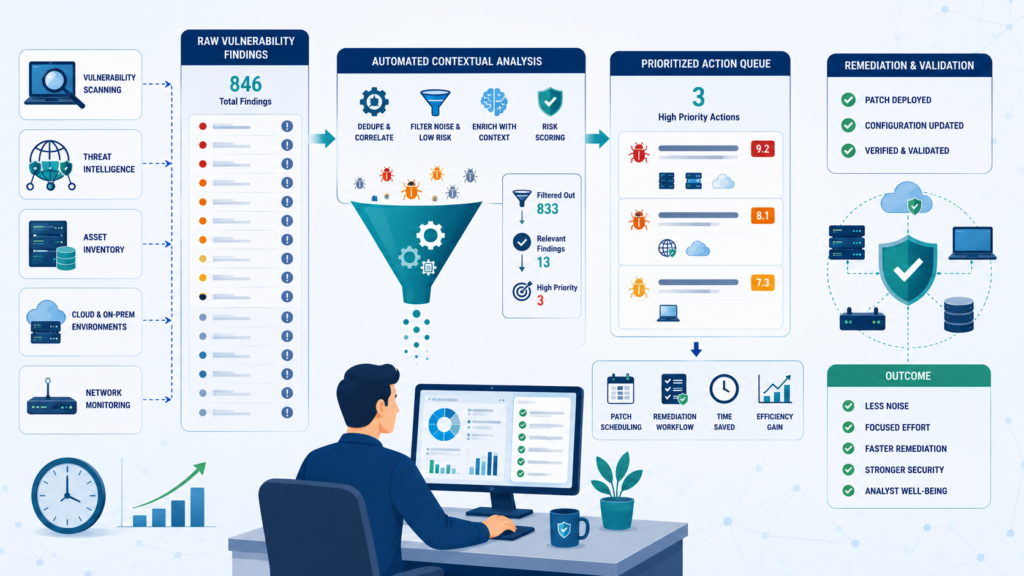
The classic “patch all highs and criticals” mandate is a recipe for exhaustion. It’s an infinite, demoralizing treadmill. Contextual prioritization breaks that cycle by introducing the concept of justified inaction, or rather, delayed, scheduled action.
Teams stop wasting cycles on vulnerabilities that pose no realistic threat to their specific environment. They aren’t rushing to patch a Linux kernel flaw on a server that only runs a closed-off Windows application. That time and mental energy is reclaimed. The feeling of constantly fighting the wrong battles dissipates.
More importantly, it builds confidence and expertise. Analysts transition from robotic ticket closers to strategic risk assessors. They learn to ask the right questions: “Where is it?” “Can they get to it?” “Are they trying?” This professional development is a powerful antidote to burnout. People need to feel effective, not just busy.
From a business perspective, it saves money. You avoid unnecessary downtime for emergency patches on systems that weren’t truly at risk. You focus costly emergency change procedures on the handful of issues that genuinely warrant them.
You can provide clear, evidence-based reports to leadership: “We’re not patching these 50 high-severity flaws because here’s the context showing they’re not exploitable in our setup. Instead, we’re focusing all effort on these 3, which are being actively attacked.”
We saw this transformation directly. Before context, our team was buried, morale was low, and we were always behind. After implementing this mindset, the workload became manageable. The team could see the impact of their work because they were stopping real, imminent threats, not checking boxes on a generic list. That shift is priceless.
FAQ
Doesn’t this let some vulnerabilities slip through forever?
No, it lets them be handled appropriately. Low-context vulnerabilities still get patched, but on a regular, scheduled maintenance cycle, not as emergency fire drills. The goal is intelligent pacing, not neglect. It’s about aligning effort with actual risk.
What’s the biggest source of context people overlook?
Existing security controls. A web application firewall (WAF) might already have a signature blocking a specific exploit. Network segmentation might already isolate the vulnerable system. Failing to factor in your own defenses means you’ll over-prioritize issues you’re already protected from.
How do you handle “zero-day” vulnerabilities with no patch?
You immediately assess: Is our specific configuration vulnerable? Is the system exposed? What compensating controls (WAF rules, IPS signatures) can we deploy right now? The focus shifts from patching (impossible) to detection and containment based on the exploit’s behavior, which is where robust Network Threat Detection proves essential.
Can you automate this whole process?
You can automate the data collection and enrichment, tagging assets, pulling exploit intel, calculating contextual scores. The final decision, especially for borderline cases or critical assets, should involve human judgment. The automation does the heavy lifting, freeing the human to apply experience and nuance.
From Overwhelmed Lists to Confident Action
A list of vulnerabilities without context creates noise, but exploitability context transforms that noise into clear priorities. By combining threat intelligence with your own environment, your team can focus on the risks that truly matter instead of reacting to every high CVSS score.
Ready to make vulnerability management more actionable? Discover how Network Threat Detection helps teams prioritize risk with real-time threat modeling, CVE mapping, and automated analysis: Join Network Threat Detection
References
- https://www.aminer.cn/pub/602ce11291e011c3e8f66a1c/expected-exploitability-predicting-the-development-of-functional-vulnerability-exploits
- https://www.sciencedirect.com/science/article/abs/pii/S0950584922002245?via%3Dihub