
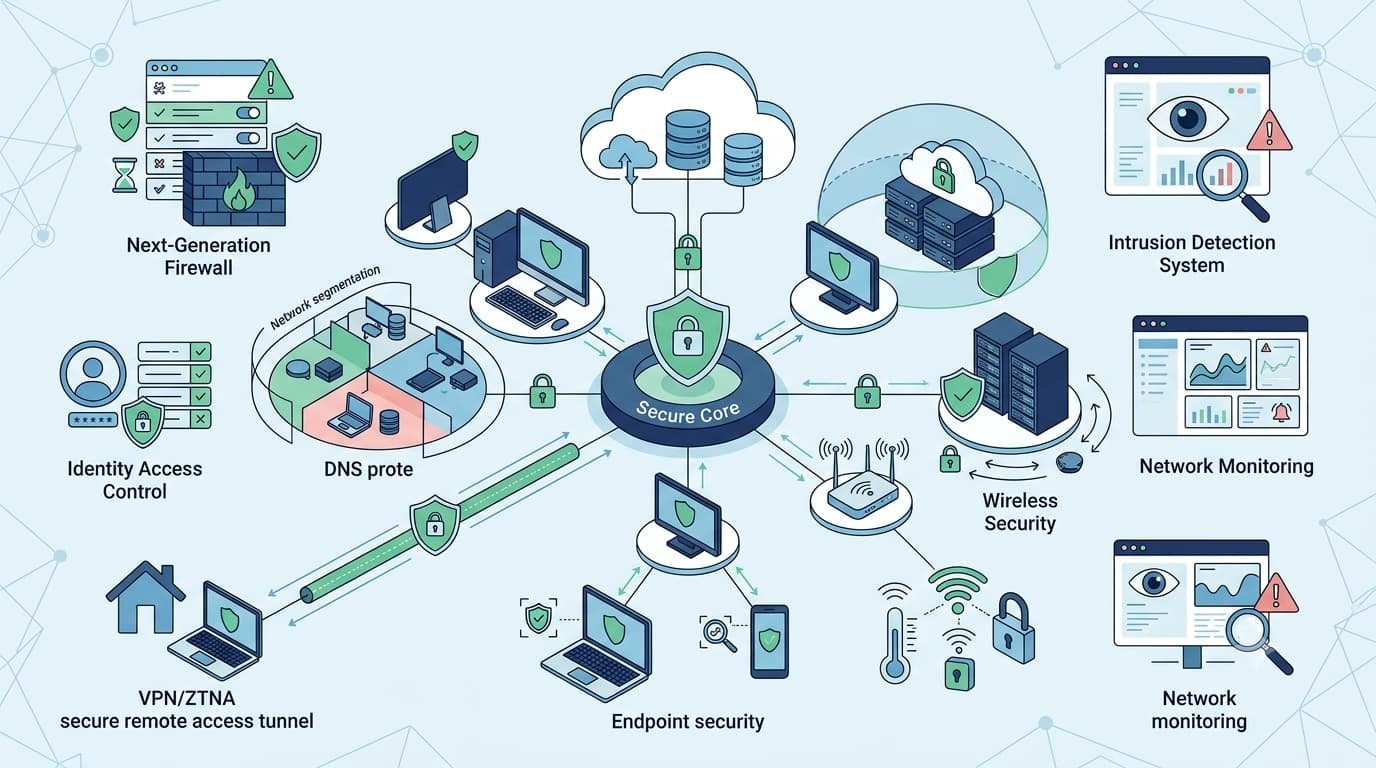
Network Infrastructure and Controls protect traffic, users, devices, and applications through layered security systems, with Network Threat Detection helping identify suspicious activity early.
The average global data breach cost reached $4.88 million in 2024, which shows the financial risk of weak defenses. Companies now treat network security as a core business concern, not only an IT task.
Each control, such as access rules, monitoring tools, and response systems, works together to limit exposure and reduce impact. Clear design and consistent oversight help teams avoid gaps and react faster to threats. Keep reading to understand how these controls work together.
Network Security in a Nutshell
- Next-Generation Firewalls (NGFWs) inspect encrypted traffic and applications, moving far beyond basic port blocking.
- Effective security requires layered controls: segmentation, strict access management, and DNS protection are non-negotiable.
- Cloud and remote workforces demand a shift from traditional VPNs to identity-centric models like Zero Trust Network Access (ZTNA).
Why Are Next-Generation Firewalls (NGFWs) Different?
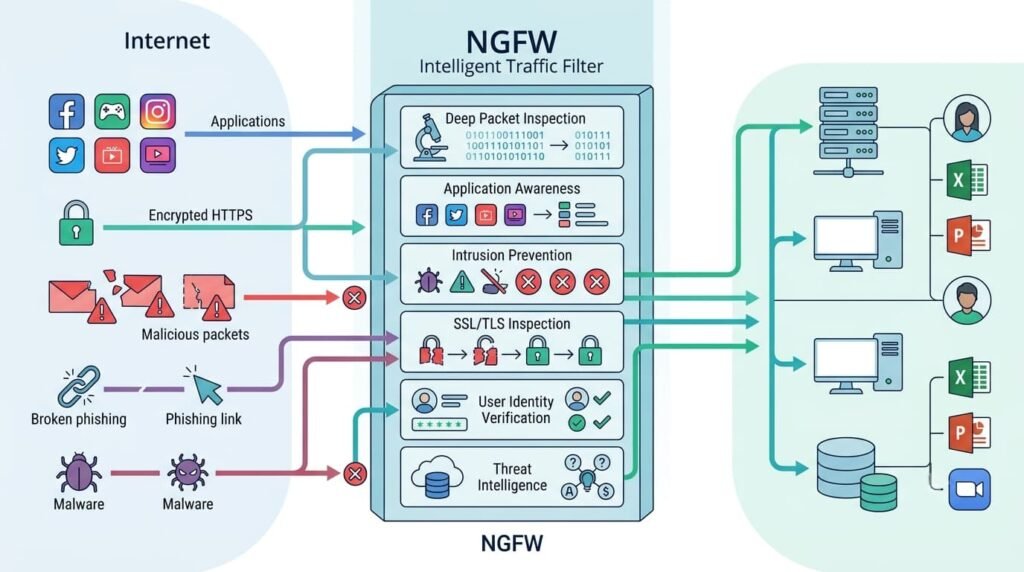
An NGFW does more than check IPs and ports. In practice, we see it identify apps, users, and payload data, even in encrypted traffic.
Traffic on port 443 can look normal yet hide malware callbacks. That shift, from port-based rules to application awareness, changes how teams set controls.
In our assessments, deep packet inspection exposes protocol misuse and hidden payloads. IPS signatures catch known exploits early. Deploying outbound TLS/SSL inspection (SSL Forward Proxy) remains the most operationally delicate NGFW feature.
Without dedicated crypto-acceleration hardware, turning on deep packet decryption can cause CPU spikes exceeding 40% on standard firewalls. Furthermore, proper rollout requires pushing private root CA certificates to every managed endpoint via GPO/MDM to prevent browser breaking on pinning-enabled traffic.
Key NGFW features that matter:
- Intrusion Prevention System (IPS)
- TLS/SSL Decryption
- Application and User Identity Control
- Integrated VPN Services
How Should Routers and Switches Be Secured?
Credits: NGT Academy
Switches and routers sit in the background, but they carry everything. If an attacker takes a switch, they can watch traffic move across the network. If they take a router, they can change where that traffic goes.
During perimeter audits, we routinely harvest exposure via forgotten out-of-band management interfaces. Hardening core switches requires enforcing TACACS+/RADIUS authentication, completely disabling HTTP/Telnet in favor of SSHv2 with public key authentication, and isolating management interfaces into a dedicated, non-routable Out-of-Band (OOB) VLAN.
From what we see in incident cases, strong router security and switch security depend on consistent security best practices. Use SSH for command-line access. Choose SNMPv3 for monitoring, since older versions expose credentials. Send syslog to a central system, and track flows with NetFlow or IPFIX.
Backups matter too, keep device configs saved so recovery is fast. Apply role-based access so each admin has only the rights they need.
VPN Security and Zero Trust Are Often Discussed Together
Traditional VPNs build a secure tunnel, but access often extends too far. These VPN technologies continue to raise security concerns when broad network access remains the default. In our threat models, once a user connects, they can move across large parts of the network. That creates risk.
Stolen credentials turn a single account into wide access. A 2025 survey of security teams points to this exposure as a growing concern.
ZTNA changes that approach. Instead of trusting the network, it checks the user and device on each request. Access stays limited to one application at a time, not the full network.
According to the National Institute of Standards and Technology
“Zero trust assumes there is no implicit trust granted to assets or user accounts based solely on their physical or network location (i.e., local area networks versus the internet) or based on asset ownership.” – National Institute of Standards and Technology
In practice, we see tighter control and fewer lateral movement paths. It also improves the user side, since access aligns with the exact task, not a broad connection.
What Does a Web Application Firewall (WAF) Protect?
Unlike NGFWs that evaluate layer 3 through 5 session flows, a WAF performs layer 7 deep-payload inspection, parsing HTTP/HTTPS request bodies, JSON/XML schemas, and API headers to intercept OWASP Top 10 exploits like SQL injection, cross-site scripting (XSS), and automated bot-driven credential stuffing before requests hit web application runtimes.
It sits in front of web servers and filters requests before they reach the app.
From incident reviews, most attacks map to common web risks. A WAF blocks SQL injection that targets databases. It stops XSS that tries to take user sessions.
It also detects credential stuffing and limits app-layer DDoS traffic. For any public service, teams treat a WAF as required, not optional. This layered WAF protection helps stop application-layer attacks before they reach production systems. It works with the NGFW to add a focused layer.
| Threat type | WAF action |
| SQL injection | Block query abuse |
| XSS | Filter script payloads |
| Credential stuffing | Rate limit, detect bots |
| App-layer DDoS | Throttle requests |
How Can DNS Security Prevent Modern Threats?
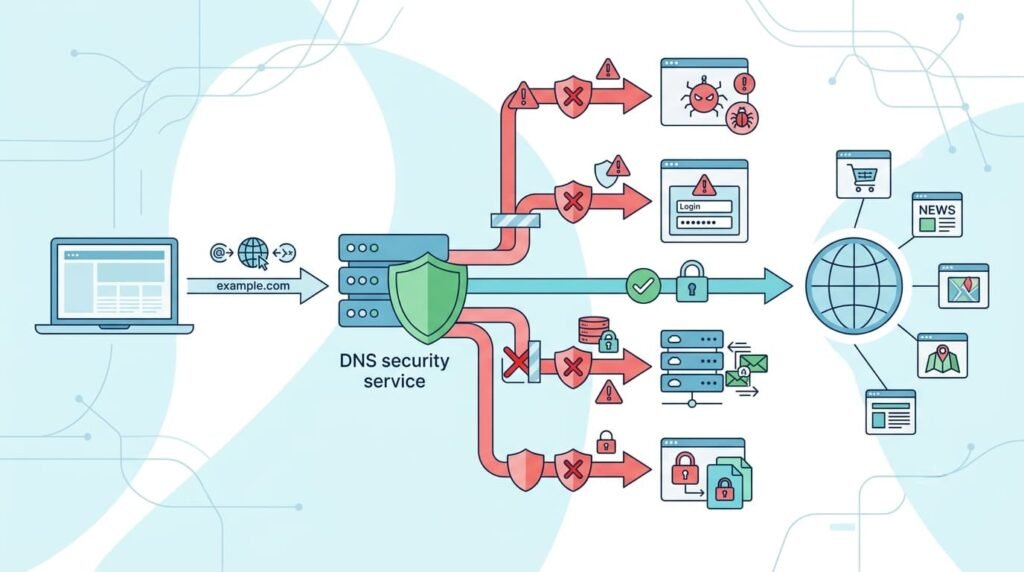
DNS acts as the internet’s phonebook. If it gets poisoned, users land on fake sites without warning. In our risk analysis, DNSSEC helps protect record integrity. It signs DNS data so resolvers can confirm the response is valid, not altered in transit.
In our SOC workflows, automated DNS Security provides the fastest pre-session intervention.
By deploying Response Policy Zones (RPZ) on internal recursive resolvers, we sinkhole outbound command-and-control (C2) beaconing, block domain generation algorithm (DGA) lookups at the query stage, and decrypt DoH/DoT traffic to prevent attackers from tunneling data out over port 53.
We route queries through secure resolvers and see fewer successful attacks. Logging also matters. Effective DNS security measures rely on DNS logs that reveal patterns other tools often miss. Repeated lookups to odd domains can point to beaconing malware or data leaks.
Network Segmentation Is Essential
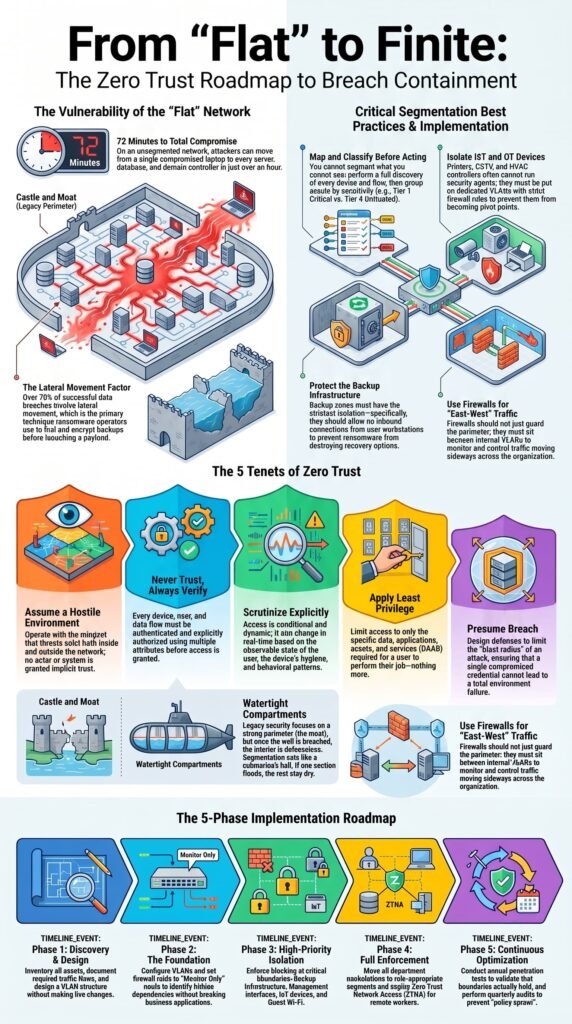
A flat network gives attackers room to move. Once inside, they can reach many systems without much resistance. In our threat models, this setup increases lateral movement and makes containment harder.
Effective segmentation requires moving beyond flat layer-2 subnets by deploying dedicated Virtual Routing and Forwarding (VRF) instances and layer-3 firewalls between zones.
Restricting inter-VLAN routing with default-deny policies ensures that compromised corporate Wi-Fi clients cannot route traffic into PCI-DSS scope or internal database clusters.
From incident cases we review, well-planned network segmentation strategies reduce damage by limiting how far attackers can move. If one device is compromised, it stays within its segment and cannot reach critical systems.
Micro-segmentation pushes this further, down to each workload or virtual machine, which we often apply in cloud setups. It adds control where traffic is dense and fast-changing.
How Does Network Access Control (NAC) Improve Security?
NAC answers a simple question: which devices can connect, and where they should go. In our assessments, teams often lack this control. Devices join the network with little verification. With 802.1X, each device must prove its identity, often through a certificate, before it gets access.
From what we see in deployments, successful NAC implementation strengthens network access control by enforcing placement and health checks. It assigns devices to the right VLAN, employees in corporate networks, contractors in restricted segments, and unknown devices in guest zones. It also checks posture.
Deploying 802.1X NAC allows us to enforce dynamic VLAN assignment via RADIUS based on health telemetry.
If an endpoint fails pre-admission posture checks, such as missing endpoint detection and response (EDR) agents, disabled local disk encryption, or outdated OS patch levels, the switch automatically places the host into an isolated remediation VLAN with restricted internet-only access. Many teams start with Wi-Fi, then extend to wired networks.
Visibility alone, knowing every device on the network, changes how risks are managed.
Cloud Network Security Is Different from Traditional Network Security
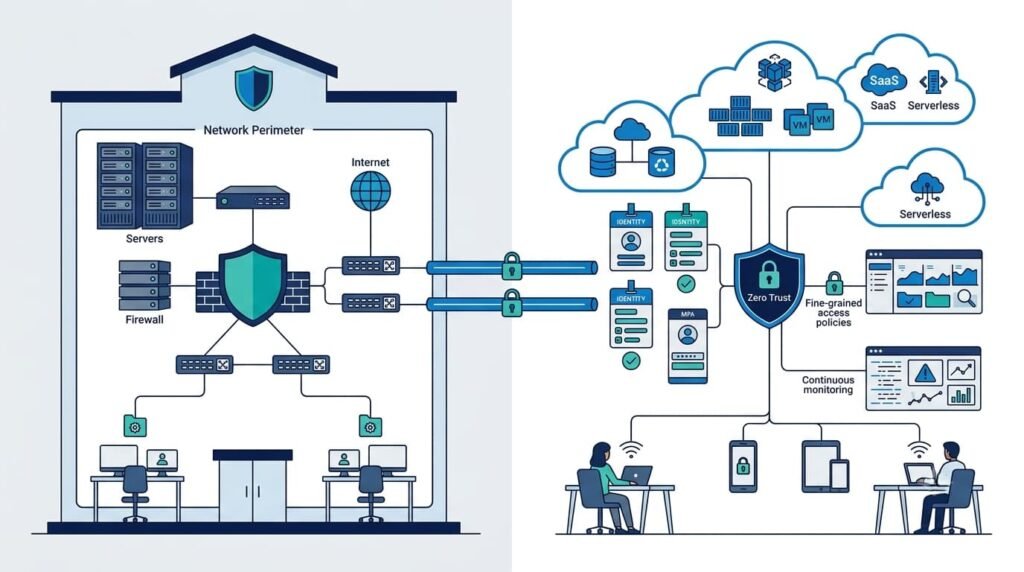
In cloud setups, the edge is not clear. Traditional firewalls do not map well here. In our work, identity becomes the first control. IAM defines who and what can act, and small errors in roles often create more risk than exposed ports.
Cloud network security requires enforcing isolation at the management and workload planes.
We isolate workloads using distinct VPCs/VNets connected via central Transit Gateways, restrict east-west inter-service communication using stateful Security Groups/NSGs at the ENI (Elastic Network Interface) level, and mandate IAM role-based access for all internal service-to-service API calls.
We treat each workload as untrusted by default. This reduces lateral movement. Effective cloud network security also depends on recording and monitoring every API call, network flow, and configuration change.
We use these logs in threat models to detect misuse early. Cloud providers secure the infrastructure, but teams must secure what they run inside it.
Organizations Should Secure Enterprise Wireless Networks with Layered Controls
Wi-Fi remains a common entry point for attacks. In our assessments, weak encryption and shared passwords still show up. Moving to WPA3-Enterprise improves the handshake and reduces exposure.
For access control, 802.1X with EAP-TLS gives stronger protection since it relies on certificates, not passwords.
From deployment experience, securing wireless networks starts with segmentation at the wireless layer. Separate SSIDs for corporate devices, IoT, and guests, each mapped to its own VLAN. This limits how far a compromised device can reach.
To mitigate wireless vectors in dense environments, we pair WPA3-Enterprise (EAP-TLS) with active Wireless Intrusion Prevention Systems (WIPS). WIPS continuously monitors the RF spectrum to pinpoint unauthorized ‘evil twin’ access points, suppress rogue BSSIDs, and automatically block 802.11 deauthentication frame attacks targeting enterprise clients.
How Can Organizations Protect IoT and OT Networks?
IoT and OT systems often carry the highest risk. In our reviews, many run for years without patches and rely on old protocols. Strong IoT security controls and OT network security begin with isolation as a foundational part of broader network security controls. The Purdue Model gives a clear structure, with strict separation between IT networks, an OT DMZ, and control layers.
As emphasized in NIST Special Publication
“Network segmentation is fundamental to OT security creating distinct security zones within the environment to provide a defense-in-depth strategy, limit the impact of a breach, and hinder the lateral movement of attackers within the network.” – NIST Special Publication
From field work, tight communication rules reduce exposure. Use allow-listing so only approved protocols and endpoints can connect. Apply mTLS to confirm device identity on both sides.
Where supported, enable secure boot and signed updates to prevent tampering. Monitoring also needs a different approach. We use tools that understand Modbus, DNP3, and similar protocols to spot abnormal behavior.
Standards like IEC 62443 guide how to build and maintain these controls over time.
FAQs
How does a next generation firewall improve network security?
A next generation firewall strengthens security by combining advanced ngfw features such as an application aware firewall, deep packet inspection, and an intrusion prevention system.
These capabilities inspect traffic at the application layer, identify suspicious activity, and enforce detailed security policies. Together, they help organizations build a secure network infrastructure that provides stronger protection than traditional firewall filtering alone.
Why is network segmentation important for stopping cyberattacks?
Network segmentation reduces the impact of cyberattacks by limiting how far attackers can move after compromising a device. Organizations use microsegmentation, effective vlan design, east west traffic control, and zero trust segmentation to strengthen lateral movement prevention.
A well-planned network zoning strategy and dmz architecture also isolate critical systems and reduce the risk of unauthorized access.
What should businesses secure before allowing remote network access?
Organizations should establish strong vpn security before granting remote access to internal resources. They should select an ipsec vpn, ssl vpn, or remote access vpn that matches their security requirements and evaluate split tunneling risks before enabling remote connections.
Many organizations also implement zero trust network access (ZTNA) to verify every user and device before granting access to business systems.
How can organizations protect their DNS from phishing attacks?
Organizations can strengthen dns security by implementing dnssec validation, dns filtering, and a trusted recursive dns resolver.
They should also use response policy zones (RPZ) to support phishing domain blocking and perform regular dns log analysis to detect suspicious requests and unusual traffic patterns. These practices reduce the risk of users accessing malicious or compromised domains.
What is the best way to secure wireless and industrial networks?
Organizations should strengthen wireless network security by implementing wpa3 enterprise, 802.1x wifi, radius wifi authentication, and eap tls to authenticate users and devices securely.
They should also improve iot security, ot network protection, industrial control system security, scada network security, and plc protection to protect operational technology from unauthorized access and evolving cyber threats.
Build a Defense That Works Together
A single security control won’t stop every attack, and that’s where many teams get caught off guard. Your network is only as strong as the weakest point, and one missed gap can open the door to a serious breach. That’s the reality.
Start by fixing the biggest weakness, then keep building from there. Add Network Threat Detection to connect the dots across your security stack, giving your team the visibility needed to catch threats that slip past preventive controls.
Validating these ten controls requires scheduled adversary emulation and automated breach-and-attack simulation (BAS) testing. Rather than relying on static firewall rules, test your detection stack by running benign malware callback scripts and monitoring whether your SIEM triggers on the resulting DNS queries and east-west flow anomalies.
References
- https://csrc.nist.gov/pubs/sp/800/207/final
- https://www.nist.gov/publications/guide-operational-technology-ot-security
Related Articles
- https://networkthreatdetection.com/next-generation-firewalls-ngfw-features/
- https://networkthreatdetection.com/router-and-switch-security-best-practices/
- https://networkthreatdetection.com/vpn-technologies-and-security-concerns/
- https://networkthreatdetection.com/web-application-firewall-waf-protection/
- https://networkthreatdetection.com/dns-security-measures-dnssec-filtering/
- https://networkthreatdetection.com/network-segmentation-strategies/
- https://networkthreatdetection.com/network-access-control-nac-implementation/
- https://networkthreatdetection.com/cloud-network-security-aws-azure-gcp/
- https://networkthreatdetection.com/securing-wireless-networks-wpa3-eap/
- https://networkthreatdetection.com/iot-and-ot-network-security-controls/