
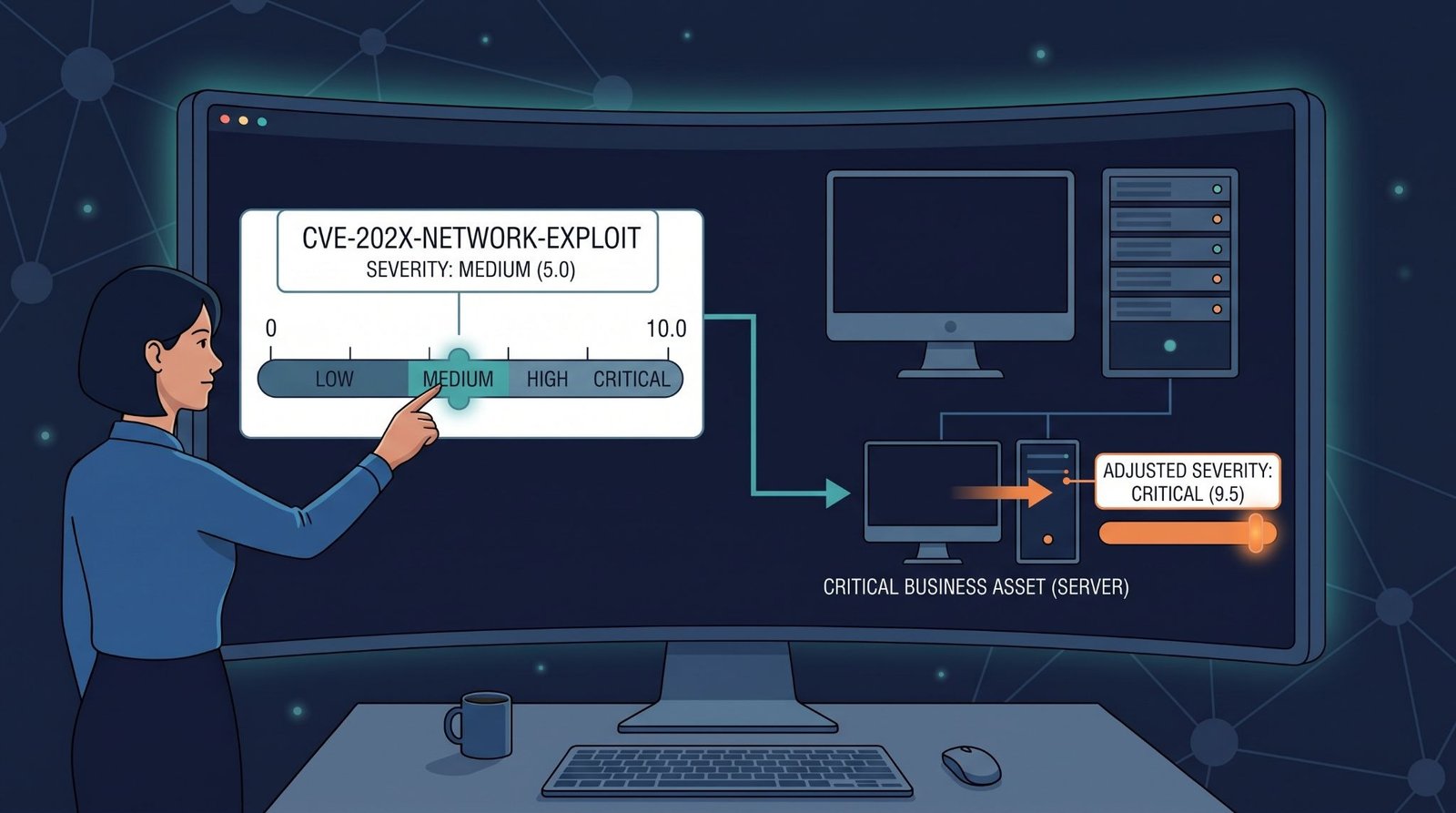
Using CVSS helps security teams measure vulnerability severity on a standardized 0.0 to 10.0 scale. The score gives analysts a consistent technical baseline, but it doesn’t show the full risk in a specific environment. A high CVSS score may need less urgent action if the affected system is isolated.
Meanwhile, a lower score could matter more on an exposed production server. We use CVSS with asset value, network exposure, exploit activity, and available controls to set a practical priority. CVSS starts the review, not ends it. Keep reading to see how CVSS can support better vulnerability prioritization.
Quick Reads: CVSS Scoring Essentials
CVSS helps teams assess vulnerability severity, but context is still needed to set practical remediation priorities.
- CVSS measures severity on a 0.0-10.0 scale, not overall business risk.
- Threat intelligence and asset context can improve vulnerability prioritization.
- CVSS v3.1 and v4.0 standardize vulnerability scoring for risk-based security decisions.
What Is CVSS and What Does Its 0.0 to 10.0 Score Mean?
CVSS gives a vulnerability a number based on how it can be exploited and what damage it could cause. The score runs from 0.0 to 10.0.
| CVSS score | Severity |
| 0.0 | None |
| 0.1 to 3.9 | Low |
| 4.0 to 6.9 | Medium |
| 7.0 to 8.9 | High |
| 9.0 to 10.0 | Critical |
The score gives security teams a common way to talk about vulnerability severity. We use it as a starting point, though. It should not decide the entire patching order by itself.
Why? Because the same flaw can mean very different things on two systems.
A critical vulnerability on a disconnected test machine may not need the same attention as a medium severity flaw on an Internet facing production server. The second system could hold customer data or give an attacker access to other important systems.
That is where context matters.
Why Does A CVSS Score Not Tell You Which Vulnerability To Fix First?
CVSS describes technical severity. It does not know everything about a company’s network.
An analyst still needs to ask a few basic questions. What system is affected? Can someone reach it from the Internet? Does it contain sensitive data? Is the vulnerability being exploited? Are other security controls already blocking access?
We have seen why these questions matter when building risk models. A number may look alarming until the surrounding details are checked. In another case, a lower score can deserve faster action because the affected asset is far more exposed.
So, CVSS helps rank the problem. It does not make the final call.
“They must prioritize vulnerabilities and remediate those that pose the greatest risk.” – NIST
How Does The CVSS Base Score Measure Vulnerability Severity?
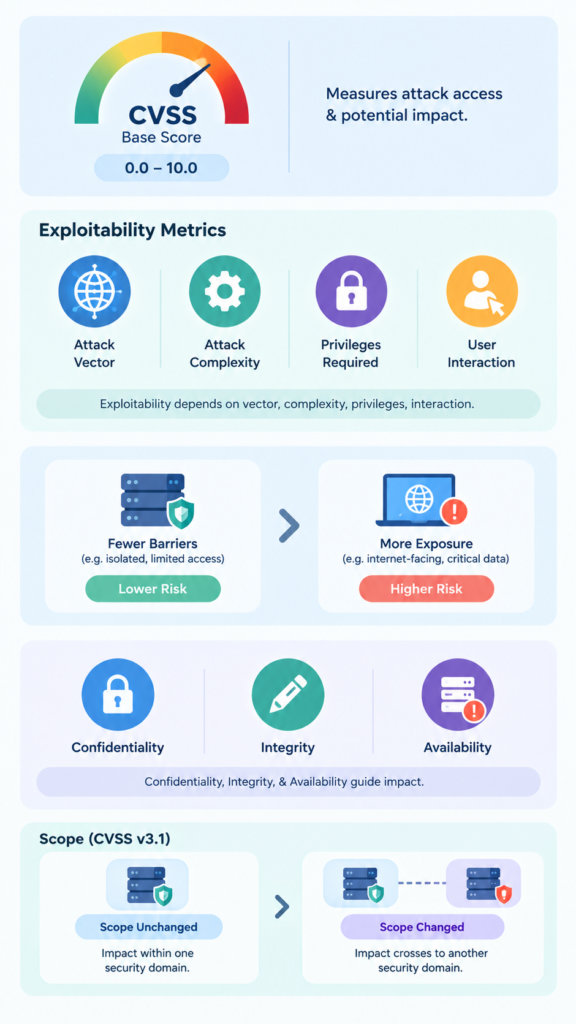
The CVSS Base Score looks at the vulnerability itself. It considers how an attacker could reach it and what could happen after a successful attack.
That makes the Base Score useful across different environments. The technical details stay tied to the vulnerability rather than changing for every company.
Which Exploitability Metrics Affect The CVSS Base Score?
CVSS looks at several conditions that can affect exploitation:
- Attack Vector: How the attacker reaches the vulnerable system.
- Attack Complexity: Whether special conditions are needed.
- Privileges Required: What level of access the attacker needs.
- User Interaction: Whether another person must take an action.
A flaw that can be attacked remotely without an account or user action has fewer barriers than one that needs local access and a privileged account.
Still, fewer barriers do not automatically mean greater business risk. The target matters too.
For example, a remote flaw on a public server deserves close attention. But if that server has no sensitive data and strong network controls limit access, the situation may be different from an identical flaw on a core production system.
How Does CVSS Measure Confidentiality, Integrity, And Availability?
CVSS also looks at what an attacker could affect.
Confidentiality deals with unauthorized access to information. Integrity covers unauthorized changes. Availability deals with systems or services becoming unavailable.
Consider a database vulnerability that lets an attacker read customer records. The main concern may be confidentiality. A flaw that allows changes to system settings raises integrity concerns. A denial of service issue could mainly affect availability.
These values help calculate the Base Score. They don’t tell the security team what the incident would cost the business.
That part needs local information.
What Does Scope Mean In CVSS v3.1?
In CVSS v3.1, Scope describes whether an attack can affect something outside the security authority of the vulnerable component.
With Scope Unchanged, the impact stays within the same security authority. With Scope Changed, exploitation can affect another security authority.
This can matter in systems where several services depend on each other. A flaw in one application might give an attacker a path into another system.
That connection can change how analysts view the finding.
When Should Teams Use Threat And Temporal Metrics?
A vulnerability can change after it becomes public. An exploit may appear. A patch may be released. Attackers may also begin using the flaw.
Those changes matter.
How Does Exploit Code Maturity Affect Vulnerability Priority?
CVSS v3.1 includes Exploit Code Maturity. It describes how much usable exploit information exists.
The levels include Unproven, Proof of Concept, Functional, High, and Attacked.
A vulnerability being used in real attacks deserves more attention than one with no known working exploit. That seems obvious, but it can get lost when teams rely too heavily on threat prioritization and a static severity list.
We look at this as another signal. If active attacks are reported and the vulnerable system is exposed, the case becomes harder to ignore.
How Do Patches And Report Confidence Affect Scoring?
CVSS also includes Remediation Level and Report Confidence in its Temporal metrics.
Remediation Level considers whether a fix or workaround exists. Report Confidence looks at how certain the vulnerability information is.
An official patch gives a security team a clear action. No patch means the team may need temporary controls instead, such as blocking access or changing network rules.
That difference can affect the response plan.
How Do Environmental Metrics Add Organizational Context?
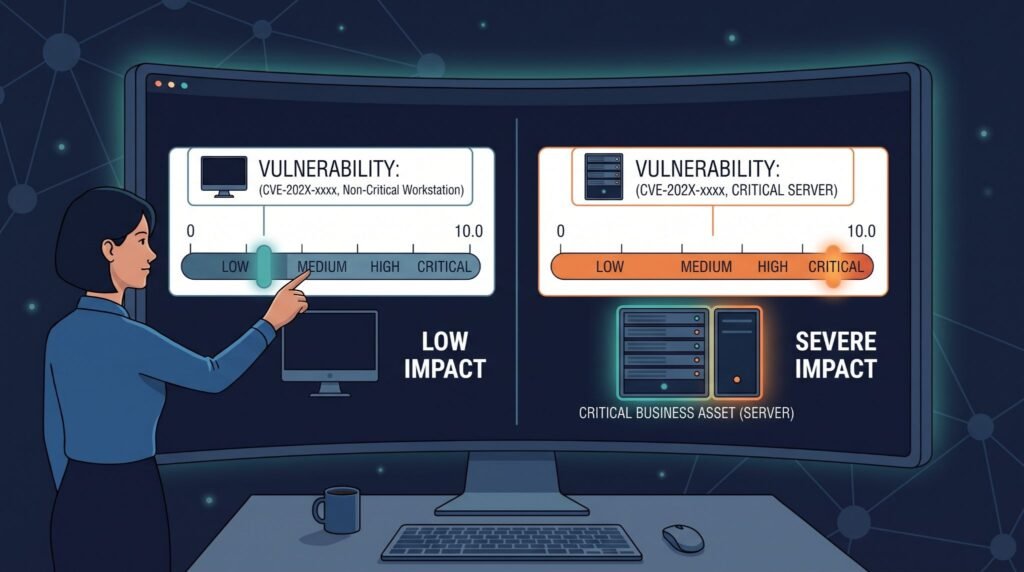
Environmental metrics help teams consider how a vulnerability affects their own systems. Risk exposure dashboards can also help teams see how those findings are distributed across assets and environments.
This is useful because every network is different.
Why Does Asset Criticality Matter?
A vulnerability on a business critical database can matter far more than the same vulnerability on a test machine.
Teams can consider Confidentiality Requirement, Integrity Requirement, and Availability Requirement when assessing environmental impact. They can also look at asset value, exposure, and business dependency.
Our risk analysis tools use this type of information to connect vulnerability findings with the systems they could affect.
A score by itself can’t show that connection.
How Do Compensating Controls Change Risk?
Security controls can reduce exposure. Network segmentation, access restrictions, monitoring, and endpoint controls are a few examples.
Imagine two servers with the same vulnerability. One is open to the Internet. The other can only be reached through a restricted internal network.
The vulnerability has not changed. The practical risk has.
That is why environmental information belongs in the discussion.
How Can CVSS Work With EPSS And The KEV Catalog?
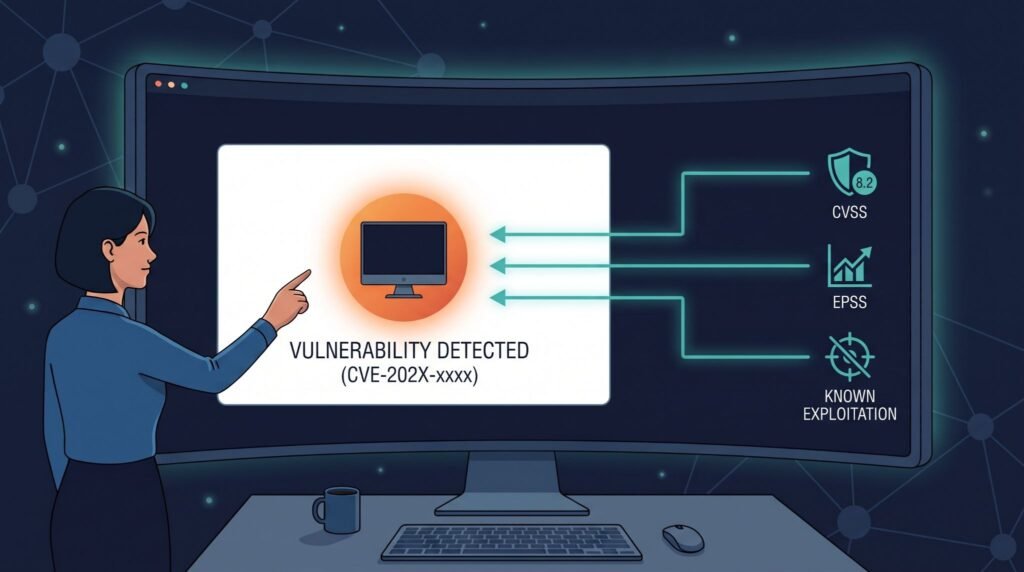
CVSS tells teams about severity. EPSS adds an estimate of exploitation probability, while the CISA Known Exploited Vulnerabilities (KEV) Catalog identifies vulnerabilities known to have been exploited in real attacks.
Together, these signals can help teams decide what deserves attention first.
“EPSS assigns a probability of exploitation across the entire CVE population.” – FIRST
What Does EPSS Add To CVSS?
EPSS focuses on exploitation likelihood. This gives teams information that a CVSS Base Score does not provide.
A high severity vulnerability with strong evidence of exploitation may deserve faster action than another high severity vulnerability that has little evidence of current exploitation.
We don’t replace CVSS with EPSS. They answer different questions.
Asset context still matters too.
How Should CVSS Fit Into Risk Based Vulnerability Management?
Source: Technology Interpreters
CVSS works better when it sits inside a larger process.
A team can review:
- CVSS severity
- Asset importance
- Network exposure
- Exploitation evidence
- Sensitive data
- Existing controls
- Patch availability
This keeps one number from controlling every decision.
Our threat models can connect these details and help security teams see where a vulnerability fits within the wider network. Security risk communication can also help explain why some vulnerabilities need attention before others. That can make the remediation queue easier to review.
FAQs
Can a high CVSS score still result in a lower remediation priority?
Yes. A high CVSS score can receive a lower remediation priority when the affected asset has limited exposure or strong compensating controls. Teams using RBVM prioritization can also consider asset criticality, active exploitation, business impact, and patch availability. This approach separates technical vulnerability severity from the actual risk the vulnerability creates for the organization.
How should teams prioritize vulnerabilities when no exploit is available yet?
Teams should not assume that an unproven vulnerability carries the same risk as one being actively exploited. Threat intelligence enrichment can provide information about exploit availability, attack activity, and disclosure timelines. For a zero-day vulnerability, teams should also assess exposure, affected assets, available mitigations, and evidence of exploitation before setting a remediation priority.
Should teams use EPSS and CVSS together when prioritizing vulnerabilities?
Yes. CVSS EPSS correlation can provide a broader view because the two measures answer different questions. CVSS measures vulnerability severity, while EPSS estimates the likelihood of exploitation. Teams can combine both measures with business context scoring, asset exposure, and threat intelligence to identify vulnerabilities that require faster remediation.
How does a scope change affect the impact of a CVSS score?
A scope change can increase the potential impact when exploiting a vulnerable component affects resources outside its original security authority. Teams should consider both the vulnerable component and the impacted component when assessing downstream consequences. This helps explain why vulnerabilities with similar technical characteristics can receive different impact scores when their effects extend to other security authorities.
When should teams use environmental metrics instead of only the base score?
Environmental metrics are useful when the same vulnerability creates different levels of risk across systems. Teams can adjust the assessment based on asset criticality, security requirements, exposure, and compensating controls. For example, a vulnerability affecting an internet-facing production server may require faster remediation than the same vulnerability on an isolated test system, even when both have identical base scores.
How Can Network Threat Detection Use CVSS More Effectively?
CVSS shows potential severity, but your network context shows how much a vulnerability actually matters. Adding exposure and network evidence can help analysts focus on realistic risks.
Network Threat Detection helps connect these signals, so teams can prioritize important vulnerabilities without relying on CVSS alone.
References
- https://www.nist.gov/publications/common-vulnerability-scoring-system
- https://www.first.org/epss/why-epss.html