
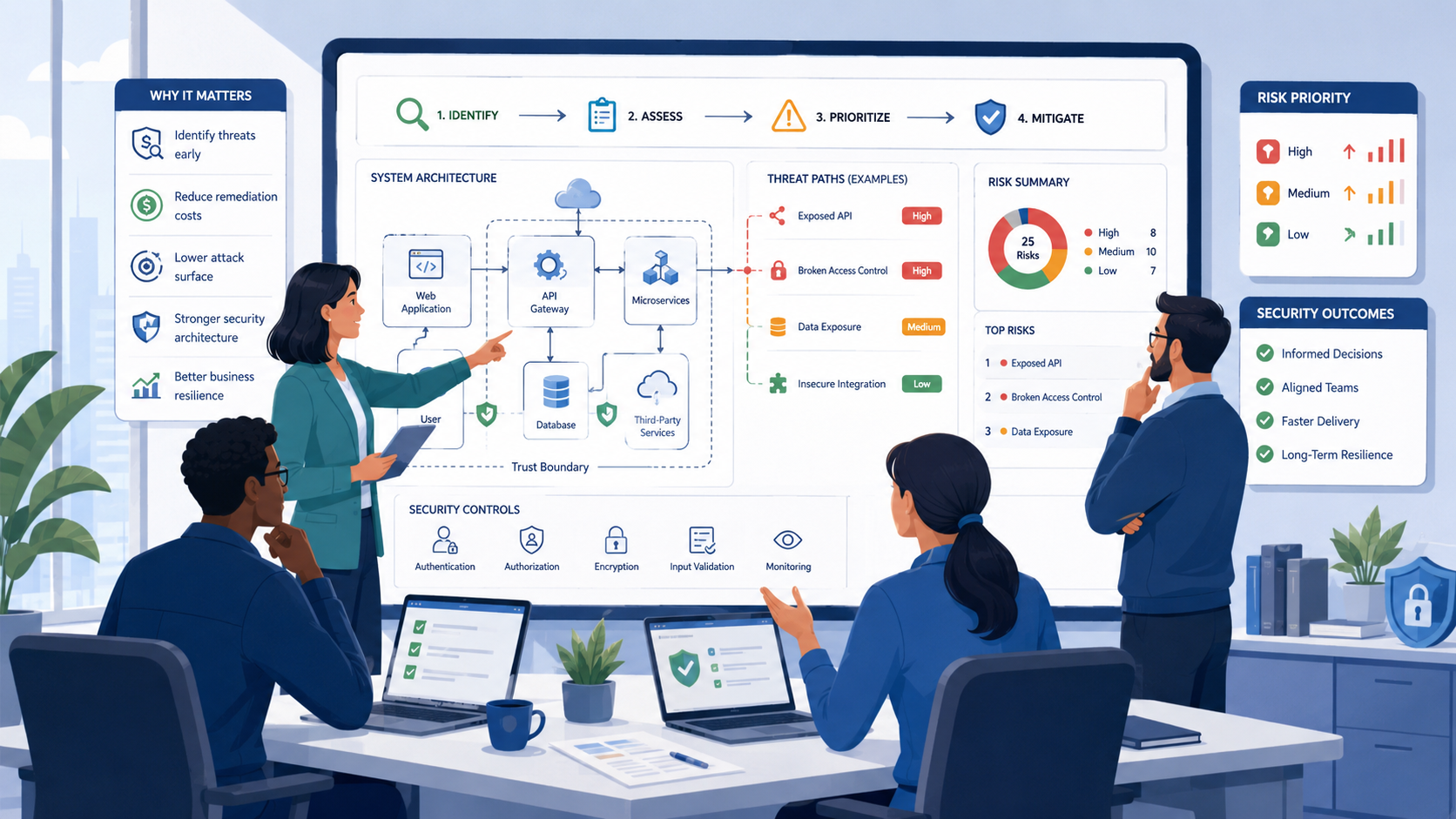
Benefits proactive threat modeling security programs rely on include identifying risks before deployment, reducing remediation costs, and strengthening overall resilience. As applications, APIs, cloud services, and distributed systems expand, addressing weaknesses late in the lifecycle often leads to costly fixes and operational disruption.
At Network Threat Detection, we see stronger outcomes when organizations build security into design decisions instead of reacting after incidents occur. This approach supports smarter risk management and more sustainable protection. Keep reading to see why proactive threat modeling deserves a place in modern security strategies.
Security Snapshot: Why Proactive Threat Modeling Matters
These points capture the practical benefits of addressing risks before they become incidents and explain why proactive threat modeling has become a core part of modern security programs.
- Proactive threat modeling helps identify threats before deployment, reducing remediation costs and strengthening security architecture.
- Threat modeling supports risk-based security decisions by prioritizing the threats most likely to impact business objectives.
- Continuous threat modeling improves security preparedness, compliance readiness, and adaptation to changing threats.
Quick wins: The biggest benefits of proactive threat modeling
Threat modeling helps organizations find weaknesses before attackers do. Instead of waiting for security testing at the end of a project, teams examine systems during planning and design. This creates a clearer picture of how an application, cloud environment, or service could be attacked.
Several practical benefits appear early. Teams can identify risky design choices, reduce unnecessary system exposure, and document security requirements before development is complete. Security conversations also become easier because developers, operations teams, and security specialists work from the same understanding of risk.
Common advantages include:
- Earlier detection of security weaknesses
- Smaller attack surfaces
- Better prioritization of security investments
- Improved support for compliance efforts
- Faster remediation of identified issues
- Stronger collaboration across teams
- Better visibility into critical assets and data flows
Threat modeling also supports frameworks such as STRIDE and other structured methods that help organizations evaluate threats consistently. Teams that want a practical walkthrough can follow a detailed Microsoft threat modeling tool tutorial to understand how structured threat analysis is applied during system design.
Rather than treating security as a final checkpoint, teams make it part of everyday decision-making. That shift often leads to fewer surprises, lower costs, and stronger protection across the environment.
How does proactive threat modeling reduce security costs?
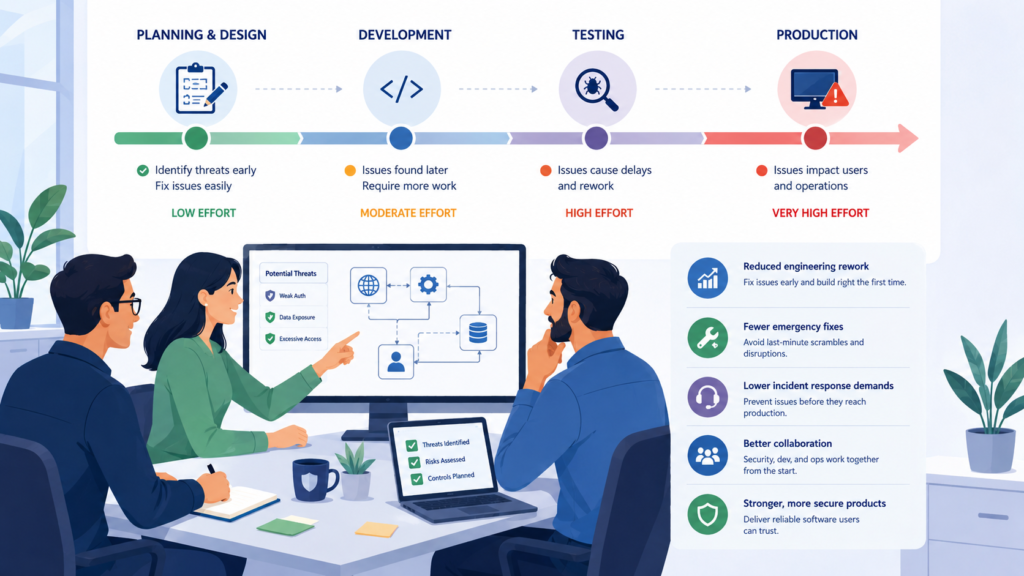
Security flaws become more expensive to fix as projects move closer to production. A weakness discovered during design may require only a small adjustment. The same weakness found after deployment can trigger code changes, retesting, downtime, and emergency response efforts.
Threat modeling reduces these expenses by identifying risks before systems are built or released. Teams can evaluate architecture decisions early and correct weaknesses before they spread throughout the environment. This saves time for developers and reduces pressure on security teams later.
Organizations often see cost savings in three areas:
- Less engineering rework
- Fewer emergency fixes
- Lower incident response expenses
The difference becomes more noticeable in large environments with multiple applications, APIs, and cloud services. A design issue that affects authentication or access control can impact several systems at once. Finding the problem early limits the amount of work required.
Threat modeling also supports better planning. Teams understand which risks matter most and can focus resources where they provide the greatest value. Instead of reacting to security incidents, organizations spend more time preventing them, which usually produces better outcomes and more predictable security spending.
The economics of early risk identification
Early risk identification gives organizations a chance to solve security problems while options remain open. During design and planning, changes are often straightforward. After deployment, those same changes can affect users, business operations, and connected systems.
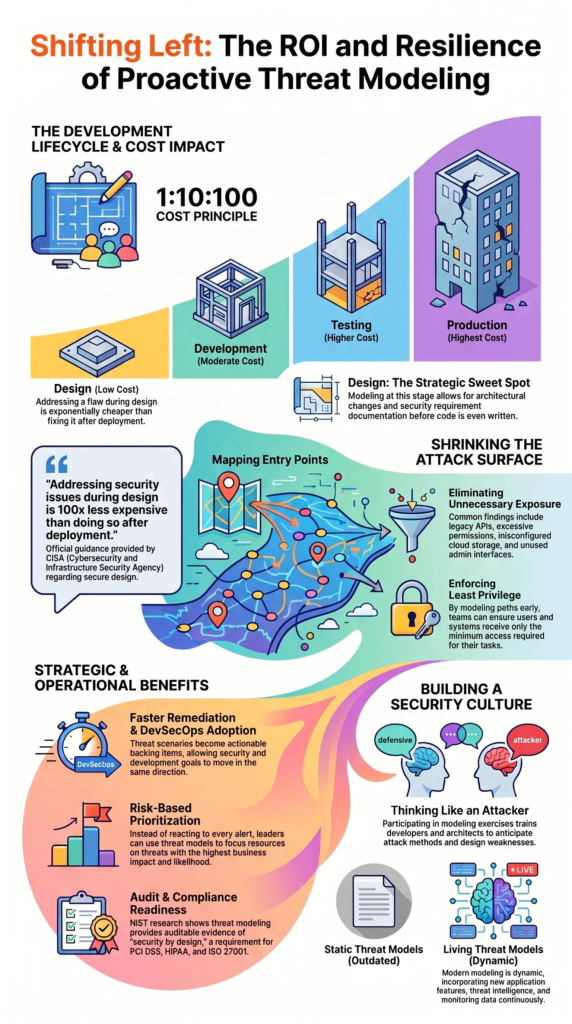
The widely cited 1:10:100 principle highlights this reality. Security issues generally cost far less to address during design than during testing or production. While exact numbers vary by organization, the underlying lesson remains consistent: earlier fixes cost less.
As highlighted by CISA (Cybersecurity and Infrastructure Security Agency)
“Addressing security issues during design is 100x less expensive than doing so after deployment.” – CISA
The table below shows a simplified view of how remediation costs typically grow across the development lifecycle.
| Development stage | Relative cost impact |
| Design | Low |
| Development | Moderate |
| Testing | Higher |
| Production | Highest |
Early identification also reduces indirect costs. Security teams spend less time investigating incidents, developers avoid rushed changes, and business operations face fewer disruptions.
Threat modeling creates a structured process for spotting weaknesses before they become expensive problems. By examining data flows, trust boundaries, and potential attack paths early, organizations gain a clearer understanding of risk.
How does threat modeling reduce the attack surface?
Every application, service, and connected system creates potential entry points for attackers. Threat modeling helps organizations map those entry points and decide which ones should be removed, restricted, or monitored more closely.
The process begins by examining assets, users, data flows, and trust boundaries. Teams look at how information moves through systems and identify locations where attackers may attempt unauthorized access.
Common findings include:
- Legacy APIs that are still accessible
- Excessive user permissions
- Misconfigured cloud storage
- Unused administrative interfaces
- Weak authentication controls
- Third-party integration risks
Reducing the attack surface does not mean removing functionality. It means limiting unnecessary exposure. For example, an administrative portal may remain available but only through secure access controls and restricted network paths.
Threat modeling also supports least-privilege principles. Users and systems receive only the access required to perform their tasks. Fewer permissions mean fewer opportunities for attackers to move through the environment after gaining access.
A smaller attack surface gives defenders fewer areas to protect and attackers fewer opportunities to exploit. This approach aligns closely with proactive network threat modeling, where organizations continuously evaluate potential attack paths, trust boundaries, and exposed assets before adversaries can take advantage of them.
Why does threat modeling accelerate DevSecOps adoption?
Traditional security reviews often happen near the end of development. By that point, developers are focused on release schedules, and security findings can create delays. Threat modeling changes the process by bringing security discussions into planning, design, and development.
When teams identify risks early, security requirements become part of the project instead of a last-minute obstacle. Developers understand what needs protection, architects can address weaknesses before implementation, and security teams gain visibility into upcoming changes.
One of the biggest advantages is the ability to convert security concerns into actionable tasks. Threat scenarios become backlog items that developers can track alongside feature work. This makes security easier to manage and less likely to be ignored.
Organizations using threat modeling within DevSecOps programs often experience:
- Better collaboration between teams
- Fewer release delays caused by security findings
- More predictable development cycles
- Improved visibility into security risks
- Faster validation of security controls
Threat modeling also supports shift-left security practices. Rather than discovering weaknesses after code is complete, teams identify and address risks earlier. This approach allows security and development goals to move in the same direction, helping organizations deliver software more efficiently without sacrificing protection.
How does threat modeling help teams prioritize security resources?
Security teams rarely have enough time, staff, or budget to address every possible threat at once. Threat modeling helps organizations focus on the risks most likely to affect critical systems, sensitive data, and business operations.
Without a structured process, security investments can become reactive. Teams may spend resources on low-impact issues while overlooking more serious risks. Threat modeling creates a framework for evaluating likelihood, impact, and business value before making decisions.
Key factors often considered include:
- How likely an attack is to occur
- The value of the targeted asset
- Potential financial impact
- Operational consequences
- Regulatory concerns
- Recovery requirements
This information helps leaders decide where investments will have the greatest effect. Monitoring tools, security testing efforts, access controls, and defensive technologies can be aligned with actual business risk rather than assumptions.
Understanding the network threat modeling process helps security teams establish a repeatable method for identifying, evaluating, and ranking risks so resources can be directed toward the most significant threats.
Threat modeling also improves communication with executives and stakeholders. Security teams can explain why specific projects deserve funding and how proposed controls reduce risk. Clear prioritization supports smarter spending and helps organizations avoid spreading resources too thin across low-priority initiatives.
Escaping paralysis: Why should organizations bound their threat models?
Credits: The SaaS Pros Breakdown
One common mistake in threat modeling is trying to analyze every possible attack scenario. Modern systems are complex, and the number of theoretical threats can become overwhelming. Without limits, teams may spend more time discussing unlikely events than addressing realistic risks.
Effective threat modeling requires focus. Organizations should define which systems are being evaluated, who the likely attackers are, and which business objectives require protection. Clear boundaries keep discussions productive and make findings easier to act on.
Threat assessments often focus on:
- External attackers
- Insider threats
- Credential theft
- Supply chain risks
- Privilege misuse
- Data exposure scenarios
Not every threat requires the same level of attention. Some risks may be accepted, transferred, or scheduled for later review. Documenting these decisions helps prevent confusion and keeps projects moving forward.
Bounded threat models also improve engineering velocity. Developers receive clear guidance about the issues that need attention rather than an endless list of hypothetical concerns. Security becomes a practical part of the development process instead of an open-ended exercise.
Organizations that maintain realistic scope often produce more useful threat models because they concentrate on credible threats and achievable improvements rather than chasing every possible scenario.
How can threat modeling strengthen security culture?
Technology alone does not create a strong security program. People play an equally important role. Threat modeling helps teams develop a deeper understanding of risk by encouraging them to think from an attacker’s perspective.
As employees participate in threat modeling exercises, they become more familiar with common attack methods, security weaknesses, and defensive strategies. This knowledge often leads to better decisions throughout the development lifecycle.
Developers, architects, product teams, and security professionals gain a shared understanding of:
- How attackers target systems
- Which assets require protection
- Common design weaknesses
- Security responsibilities across teams
- Risk mitigation strategies
Threat modeling also improves communication. Technical and nontechnical stakeholders can discuss risks using a common framework, making security conversations more productive.
Over time, security becomes part of normal planning and design discussions rather than a separate activity handled only by specialists. Teams begin considering risk earlier when proposing features, selecting technologies, or modifying infrastructure.
This cultural shift can be difficult to measure, but it often has lasting value. Organizations with strong security awareness are more likely to identify issues early, respond effectively to emerging threats, and make decisions that support long-term resilience.
What makes modern threat models more effective than static security reviews?
Traditional threat models were often created once and rarely updated. That approach worked when systems changed slowly, but modern environments evolve constantly. Cloud services, APIs, microservices, and automated deployment pipelines introduce new risks on a regular basis.
Modern threat modeling is more dynamic. Instead of relying on static diagrams, organizations continuously review and update threat assessments as systems change.
A living threat model may incorporate:
- Infrastructure updates
- New application features
- Threat intelligence
- Security incident findings
- Monitoring data
- Business requirement changes
Security telemetry plays an important role in this process. Data collected from monitoring platforms helps teams verify assumptions made during design reviews and identify emerging risks.
Many organizations also use AI-assisted analysis to process large volumes of security data. These tools help identify unusual activity patterns and highlight potential threats that deserve further investigation.
The goal is not to replace traditional threat modeling but to strengthen it. By combining design reviews with ongoing visibility, organizations gain a more accurate understanding of risk. This allows security teams to adapt more quickly and maintain protection as technology environments continue to evolve.
How does threat modeling support compliance and audit readiness?
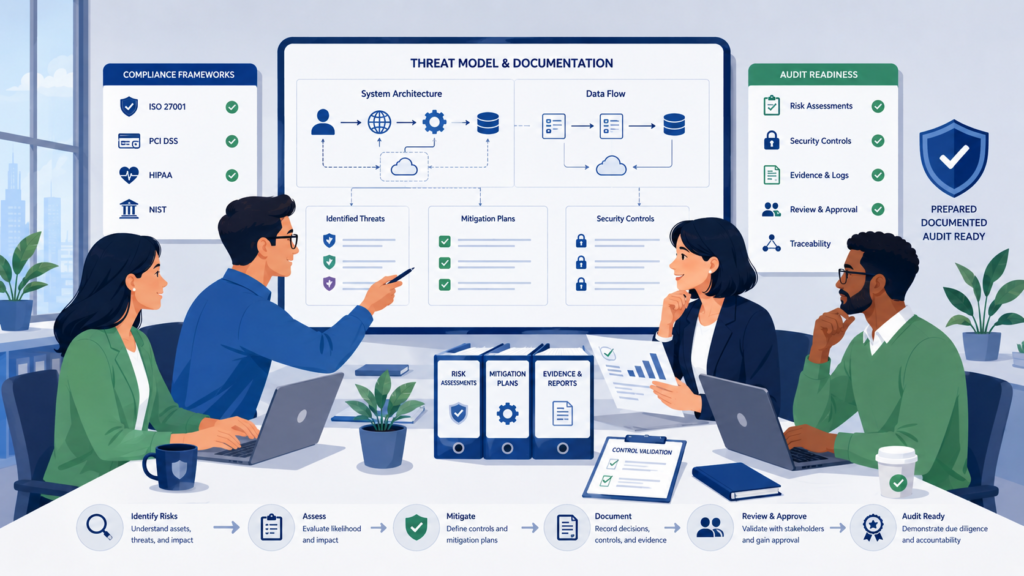
Many security and privacy regulations require organizations to demonstrate structured risk management practices. Threat modeling provides documented evidence that risks were identified, evaluated, and addressed through a formal process.
Auditors often look for proof that security decisions were based on risk rather than assumptions. Threat models help provide that evidence by documenting assets, attack scenarios, mitigation plans, and security controls.
Research from NIST (National Institute of Standards and Technology) shows
“Threat modeling provides auditable evidence that security was considered during design, which is a key requirement for compliance frameworks like PCI DSS, HIPAA, and ISO 27001.” – NIST
Threat modeling can support compliance efforts by helping organizations:
- Document risk assessments
- Justify security controls
- Track remediation activities
- Demonstrate due diligence
- Improve audit preparation
- Support governance requirements
The process also creates a record of how security decisions were made. For organizations operating in regulated industries, threat modeling often supports broader compliance initiatives by linking security controls to identified risks.
Rather than treating compliance as a separate activity, teams integrate risk assessment into normal development and operational processes. Compliance becomes easier to manage because security decisions are supported by clear evidence and structured analysis.
FAQ
How can proactive threat modeling benefits support long-term business planning?
Proactive threat modeling benefits go beyond improving technical security. They help organizations align security efforts with business goals and support stronger business security preparedness.
This approach also guides smarter cybersecurity investments and encourages risk-based security decisions. As a result, organizations can improve long-term resilience while supporting growth and operational priorities.
How does attacker perspective security analysis improve threat detection?
Attacker perspective security analysis helps teams understand how criminals may target their systems. By thinking like an attacker, organizations can strengthen early threat detection security efforts and improve threat identification before attacks occur.
This process also supports threat likelihood assessment benefits, creates a practical risk reduction plan, lowers threat materialization chances, and helps minimize damage if an attack happens.
Why is a continuous threat modeling process important?
A continuous threat modeling process helps organizations keep pace with evolving threat landscape protection needs. Systems, applications, and infrastructure change over time, and security reviews should change with them.
Ongoing assessments support continuous security refinement processes, improve security posture improvement metrics, and strengthen security threat lifecycle management through preventive cybersecurity strategies.
How can threat modeling improve security investment decisions?
Threat modeling helps organizations decide where security resources will have the greatest impact. Security risk prioritization benefits include identifying which threats pose the highest risk to critical assets and business operations.
This approach supports cost effective threat mitigation and security investment prioritization benefits, helping organizations spend wisely while improving overall protection.
What role does threat modeling play in modern development practices?
Threat modeling supports DevSecOps threat modeling integration by introducing security by design principles early in the development lifecycle. Teams can perform early stage security testing and complete pre deployment threat assessments before release.
This process leads to faster security validation processes, improved security team collaboration, and stronger application security threat modeling as systems continue to evolve.
Turn Early Insight Into Stronger Security Decisions
Security issues become much harder and more expensive to fix once they’ve reached production. Building visibility into risks earlier helps teams focus their efforts, support business goals, and respond with greater confidence when priorities shift. That’s the practical advantage.
Organizations that review threats before they become incidents are better prepared for what’s ahead. Ready to strengthen your security planning? Discover how Network Threat Detection can help.
References
- https://www.cisa.gov/resources-tools/resources/secure-design
- https://csrc.nist.gov/glossary/term/threat_modeling