
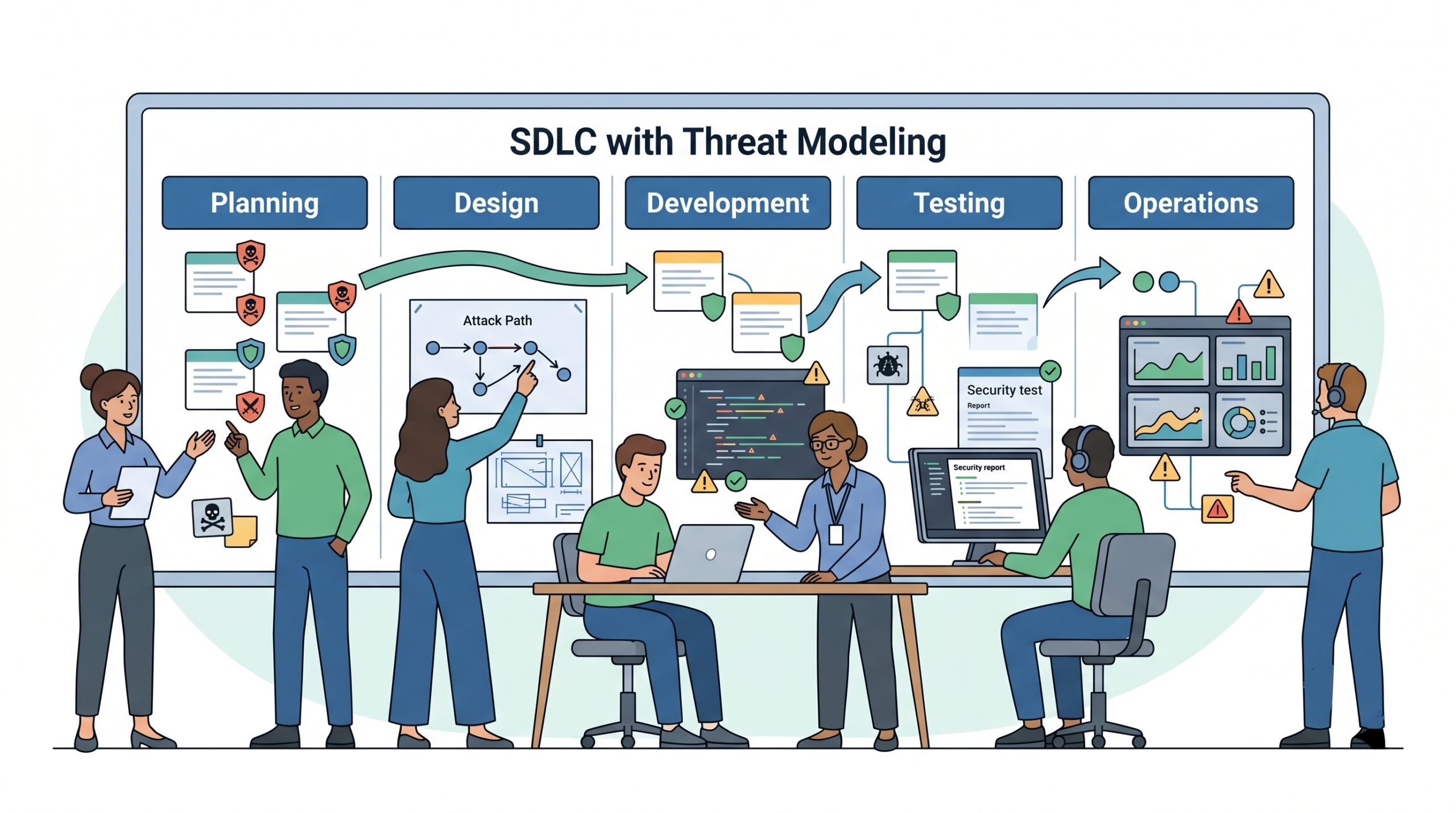
Integrating threat modeling SDLC practices works best when security becomes part of everyday engineering, not a one-time audit exercise. We’ve seen organizations hold a workshop, document the findings, and never revisit them. Meanwhile, fixing security issues after release can cost far more than addressing them during design.
The teams that make progress build threat modeling into sprint planning, architecture discussions, and code reviews. At Network Threat Detection, we’ve found that real attack visibility helps teams make better assumptions and focus on practical risks. Keep reading to see how threat modeling can fit into normal development work without slowing delivery.
Threat Modeling in Practice: What Matters Most
Integrating threat modeling into the SDLC is most effective when it becomes a continuous engineering habit rather than a one-time exercise. By focusing on incremental changes, translating findings into actionable work, and feeding operational insights back into the process, teams can strengthen security without slowing delivery.
- Threat modeling delivers the most value when it starts early and evolves alongside every system change.
- Lightweight, feature-focused exercises integrated into sprint workflows improve security without creating delivery bottlenecks.
- Threat model insights become meaningful when they drive implementation, testing, and operational activities, including detection strategies such as Network Threat Detection.
What Is Threat Modeling Within the SDLC?
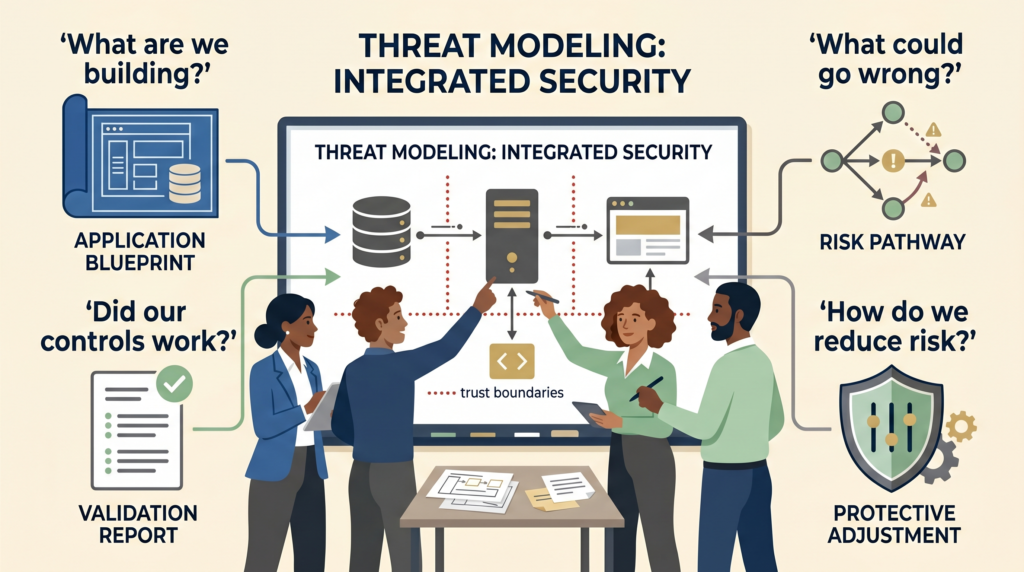
Threat modeling comes down to asking a few practical questions about the system you’re building. Teams need to understand what they’re creating, what could go wrong, how they plan to reduce those risks, and whether those fixes actually work once they’re in place. Simple questions like these help shift security from guesswork to informed decisions.
In our experience, the biggest benefit is getting developers to think like attackers early. We’ve seen teams uncover risky assumptions before writing a single line of code. That early discussion changes how people approach design decisions and helps security become part of the build process instead of an afterthought.
Threat modeling is not limited to applications. It can support architecture reviews, infrastructure changes, and new projects from day one. Teams that embrace using threat modeling for secure design often identify weaknesses earlier. We often use it alongside network threat detection to ground discussions in real-world attack behavior rather than theoretical risks.
The process usually focuses on a few core activities:
- Identifying potential threats.
- Finding vulnerabilities and weak points.
- Reviewing the attack surface.
- Choosing practical countermeasures.
Instead of a vague goal to “be secure,” teams walk away with a clear plan they can act on.
How Should Threat Modeling Be Integrated Across Each SDLC Phase?
You can’t just do it once. Each phase of building software needs its own flavor of threat modeling, aligned with what the team is doing right then.
We break it down across five phases.
| SDLC Phase | Threat Modeling Activity | Output | Business Value |
| Requirements & Planning | Defining security needs and profiling risk. | An initial risk profile. | Early prioritization. |
| Architecture & Design | Drawing data flows and doing STRIDE analysis. | A documented threat model. | Fewer design flaws. |
| Development | Turning mitigations into backlog tasks. | Security user stories. | Faster implementation. |
| Testing | Validating fixes based on the threats we identified. | Test evidence. | Targeted, efficient assurance. |
| Operations & Maintenance | Reviewing controls and updating detection. | Updated runbooks and alerts. | Better detection over time. |
The requirements phase catches compliance needs like NIST or GDPR. The design phase is all about data flow diagrams. Development is where threats become Jira tickets. Testing makes sure our fixes hold up. And operations closes the loop, we often feed these outputs into our network detection to watch for the attacks we predicted.
Why Do Threat Modeling Sessions Hit the 3-Hour Wall?
Threat modeling sessions rarely fail because people do not care. More often, they lose focus. We’ve been in meetings that started with good intentions but turned into long debates about frameworks or unlikely attack scenarios. By the end, everyone was tired, and no clear decisions had been made.
A few warning signs show up again and again:
- Teams argue about the “right” method instead of discussing actual risks.
- The session starts with a blank page and no structure.
- Delivery timelines get ignored.
- No one owns the follow-up actions.
- The group tries to model the entire system at once.
Over time, we’ve learned that smaller discussions work better. Focus on one feature, API, or change in scope. Use a pre-filled template so people are not stuck wondering where to begin. Bring a realistic attacker profile informed by insights from network threat detection and emerging threats.
Most importantly, leave the room with action items. We turn findings into sprint tickets with clear owners. The goal is not to build a perfect threat model. It is to make practical decisions that teams can act on right away.
How Can Teams Break Large Systems into Actionable Threat Models?
Credits: Hans IT Academy
One of the biggest mistakes teams make is trying to model an entire system in one sitting. Large platforms have too many moving parts. People get overwhelmed, and the discussion loses value. We’ve found it works better to focus on what is changing right now, whether that is a new feature, an updated API, or a shift in the architecture.
In practice, our teams often start with a short list of likely threats tied to a single component. That narrow scope keeps the conversation grounded and makes it easier to identify risks that actually matter.
A simple approach usually includes a few key steps:
- Focus on the feature or change planned for the current sprint.
- Revisit trust boundaries affected by the update.
- Document assumptions and dependencies.
- Review attack paths and emerging threats.
- Assign a Security Champion to guide the discussion.
This approach fits naturally into agile workflows. In practice, proactive network threat modeling helps teams focus on emerging risks tied to current changes instead of revisiting the entire environment every sprint.
Smaller sessions lead to clearer decisions, stronger ownership, and actions that teams can put into practice right away.
Is STRIDE Enough for Modern Engineering Teams?
STRIDE remains one of the most useful ways to uncover technical threats. It helps teams think through issues like spoofing, tampering, and privilege abuse in a structured way. We’ve used it often during design reviews because it keeps discussions practical and focused on the system being built.
In our experience providing threat models and risk analysis tools for network security, technical findings do not always tell the full story. Business priorities, compliance needs, and emerging threats also shape how teams decide what matters most. Insights from network threat detection can help validate which risks deserve immediate attention.
Choosing the right approach depends on the problem in front of you.
| Framework | Primary Focus | Best For | The Catch |
| STRIDE | Identifying technical threats. | Application and architecture reviews. | Limited business context. |
| PASTA | Risk and business impact. | Regulated or high-risk environments. | More time and effort required. |
| TRIKE | Defining acceptable risk. | Security-focused organizations. | Less commonly adopted. |
| Security Cards | Team brainstorming. | Agile and collaborative workshops. | Depends on strong facilitation. |
We’ve learned that frameworks should guide better conversations, not replace judgment. Use STRIDE to uncover technical concerns, and bring in broader methods when business context matters.
How Does Threat Modeling as Code Support DevSecOps?
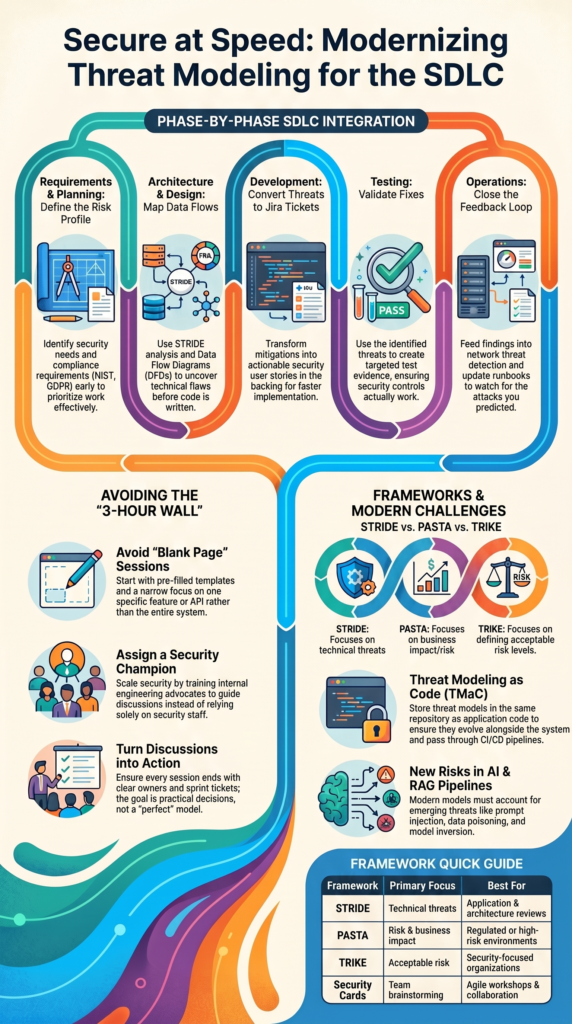
Threat Modeling as Code (TMaC) helps teams build security into the work they already do. Instead of treating threat models as separate documents, developers keep them close to the code. As the application changes, the threat model changes with it. Security becomes part of the delivery process rather than a task saved for the end.
Over the years, we’ve seen that developers adopt security faster when it fits naturally into their workflow. Our teams often connect threat models to existing CI/CD processes so checks happen automatically and findings do not get lost.
A practical TMaC setup may include:
- Storing threat models alongside application code.
- Running validation checks during pipeline builds.
- Reviewing updates during pull requests.
- Generating reports and follow-up tasks automatically.
- Tracking changes as systems evolve.
Many of the long-term benefits of proactive threat modeling security come from this consistency, as teams can spot issues earlier and respond before small gaps become larger security problems. It also helps teams respond to emerging threats identified through network threat detection and ongoing risk analysis.
For us, the biggest benefit is consistency. Threat modeling stops being a one-time checkpoint and becomes part of everyday engineering decisions.
How Can Teams Prevent Threat Model Drift?
Drift happens when the system changes but the model doesn’t. A small infra change can create thousands of false-positive dependencies. Prevention needs both automation and clear ownership.
Inspired by OWASP SAMM, we know ownership is critical. Our drift prevention steps are:
- Assign an owner for each model.
- Monitor for architectural changes automatically.
- Validate models in the CI/CD pipeline.
- Have a process for reviewing exceptions.
- Treat the model as a living doc, always updated.
Research from IEEE Xplore shows
“Current threat modeling approaches are not well-aligned with contemporary development practices. Modern software development happens at a fast pace with frequent changes to the code base to introduce new functionality, fix bugs, and refactor the design. … Threat modeling, on the other hand, is often a manual, time-consuming, one-off (or infrequently repeated) activity conducted in workshops involving experts and numerous stakeholders. This prohibits frequent re-evaluation as the software design evolves.” – IEEE Xplore
We’ve seen teams fail when they treat the threat model as an artifact to file away. A living model needs a steward. Without it, even the fanciest automated pipeline becomes a compliance exercise, disconnected from what’s really running.
What Changes When Modeling Microservices, Legacy Systems, and AI Pipelines?
Modern systems rarely fit into neat boxes. As architectures evolve, the trust boundaries that once seemed clear can become harder to define. We’ve learned that the same threat modeling approach does not work for every environment. Teams need to adjust based on what they are trying to protect.
Microservices, for example, create many connections between services. A simple question like who owns the security boundary between two APIs is not always easy to answer. In our work, we start by mapping communication paths and identifying dependencies before digging deeper.
Each environment brings its own challenges:
- Microservices require visibility into containers, configurations, and third-party dependencies.
- Legacy systems often involve missing documentation, limited source code access, and supply chain blind spots.
- AI and RAG pipelines introduce risks such as prompt injection, data poisoning, and model inversion.
We’ve found that documenting assumptions is just as important as documenting known risks. Insights from network threat detection also help us spot emerging threats that may not appear in design documents.
The goal stays the same: understand how the system works today and make practical decisions to reduce risk as it evolves.
How Can Organizations Scale Threat Modeling Without Security Gatekeeping?
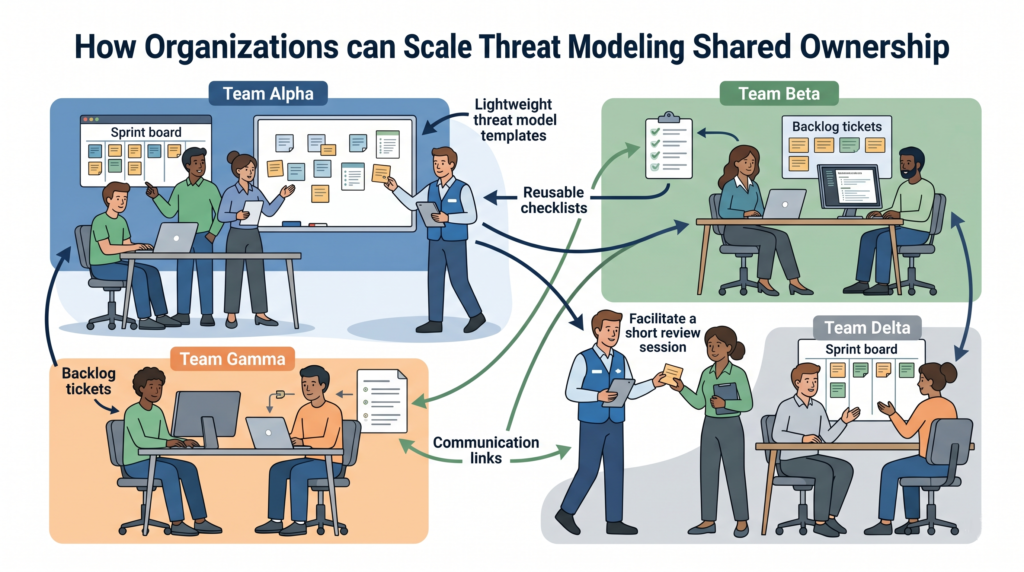
Scaling means distributing the work. You can’t have the security team do everything. Train Security Champions within product teams. Give them standardized templates and automated tools.
We scale by enabling, not gatekeeping. Principles that work:
- Train internal advocates from engineering.
- Standardize simple templates.
- Automate ticket creation from model findings.
- Make the process easy for developers to use.
- Encourage cross-functional workshops.
As noted by OWASP
“Traditional threat modeling methods require deep security expertise and attempt to model entire systems at once, which is impractical for modern agile development. This creates bottlenecks and delays, often resulting in late-stage security findings when changes are expensive. Developers need a lightweight, accessible methodology that can be applied early and continuously throughout the development lifecycle.” – OWASP
The security team’s role shifts from doing all the modeling to being partners and coaches. Engineers adopt security faster when they see it helping their product, not just satisfying an auditor. Building relationships first makes imposing controls later much easier.
FAQ
Why should integrating threat modeling SDLC start early?
Integrating threat modeling SDLC activities early helps teams identify risks before development begins. During the planning stage, teams can define security requirements, clarify assumptions, and prioritize potential threats.
This early effort supports proactive security SDLC practices and reduces the cost and effort of fixing issues later. It also gives developers and stakeholders a shared understanding of security expectations before work starts.
How does threat modeling agile SDLC fit into sprint planning?
Threat modeling agile SDLC works best when teams review new features and changes during each sprint. Teams can discuss likely threats, update assumptions, and identify new attack scenarios as requirements evolve.
Threat modeling sprint planning helps developers address security concerns while work is still in progress. This approach supports continuous improvement without slowing delivery or creating unnecessary bottlenecks.
Why should developers participate in secure SDLC threat modeling?
Developers understand how applications function and where weaknesses may exist. Developer trained threat modeling encourages engineers to identify risks while designing and building features.
Cross functional threat modeling also brings together developers, testers, architects, and operations staff to improve threat identification SDLC activities. Shared responsibility leads to stronger security decisions and more practical mitigation strategies.
How can teams address cloud and microservices security risks?
Cloud threat modeling SDLC requires teams to examine trust boundaries, service interactions, and third-party dependencies. Microservices threat modeling SDLC should also account for APIs, containers, and communication paths between services.
Container threat modeling SDLC helps teams identify configuration weaknesses and exposure points. Regular attack vector mapping SDLC reviews ensure that security practices evolve alongside changes in the environment.
Can automated threat modeling SDLC support compliance efforts?
Automated threat modeling SDLC helps teams maintain consistent documentation and track security decisions throughout development. It can strengthen security control integration SDLC processes by creating repeatable records of identified risks and mitigations.
Organizations may also use these records to support compliance driven threat modeling initiatives and demonstrate alignment with NIST threat modeling SDLC, ISO 27001 threat modeling, and GDPR threat modeling SDLC requirements.
Make Security Part of How You Build
Security efforts lose momentum when they live outside everyday development work. The teams that see real progress turn insights into action, revisit decisions as systems change, and use operational feedback to improve future outcomes. That’s what drives lasting results.
Threat modeling delivers the most value when it’s built into the way teams work, not treated as a separate task. Ready to strengthen your security process? Learn how Network Threat Detection can help.
References
- https://ieeexplore.ieee.org/document/9652652/figures#figures
- https://owasp.org/www-project-rapid-developer-driven-threat-modeling/#div-main