

SIEM is a centralized security system that collects, normalizes, and correlates logs to detect threats across complex environments. It pulls scattered telemetry into one place so analysts can read patterns without jumping between tools, and it doesn’t rely on a single signal.
Network Threat Detection often shows up first, catching packet anomalies before endpoint alerts. Raw logs everywhere. No single source tells the full story. Dashboards and compliance checks sit on top, shaping response decisions in near real time. Get logs. Correlate signals. It’s not perfect, but it works, and teams depend on it.
More context below here
SIEM Essentials at a Glance
SIEM brings together security logs, detection logic, and automated response into one coordinated system for better visibility and faster threat handling.
- SIEM consolidates logs into a unified detection and investigation layer across systems and networks
- Correlation logic connects multi-step attack behavior into meaningful security incidents
- Modern SIEM integrates behavioral analytics and automated response workflows
What Is SIEM System And Why It Matters
SIEM is basically a central hub where security data lands, gets cleaned, and becomes usable.
We treat it in our training environment like a “translation layer” between machines and humans. Systems don’t speak the same language, so SIEM forces consistency.
Logs from servers, identity systems, applications, and network devices all flow in. Then the system reshapes them into fields we can actually reason about, like user, time, IP, and action.
“Security information and event management (SIEM) systems provide real-time analysis of security alerts generated by applications and network hardware.” – U.S. National Institute of Standards and Technology (NIST)
From what we see in practice sessions, learners often expect SIEM to “detect hackers automatically.” SIEM supports both automated detection through rules and analytics, and human-led investigation.
Still, it becomes the first place we look when something feels off in production-style simulations.
What Are the Core Functions of SIEM Systems?
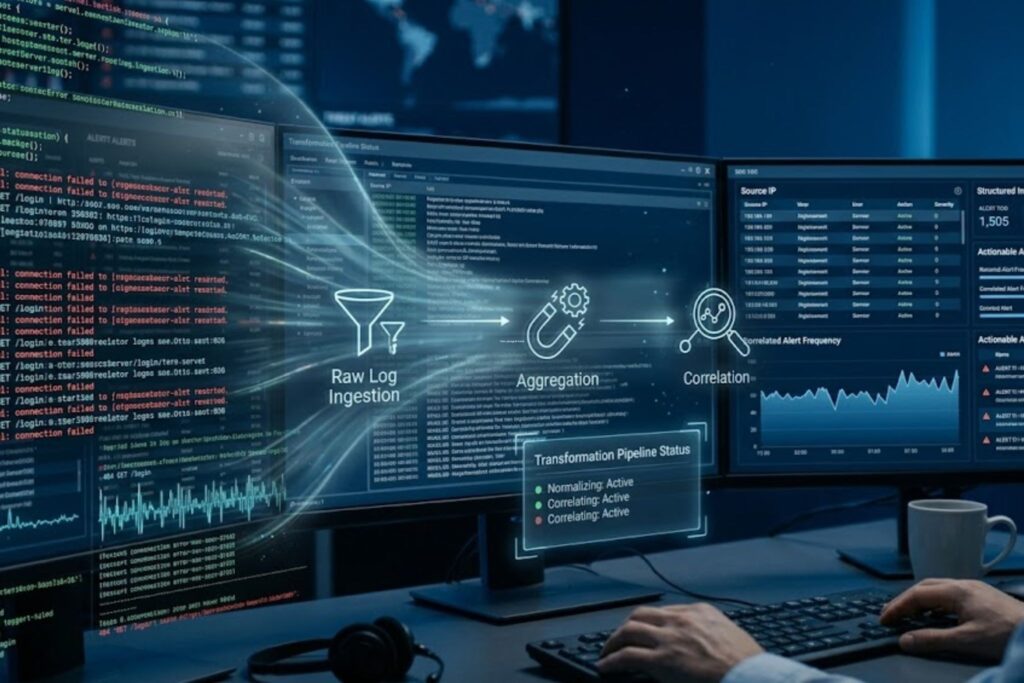
We break SIEM down into three core functions during training. Nothing fancy, just the pipeline.
How Does Data Aggregation and Normalization Work in SIEM?
Different systems log differently. One writes timestamps in UTC, another doesn’t. One uses JSON, another spits plain text.
So SIEM steps in and cleans it up.
We usually show learners a before-and-after log transformation. That moment tends to stick. Suddenly chaos becomes structured rows.
How Does the Event Correlation Engine in SIEM Work?
This is where things get interesting.
Instead of treating each event alone, SIEM connects them. A failed login here, a success from another country there, and suddenly you’re looking at a possible compromise chain.
In our labs, we often say: “One log is noise. Ten logs in sequence become behavior.”
“Correlation techniques are used to combine multiple events from different sources in order to detect security incidents that cannot be identified by single events alone.” – ISO/IEC
What Are SIEM Architecture Components and Deployment Models?
Architecture sounds heavy, but we simplify it early in training so it doesn’t overwhelm.
At its core, SIEM has a few moving parts that stay consistent across vendors.
We often map system behavior using network threat modeling process, which helps visualize how different architecture layers interact with potential attacker paths across on-prem, cloud, and hybrid environments.
What Are SIEM Deployment Models?
Different environments shape how SIEM behaves.
| Model | How It Feels In Practice | Main Tradeoff |
| On-Premises | Full internal control | Heavy maintenance |
| Cloud-Based | Fast scaling, easier setup | Less direct control |
| Hybrid | Split workload design | More complexity |
We usually recommend learners think in terms of constraints, not preference. Every setup is a compromise somewhere.
How Does SIEM Collect and Correlate Security Logs?

Log collection is where everything starts, and where most real-world issues show up.
In our bootcamp environments, we often simulate missing logs on purpose. The result is always the same: correlation breaks down fast.
How Does the Log Collection Workflow in SIEM Work?
In our training labs, we map out the ingestion pipeline as a non-negotiable sequence.
First, active infrastructure components generate raw telemetry. Instead of relying on generic collection, we deploy lightweight software agents, like Universal Forwarders, to securely ship these events.
From there, the SIEM engine parses the incoming data. This is where the magic happens: the system translates messy Syslog lines or structured JSON blobs into predictable fields.
At this stage, contextual enrichment becomes critical, especially when using analysis intelligence context provider focus, which helps align raw security signals with meaningful operational context for faster decision-making.
Finally, the centralized logic groups and analyzes these structured records, letting us apply our risk analysis tools to flag emerging threats before they compromise the network.
Nothing works if step one or two is weak.
We’ve seen learners focus too much on detection rules while ignoring ingestion quality. That usually leads to blind spots later.
How Does Correlation Logic Work in Practice?
Correlation is where SIEM starts feeling useful.
Some common patterns we use in training scenarios:
- Multiple failed logins followed by success → possible credential use
- Unusual location + admin access → suspicious session
- Network spike + endpoint anomaly → possible lateral movement
And in real environments, Network Threat Detection often gives the earliest hint. Packet-level anomalies show movement before user-level alerts catch up.
That gap is where early response decisions are made.
How Do SIEM Rule Tuning and Alert Management Work?
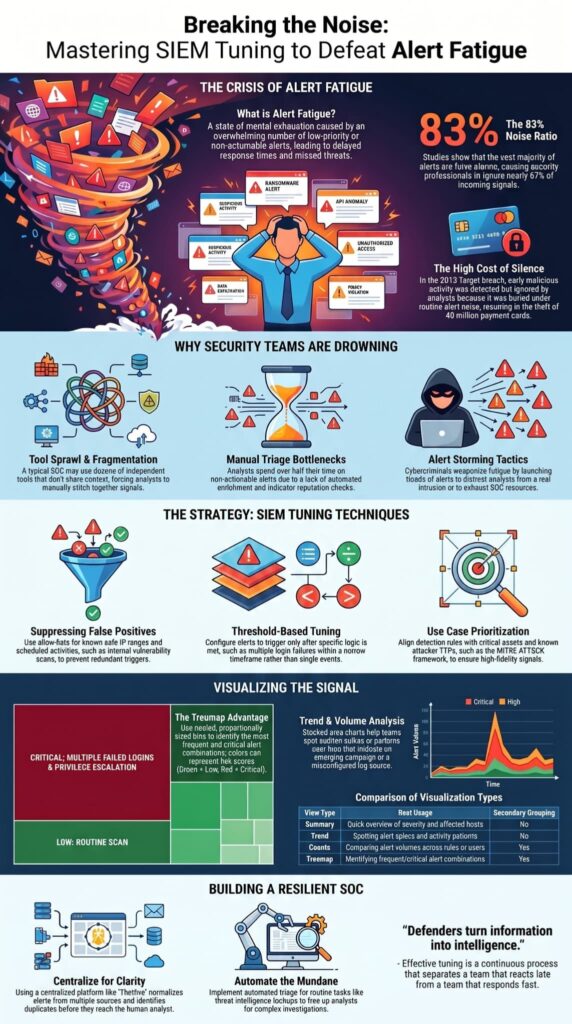
Once SIEM is running, the real work starts. We usually tell learners this part never really ends, it just changes shape over time.
Alert noise is the first thing everyone notices. A fresh SIEM setup feels loud. Too loud.
In our training environments, we deliberately flood systems with synthetic logs. The goal is simple: show how quickly alerts lose meaning when everything is marked “high priority.”
Rule Tuning Process
We approach tuning as cleanup, not optimization:
- Baseline normal network activity over a multi-week period to understand true operational traffic
- Identify repetitive false positives caused by routine system tasks or internal software updates
- Remove safe-known patterns carefully from the primary alert queue to keep the dashboard clean
- Group similar alerts into clusters so analysts can review them as a single incident
- Recheck active correlation rules immediately after any major corporate infrastructure change
We’ve seen teams skip baselining and jump straight into “tight rules.” That usually backfires. The system becomes blind in one area while still noisy in another.
And honestly, tuning feels less like configuration and more like maintenance discipline.
What Causes Alert Fatigue in SIEM?
Analysts don’t struggle because SIEM is weak. They struggle because it talks too much.
In real SOC-style exercises, we often see learners ignore medium alerts after being overwhelmed early on. That’s alert fatigue in action.
So we teach a simple habit: reduce noise first, then improve detection quality. Not the other way around.
Next Generation SIEM: UEBA And Automation

Modern SIEM systems don’t just react anymore. They try to anticipate behavior shifts.
We introduce this section carefully in training because it can sound more advanced than it really is.
UEBA (User And Entity Behavior Analytics)
UEBA builds a baseline of normal activity. Then it watches for deviations.
Things it typically tracks:
- Login timing habits
- Access frequency to systems
- Device consistency
- Location changes over time
In practice labs, we simulate a user logging in from a new region. UEBA flags it quickly, but we always remind learners: context matters. Travel, VPNs, and shared systems can all trigger noise.
So we don’t treat UEBA alerts as truth. We treat them as signals.
SOAR Integration
SOAR tools connect response actions directly into SIEM workflows.
Examples we use in training:
- Disable user account
- Block suspicious IP
- Terminate active sessions
- Open incident tickets automatically
We’ve seen environments go from slow manual response to near real-time action pipelines.
But there’s a tradeoff. Automation mistakes scale fast if rules are wrong. That’s why we stress testing before enabling full response chains.
What Are the Limitations and Challenges of SIEM?
http://youtube.com/watch?v=TSANxgiX8ts
Source: The Helpful Hacker
No SIEM setup is perfect. We make that clear early in training so expectations stay grounded.
Common Limitations
We repeatedly see these in real environments:
- High ingestion cost under scale
- Heavy rule maintenance load
- False positives stacking up
- Skill gaps in tuning and analysis
- Performance drops with poor design
We also see that modern environments benefit from proactive threat modeling security, especially when trying to reduce blind spots before they appear in SIEM visibility layers.
And honestly, most failures we see aren’t tool failures. They’re configuration issues.
Where Does SIEM Usually Break?
In lab scenarios, breakdowns tend to follow a pattern:
- Missing log sources → blind detection
- Overly broad rules → alert overload
- Poor normalization → broken correlation
We often say: SIEM doesn’t fail suddenly. It degrades slowly when ignored.
FAQs
What is a SIEM system and what are its core functions in security operations?
Think of a SIEM system as the flight data recorder for your entire digital enterprise. Instead of checking five different systems to figure out how a security breach happened, a SIEM pulls raw data from web servers, firewalls, and active user logins into a single dashboard.
During our live bootcamp simulations, we use this unified view to stitch together isolated events. For instance, when a network threat model flags a sudden data spike, the SIEM lets us immediately cross-reference it with endpoint logs to see exactly which user account initiated the transfer.
What are SIEM architecture components like parsing engine and data normalization?
SIEM architecture is built on several key components that process security data in a structured way. The parsing engine converts raw log data into a readable format, while data normalization ensures consistency across different log sources.
A centralized log repository stores processed events for analysis, reporting, and investigation. These components improve detection accuracy, system performance, and scalability in large security environments.
What are SIEM deployment models including cloud, on-premises, and hybrid options?
SIEM deployment models typically include cloud-based, on-premises, and hybrid approaches. Cloud SIEM deployment provides flexibility and scalability for dynamic environments.
On-premises SIEM offers full control over data storage, log retention, and internal security policies. Hybrid SIEM deployment combines both models, allowing organizations to balance control and scalability based on operational needs and compliance requirements.
How do SIEM rule tuning and alert management reduce false positives?
SIEM rule tuning improves detection accuracy by refining correlation rules to better match real threats. This process reduces false positives and improves SIEM alert quality.
SIEM alert management organizes and prioritizes notifications so security teams can focus on critical issues first. Effective tuning also reduces alert fatigue and supports faster incident response by limiting unnecessary or low-value alerts.
How do next-generation SIEM, UEBA, and SOAR improve modern security operations?
Next-generation SIEM systems use machine learning and automation to improve threat detection and response speed. UEBA integration adds user behavior analytics to identify unusual activity that traditional rules may miss.
SOAR platforms automate incident response workflows, reducing manual effort. Together, these technologies improve detection accuracy, streamline security operations, and strengthen compliance reporting while reducing operational workload.
SIEM In Modern Security Operations
SIEM turns scattered logs and security events into structured signals that help you see what is happening across your environment. In practice, its effectiveness depends on continuous tuning, reliable data ingestion, and how well correlation rules are maintained across systems.
SIEM works best when treated as an evolving operational layer, not a static tool. For teams looking to strengthen detection and response, Network Threat Detection can support improved visibility, faster threat analysis, and more consistent security decision making in complex environments.
References
- https://csrc.nist.gov/pubs/sp/800/92/final
- https://www.iso.org/standard/75652.html