
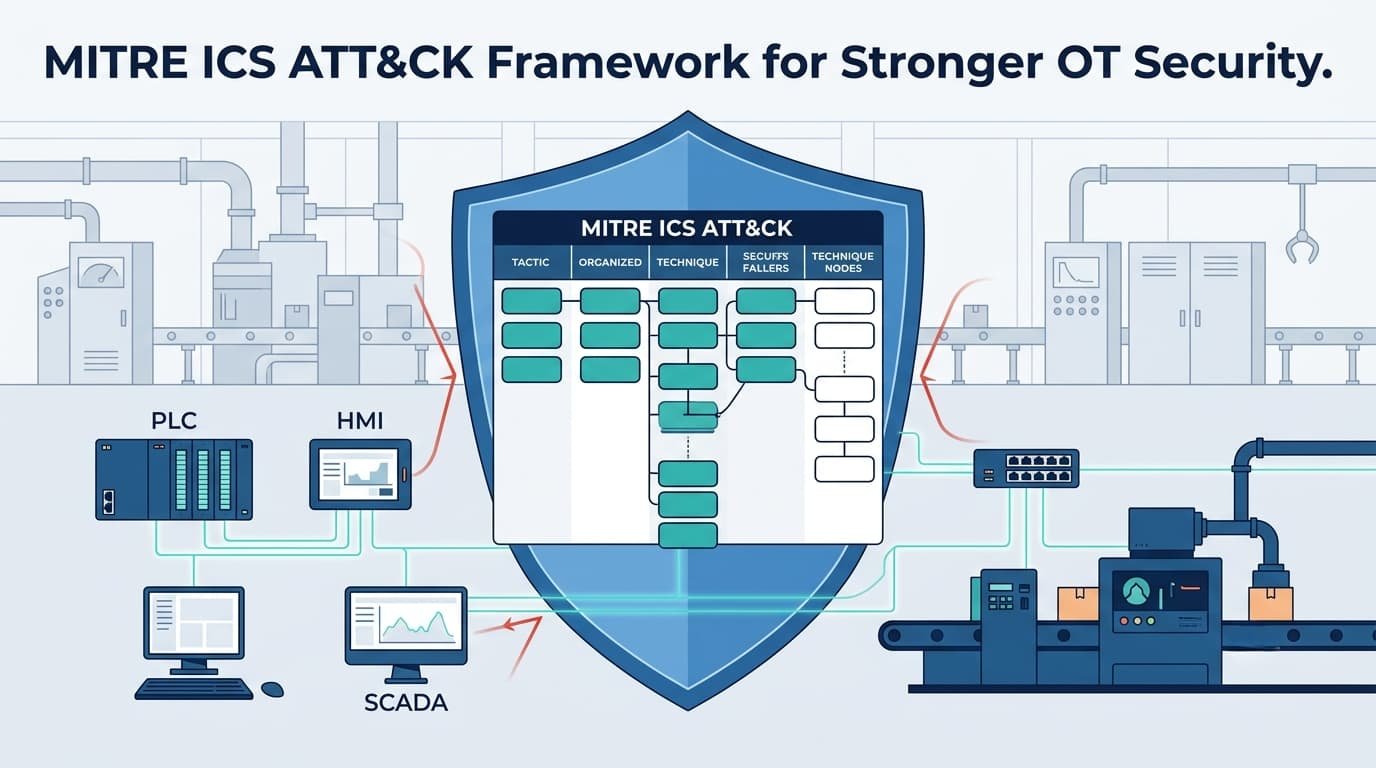
It’s a toolkit for fighting hackers who target factories and power plants. I learned its real value on a plant floor, tracing a ruined production batch to a hacker’s actions. The MITRE ATT&CK for ICS framework gave us the precise terms, like “Modify Parameter,” transforming a mysterious glitch into a known attack we could stop.
It’s a knowledge base of over 80 real-world techniques for industrial systems. Its power, though, is in the doing, not just the knowing. Network Threat Security can help you move from theory to action. Keep reading to make it your plant’s protection.
ICS ATT&CK in Action: The Essential Takeaways
- ATT&CK for ICS provides a common language for attacks targeting physical processes, not just data.
- Its true value is unlocked by mapping techniques to your specific PLCs, HMIs, and control loops.
- Operationalizing it requires process-aware telemetry, like network detection, to see the attacks it describes.
What Is This Framework, Really?
We see the matrix: orderly columns and cells. But a real attack is a messy, linear story. ATT&CK for ICS is the glossary for that story, built by MITRE from incidents like TRITON.
It catalogs the “how” and “why” of actions against industrial control systems, like inhibiting a safety function or manipulating I/O data.
The core difference from the Enterprise version is the target. Our world cares about availability and physical safety, not just data. The attacker’s goal is often to stop a process or cause physical impact, which is why the ICS framework includes unique tactics.
It’s become a standard because it creates a common language. When an engineer describes a controller download and a security analyst references T0843, they’re finally talking about the same thing.
According to Association for Computing Machinery
“Has the potential to form the basis of a common framework for security professionals, enabling interoperability of tools and platforms.” – Association for Computing Machinery
This bridges the gap between the control room and the SOC, turning security from a vague checklist into a threat-informed practice. We use it as the backbone for our threat models because it’s based on what attackers actually do.
Why Your IT Security Playbook Fails on the Plant Floor
We’ve seen it happen. A team brings their IT security mindset to the OT network, deploying agents and centralizing logs. Then an incident hits, and they’re blind because the attack used a Modbus write command, not a Windows event.
Our threat models show the target shifts from data to physical assets, like a compressor in Cell 3. The consequences are lost production or safety failures.
| IT Impact | ICS Impact |
| Data exfiltration | Denial of Control (T0813) |
| Ransomware note | Loss of Safety (T0834) |
Everything changes. Attackers aren’t after domain admin rights; they want to be the invisible operator, changing setpoints or downloading rogue logic using the plant’s own engineering software. The objectives are physical.
Which tactics are uniquely OT? Entire columns in the ICS matrix describe this reality. Inhibit Response Function (T0819) means suppressing alarms. Impair Process Control (T0827) means manipulating logic to cause damage.
When we see these in a threat model, we know we’re looking at the right problem.
Decoding the Matrix: From Tactics to Techniques
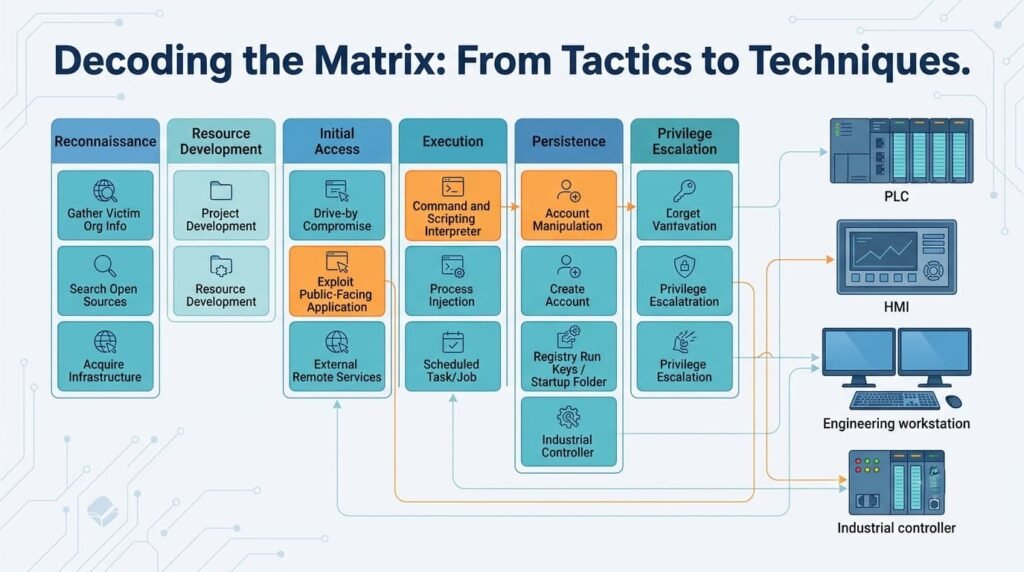
The structure is a guide. Tactics are the “why,” techniques are the “how.” It’s a deliberate abstraction, focusing on the behavior itself, not a specific malware sample.
An industrial attack path follows a clear, active timeline:
- The adversary gains Initial Access by sending a targeted phishing email to an engineer.
- The malware runs Execution commands directly on the engineering workstation.
- The hacker secures permanent Persistence by uploading modified firmware straight to the physical PLC.
Lateral Movement happens over remote services, Collection involves a program upload to steal logic, and ends with Impact through control manipulation. This linear path is the adversary’s blueprint, and our roadmap for defense.
From our work, not all 80+ techniques are equally likely. But some are universal red flags:
- Valid Accounts (T0859): Abusing legitimate credentials, often defaults.
- Remote Services (T0862): Unsecured access paths from IT to OT.
- Program Download (T0843): Unauthorized logic changes to a PLC.
- Unauthorized Command Message (T0855): Malicious commands sent over legitimate industrial protocols.
Focusing on these high-likelihood techniques is where you start building meaningful, practical detections.
The Attack Path: From a Phishing Email to a Silent Shutdown
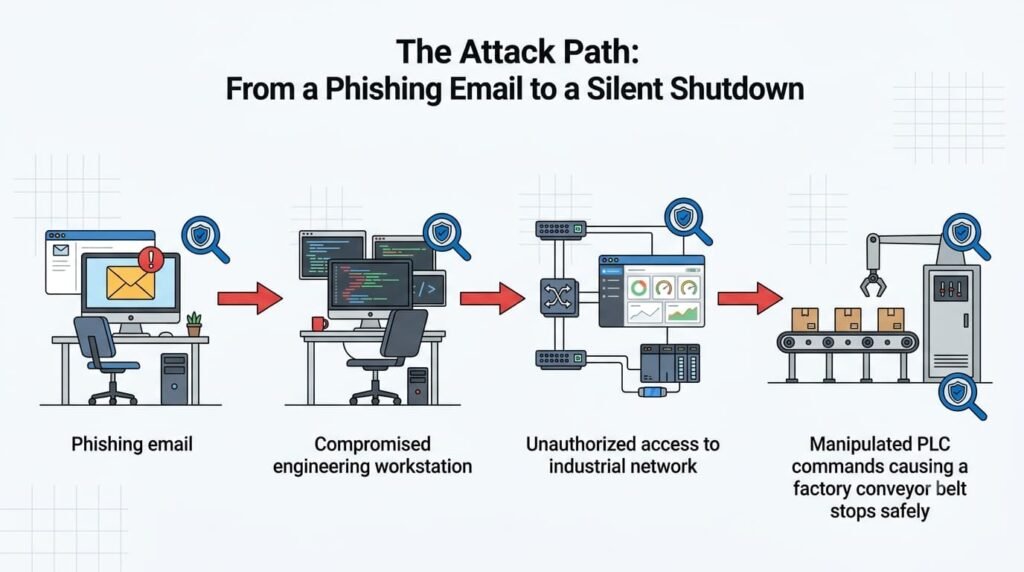
Let’s walk the attack path. It typically starts in the corporate network, with a phishing email landing in an engineer’s inbox. That’s Initial Access. The adversary moves using Valid Accounts, following the Enterprise ATT&CK playbook.
The critical pivot happens when they cross into the OT environment, often via a jump box or engineering workstation in the DMZ. That’s where the ICS matrix takes over.
From our threat models, the sequence then follows a predictable, physical logic:
- Remote System Discovery: Scanning for OPC UA or Modbus TCP ports.
- Program Upload: Using legitimate software to steal process logic from a PLC.
- Program Download: Injecting malicious control logic.
- Denial of Control: The final act, a conveyor belt stops, a temperature spikes.
This journey, from a generic email to a physical halt, is written across both matrices. Defending it requires seeing that entire narrative, not just one side.
Your First Practical Step: Mapping Techniques to Assets
You can’t defend what you don’t understand. That’s the first step. We tell our teams their ATT&CK journey starts with a spreadsheet, not the matrix. List your actual assets: “Siemens S7-1500, Controller for Boiler #3,” not just “a PLC.”
For each one, ask what an attacker could do. The matrix provides the answers. We map them out like this:
- Asset: Engineering Workstation
- Techniques: User Execution, Scripting
- Detection Source: Endpoint logs
- Asset: Safety PLC
- Techniques: Modify Parameter, Impair Process Control
- Detection Source: Network traffic for anomalous writes
This map becomes your single source of truth. It shows where you have visibility and where you have a silent, dangerous gap. In our experience, this exercise alone often reveals that 60% of critical techniques have no monitoring at all. That’s your starting line.
From Theory to Telemetry: Building ATT&CK Detections
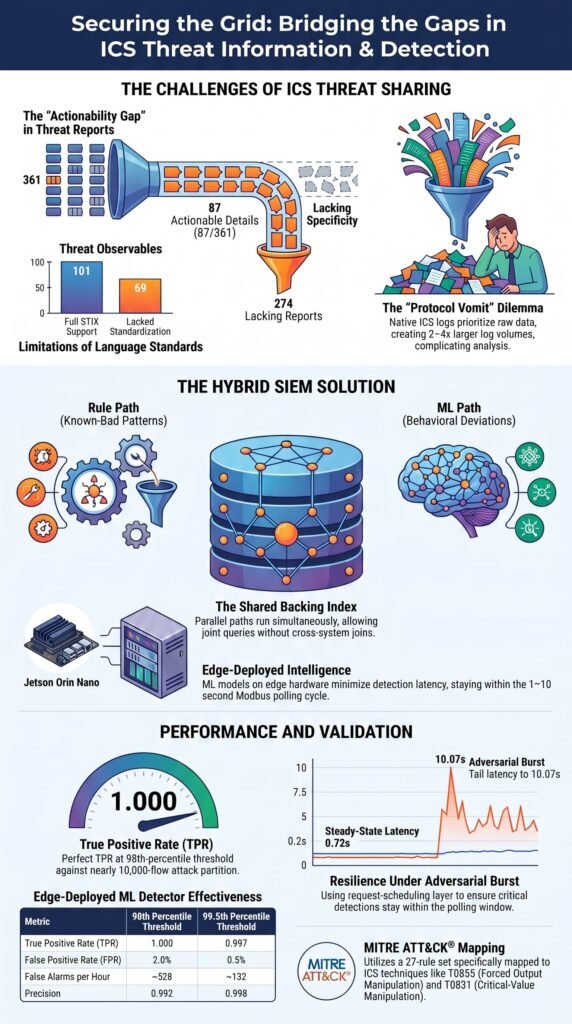
A technique on a page is just theory. An alert in your SOC is actual defense. The bridge is detection engineering.
Take T0843: Program Download. The description says an adversary may download a program to a controller.
Your detection rule must answer: what does that look like on our network? It could be an S7COMM “Download” command from an unauthorized IP, or a login to engineering software after hours followed by a download.
The alert must be contextual, tagging the ATT&CK ID and asset. “Alert: Suspicious Program Download to PLC-101 from host 10.0.2.15. Check change management.”
Combining ATT&CK mapping with indicators of compromise, such as unusual network activity or unauthorized controller changes, gives analysts stronger evidence when investigating industrial attacks.
You need a blend of telemetry:
- Industrial Protocol Monitoring: For unauthorized commands and program downloads.
- Network Detection & Response: To correlate IT-side access with OT movement.
- Endpoint Logs: From engineering workstations.
- Process Anomaly Detection: For control manipulation.
Without visibility into those raw industrial protocols, you miss the critical layer where setpoints are changed or pumps are started. To catch these without breaking your budget on vendor tools, you must tap your network switches (using SPAN or network TAPs) and feed that raw traffic into an open-source tool like Zeek.
By loading industrial protocol scripts for Modbus or S7comm into your packet analyzer, you can translate abstract ATT&CK techniques into the exact hexadecimal bytes crossing the wire.
Lessons Written in Code: Stuxnet, TRITON, and Industroyer
History teaches best. Let’s talk about ghosts.
Stuxnet was a masterclass. It used removable media for access and zero-days for privilege escalation, but its ICS goal was pure Impair Process Control. It manipulated centrifuge speeds while feeding normal readings to operators.
Industroyer, which hit Ukraine’s grid, used Project File Infection and then executed Denial of Control by switching breakers. TRITON aimed at safety systems, an attempt at Inhibit Response Function.
According to MDPI
“A tactical shift from espionage to deliberate operational disruption.Industroyer was a turning point because it did not just steal data. It used automated tools built specifically to speak power grid languages, allowing it to flip heavy electrical circuit breakers off and on in seconds. Triton went a step further by directly targeting Safety Instrumented Systems. These systems are the emergency brakes of a chemical plant. When a hacker overrides your emergency brakes, the risk to human life skyrockets.” – MDPI
What do these teach us? They weren’t magic. They were sequences of known techniques: Program Upload, Modify Parameter, Service Stop. Looking at the difference between IOCs and IOAs also helps defenders distinguish evidence left behind after an attack from behaviors that reveal an attack while it is still unfolding.
Community mapping from groups like OTSecPro shows this clearly.
By dissecting these attacks through the ATT&CK lens, we break down the “cyber weapon” myth into discrete, understandable steps. Steps we can look for. Steps we can, with the right visibility, hope to interrupt.
Our threat models are built on this principle of breaking down the monumental into the manageable.
The Pitfalls: When Good Frameworks Go Bad
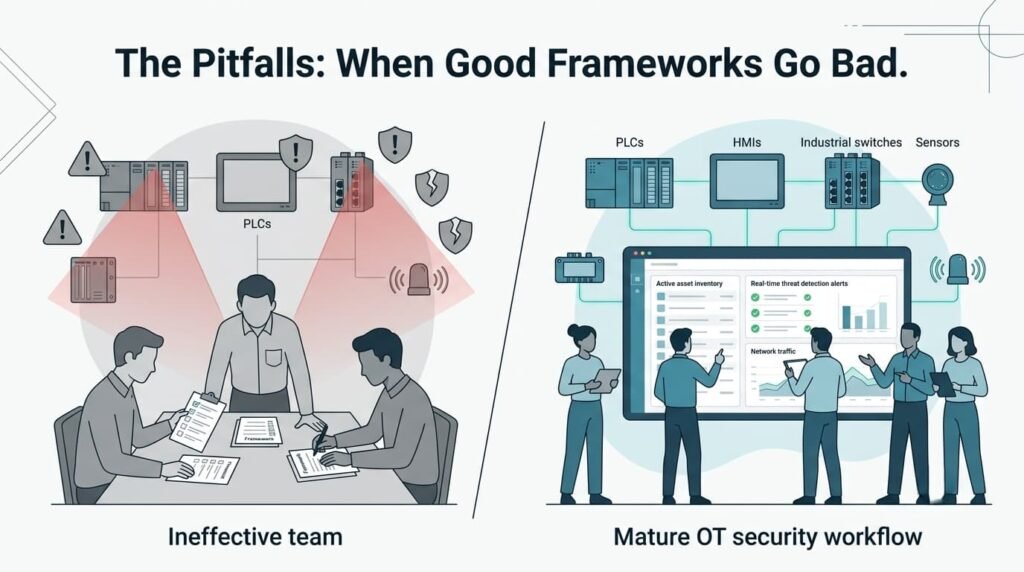
We’ve watched teams adopt ATT&CK with fervor, only to end up with a color-coded spreadsheet that changes nothing. The framework isn’t to blame. The implementation is.
Why do these programs fail? They start with the matrix, not the asset inventory. They rely on IT telemetry alone, missing the command-and-control layer happening over Modbus.
They suffer from “tool-first” thinking, buying a platform without a plan for the right data. Worst of all, they never validate. A mapped technique is not a defended technique.
From our work, several misconceptions must die:
- “Our air gap protects us.” It doesn’t. Removable media and vendor laptops bridge that gap.
- “Enterprise ATT&CK is enough.” It blinds you to the second half of the kill chain, the part that breaks physical things.
- “Logs are sufficient.” Most Level 1 devices don’t generate logs. The truth is on the network wire, in the raw protocol traffic we monitor.
Proving Your Defenses: Validation Without Breaking the Plant
How do you know your detection for “Modify Parameter” actually works? You test it. But you can’t run an exploit on a live compressor. Validation requires care.
What does a safe workflow look like? We recommend this approach:
- Select: Pick a high-risk technique for your environment, like T0855: Unauthorized Command Message
- Scenario: Build a safe test. In a lab or during a planned outage, use a tool to send a rogue “stop” command to a non-critical pump.
- Execute: Run the test.
- Measure: Did your network detection alert? Did your SIEM correlate it? Did the right person get notified?
- Improve: If not, fix the gap. Tune the rule or add a sensor.
This process, documented in research from places like Cardiff University, turns your ATT&CK program from a paper exercise into a living system. It moves you from “we think we’re covered” to “we proved we’re covered.” Our tools are designed to support exactly this kind of validation.
How Network Threat Detection Makes the Framework Real
Credits: SANS ICS Security
This is where theory meets the wire. A robust Network Threat Detection capability is the central nervous system for an ATT&CK-driven defense. It provides the continuous, protocol-aware visibility that endpoint logs can’t.
It sees the Unauthorized Message on a Profinet network. It detects the Lateral Tool Transfer of a malicious engineering file. It correlates a Remote Services connection from IT with a sudden spike in OPC UA writes in the control zone.
We built our approach on this principle. You have to understand the normal conversation, what “good” looks like for Siemens S7, Allen-Bradley EtherNet/IP, Modbus TCP.
Only then can you flag the anomalies that map directly to ATT&CK techniques. Teams can also enrich investigations with common indicators of compromise, including suspicious IP addresses, malicious file hashes, or unexpected communication patterns that support faster incident validation.
It’s about closing the loop between knowing what T0843: Program Download is and actually seeing the packet that constitutes it. Our tools are designed to provide that exact visibility, translating abstract techniques into the traffic we monitor. This is how you move from a threat-informed plan to a threat-visible operation.
FAQs
How does MITRE ATT&CK for ICS improve OT threat detection?
MITRE ATT&CK for ICS documents how attackers target industrial systems. It gives security teams a shared language to map suspicious activity, like a rogue PLC command, to known attack patterns. This makes investigations faster and more precise, strengthening OT security.
Why is asset visibility important for ICS cybersecurity?
Accurate industrial asset visibility starts with a complete inventory. Knowing every controller and workstation lets you perform reliable risk assessments and strengthen network security. It also helps teams prioritize maintenance, monitor critical systems, and close the security gaps attackers look for.
Which security standards work well with MITRE ATT&CK for ICS?
Organizations often combine MITRE ATT&CK for ICS with IEC 62443 and the NIST Cybersecurity Framework. Each resource addresses a different aspect of security.
Using them together supports better mitigations, detection strategies, and controls, creating a more structured, comprehensive approach to protecting industrial environments.
How can industrial organizations reduce the risk of ransomware in OT?
Industrial organizations can reduce ransomware risk in OT by implementing network segmentation, deploying industrial firewalls, and maintaining continuous network monitoring.
An updated incident response plan, regular vulnerability management, and following proven security practices improve resilience and lower the chance of widespread operational disruption.
What role does threat hunting play in OT cybersecurity?
Threat hunting for OT helps teams find malicious activity before operations are disrupted. Analysts use threat intelligence and detection rules to investigate suspicious behavior across industrial assets.
Organizations strengthen their defenses by running adversary emulation and attack simulations to validate their detection and response capabilities.
Turn ATT&CK Into Real Defense
Knowing the MITRE ATT&CK for ICS framework is a strong first step, but real security comes from putting it to work. Every small improvement, from closing a visibility gap to validating a new detection rule, helps you build a stronger defense over time. That’s how you move from reacting to threats toward staying ahead of them.
If you’re ready to take the next step, Network Threat Detection can help you turn threat intelligence into practical action with real-time threat modeling, automated risk analysis, MITRE ATT&CK mapping, and clear attack path visualization.
References
- https://dl.acm.org/doi/10.1145/3465481.3470023
- https://www.mdpi.com/2076-3417/15/17/9233