
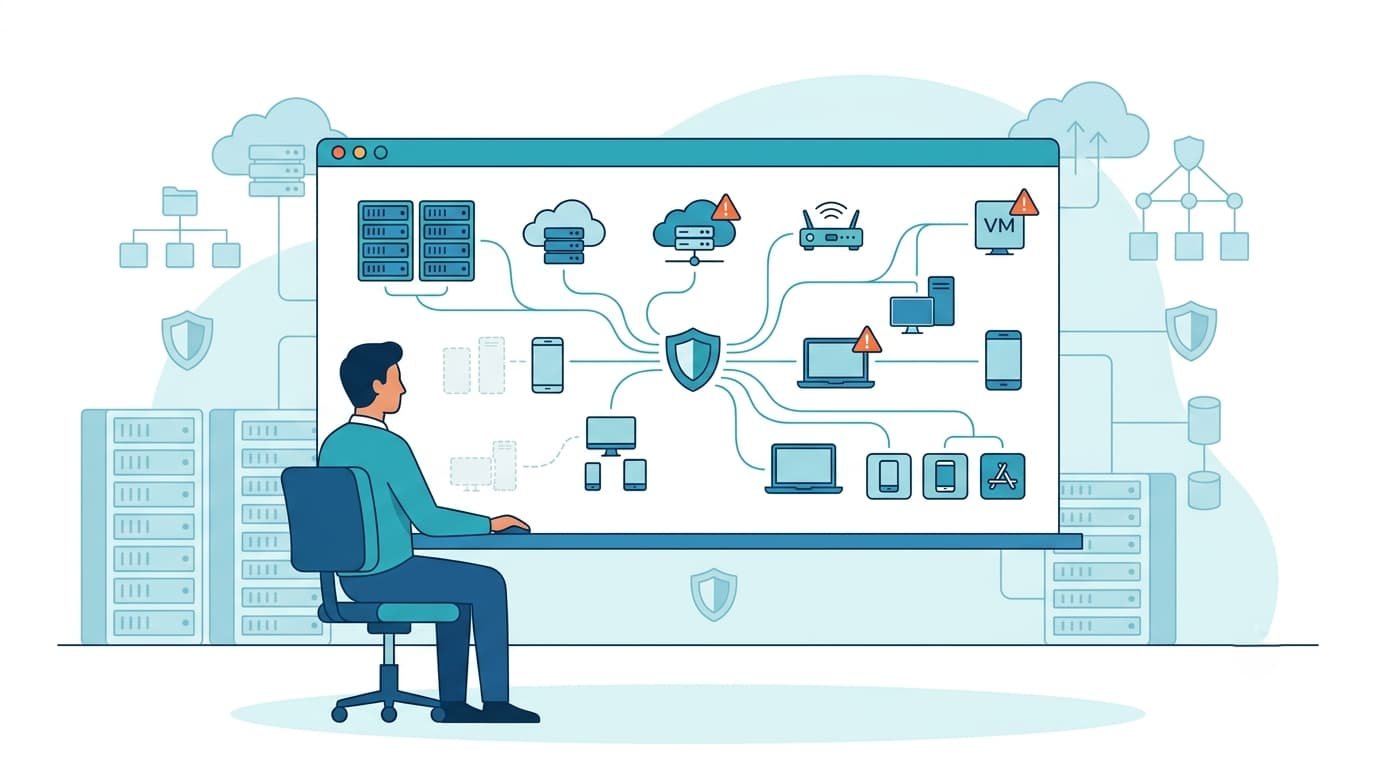
Automating asset discovery classification is your only way out of the mess. Your current inventory is wrong. It’s outdated, full of gaps, and cluttered with records for old machines that no longer exist. That spreadsheet you check is a relic.
You need tools that continuously scan for every device, server, cloud instance, and piece of software, then automatically label them with context like owner and criticality. This live view from Network Threat Detection shows what you actually have and its real risk. To stop securing ghosts and start protecting your real network, keep reading.
Quick Reads: Automating Asset Discovery Classification Essentials
- Manual tracking is a security liability. Hybrid environments change too fast for spreadsheets, creating dangerous blind spots.
- Effective automation combines multiple sources. No single scanner finds everything; you need a blend of network, cloud, and endpoint data.
- Classification turns a list into intelligence. Knowing a device exists is useless unless you also know what it does and how important it is.
Why Your Spreadsheet Is a Security Threat?
Consider the shift we’ve lived through. Our teams scattered to home offices, taking endpoints with them. We spun up cloud resources that last only hours. Colleagues adopted new SaaS tools on a whim. You can’t draw a perimeter around this.
A manual inventory, even quarterly, can’t keep pace. The data decays as soon as you collect it. The risks are immediate.
According to Emeral Insight
“An analysis is always just as good as the data it is based upon, and most risk management approaches are of little use without a reliable asset inventory.” – Emerald Insight
- Missed vulnerabilities: We can’t patch assets we don’t know exist. That forgotten server is an open door.
- Compliance failures: Frameworks like SOC 2 (Trust Services Criteria CC6.1), NIST CSF v2.0 (ID.AM), and ISO 27001 require a complete, continuous asset inventory. During regulatory audits, discovering an unmanaged S3 bucket or shadow cloud VM results in an immediate control failure, exposing your organization to severe regulatory fines and breach liabilities.
- An expanding attack surface: Every unmanaged device or rogue SaaS app is a potential beachhead for an attacker. Continuously identifying unmanaged shadow IT devices helps reduce these blind spots before they become entry points.
Industry analysts like Gartner consistently emphasize that hybrid growth makes periodic discovery obsolete, driving the need for continuous asset visibility. For our security, it’s now a necessity.
How Does Continuous Discovery Actually Work?
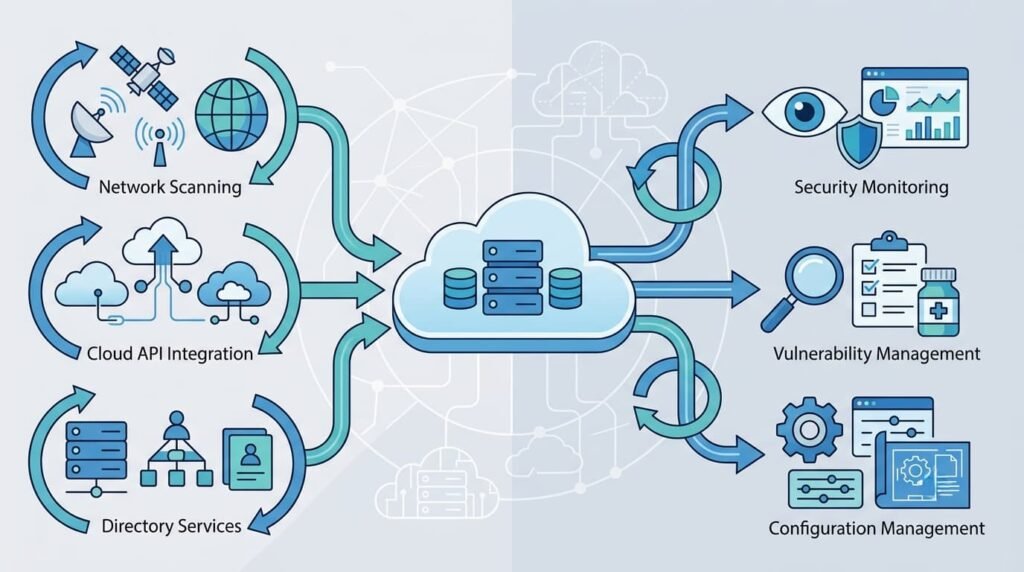
Building that continuous feed isn’t about finding a single magic tool. It’s a process of synthesis, pulling signals from wherever we can get them.
We start with the broad sweep, using multiple scans that work together. Network scanners find devices by their digital heartbeat. Cloud APIs give us a direct list of every running resource from AWS or Azure.
EDR agents on our laptops report back with detailed system information. Directory services show us the users and accounts. Each source has gaps, but together they form the first rough picture.
Data correlation poses the biggest operational challenge. To solve this, our correlation engine ingests raw signals, deduplicates overlapping records, and merges AWS cloud VMs, internal IP subnets, and EDR agent telemetry into a single authoritative asset profile within seconds.
It’s messy work. You’ll see duplicates and conflicts. The goal is a normalized inventory that updates as fast as the environment changes.
With our work on threat detection, we’ve focused here. Our goal isn’t just to find assets, but to weave them into your security monitoring. An asset isn’t just a database entry. It’s a potential victim, a pivot point for an attackerthe crucial context that makes an alert mean something.
What to Look For and How to Label It?
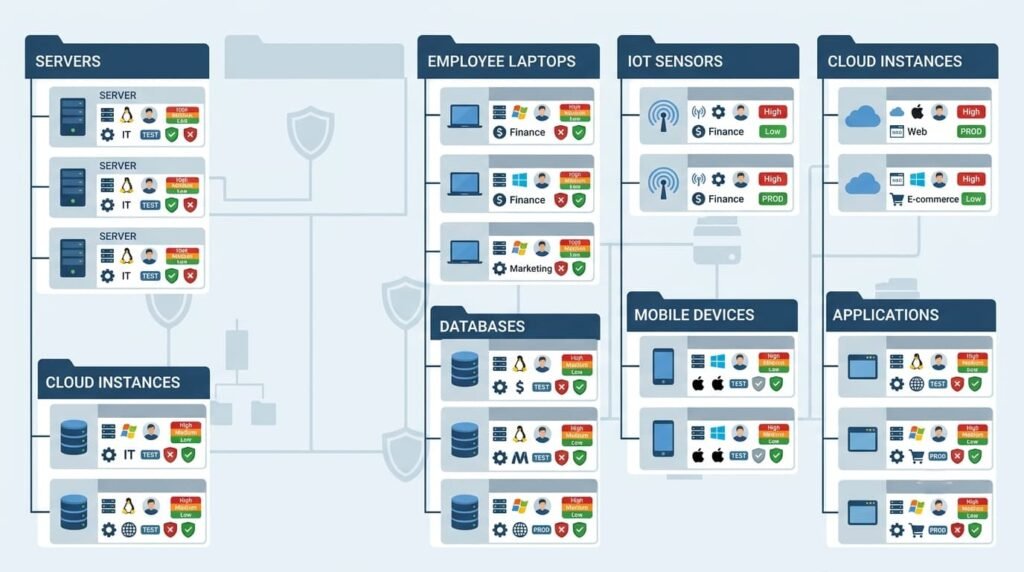
A raw list of assets isn’t useful. You need to classify them. It’s the difference between a list of names and a detailed personnel file.
We start with the basics. What is it, a web server, a database, a developer’s laptop? Technical fingerprints like open ports help. Then we add business context: who owns it, which department is responsible? What does it actually do? This context is often harder to get but more critical.
The most important label is criticality. Not every asset matters the same. A public web server with customer data is a crown jewel. A temporary testing VM is not. In our threat models, we classify based on impact. This drives everything. A critical flaw on a developer’s machine can wait. That same flaw on your core database cannot.
A practical classification covers:
- Endpoints and servers.
- Cloud resources.
- Containers.
- SaaS applications.
- IoT and OT devices.
- Network infrastructure.
This isn’t a one-time task. It’s a continuous process using rules and machine learning. ML models analyze behavior to suggest labels, often improving accuracy over static rules. Machine learning models analyze behavioral patterns to automate tagging, significantly reducing the manual errors inherent in traditional static mapping.
The Toolchain That Makes It Possible
Credits: runZero, Inc
No single vendor sees everything. You need a unifying platform or a careful integration of tools into one central system.
It starts with data collectors. These are your scouts. Organizations deploy an integrated stack of network scanners, cloud API connectors, identity providers, and EDR agents to maintain full visibility.. Specialized sensors for industrial sites might join them. Each reports from its own sector.
Then comes the correlation engine, the brain. It takes all those feeds, normalizes the data, fights duplicates, and applies rules. It checks a CMDB or queries an HR system to find an asset owner.
Finally, you have the consumers, this is the whole point. The enriched inventory feeds your security tools. It tells vulnerability management what to prioritize by improving asset management and adding vulnerability context to every decision. It gives your SIEM critical context.
An alert for us doesn’t just say “anomalous connection.” It says, “Anomalous connection from the unmanaged QA workstation owned by John Doe, running vulnerable OpenSSL.” That’s the difference between noise and something you can act on.
| Component | Role | Examples |
| Collectors | Gather raw data. | Network scanners, Cloud APIs. |
| Correlation Engine | Normalizes & enriches data. | Links assets, finds owners. |
| Consumers | Use data for security action. | SIEM, vulnerability management. |
The Inevitable Hurdles You’ll Face
This isn’t a plug-and-play paradise. Implementation brings headaches. Data quality is a constant fight. You’ll get duplicate records because one tool knows a server by its hostname and another knows it by its IP. Naming inconsistencies break automated ownership mapping.
According to MDPI
“Duplicate data lead to inaccurate analyses, leading to wrong decisions and negatively affect data-driven activities. To defuse the complexity of the problem, especially in large data sources, record linkage methods are used to resolve non-uniqueness across heterogeneous systems.” – MDPI
The hardest part is often getting clean business context. Answering “who is responsible for this?” is much tougher than technical classification. If your HR data is messy, that critical field stays empty.
Then there’s integration sprawl. Connecting all these tools, maintaining API keys, handling schema changesit’s unglamorous plumbing work, but it’s essential.
We learned a practical tip the hard way. Start with your most authoritative sources. Maybe it’s your cloud infrastructure, because those APIs are clean. Or your corporate laptops managed by an EDR tool. Get one source flowing perfectly into your classified inventory.
Prove the value thereshow how a clean, prioritized vulnerability report saves real time. Then expand. Trying to connect every scanner on day one just creates a swamp of unmanageable data.
From Inventory to Active Defense
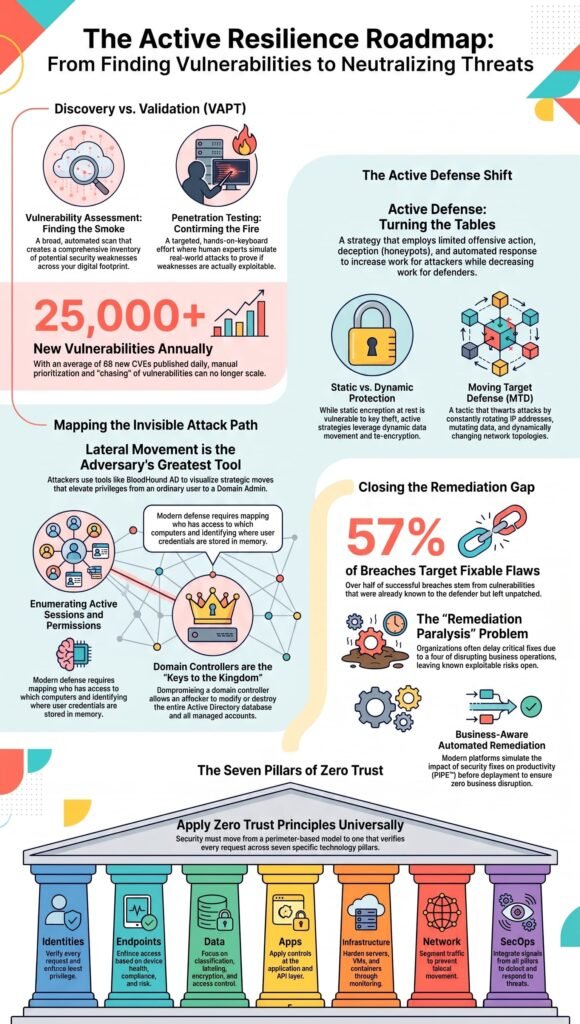
This is where you see the real payoff. A dynamic, classified asset inventory changes security from reactive to proactive. Your vulnerability management stops being a frantic race to patch everything.
It becomes a risk-based triage. You fix the critical flaws on your most important assets first, and your mean time to remediation drops fast.
During an incident, responders aren’t flying blind. They can instantly see what a compromised asset is, what it connects to, and who owns it. They can map attack paths with much more precision. In our own threat detection work, this context is everything.
We’re not just looking for malicious signals; we’re evaluating them against what’s normal for that specific asset. This makes prioritizing alerts based on asset criticality far more accurate. A compiler launching on a developer’s machine is expected. On your domain controller, it’s an emergency.
It also makes a Zero Trust mindset possible. You can’t enforce “least privilege” if you don’t know what all the “things” are that need access. Automated discovery tells you what’s on your network. That knowledge is what lets you finally build smarter, tighter gates.
Making It Last
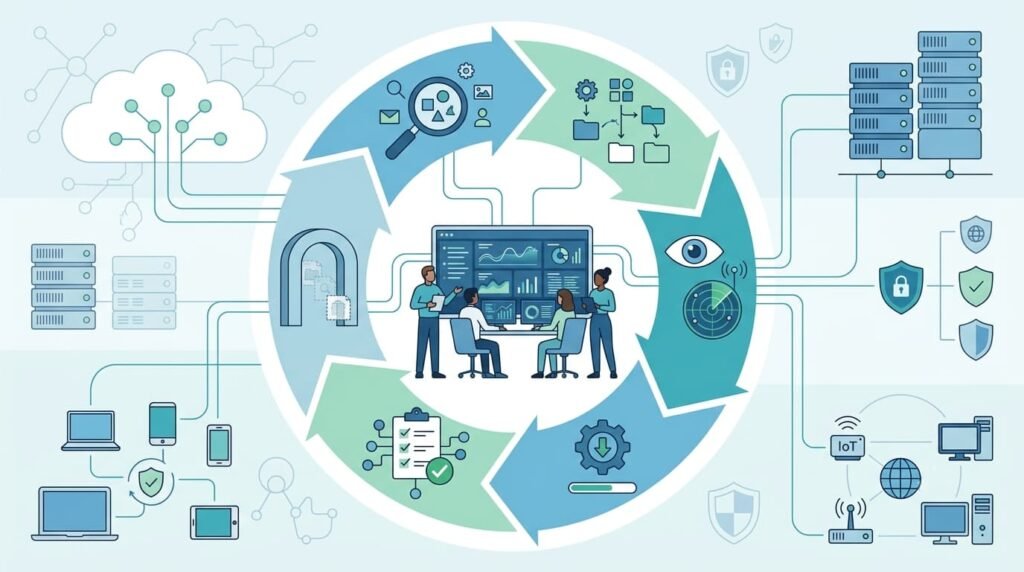
Success isn’t a project with an end date. It’s a continuous operational discipline. We’ve learned you need to treat it like one.
Here’s what that looks like in practice:
- Discover continuously. Make it a heartbeat, not an annual physical.
- Classify with rules first. Automate the basics, then enhance with machine learning where it helps.
- Validate regularly. Run spot checks and have a process for humans to correct misclassifications.
- Measure your coverage. What percentage of endpoints are you seeing? Your cloud instances? Find the gaps and close them.
- Integrate the output. Feed this intelligence into every security and IT process. Make the inventory a living part of operations.
The goal is an always-current inventory. Not 95% accurate from three months ago, but 99% accurate from five minutes ago. That’s the standard modern infrastructure demands, and it’s what we build our threat models around.
FAQs
What is the difference between asset discovery and automated asset discovery?
Asset discovery is the process of identifying devices, software, and services connected to an organization’s environment. Automated asset discovery performs the same task continuously without requiring manual updates.
This approach improves IT asset inventory, increases asset visibility, and maintains better inventory accuracy by identifying new assets as they appear and removing outdated records from the inventory.
How does continuous asset discovery improve security over time?
Continuous asset discovery monitors changes across networks, cloud environments, and endpoints on an ongoing basis instead of relying on occasional scans. It supports continuous monitoring, maintains a current security asset inventory, and improves asset lifecycle management.
This process helps organizations detect new or removed assets quickly, reduce security blind spots, and strengthen overall security visibility.
Why is asset classification important after discovering new assets?
Discovering an asset only identifies that it exists. Asset classification and automated asset classification add context by assigning asset types, ownership, and business importance.
Combined with asset tagging, metadata enrichment, business criticality classification, and ownership assignment, classification helps organizations improve risk-based asset prioritization and make faster, more informed security decisions.
Can cloud asset discovery catch transient shadow IT and unmanaged resources?
Yes, but static daily scans will fail. To catch ephemeral serverless functions, micro-containers, or developer-provisioned dev instances that exist for only a few hours, your discovery system must hook directly into AWS CloudTrail, Azure Activity Logs, or GCP Audit Logs via real-time event-driven API webhooks.
How does CMDB integration support automated asset management?
CMDB integration synchronizes discovery results with a configuration management database to maintain accurate and current asset records. This integration improves automated inventory management, strengthens asset correlation and asset normalization, and supports vulnerability management integration.
As a result, organizations enhance cyber asset management and improve exposure management by making security decisions based on reliable asset data.
Visibility Is Where Stronger Security Begins
You can’t secure systems you haven’t found, and that’s a risk that grows over time. Once every asset has context, security decisions become clearer. That’s when your team can focus on real priorities instead of chasing unknowns.
If you’re ready to map your attack surface with confidence, Network Threat Detection offers real-time threat modeling, automated risk analysis, and continuously updated intelligence to help security teams uncover blind spots faster.
References
- https://www.emerald.com/ics
- https://www.mdpi.com/2414-4088/6/4/27