

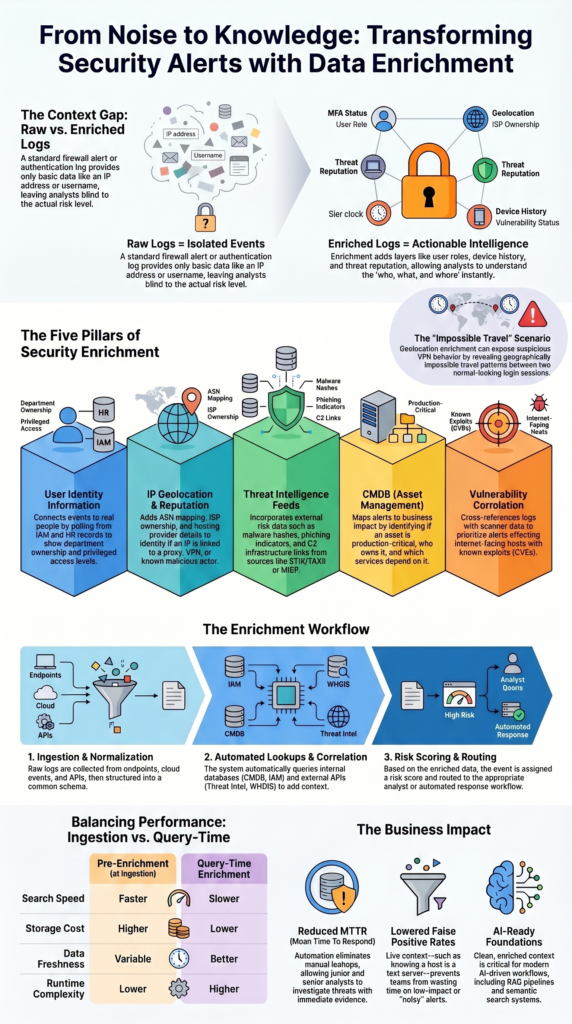
Data enrichment for contextual analysis helps security teams investigate alerts faster by adding relevant context to raw security data. Instead of reviewing isolated events, analysts can immediately see user identities, asset information, vulnerability data, and threat intelligence alongside each alert.
We often see this reduce investigation time in environments generating large volumes of telemetry every day. At Network Threat Detection, we use enrichment to make alerts more meaningful and actionable. Keep reading to learn how modern enrichment works and how organizations scale it effectively.
Context That Makes Security Alerts Actionable
Strong data enrichment helps analysts investigate threats faster by adding identity data, asset details, vulnerability findings, and threat intelligence directly into alerts. This guide explains how enrichment improves visibility, reduces false positives, and supports faster incident response across modern SOC environments.
- Data enrichment gives raw logs useful context, helping analysts understand risks without jumping between multiple tools.
- Combining ingestion-time and query-time enrichment helps organizations balance performance, storage costs, and investigation speed.
- Automated enrichment workflows improve alert quality, reduce analyst workload, and support scalable threat detection operations.
Importance Security Data Enrichment Context

Security logs on their own often miss the details analysts need. A firewall alert might show an IP address. An authentication log may only show a username. Without security data enrichment context, teams cannot quickly tell whether the activity is risky or normal.
Modern SOC environments collect:
- Firewall logs
- Endpoint telemetry
- Cloud events
- DNS records
- API activity
- Authentication logs
That volume grows fast. Most events are harmless, but the dangerous ones still need attention right away.
We regularly see analysts waste time switching between tools during investigations. A simple login review can turn into multiple manual lookups across IAM systems, CMDB platforms, and threat intelligence feeds. Data enrichment pulls that information together before the analyst even opens the alert.
A login event becomes much more useful when it also shows:
- User role
- MFA status
- Device history
- ASN details
- Asset ownership
- Threat reputation
Those details improve:
- Risk scoring
- Alert prioritization
- False positive reduction
- Incident response speed
Security teams also use enrichment inside AI-driven workflows, including RAG pipelines, semantic search systems, and knowledge graphs. As organizations rely more on AI-assisted investigations, clean context matters even more.
Enriching Logs IP Geolocation Data
IP geolocation enrichment adds location and network details to security events. An IP address by itself says very little. Once enrichment adds geographic data, ASN ownership, ISP information, and hosting details, the event becomes easier to investigate.
Common enrichment data includes:
- Country and region
- ASN mapping
- ISP ownership
- Hosting provider details
- Latitude and longitude
- Reputation indicators
We have seen this help uncover suspicious VPN behavior that looked harmless in raw logs. The authentication events appeared normal until location data exposed impossible travel patterns between sessions.
Many teams also combine geolocation with:
- IP reputation
- Passive DNS
- Hosting detection
- Proxy identification
- Threat intelligence feeds
| Enrichment Type | Purpose | Typical Data Source |
| Geo-IP Mapping | Adds location context | Geo-IP databases |
| ASN Mapping | Shows network ownership | Internet registries |
| Reputation Scoring | Flags malicious activity | Threat intel feeds |
| Passive DNS | Maps infrastructure links | DNS intelligence |
| Hosting Detection | Identifies VPN or cloud usage | Threat APIs |
Behavior analytics also improves with geolocation data. Systems can compare user activity against normal login regions and known device behavior.
Adding User Identity Information Logs
Credits: Tech with Jono
Identity enrichment connects security events to real people, roles, and access levels by adding user identity information to logs.
Authentication alerts become more useful once analysts can see who owns the account and what access that person has. A failed login tied to a privileged admin account carries far more risk than one linked to a temporary test account.
Most identity enrichment pipelines pull data from:
- IAM systems
- Directory services
- HR records
- Device management platforms
- MFA systems
We often enrich logs with:
- Department ownership
- Privileged access levels
- Employment status
- MFA enrollment
- Device registration history
That extra context improves:
- Behavioral analytics
- Alert triage
- Threat hunting
- Risk scoring
- Investigation speed
Identity enrichment also helps analysts move faster inside SIEM and observability platforms. Instead of searching across several systems, they can pivot directly from an alert into a user timeline.
A common workflow may connect:
- VPN activity
- Cloud access logs
- Endpoint telemetry
- IAM records
- Privileged access changes
We have found that this reduces investigation time because ownership and intent become clearer early in the process.
Incorporating Threat Intelligence Feeds Data
Threat intelligence enrichment adds external risk data to indicators inside logs by incorporating threat intelligence feeds data from multiple trusted sources. A suspicious domain or IP address means more when analysts can see whether it has been linked to phishing, malware, or command-and-control infrastructure.
Security teams often enrich telemetry with:
- Threat intelligence feeds
- Malware hash databases
- Reputation APIs
- Sandbox results
- Passive DNS records
Many pipelines combine:
- STIX TAXII feeds
- MISP
- Virus analysis tools
- URL reputation services
- Open threat intelligence sources
These enrichments help identify:
- Malware infrastructure
- Phishing campaigns
- Malicious file hashes
- Botnet activity
- Suspicious domains
Two enrichment models are common:
- Static correlation using local threat databases
- Dynamic API lookups during investigations
Dynamic lookups provide fresher data but can slow searches if pipelines are not optimized.
We have seen enrichment improve confidence during investigations. A PowerShell alert may seem low priority until the related hash or IP matches known malicious infrastructure. Context changes the outcome quickly.
Threat intelligence enrichment also works well with:
- Detection rules
- Sandbox correlation
- Behavioral analytics
- Network threat detection
- Automated response workflows
For additional guidance on threat intelligence standards, the Cybersecurity and Infrastructure Security Agency provides reference material and sharing frameworks.
Asset Management Database Integration CMDB
CMDB enrichment connects alerts to business impact and asset ownership. Not every system matters equally. A critical alert on a test server does not carry the same urgency as one affecting a production payment platform.
CMDB integration helps analysts understand:
- Who owns the asset
- Which services depend on it
- Whether the system is production-facing
- How exposed the asset is
We have seen major improvements in network threat detection once alerts included ownership and service mapping data. Analysts no longer had to stop investigations to figure out who manages the affected infrastructure.
Useful CMDB enrichment fields include:
| CMDB Field | Security Value |
| Asset Owner | Faster escalation |
| Business Unit | Better impact analysis |
| Environment Type | Production prioritization |
| Service Dependency | Blast radius visibility |
| Exposure Rating | Stronger risk scoring |
This becomes even more important in cloud environments where resources appear and disappear constantly.
Many organizations enrich telemetry with:
- Asset inventories
- Configuration management data
- Service maps
- Ownership records
- Exposure management platforms
That context improves prioritization during incidents and threat hunts.
Vulnerability Scanner Data Correlation
Vulnerability enrichment helps teams focus on active risk instead of long vulnerability lists. Most organizations already have thousands of scanner findings. The challenge is figuring out which ones matter right now.
We usually correlate telemetry with:
- CVE severity
- Patch status
- Internet exposure
- Exploit availability
- Active suspicious behavior
That combination gives analysts a clearer picture of risk.
For example, a critical vulnerability becomes far more urgent when:
- The host is internet-facing
- The asset is production-critical
- Threat feeds show active exploitation
- Network traffic looks suspicious
This type of enrichment improves:
- Threat hunting
- Incident response
- Risk scoring
- Exposure management
- SOC prioritization
Security teams also reduce alert fatigue because decisions rely on live context instead of static severity scores alone.
Large environments often process this data through:
- Stream processing pipelines
- Data lakehouse systems
- Batch enrichment jobs
- Real-time analytics platforms
The NIST National Vulnerability Database remains one of the main public references for vulnerability tracking and CVE information.
WHOIS Information Domain Reputation Lookup
WHOIS and domain reputation enrichment help analysts investigate suspicious domains faster. A domain name alone rarely tells analysts much. Enrichment adds ownership history, registration details, hosting information, and abuse records.
Common enrichment fields include:
- Registration date
- Registrar details
- Hosting provider
- Reputation history
- Passive DNS relationships
Newly registered domains often receive extra attention because phishing campaigns frequently rely on short-lived infrastructure.
As noted by the Federal Trade Commission
“WHOIS databases often are one of the first tools FTC investigators use to identify wrongdoers.” – Federal Trade Commission
Many analysts combine:
- WHOIS lookups
- Passive DNS
- Domain reputation feeds
- URL analysis tools
- IP reputation services
We have seen phishing investigations shift quickly after enrichment exposed recently created infrastructure tied to broader malicious activity.
This context supports:
- Threat hunting
- Anomaly detection
- Event correlation
- Malware investigations
- Enriched alerting
The biggest benefit is speed. Analysts can review ownership and reputation data directly inside the workflow instead of searching across multiple external tools.
Data Enrichment Techniques Workflow
Strong data enrichment pipelines depend on clean workflows and automation. Most pipelines begin with log normalization and structured parsing. After that, systems apply enrichment before storing or analyzing the data.
Organizations usually balance two models:
- Pre-enrichment during ingestion
- Query-time enrichment during searches
Pre-enrichment makes searches faster but increases storage usage. Query-time enrichment lowers storage overhead but may slow investigations.
Research from Oak Ridge National Laboratory shows
“Security event data, such as intrusion detection system alerts, provide a starting point for analysis, but information is impoverished. To provide context, analysts must manually gather and synthesize relevant data from myriad sources within their enterprise and external to it.” – Oak Ridge National Laboratory
A common workflow includes:
- Log ingestion
- Schema normalization
- Context lookups
- Risk scoring
- Event correlation
- Alert routing
- Automated response actions
Many teams support these pipelines with:
- Stream processing
- Batch jobs
- API lookups
- Serverless enrichment
- Real-time analytics
- Distributed data platforms
We are also seeing enrichment tied more closely to AI-assisted investigations. Better metadata improves semantic search, RAG workflows, and automated summarization across large telemetry datasets.
Impact Enrichment Query Performance
Security enrichment can speed up investigations, but the impact enrichment query performance issue becomes clear when pipelines grow too complex. We often see this in large environments where teams collect logs from cloud systems, endpoints, and network devices all at once.
Query-time enrichment gives analysts fresh context during searches. The downside is that extra joins, lookups, and API requests can slow response times. In several SOC projects we supported, poorly tuned lookups caused dashboards to lag during active incidents.
Pre-enrichment removes some of that pressure because data gets enriched before storage. Search results become faster, but storage costs rise and ingestion pipelines become harder to manage.
| Performance Factor | Query-Time Enrichment | Pre-Enrichment |
| Search Speed | Slower | Faster |
| Storage Cost | Lower | Higher |
| Data Freshness | Better | Variable |
| Runtime Complexity | Higher | Lower |
Most teams use a mixed model instead of relying on one method alone. Critical context is added during ingestion, while smaller lookups happen later during investigations.
Common optimization methods include:
- Local caching
- Batch lookups
- Columnar storage
- Distributed processing
- Vector-based indexing
Our threat modeling and risk analysis work also shows that scalable telemetry systems often depend on stream processing and lakehouse architectures to keep investigations fast without overwhelming infrastructure.
Automating Data Enrichment Processes

Automation helps security teams turn enrichment into a reliable and scalable process. Without it, analysts spend too much time collecting context from different tools. We have seen investigations slow down because each analyst followed a different workflow and checked different sources.
Automated data enrichment fixes many of those problems by adding context directly to alerts before analysts review them. That makes investigations faster and more consistent across the SOC.
Modern enrichment pipelines often include:
- Rule-based enrichment
- API-driven lookups
- Stream processing
- Batch enrichment
- Automated correlation engines
Many organizations now run enrichment through:
- Serverless workflows
- Distributed analytics jobs
- Real-time enrichment pipelines
- Stream processing frameworks
In our own threat modeling and risk analysis projects, automation made a major difference for junior analysts. Once alerts included ownership details, vulnerability data, and reputation scoring automatically, they spent less time gathering evidence and more time investigating threats.
Advanced environments also enrich telemetry with:
- Knowledge graph relationships
- Vector embeddings
- Entity resolution
- Data lineage tracking
- Semantic search context
These capabilities improve AI-assisted detection, network security analysis, and large-scale threat investigations across modern systems.
FAQ
How does data enrichment improve contextual analysis in SOC operations?
Data enrichment adds useful context to security logs. Analysts can quickly see user identity, asset details, IP geolocation, and threat intelligence in one place. This helps security teams understand alerts faster and reduce false positives.
Many SOC teams also use event correlation, risk scoring, and behavioral analytics to improve detection accuracy and speed up incident response across SIEM environments.
Why do teams use query time enrichment with threat intelligence feeds?
Query time enrichment gives analysts fresh threat data during investigations. Teams often check WHOIS lookup records, IP reputation, domain reputation, passive DNS, and threat feeds while reviewing alerts.
This method helps analysts investigate suspicious activity faster without storing large amounts of extra data. It also improves risk prioritization and helps teams create more accurate enriched alerts.
What role does CMDB integration play in log enrichment workflows?
CMDB integration connects security logs with asset management and ownership data. Analysts can quickly identify affected systems, responsible teams, and possible business impact during investigations.
Many organizations also combine vulnerability scanner results, configuration management records, and dependency mapping data. This added context improves vulnerability correlation and helps security teams respond faster during incidents.
Can automation pipelines improve analyst productivity and MTTR reduction?
Automation pipelines reduce manual work during investigations. Many teams use API lookups, batch processing, rule-based enrichment, and real-time enrichment to add context automatically.
We often see faster MTTR reduction when alerts already include IAM correlation, reputation scoring, and scanner data. Automation also improves operational efficiency by keeping enrichment workflows consistent across large environments.
How do scalable enrichment systems handle performance and storage overhead?
Scalable enrichment systems balance query performance and storage overhead by combining query time enrichment with pre-enrichment storage. Many organizations use Kafka streams, Spark jobs, Flink processing, and serverless enrichment to handle large data pipelines.
Others improve contextual analysis with vector embeddings, knowledge graphs, and RAG pipeline workflows. These methods support anomaly detection and semantic context without slowing cybersecurity analytics systems.
Stronger Security Decisions Start With Better Context
Raw telemetry creates problems when analysts have to sort through disconnected alerts without enough context to understand what actually matters. Investigations slow down, response times increase, and critical risks become harder to prioritize across large environments. Better enrichment helps security teams cut through that noise much faster.
That’s why many organizations improve visibility with platforms like Network Threat Detection that combine into one operational view. If you want clearer investigations and faster risk analysis as environments grow more complex. Explore the context-driven detection assessment built for modern cybersecurity operations.
References
- https://search.ftc.gov/news-events/news/press-releases/2006/06/ftc-issues-statement-whois-databases
- https://www.ornl.gov/division/projects/stucco
Related Articles
- https://networkthreatdetection.com/importance-security-data-enrichment-context/
- https://networkthreatdetection.com/enriching-logs-ip-geolocation-data/
- https://networkthreatdetection.com/adding-user-identity-information-logs/
- https://networkthreatdetection.com/incorporating-threat-intelligence-feeds-data/
- https://networkthreatdetection.com/asset-management-database-integration-cmdb/
- https://networkthreatdetection.com/vulnerability-scanner-data-correlation/
- https://networkthreatdetection.com/whois-information-domain-reputation-lookup/
- https://networkthreatdetection.com/data-enrichment-techniques-workflow/
- https://networkthreatdetection.com/impact-enrichment-query-performance/
- https://networkthreatdetection.com/automating-data-enrichment-processes/