
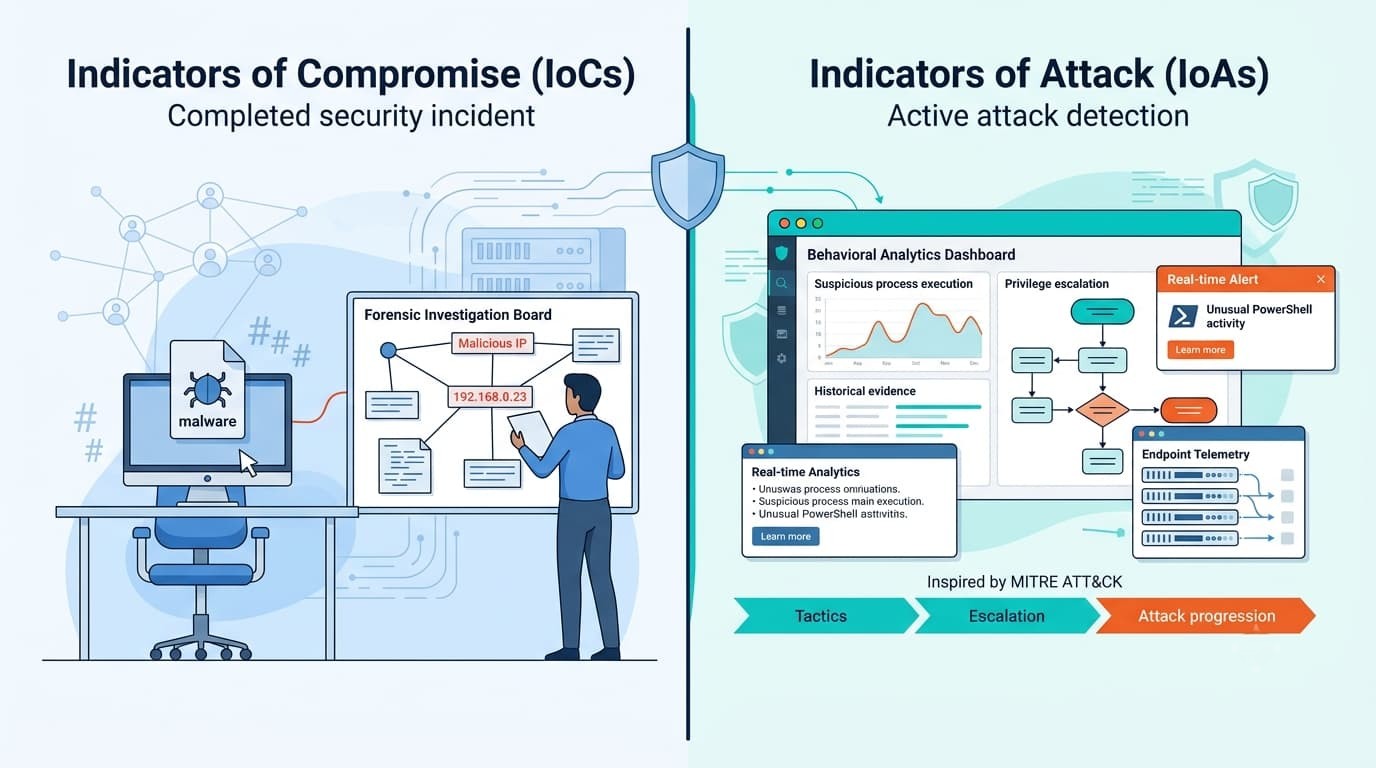
An Indicator of Compromise (IoC) confirms an attacker was in your system. An Indicator of Attack (IoA) shows they’re still there. That’s the difference. At Network Threat Detection, we see teams stuck reviewing old alerts about bad IPs and hashes, missing the real attack happening right now. A modern defense uses both.
IoCs provide a history. IoAs let you respond in real time. This combination reduces noise and cuts down how long an attacker can operate inside your network. Keep reading to see how it works.
Threat Detection at a Glance
- IoCs confirm a breach happened, using static artifacts like malware hashes and malicious IPs for scoping and hunting.
- IoAs catch attacks in progress, by spotting malicious behaviors and sequences of actions that reveal intent.
- A mature program needs both, using IoAs for early warning and prevention, and IoCs for rapid investigation and cleanup.
What Is the Difference Between IOC and IOA Indicators?
Think of an IOC like evidence at a crime scene. That’s a specific malware hash or a known bad IP address. It’s concrete, perfect for answering, “Did this known threat touch my system?”
An IOA, though, is about the story. It’s the sequence of events that means trouble. A normal Microsoft Word file spawning PowerShell, which then pulls code from a remote server. That’s an IOA. It describes the behavior, the tactic.
The attacker can change the file or the IP instantly, but that intent, to use a trusted process to run code, stays the same. In our work, we see IOAs as our best shot at catching an attack while it’s happening, before the damage is done.
The timing defines them. Understanding the difference between IoCs and IoAs starts here: IOCs are usually reactive, found after a breach. This structural delay remains a core challenge.
According to A Cell Press Journal
“A peer-reviewed study on threat postures in the journal Patterns (Cell Press) highlights a hard truth: relying solely on post-incident forensics results in strictly reactive defenses. In my years on the blue team, I’ve lived this reality daily, if your security strategy is built entirely on analyzing yesterday’s wreckage, you will always be one step behind the adversary.” – A Cell Press Journal
IOAs are proactive; they try to interrupt the attack chain. One tells you you’ve been hit. The other tries to stop the punch. We’ve seen how long breach containment can drag on, and behavioral detection aims to collapse that timeline entirely.
What Are Examples of Common Indicators of Compromise?
These classic IoCs sit at the bottom of David Bianco’s Pyramid of Pain. Common file hashes and IPs remain some of the most recognizable indicators of compromise, but while easy to collect, they are also trivial for attackers to modify. They’re valuable, no doubt, but their shelf life is short.
- File Hashes (SHA256, MD5): The fingerprint of a malicious file. Good for blocking known malware, but attackers change them constantly.
- IP Addresses & Domains: Locations for command servers or phishing. Useful, but often ephemeral, changing in hours.
- Registry Keys & File Paths: Artifacts of persistence, like a specific Run key.
- Mutexes: Unique strings to avoid double-running. Specific, but also changeable.
In our work, the most stable IOCs are often the hashes of core malware binaries. The least stable are IP addresses, which can be rotated daily. This is exactly why you can’t just rely on a static blocklist.
You need context. Our tools are built to provide that, to connect a new IP to last week’s credential harvesting campaign. The address might be fresh, but its malicious behavior isn’t.
What Are Examples of Indicators of Attack Based on Behavior?
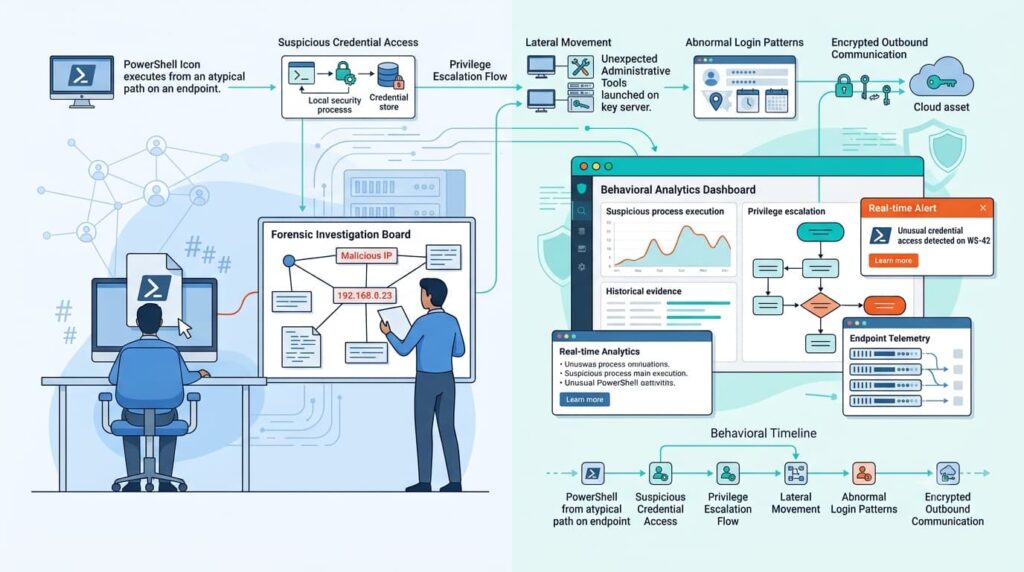
This is where the story gets written live. IOAs look for the plot, not the props. We’ve built detections around these exact sequences, and they catch what hash lists consistently miss.
Take a common attack. An employee opens a phishing email attachment, a Word doc. That doc uses a macro to launch PowerShell.
That PowerShell, with a scrambled command line, reaches out to a remote server and downloads a second payload, then runs it. An IOC system might miss this if the doc, payload, and server are all new.
An IOA system sees the narrative: Document → Script Interpreter → Network Callback → Execution. It’s a high-fidelity IOA, mapping to MITRE ATT&CK techniques like User Execution and PowerShell.
Other IOAs we track include:
- Lateral Movement: One internal host suddenly trying RDP or SMB connections to dozens of others.
- Privilege Escalation: A standard user process trying to dump a local admin’s credentials.
- Defense Evasion: Command-line attempts to disable endpoint security services.
These behaviors are the attacker’s goals in motion. Spotting them means you’re seeing the attack itself, not just cleaning up the mess. That’s why indicators of attack based on behavior are often more resilient than static artifacts, because they reflect attacker TTPs rather than a single file or IP.
How Are IoCs Used for Reactive Threat Detection?
Finding a compromised machine means answering one question first: how bad is it? IoCs are the primary tool for that scoping.
The process is methodical, almost forensic. You start by collecting every artifact from the infected endpoint, the malware file’s hash, the IP it called back to, the domain in the phishing link. These become your hunting IOCs.
According to Arxiv
“Analysts rely on IoCs for both immediate defense, such as creating block lists and firewall rules, and for activities such as threat hunting”. – Arxiv
Then you sweep. You take that hash and query every other endpoint in your environment. You search SIEM logs for connections to that malicious IP over the last 30, 60, 90 days. You check proxy logs for visits to that suspicious domain.
This is reactive threat detection at its most effective. It’s about containment and understanding the blast radius.
You can then add these high-confidence IOCs to blocklists at your firewall and proxy, preventing any further communication. It’s a crucial cleanup phase, but it starts from a position of known loss. Our tools are built to automate and accelerate this sweep, turning hours of manual querying into minutes.
How Can Organizations Leverage IOAs for Proactive Threat Hunting?
Proactive threat hunting flips the script. You don’t start with a known-bad artifact. You start with a hypothesis about behavior built from analysis and context. “What if an attacker is moving laterally with stolen credentials?” So you craft a hunt.
You look for anomalous login patterns, like a single account hitting multiple different hosts in a sequence that doesn’t match normal behavior. That’s how proactive threat hunting works when leveraging IOAs to identify suspicious behavior before attackers achieve their objectives.
The real power of IOAs is their resilience. An attacker can get a new malware hash in seconds. They can switch command server IPs with a script. But changing their core behavior, their TTPs, is much harder. That’s their playbook.
When you build detections for the behavioral sequence, credential dumping followed by lateral movement, for instance, you’re building a defense that lasts. This is how you catch fileless attacks, living-off-the-land binaries, and zero-days. You’re not looking for a malicious file, you’re looking for a malicious action.
Our approach is straightforward:
- Start with common MITRE ATT&CK techniques.
- Map them to the telemetry you actually collect.
- Build detection rules for the behavioral sequence, not a single event.
It’s a logic that focuses on what the attacker does, not what they leave behind.
How Do You Find IOAs Using the MITRE ATT&CK Framework?
The MITRE ATT&CK framework is the common language for this. It’s not a list of IOCs, it’s a taxonomy of adversary behavior. That makes it the perfect bridge to IOAs. You don’t invent IOAs from thin air, you derive them from ATT&CK.
Take a technique: T1059.001, Command and Scripting Interpreter: PowerShell. The entry describes how adversaries use it. Your job is to ask, “What does that look like in my logs?” The answer becomes your IOA.
You might look for PowerShell spawned by unexpected parents like Outlook, or long, obfuscated command lines with -EncodedCommand, or PowerShell making web requests. Combined, these form a robust IOA for PowerShell abuse.
| ATT&CK Technique | Behavioral Indicator (IOA) |
| T1059.001 | PowerShell with -WindowStyle Hidden spawned by an Office app. |
| T1218 | Signed system utilities (rundll32.exe) launching unusual, unsigned code. |
| Credential Access | Process memory dump tools, or their behavioral equivalents, in execution logs. |
The framework tells you what to look for. Your telemetry, process trees, command lines, network flows, tells you how to see it. In our models, we map these behaviors directly to the risks they introduce, turning abstract techniques into concrete detection logic.
What Are the Best Practices for Managing an IOC and IOA Database?
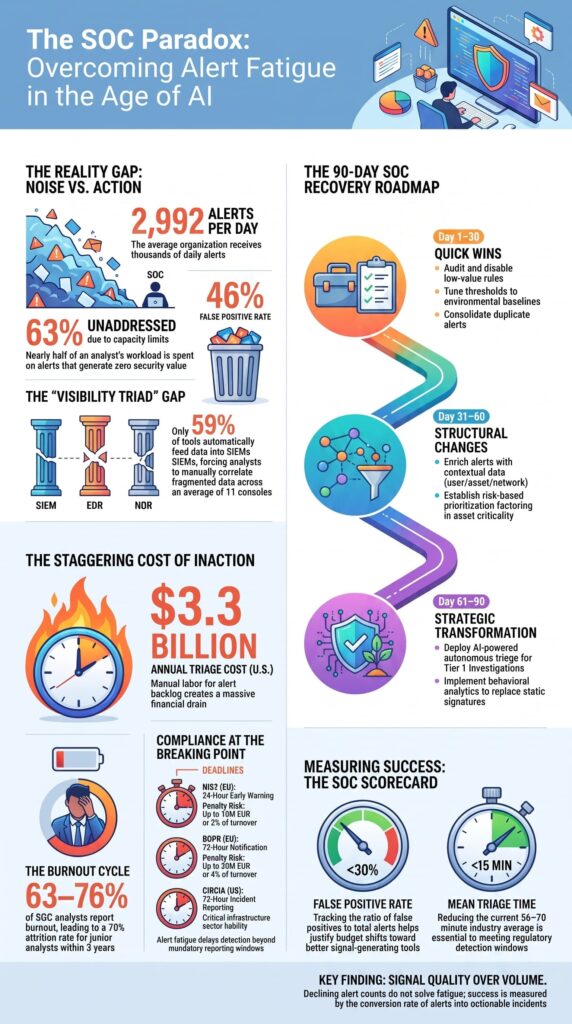
A threat intelligence database without curation is a landfill, not a library. You need a database lifecycle. IOCs and IOAs must be ingested, scored, enriched, and retired. We learned this early on, getting flooded by low-fidelity IPs from public feeds that caused more alert fatigue than security.
First, normalize your data. Think of STIX 2.1 as a universal translator for cyber threats. Instead of using confusing jargon, it organizes threat data into simple ‘Domain Objects’, which are basically standard labels.
It categorizes what the bad guy did (the Attack Pattern), what files they touched (the Observed Data), and how to spot them next time (the Indicator). This keeps your entire team speaking the exact same language during a high-stress incident.
Tag each indicator with a confidence score, a source, and map it to ATT&CK. Then enrich it. That IP address, what’s its geolocation? Has it been seen in other campaigns? Most critically, apply a Time-To-Live. A malicious IP might be useful for 24 hours.
A high-confidence malware hash could last for months. Let them expire automatically unless an analyst re-validates them. You have to track provenance religiously. Knowing who added an indicator and why is crucial during an investigation.
This disciplined management turns raw data into something you can actually use. Our tools enforce this lifecycle, ensuring the intelligence driving your security is current, relevant, and actionable.
How Should Organizations Share IoCs and IOAs With the Community?
Credits: Cyber Security Entertainment
Threat intelligence is a collective defense. Sharing what you see with the security community makes everyone stronger. But dumping raw IOCs without context can cause harm, spreading false positives. The key is structured, contextual sharing.
When we share threat intelligence, we rely on the OASIS STIX 2.1 standard to structure our data and TAXII to transport it.
This ensures that whether we are mapping an adversary’s footprint to the MITRE ATT&CK framework or passing a specific file hash, the receiving security tools can ingest, parse, and block the threat instantly Channels like ISACs and CERTs exist for this.
The goal isn’t just to give someone a hash to block. It’s to give them the story: “We saw this phishing campaign using this domain, which led to this payload, which performed these ATT&CK techniques.” That lets others build behavioral detections even before they see the same hash.
Always validate indicators from community feeds before auto-blocking to prevent accidental self-inflicted Denial of Service (DoS) when a shared IP turns out to belong to a critical CDNs. Automation is powerful, but a poorly-vetted indicator can break a critical application.
We’ve seen this happen. Our approach embeds validation checks and context directly into the shared data, turning a simple warning into actionable intelligence for the entire community.
How Can You Automate IOC Scanning Across Network Endpoints?
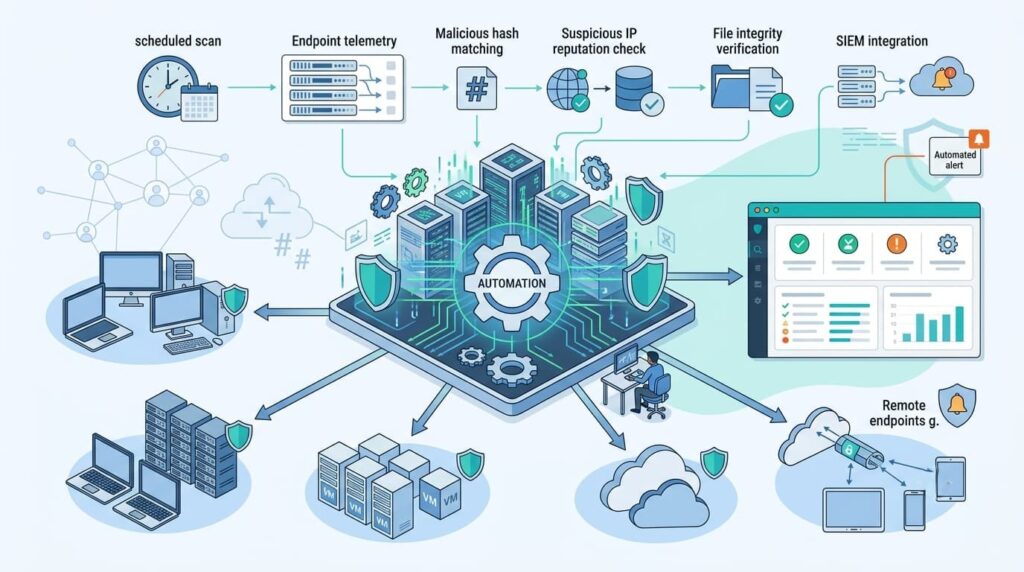
Manual hunting is necessary, but it doesn’t scale. Automating IOC scanning across network endpoints is the force multiplier. The goal is to continuously match incoming telemetry against your curated IOC and IOA database, responding at machine speed.
The workflow ties several systems together. EDR agents watch process creation and file activity. Network sensors analyze flow and packet data. These platforms ingest your threat intelligence feeds and run your behavioral detection rules.
When a match occurs, it fires an alert to your SIEM or SOAR platform. This is where automation truly shines. A SOAR playbook can trigger: it might automatically isolate the affected host from the network, kill the malicious process, revoke user sessions, and open a ticket, all within seconds.
This contains the threat before a human even logs in to check email. Our tools are designed to plug directly into this orchestration, providing the high-fidelity intelligence that makes automated response both fast and accurate.
What Are the Limitations of Relying Solely on IoCs?
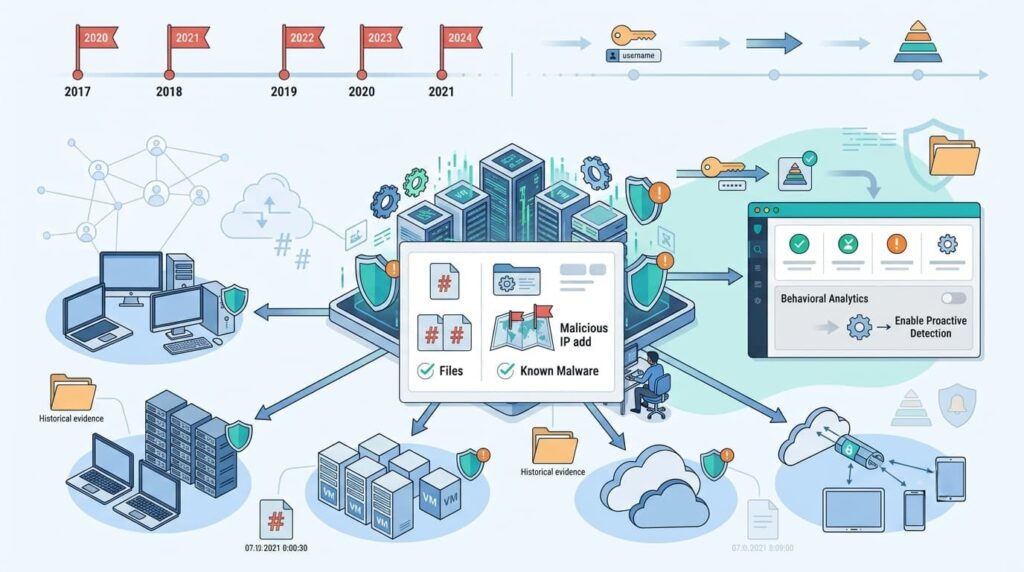
An IOC-only defense is brittle, perpetually behind. Attackers know you use hash blocklists, so they polymorph their malware. They know you block IPs, so they use fast-flux networks or legitimate cloud services.
Fileless attacks leave no file to hash. Living-off-the-land attacks use your own trusted tools against you, making leveraging IOAs increasingly important for detection. Public IOC feeds are often noisy, full of outdated data that creates false positives, wasting analyst time.
Ultimately, IOCs are great for answering “what happened?” but poor at answering “what is happening right now?” A sophisticated attacker assumes you’re using them and works around the constraints. We design for this reality, layering behavioral IOAs on top of static indicators to close the gap.
How Does Network Threat Detection Combine IoCs and IoAs?
Effective Network Threat Detection isn’t just sniffing packets for bad IPs. It’s about synthesizing artifacts and behavior across the whole environment instead of relying solely on IoCs.
The modern workflow is a loop:
- It starts with a behavioral anomaly in network traffic, beaconing to a new domain, an unusual data transfer protocol (an IOA).
- This triggers an investigation. The system correlates that behavior with endpoint telemetry, finding the process that caused it.
- It checks the destination IP against threat intel feeds for validation.
- Once confirmed, automated hunting sweeps for related artifacts.
Findings feed back, improving behavioral models and adding new IOCs to blocklists. This continuous cycle, behavior-led detection, artifact-based validation, automated response, compresses the attacker’s timeline from months to minutes. Our tools are built to enable this integrated loop.
FAQs
What are the most useful indicators of compromise to investigate first?
The clearest signs of a breach are often specific, technical details. Look for strange IP addresses, weird domain names, or unusual file hashes (like SHA256). Unusual network traffic or scheduled tasks are also major red flags. Cross-checking these findings with up-to-date threat reports makes your investigation much more accurate and faster.
How can I identify indicators of attack before a breach becomes serious?
Look for behaviors that show an attacker is already inside. This includes misuse of tools like PowerShell, attempts to move across your network, stealing passwords, or trying to hide from security tools. Spotting these actions quickly is key. It leads to faster detection and lets your security team hunt for threats proactively, before more damage is done.
Which security tools help detect IoCs and IoAs together?
Most security teams use a layered setup with tools like SIEM, EDR, and XDR. These platforms gather and analyze logs from endpoints, networks, and user behavior.
They also pull in external threat data using standards like STIX/TAXII and apply detection rules like YARA and Sigma. Combining all this gives you stronger, more reliable detection for both known threats and active attacks.
How do threat hunters validate suspicious activity without creating unnecessary alerts?
Good threat hunting means never trusting just one alert. Analysts piece together clues from different sources: how processes are linked, unusual network traffic, weird logins, and scripts that shouldn’t be running.
They check this activity against known attack methods, like those in the MITRE ATT&CK framework. This cross-checking cuts down on false alarms and helps teams fine-tune their security rules to catch the real threats.
What should happen after suspicious activity is confirmed during an investigation?
Once you confirm an attack, the first step is containment, stop the damage but preserve evidence. Then, analyze the malware, clean up the systems, and map out exactly how the breach happened.
Document every clue and indicator you find. Use those findings to update your detection rules and monitoring. This process directly strengthens your security for the next time.
Building a Resilient Detection Posture
Relying on just one approach can leave gaps in your defenses. IoCs help you understand what already happened, but IoAs give you a chance to spot suspicious behavior before it turns into a serious incident. That’s the difference that helps security teams respond faster.
If you want a simpler way to bring both approaches together, NetworkThreatDetection.com can help. It gives SOC teams real-time threat modeling, automated risk analysis, and intelligence built around frameworks like MITRE ATT&CK. You can learn more or request a demo here, Network Threat Detection.
References
- https://www.cell.com/heliyon/fulltext/S2405-8440%2821%2900074-8
- https://arxiv.org/html/2506.11325v2
Related Articles
- https://networkthreatdetection.com/difference-between-ioc-ioa-indicators/
- https://networkthreatdetection.com/examples-common-indicators-compromise-file-hashes-ips/
- https://networkthreatdetection.com/examples-indicators-attack-ttps-behavior/
- https://networkthreatdetection.com/using-iocs-reactive-threat-detection/
- https://networkthreatdetection.com/leveraging-ioas-proactive-threat-hunting/
- https://networkthreatdetection.com/finding-ioas-mitre-attck-framework/
- https://networkthreatdetection.com/managing-ioc-ioa-database-lifecycle/
- https://networkthreatdetection.com/sharing-iocs-ioas-security-community/
- https://networkthreatdetection.com/automating-ioc-scanning-network-endpoints/
- https://networkthreatdetection.com/limitations-relying-solely-iocs/